
Hill and Adamson's Calotypes: Edinburgh and the Birth of Photography as Art
Contents
Legend vs Myth
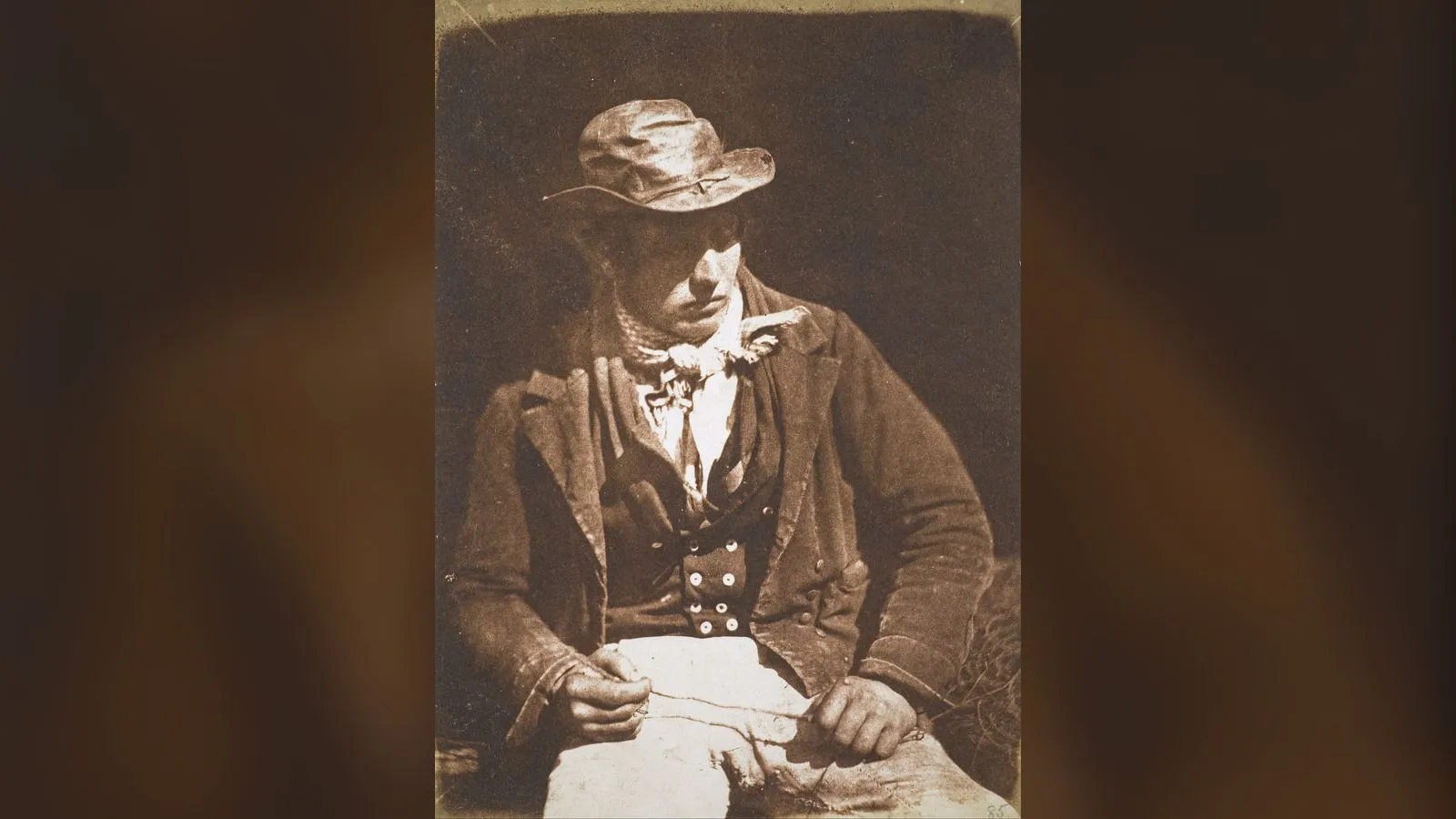
Early photography is often popularly imagined as a purely mechanical, documentary novelty — a scientific curiosity that only later became "art." David Octavius Hill and Robert Adamson's 1840s Edinburgh calotype portraits complicate that picture directly: within just a few years of photography's invention, this Scottish partnership was already producing images with deliberate composition, lighting, and psychological presence that art historians now treat as among the earliest serious photographic art, not merely early photographic record.
TL;DR
- established David Octavius Hill (1802–1870), an established painter, and Robert Adamson (1821–1848), a young chemist and technician trained in the new calotype process, formed a photographic partnership in Edinburgh beginning in 1843, producing several thousand calotype images over about four to five years — this partnership, its dates, and approximate output are well documented through surviving prints and institutional records.
- established Their most famous single project was photographing the ministers and supporters of the Free Church of Scotland following the Great Disruption of 1843, originally intended as reference material for a large commemorative painting by Hill — this origin and purpose is documented through Hill's own stated intentions and the resulting painting.
- established Beyond the Disruption portraits, Hill and Adamson produced extensive and highly regarded studies of Newhaven fishing community members, Edinburgh landscapes and architecture, and portraits of numerous notable contemporaries — this range of subject matter is documented through the surviving body of their work, much of it held by institutions including the Scottish National Portrait Gallery and the Victoria and Albert Museum.
- established The partnership ended with Robert Adamson's early death in 1848, after which Hill largely abandoned photography for an extended period before a brief, less celebrated return to the medium later in life — this is a documented biographical fact.
- traditional Hill and Adamson's calotypes are very widely regarded by historians of photography as among the earliest work to demonstrate photography's capacity for genuine artistic, rather than purely documentary or technical, achievement — this is a broadly accepted critical judgement with strong scholarly support, though, like any claim about photography's earliest "art," it necessarily involves comparative judgement rather than a single indisputable fact.
Key Facts
- Partners
- David Octavius Hill (painter, 1802–1870) and Robert Adamson (photographic technician, 1821–1848)
- Process
- Calotype (paper negative process patented by William Henry Fox Talbot, 1841)
- Active partnership
- 1843–1848, Edinburgh
- Key subjects
- Free Church of Scotland ministers (Disruption portraits); Newhaven fishing community; Edinburgh landscape and architecture; portraits of notable contemporaries
- Approximate output
- Several thousand calotype images, variously estimated
- Partnership's end
- Robert Adamson's death in 1848
- Legacy
- Widely regarded as foundational figures in the history of photography as an art form
Scottish Impact Index (SI Score)
- Cultural Impact
- 10/10
- Enduring Relevance
- 10/10
- Artistic / Cultural Contribution
- 10/10
- Artistic Originality
- 10/10
- Artistic Legacy
- 10/10
- Recognition
- 9/10
59/60
Ranked =9th of 50 in Arts
A Note on Claims and Evidence
The existence, dates, and partnership between Hill and Adamson, their key projects, and the survival of their work in major institutional collections are well documented through the photographs themselves, contemporary records, and extensive subsequent scholarship in the history of photography. The characterisation of their work as among the earliest "artistic" photography, as opposed to merely documentary or technical photography, is a widely shared and well-supported critical judgement within the history of photography as a discipline, but like any claim about artistic priority or significance, it involves comparative historical and aesthetic judgement rather than being a single, simply verifiable fact, and is flagged accordingly.
Timeline
David Octavius Hill born in Perth, Scotland.
Robert Adamson born near St Andrews, Scotland.
Hill establishes himself as a successful landscape painter and is closely involved with the Royal Scottish Academy as a founding secretary.
William Henry Fox Talbot patents the calotype process, an early photographic technique using paper negatives, distinct from the daguerreotype.
The Great Disruption divides the Church of Scotland, with a large body of ministers leaving to form the Free Church of Scotland; Hill resolves to paint a large commemorative picture depicting the event's key participants.
Hill is introduced to Robert Adamson, trained in the calotype process, and the two begin a photographic partnership intended initially to produce reference portraits for Hill's planned painting.
Hill and Adamson's partnership, based at Rock House on Calton Hill, Edinburgh, expands well beyond the original Disruption portrait project, producing extensive photographic studies of Newhaven fishing community members, Edinburgh architecture and landscape, and portraits of numerous notable contemporaries.
Robert Adamson dies prematurely, ending the partnership.
Robert Adamson dies at Burnside, near St Andrews, aged 27.
Hill finally completes and exhibits his large commemorative painting of the Disruption, decades after the photographic project that had originally supported it.
David Octavius Hill dies.
Hill and Adamson's calotypes gradually become recognised by historians of photography as foundational early work demonstrating the medium's artistic potential.
Major institutional holdings (Scottish National Portrait Gallery, National Galleries of Scotland, Victoria and Albert Museum, and others) and scholarship consolidate their historical and artistic significance.
Hill's photographs are shown at the London Photographic Salon, many in photogravures by James Craig Annan.
Details
A painter and a chemist: an unlikely but productive pairing
The Hill and Adamson partnership brought together two very different kinds of expertise. David Octavius Hill was already an established, successful landscape and genre painter in Edinburgh, closely connected to the Scottish art establishment as a founding secretary of the Royal Scottish Academy. Robert Adamson was a much younger man, trained in the technical chemistry of the newly patented calotype photographic process (developed by the English scientist William Henry Fox Talbot in 1841), who had set up a photographic studio in Edinburgh. Their collaboration combined Hill's trained eye for composition, pose, and visual narrative — skills developed through years of painting practice — with Adamson's technical command of the calotype process itself, a paper-negative photographic technique that, unlike the daguerreotype more common on the Continent and in some other contexts, allowed multiple positive prints to be made from a single negative. This combination of painterly sensibility and photographic technique is widely credited by historians as a key reason their work achieved a level of compositional sophistication unusual for such early photography.
established Hill was already experienced with new printing processes before he took up photography. A native of Perth, he was one of the first Scots to experiment with lithography, in his Thirty Sketches of Scenery in Perthshire, Drawn from Nature and on Stone, issued in six parts between 1821 and 1823. He also made steel engravings for The Land of Burns (1840), which The Edinburgh History of the Book in Scotland calls the most expensive Scottish publication to that date.
The Disruption and the origin of the partnership
The partnership's original purpose was intensely practical rather than purely artistic. In 1843, the Church of Scotland underwent the "Great Disruption," a major schism in which a substantial body of ministers and congregations broke away to form the Free Church of Scotland over disputes concerning church governance and patronage. Hill conceived an ambitious plan to commemorate this historic event in a large painting depicting the hundreds of ministers who had signed the deed of demission establishing the new church. Faced with the practical impossibility of individually sitting several hundred ministers for painted studies, Hill turned to the new photographic technology as a tool: Adamson's calotype process allowed relatively rapid portrait sessions that could then serve as visual reference material for the eventual painting. This commission-driven origin is important context: the photographic project that produced some of the most admired early portrait photography in history began essentially as a practical production tool for a traditional painting commission, not as an independent artistic project in its own right — though it rapidly outgrew that original, narrower purpose.
Beyond the Disruption: Newhaven and beyond
Once underway, the Hill and Adamson partnership expanded considerably beyond its original Disruption portrait brief. Among their most celebrated and art-historically significant work are extensive studies of the fishing community of Newhaven, near Edinburgh, depicting fishermen, fishwives, and children in and around the harbour and streets of the village, often in working dress and engaged in everyday activity, composed with careful attention to light, grouping, and narrative suggestion. These Newhaven photographs are frequently singled out by historians of photography as demonstrating a level of deliberate pictorial composition — drawing on painterly conventions of genre painting — well beyond what the new medium's purely mechanical capacities alone would suggest. The partnership also produced substantial photographic studies of Edinburgh's architecture and landscape, including Greyfriars Kirkyard and other notable sites, and individual portraits of numerous notable contemporaries from Scottish cultural, intellectual, and religious life, extending the partnership's output well beyond either the Disruption project or the Newhaven series alone.
Why these calotypes are treated as "art," not just record
The case for treating Hill and Adamson's calotypes as significant early photographic art, rather than merely early photographic documentation, rests on several documented characteristics of the work itself: careful attention to pose, grouping, and lighting that draws directly on painterly compositional conventions (unsurprising given Hill's background); a consistent visual sensibility across very different subjects, from formal clerical portraits to informal studies of working fisherfolk; and a degree of psychological presence and individual characterisation in many of the portraits that goes well beyond simple likeness-taking. Historians of photography frequently cite the partnership's work, alongside a small number of other mid-19th-century pioneers internationally, as evidence that photography's artistic possibilities were being actively and successfully explored within just a few years of the medium's invention, rather than photography needing decades to be taken seriously as a potential art form — a claim with strong scholarly support, albeit one resting on comparative critical judgement about what counts as "artistic" achievement in a new medium rather than a single simply verifiable metric.
Adamson's early death and the end of the partnership
The partnership was relatively short-lived in practical terms, lasting roughly from 1843 to 1848 — about five years — before Robert Adamson's premature death in 1848 at the age of 26 or 27 ended the collaboration. Hill, whose own technical photographic skill was reportedly less developed than Adamson's, largely stepped back from serious photographic work for an extended period following Adamson's death, though he returned to the medium with less celebrated results later in his life. This means that essentially the entire body of work for which the Hill and Adamson partnership is celebrated was produced within a remarkably compressed roughly five-year window, a fact that intensifies its historical significance: an enormous and influential body of early photographic achievement compressed into a very short collaborative period, cut off by one partner's early death rather than ending through any decline in the partnership's creative or technical success.
Legacy and institutional recognition
Hill and Adamson's calotypes are now held in major institutional collections, notably the Scottish National Portrait Gallery (which holds a very substantial collection, reflecting the partnership's Edinburgh base and its close connection to notable Scottish sitters) and the Victoria and Albert Museum in London, among other institutions internationally. Their work is a standard reference point in general histories of photography, frequently illustrated in surveys of the medium's earliest decades as evidence of photography's rapid development as an artistic as well as technical and documentary medium, and the partnership is consistently credited as among the most historically and artistically significant early users of the calotype process anywhere, not only within a specifically Scottish or British context.
The St Andrews connection
established The partnership grew out of a small circle of experimenters in St Andrews. Sir David Brewster, principal of the United College and a friend of William Henry Fox Talbot, obtained details of the calotype process for his colleagues. Robert Adamson's eldest brother, Dr John Adamson, a St Andrews physician, mastered it around 1842 and taught Robert. In a letter to Talbot of 3 July 1843, Brewster reported that "Mr D.O. Hill the Painter is in the act of entering into partnership with Mr Adamson". Brewster had introduced the two men in the weeks after the Disruption of May 1843.
established Robert Adamson's health broke down in the autumn of 1847. He went home to his family at Burnside, outside St Andrews, and died there on 14 January 1848, aged 27. The historian A. D. Morrison-Low suggests that much of his equipment passed to his brother John, who in turn trained St Andrews' first professional photographer, Thomas Rodger.
Cameras, lenses and experiments
shared Surviving letters show the partners experimenting beyond portraiture. At least one of their lenses was made by the Edinburgh optician Thomas Davidson, and the Hill–Adamson studio had cameras for about seven different negative sizes. Davidson later recalled making a solar microscope with which the partners produced calotype enlargements of sections of wood about eighteen inches across, and he described a camera about two feet square built for life-size portraits, abandoned because of its imperfections and the difficulty of preparing paper so large. He also said the partners had planned to protect their microscope work with a patent caveat before Adamson's death.
A model for the Pictorialists
established Hill did not abandon photography after 1848. He later worked in a short partnership with Alexander McGlashan in the 1860s, and he kept up his friendship with John Adamson: portraits of Hill taken in 1855, by Adamson or by Thomas Rodger, survive in Adamson's album in the National Museums of Scotland.
shared Half a century after they were made, the calotypes became a model for the art photographers of the 1900s. The Glasgow photographer Thomas Annan made carbon prints from the original negatives, and his son James Craig Annan, who as a boy had met Hill, made photogravures of them. When a collection of Hill's photographs was shown at the London Photographic Salon in 1909, the critic A. J. Anderson reported that pictorial photographers admitted to one another "that pictorial photography had made no material progress since the year 1843". The historian William Buchanan sees echoes of Hill and Adamson in Craig Annan's portraits, including his celebrated Janet Burnet of 1893.
Did You Know?
- Robert Adamson's elder brother John, a St Andrews doctor, taught him the calotype process and is often called the father of Scottish photography.
- At the 1909 London Photographic Salon, art photographers admitted that their medium had made "no material progress since the year 1843", the year Hill and Adamson began.
- The Hill and Adamson photographic partnership originated as a practical tool for producing reference material for a large commemorative painting of the 1843 Disruption of the Church of Scotland.
- Robert Adamson died at only around 26 or 27 years old, in 1848, after roughly five years of partnership with Hill.
- Hill's commemorative Disruption painting, the original impetus for the photographic project, was not actually completed and exhibited until 1866 — nearly two decades after Adamson's death.
- The partnership's studio was based at Rock House on Calton Hill, Edinburgh, a site now recognised for its significance in the early history of photography.
- Their extensive studies of the Newhaven fishing community are considered among the most artistically significant early photographic depictions of working-class life.
- The calotype process they used, invented by William Henry Fox Talbot, used paper negatives, allowing multiple prints from a single image, unlike the competing daguerreotype process.
- Hill largely stepped away from serious photographic work after Adamson's death, later returning to the medium with less celebrated results.
- Major holdings of Hill and Adamson's work are held today by the Scottish National Portrait Gallery and the Victoria and Albert Museum, among other institutions.
FAQ
1Who were David Octavius Hill and Robert Adamson?
Hill was an established Edinburgh painter; Adamson was a younger technician trained in the calotype photographic process. They formed a photographic partnership in Edinburgh from 1843 to 1848.
2Why did they start photographing people?
Originally to produce reference portraits for a large commemorative painting Hill planned of the ministers involved in the 1843 Disruption of the Church of Scotland, which split to form the Free Church of Scotland.
3What is a calotype?
An early photographic process, patented by William Henry Fox Talbot in 1841, using a paper negative that allowed multiple positive prints to be made from a single image.
4What other subjects did Hill and Adamson photograph beyond the Disruption portraits?
Extensive studies of the Newhaven fishing community near Edinburgh, Edinburgh architecture and landscape, and portraits of numerous notable contemporaries.
5Why did the partnership end?
Robert Adamson died prematurely in 1848, at around 26 or 27 years old, ending the roughly five-year collaboration.
6Did Hill complete his Disruption painting?
Yes, eventually — it was finally completed and exhibited in 1866, nearly two decades after the photographic project that had originally supported it began.
7Why are Hill and Adamson's photographs considered "art" rather than just historical records?
Historians of photography point to their deliberate composition, lighting, and psychological characterisation, drawing on painterly conventions, as evidence of genuine artistic achievement rather than purely documentary or technical photography.
8Where can Hill and Adamson's work be seen today?
Major collections are held by the Scottish National Portrait Gallery in Edinburgh and the Victoria and Albert Museum in London, among other institutions internationally.
9Did Hill continue photography after Adamson's death?
He largely stepped back from serious photographic work for an extended period, later returning to the medium later in life with results generally considered less significant than the original partnership's output.
10How many images did Hill and Adamson produce?
Estimates vary, but their output over the roughly five-year partnership is generally described as running into several thousand calotype images.
11Is the Newhaven series considered especially important?
Yes — it is frequently singled out by historians of photography as among the most artistically and socially significant bodies of work from the partnership, depicting a specific working community with notable compositional care.
12Was the calotype process used elsewhere besides Scotland?
Yes — it was invented and patented in England by William Henry Fox Talbot and used by various practitioners internationally, though Hill and Adamson's Edinburgh work is among its most celebrated early applications.
Sources and Further Reading
Primary/Institutional
- Scottish National Portrait Gallery / National Galleries of Scotland — major collection holdings and curatorial material on Hill and Adamson
- Victoria and Albert Museum — collection holdings of Hill and Adamson calotypes
Scholarly/Critical
- A. D. Morrison-Low, "Dr John Adamson and Thomas Rodger: Amateur and Professional Photography in Nineteenth-century St Andrews", in Julie Lawson, Ray McKenzie and A. D. Morrison-Low (eds), Photography 1900: The Edinburgh Symposium (National Museums of Scotland and National Galleries of Scotland, 1994); and William Buchanan, "The Art of the Photographer: J Craig Annan", in Julie Lawson, Ray McKenzie and A. D. Morrison-Low (eds), Photography 1900: The Edinburgh Symposium (National Museums of Scotland and National Galleries of Scotland, 1994)
- Stevenson, Sara, Hill and Adamson's The Fishermen and Women of the Firth of Forth and related scholarship on the Newhaven series
- Stevenson, Sara, David Octavius Hill and Robert Adamson — monograph and critical study
- John Scally, "Illustration", in Bill Bell (ed.), The Edinburgh History of the Book in Scotland, Volume 3: Ambition and Industry 1800–1880 (Edinburgh University Press, 2007)
- General histories of photography (e.g. Beaumont Newhall, The History of Photography) situating Hill and Adamson within the medium's earliest artistic development
General
- National Galleries of Scotland exhibition materials and public-facing historical summaries of the Hill and Adamson partnership
- General surveys of 19th-century Scottish art and photography discussing the Disruption painting's origins and completion
Caveats: Myths and Disputed Claims
- Myth: Hill gave up photography entirely after Adamson's death. He worked with Alexander McGlashan in the 1860s, though with less success.
- The partnership's origins. It began as a practical production aid for a traditional painting commission, not as an independent artistic photography project, though it rapidly exceeded that purpose.
- "Earliest art photography" is a judgement, not a measurement. It is the strong consensus view of historians of photography, but like any claim about artistic priority in a new medium it reflects comparative historical and aesthetic assessment rather than a single indisputable fact.
Finished reading? Try the Fact Machine: three reels, one surprising Scottish connection →
Card 020 · Arts