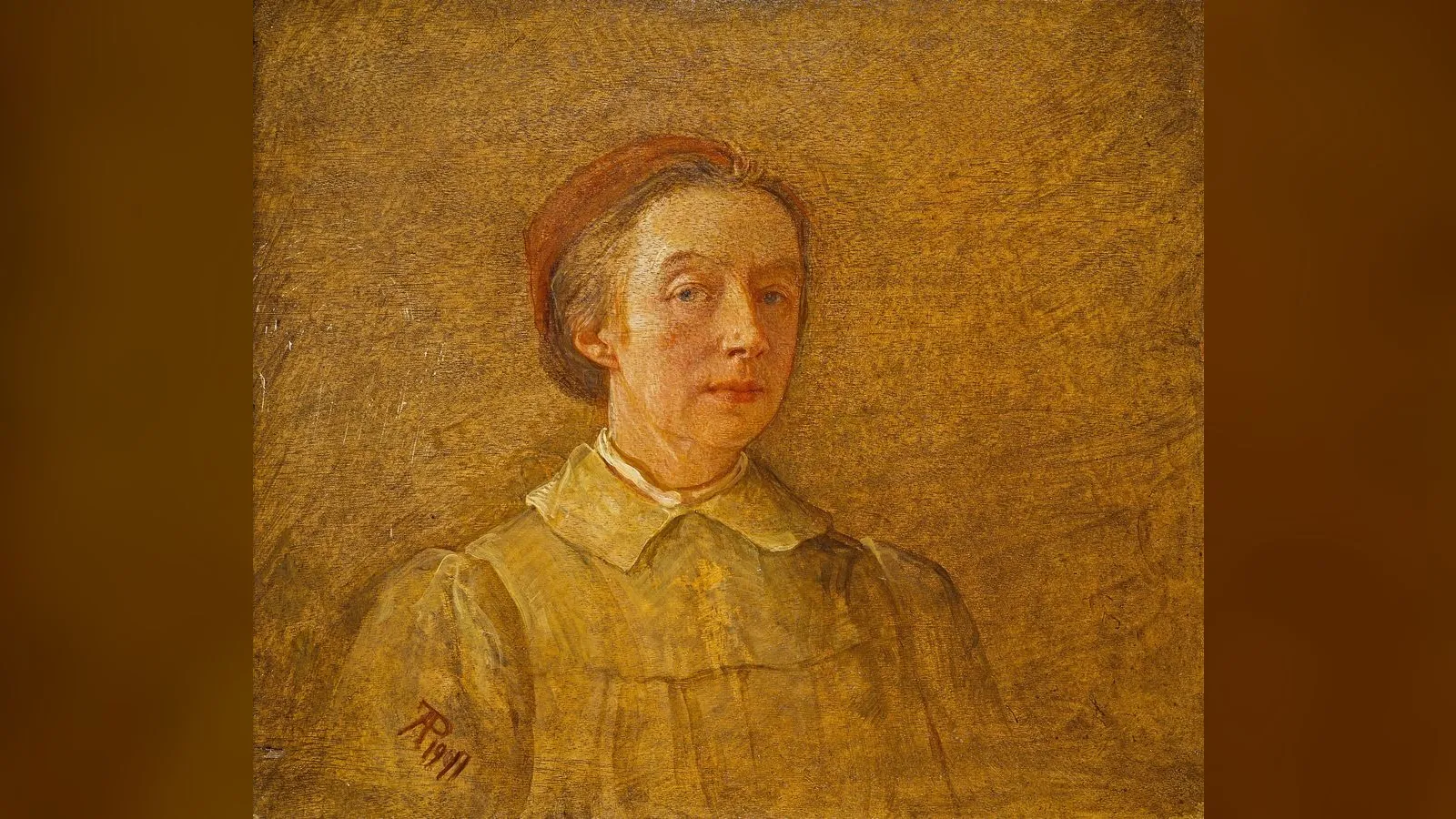

Phoebe Anna Traquair's Murals
Contents
Phoebe Anna Traquair is sometimes introduced as "Scotland's Michelangelo," a tag that tells you more about marketing than about her work. She never painted a ceiling for a Pope, and she was Irish by birth. What she actually did — covering the walls of an obscure Edinburgh church with one of the most ambitious cycles of religious mural painting in modern Britain, almost entirely unaided — is remarkable enough without the borrowed grandeur.
TL;DR
- established Traquair painted the full interior mural scheme of Mansfield Place Church (now the Mansfield Traquair Centre), Edinburgh, between 1893 and 1901 — this is documented through the church's own records, period photographs, and the surviving murals themselves.
- established She was elected an Honorary Member of the Royal Scottish Academy in 1920, one of the first women to receive that recognition — the RSA's own membership records confirm the date and category.
- traditional She is widely credited as the leading figure in bringing the Arts and Crafts aesthetic into large-scale ecclesiastical decoration in Scotland — this is the settled view among art historians, though "leading" inevitably involves comparative judgement rather than a single documentable fact.
- disputed Popular accounts sometimes describe her as "the first professional woman artist in Scotland," a claim too broad to verify and contradicted by other women working professionally in Scottish art before her (e.g. in portraiture and illustration) — the safer, demonstrable claim is about RSA recognition specifically, not professional primacy generally.
- [Legend] The "Edinburgh's Sistine Chapel" nickname is a journalistic flourish, not a contemporary description Traquair used of her own work, and the comparison overstates both scale and papal patronage while understating her very different, Arts and Crafts-rooted intentions.
Key Facts
- Full name
- Phoebe Anna Traquair (née Moss)
- Born
- 24 May 1852, Kilternan, County Dublin, Ireland
- Died
- 4 August 1936, Edinburgh
- Training
- School of Design, Royal Dublin Society (1869–1872)
- Moved to Edinburgh
- 1874, after marrying palaeontologist Dr Ramsay Heatley Traquair
- Signature work
- Murals, Mansfield Place Church (Catholic Apostolic Church), Edinburgh, 1893–1901
- Other media
- Embroidery, enamelwork, jewellery, book illumination, manuscript illustration
- Major honour
- Elected Honorary Member, Royal Scottish Academy, 1920
- Movement
- Scottish Arts and Crafts / Celtic Revival
Scottish Impact Index (SI Score)
- Cultural Impact
- 8/10
- Enduring Relevance
- 9/10
- Artistic / Cultural Contribution
- 9/10
- Artistic Originality
- 10/10
- Artistic Legacy
- 9/10
- Recognition
- 7/10
52/60
Ranked =41st of 50 in Arts
A Note on Claims and Evidence
Traquair's biography is unusually well documented for a Victorian-era woman artist, thanks to surviving correspondence, church vestry records, exhibition catalogues, and the murals themselves, which are datable and attributable beyond dispute. The genuine evidentiary gaps lie elsewhere: in superlative claims about her relative "firstness" compared with other women artists of her period, and in the retrospective mythologising that has grown up around Mansfield Place Church since its rediscovery and restoration in the late twentieth century. Where a claim can be checked against institutional records (RSA membership, exhibition dates, commission contracts), it is treated as established; where it rests on comparative rhetoric ("the first," "the greatest"), it is flagged as traditional or disputed.
Timeline
Born in Kilternan, Co. Dublin, Ireland.
Studies at the School of Design, Royal Dublin Society.
Marries Dr Ramsay Heatley Traquair, a palaeontologist.
Moves to Edinburgh.
Paints murals for the Mortuary Chapel, Royal Hospital for Sick Children, Edinburgh (restored 1896–1898).
Decorates the Song School of St Mary's Episcopal Cathedral, Edinburgh, bringing her wider national recognition.
Begins the mural scheme at Mansfield Place Church (Catholic Apostolic Church), Edinburgh.
Exhibits at the World's Columbian Exposition, Chicago.
Completes the Mansfield Place Church murals after eight years of work.
Embroidered panels exhibited at the Louisiana Purchase Exposition, St Louis.
Elected Honorary Member of the Royal Scottish Academy.
Dies in Edinburgh, aged 84.
Mansfield Traquair Trust formed to save the deconsecrated, deteriorating church building.
Restoration of the murals begins, continuing in phases into the 2000s.
Details
An Irish artist in an adopted city
Phoebe Anna Moss was born near Dublin in 1852 and trained formally — unusually for a woman of her generation — at the School of Design run by the Royal Dublin Society. Her move to Scotland in 1874 was a marriage decision, not a career one: she followed her husband, the palaeontologist Ramsay Heatley Traquair, to Edinburgh, where he took up a position at the Royal College of Surgeons' museum. For the next six decades, Edinburgh was her working base, and almost everything she is now remembered for was produced there. It is worth stating plainly that Traquair's "Scottishness" is adoptive rather than native — a detail some popular retellings quietly drop in the interest of a tidier national story.
Early commissions: chapel and song school
Traquair's reputation as a muralist was built incrementally through two significant Edinburgh commissions before Mansfield Place. Between 1885 and 1886 she painted murals for the Mortuary Chapel at the Royal Hospital for Sick Children — an unglamorous brief handled with evident seriousness, later restored in the 1890s. Her work on the Song School of St Mary's Episcopal Cathedral (1888–1892) brought her first real national attention, establishing the visual vocabulary — dense, Pre-Raphaelite-influenced figuration, saturated colour, and integration of text and image — that she would deploy at far greater scale in the 1890s.
The Mansfield Place Church murals
The commission that defines Traquair's career came from the Catholic Apostolic Church congregation at Mansfield Place in Edinburgh's New Town. Between 1893 and 1901, working largely alone and often from scaffolding, she covered the apse, nave, and ceiling of the church interior with an extensive painted cycle depicting biblical narrative, the progress of the human soul, and allegorical figures drawn from a blend of Christian and symbolist sources. The scale of the undertaking — roughly eight years of sustained work inside a single building — is itself the most concrete evidence of her ambition and stamina; there is no need to inflate it further with comparisons to Renaissance ceiling painting to make the achievement legible. The murals combine her training in figure drawing with the decorative, pattern-driven sensibility of the Arts and Crafts movement, and with a Celtic Revival interest in interlace ornament and symbolic colour that distinguishes her work from English Arts and Crafts muralists working in the same decades.
Beyond murals: embroidery, enamel, and the book arts
Traquair's output was never confined to wall painting. She was an accomplished embroiderer, producing large, intricately worked panels that were exhibited internationally, including at the 1893 Chicago World's Fair and the 1904 St Louis exposition. She also worked in enamel jewellery and book illumination, decorating manuscripts and bindings with the same density of symbolic ornament visible in her murals. This cross-media practice is characteristic of the wider Arts and Crafts ethos — the refusal to rank "fine art" above craft — and it is part of why historians place her squarely within that movement rather than treating her as a muralist who also had hobbies.
Recognition and its limits
In 1920, the Royal Scottish Academy elected Traquair an Honorary Member — a genuine landmark, since full membership of the professional body was closed to women for decades afterward, and honorary recognition of this kind was rare. It is accurate to call her one of the first women recognised by the RSA in this way; it is not accurate, on current evidence, to claim she was uniquely "first" across every possible category of Scottish professional art, a claim that occasionally circulates in less careful retellings and deserves correction rather than repetition.
Decline, rediscovery, and restoration
Mansfield Place Church was deconsecrated in the twentieth century, and the building — and Traquair's murals within it — fell into serious disrepair, suffering damp, flaking paint, and years of neglect. The murals' survival at all is due to a dedicated rescue effort: the Mansfield Traquair Trust was formed in 1991 specifically to save the building, and a phased restoration began in the 1990s, continuing into the 2000s, that stabilised and cleaned the paintings. The building, now known as the Mansfield Traquair Centre, functions as an events and exhibition space, meaning the murals are conserved but exist in a repurposed, secular setting rather than their original devotional context — a change worth noting rather than glossing over, since it affects how the work is now experienced.
Legacy
Traquair's reputation has grown substantially since the 1980s and 1990s, alongside renewed scholarly and curatorial interest in women artists of the Arts and Crafts period and in Scottish decorative art more broadly. She is now routinely included in surveys of the movement and is the subject of monographs and museum displays, a reversal of decades of relative obscurity following her death in 1936.
Placing Traquair within the wider Scottish Arts and Crafts picture
Traquair's career overlaps chronologically and philosophically with the broader Scottish Arts and Crafts movement, covered in its own dedicated card on this site, though her particular visual language — dense figuration, symbolist and Celtic Revival ornament, religious and allegorical subject matter — sits apart from the more architecturally driven strand of the movement associated with figures such as Robert Stodart Lorimer. She also predates, and is generally treated as distinct from, the later Glasgow Style associated with Mackintosh and his circle, which developed its own, different decorative vocabulary a few years after Traquair's major Edinburgh commissions were already underway. Keeping these distinctions clear matters for understanding Scottish decorative art of the period as a genuinely varied field, rather than a single undifferentiated "Scottish Arts and Crafts" category.
A career built without a school or movement label
One further point worth noting is that Traquair did not work within, or found, a named school or movement in the way some of her contemporaries did; she is best understood as an individually prolific and ambitious practitioner whose career happened to align chronologically with the wider Arts and Crafts moment, rather than as the leader of an organised group of followers. This makes her somewhat harder to categorise neatly than figures who trained a recognisable circle of students or ran an identifiable workshop, and it is part of why her individual rediscovery, decades after her death, mattered so much to restoring her place in the broader historical record.
Did You Know?
- Traquair trained in Dublin, not Scotland — she only moved to Edinburgh after marriage in 1874.
- Her husband, Ramsay Traquair, was a distinguished palaeontologist specialising in fossil fish, entirely unrelated to her artistic career.
- She worked on the Mansfield Place Church murals largely single-handedly over roughly eight years.
- Before Mansfield Place, she painted murals for a hospital mortuary chapel — a far less celebrated but formative early commission.
- She exhibited embroidered panels at two major international expositions, in Chicago (1893) and St Louis (1904).
- Mansfield Place Church was deconsecrated and nearly lost to decay before a dedicated trust rescued the building in 1991.
- Her 1920 RSA honorary membership came decades before women could hold full RSA membership on equal terms with men.
- The building housing her most famous work is now a secular events venue, not an active church.
FAQ
1Was Phoebe Anna Traquair Scottish?
No — she was born in Ireland in 1852 and moved to Edinburgh in 1874 after marriage. Her entire mature career took place in Scotland, which is why she is closely associated with Scottish art, but she was not Scottish by birth.
2What is her most famous work?
The mural cycle covering the interior of Mansfield Place Church (now the Mansfield Traquair Centre) in Edinburgh, painted between 1893 and 1901.
3Is the "Edinburgh's Sistine Chapel" comparison accurate?
It is a popular nickname rather than a historically precise description. The scale and ambition of the murals are genuinely significant, but the comparison to Michelangelo's papal commission overstates the parallel in patronage, scale, and context.
4Was she the first woman elected to the Royal Scottish Academy?
She was elected an Honorary Member in 1920, among the earliest women to receive that recognition, but claims of being definitively "the first woman" in any RSA category should be checked against the Academy's own historical membership records, which record several categories of membership with different histories.
5What other art forms did she work in besides murals?
Embroidery, enamel jewellery, manuscript illumination, and book illustration — she was a true multi-media Arts and Crafts practitioner.
6What happened to Mansfield Place Church?
It was deconsecrated and fell into serious disrepair before the Mansfield Traquair Trust was established in 1991 to save the building and its murals; restoration proceeded through the 1990s and 2000s.
7Can the public still see the murals today?
Yes, at the Mansfield Traquair Centre in Edinburgh, which now operates as an events and exhibition venue rather than a place of worship.
8Was Traquair associated with the Arts and Crafts movement or Art Nouveau?
Primarily the Arts and Crafts movement, with strong Celtic Revival and symbolist influences; she predates and differs stylistically from the later Glasgow Style associated with Mackintosh and his circle.
9Did Traquair train other artists?
She is best documented as a practitioner rather than a teacher-founder of a school; her direct influence operated more through example and exhibition than formal instruction.
10How long did the Mansfield Place Church commission take?
Approximately eight years, from 1893 to 1901.
11Did she work alone on the murals?
Largely yes — contemporary accounts describe her undertaking the bulk of the physical painting herself, an unusual degree of personal execution for a scheme of that size.
12When did she die?
4 August 1936, in Edinburgh, aged 84.
Sources and Further Reading
Primary/Institutional
- Royal Scottish Academy — membership records and historical archive
- Mansfield Traquair Trust — https://mansfieldtraquair.org.uk/the-murals/the-artist/
- National Museums Scotland — "Who Was Phoebe Anna Traquair?" — https://www.nms.ac.uk/discover-catalogue/who-was-phoebe-anna-traquair
Scholarly/Critical
- Elizabeth Cumming, Phoebe Anna Traquair, National Galleries of Scotland publications
- Entries on the Arts and Crafts movement in Scotland, Paul Mellon Centre / Yale University Press publications
General
- Wikipedia — "Phoebe Anna Traquair" — https://en.wikipedia.org/wiki/Phoebe_Anna_Traquair
- Scottish-places.info — biographical summary
Caveats: Myths and Disputed Claims
- Myth: Mansfield Place Church is "Edinburgh's Sistine Chapel". This is vivid marketing, not an art-historical equivalence. Traquair's work was distinctly her own, rooted in Arts and Crafts craft values and Celtic Revival symbolism, not Renaissance papal commissioning.
- Disputed: claims that she was "the first" woman in various Scottish art categories. These vary in precision across popular sources; the verifiable fact is her 1920 RSA Honorary Membership.
- Her origins. She was born in Ireland. Describing her simply as "a Scottish artist" is accurate for her working life but misleading as a statement of origin.
Finished reading? Try the Fact Machine: three reels, one surprising Scottish connection →
Card 021 · Arts