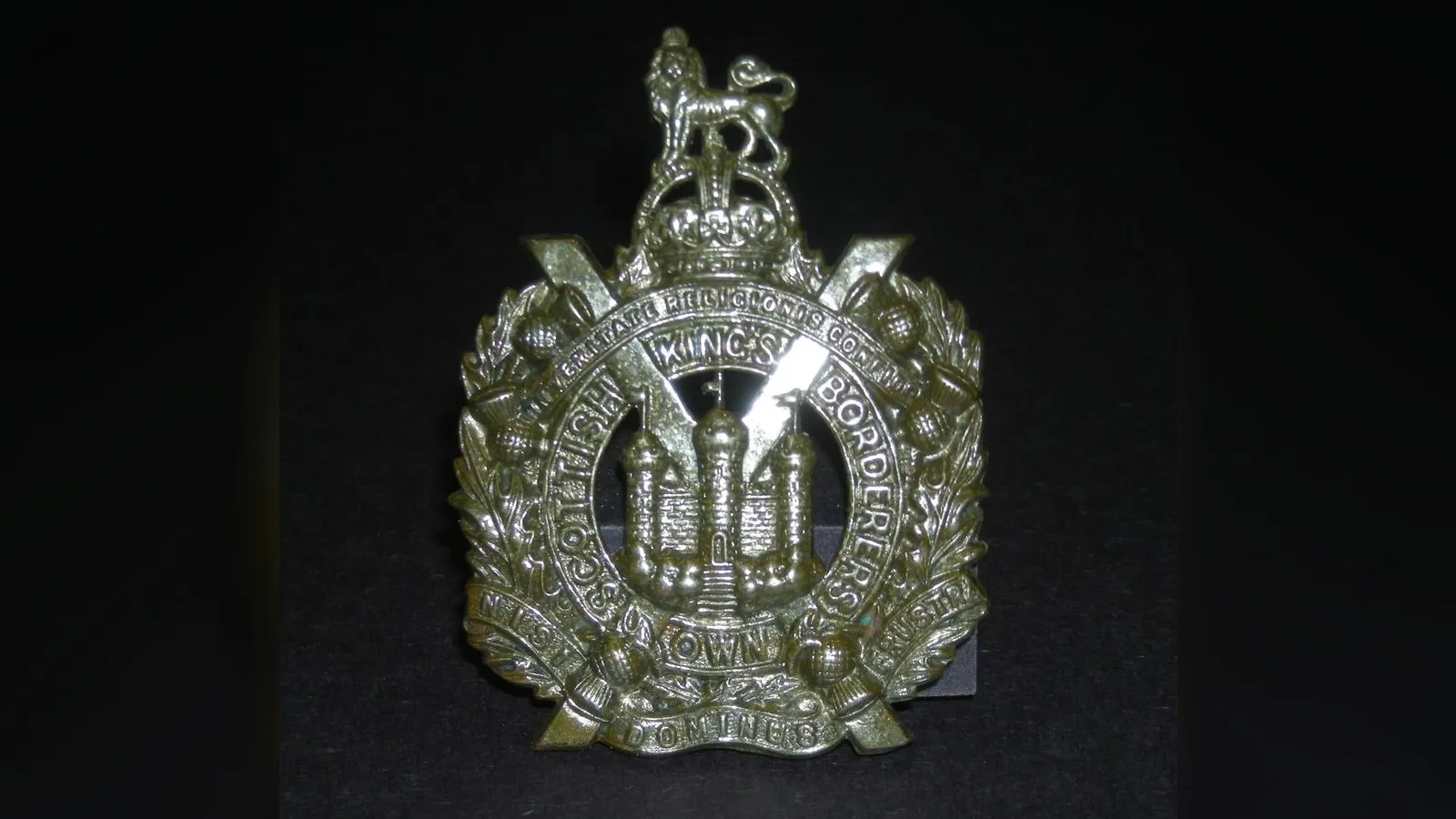

The King's Own Scottish Borderers (KOSB)
Defence Series | ScottishInventions.com
TL;DR
- The King's Own Scottish Borderers was raised on 18 March 1689 by David Melville, 3rd Earl of Leven (also styled David Leslie / Leslie-Melville) to defend Edinburgh against Jacobite forces during the Glorious Revolution — an established fact; the famous claim that ~800 men were enlisted "within two hours" is a long-standing regimental tradition, not a documented headcount.
- Despite its Edinburgh birth, the regiment became a Borders county regiment only in the 19th century — its recruiting area moved to the Scottish Borders in 1805, and it took the title King's Own Scottish Borderers in 1887, with its depot at Berwick-upon-Tweed from 1881 (established).
- As a Lowland regiment the KOSB wore tartan trews (Leslie tartan) rather than the kilt, with pipers in Royal Stewart — a dress identity distinct from the Highland regiments and from the other Lowland regiments in this series (established).
- It fought across three centuries — Killiecrankie (1689), Namur (1695), Minden (1759), the Napoleonic wars (but not Waterloo), Victorian imperial campaigns, both World Wars (Gallipoli, the Western Front, Arnhem, Burma), and Korea — before amalgamating with The Royal Scots in 2006 (established; see Cards #5 and #23).
- The 2006 merger created The Royal Scots Borderers, 1st Battalion, Royal Regiment of Scotland (1 SCOTS), which was itself re-roled as 1st Battalion, The Ranger Regiment on 1 December 2021 (established; brief endpoint only — cross-reference Cards #5 and #23).
Key Facts
- Period/dates covered: 1689–2006 (raising to amalgamation); endpoint note to 2021.
- Key institution: The King's Own Scottish Borderers Regimental Museum, Berwick Barracks, Berwick-upon-Tweed.
- Notable feature: One of only a handful of British line-infantry regiments never amalgamated in over three centuries of service until 2006; a Lowland Borders regiment wearing trews, not the kilt.
- Current status/legacy: Lineage carried by 1 SCOTS (Royal Regiment of Scotland), re-roled as 1 RANGER in December 2021; heritage preserved by the KOSB Association and museum at Berwick.
Scottish Impact Index (SI Score)
- Military Impact
- 8/10
- Enduring Significance
- 9/10
- Strategic Importance
- 7/10
- Military Distinctiveness
- 8/10
- Military Legacy
- 9/10
- Recognition
- 7/10
48/60
Ranked =28th of 43 in Defence
Claim Status
Consistent with the site's "accuracy over patriotism" principle and the three-tier framework:
- Established (documented): The 1689 founding date (18 March), the founder (David Melville, 3rd Earl of Leven), the purpose (defence of Edinburgh against Jacobites at the crisis of the Glorious Revolution), the numbering as 25th Foot (1751), the titles King's Own Borderers (1805) and King's Own Scottish Borderers (1887), the Berwick depot (1881), and the 2006 amalgamation are all well documented by the National Army Museum, the Imperial War Museum, English Heritage and the regimental museum.
- Shared/Traditional: The "800 men in two hours" recruiting story; the claim that the killing volley on Bonnie Dundee at Killiecrankie came specifically from Leven's Regiment; the Minden rose-picking origin story. These are cherished regimental traditions repeated in reputable secondary sources but not securely documented, and are flagged as such.
- Disputed / source-varying: First World War death totals (National Army Museum's "over 7,700" versus the official history's "some 7,000"); the precise count of battalions raised; and whether Bill Speakman's Korean War VC "belongs" to the KOSB (he was a Black Watch soldier attached to the KOSB).
Timeline
Convention of Estates in Edinburgh declares for William of Orange.
David Melville, 3rd Earl of Leven, is authorised by the Estates to raise a regiment of foot for the defence of Edinburgh; recruited "by beat of drum."
First action at Killiecrankie; a Williamite defeat, but the regiment is judged to have performed well and wins the privilege of recruiting in Edinburgh without the Provost's permission.
Campaigns in Ireland (Athlone, Aughrim, Limerick).
Nine Years' War in Flanders; Steenkirk (1692) and Namur (1695), where under Colonel James Maitland a mine explosion on 27 July 1695 costs the regiment 525 officers and men; "Namur 1695" later becomes the regiment's earliest battle honour (awarded 1910).
Sheriffmuir, against the Jacobites.
Fontenoy (1745) and Culloden (1746), then known as Sempill's Regiment.
Numbered the 25th Regiment of Foot.
Minden, celebrated thereafter as Minden Day.
Becomes the 25th (Sussex) Regiment of Foot.
Battle of Alexandria; awarded the Sphinx badge for Egypt.
Recruiting area moved to the Scottish Borders; renamed 25th (King's Own Borderers) Regiment of Foot after George III.
Captures Martinique and Guadeloupe.
Second Anglo-Afghan War (Khyber).
Childers Reforms: becomes The King's Own Borderers; depot moves to Berwick-upon-Tweed.
Becomes The King's Own Scottish Borderers, county regiment for the Borders shires.
Second Boer War (Paardeberg).
First World War: Gallipoli, the Western Front and Gaza; four VCs.
Second World War: Dunkirk, D-Day/Sword Beach, Caen, Arnhem, Walcheren, and Burma (Admin Box, Imphal).
Korean War; Bill Speakman VC.
Royal Regiment of Scotland formed; KOSB becomes a battalion within it.
Amalgamated with The Royal Scots to form The Royal Scots Borderers, 1st Battalion, Royal Regiment of Scotland (1 SCOTS).
1 SCOTS re-roled/re-badged as 1st Battalion, The Ranger Regiment (1 RANGER).
Details
1689 origins and the Jacobite crisis
The KOSB was born directly out of the constitutional emergency of the Glorious Revolution. In 1688 James VII and II was deposed; in March 1689 he landed in Ireland to reclaim his thrones, and Scotland's loyalties split — the Presbyterian Lowlands broadly favouring William of Orange, many Highland clans rising for James. On 14 March 1689 the Convention of Estates meeting in Edinburgh declared for William. Five days later, on 18 March 1689, the Estates commissioned David Melville, 3rd Earl of Leven — a Fife-born Whig and devout Presbyterian who had shared his father's exile at William's court in the Netherlands — to raise a regiment of foot to defend the city. Recruiting parties went along the High Street of Edinburgh's Old Town "by beat of drum."
The regiment's baptism of fire came at Killiecrankie on 27 July 1689, the opening battle of the 1689 Jacobite rising already covered contextually in Card #1. The battle was a Williamite defeat, but Leven's Regiment was one of very few units to hold together in good order, and was rewarded with the privilege — unique and thereafter cherished — of recruiting in Edinburgh by beat of drum without the Lord Provost's permission. The Jacobite commander John Graham, Viscount Dundee ("Bonnie Dundee"), was killed at Killiecrankie, which effectively ended the rising; the tradition that the fatal volley came specifically from Leven's Regiment is a regimental claim rather than an established fact and should be treated with caution.
On the "raised in hours" claim: The regiment's own accounts and reputable secondary sources describe the raising as extraordinarily rapid. The National Army Museum states "it took the Earl of Leven just four hours to raise a full regiment of foot." Regimental sources variously report "800 men within two hours" or "the complete recruitment of 1,000 men in four hours" — one 19th-century account calls the speed "unparalleled in our military annals." These figures are traditional rather than documented: they cannot be independently verified, the numbers conflict, and comparable "raised in a day" claims attach to other 1689 Scottish regiments (the Cameronians reportedly enlisted 1,200 men in a single day). The site's editorial standard treats the rapidity as real but the specific headcounts and timings as unverified regimental tradition.
Early designation and numbering
The regiment was first known simply by its colonel's name — Leven's Regiment — and also as the Edinburgh Regiment (later nicknamed "the Old Edinburgh"). Following the custom of the age, its title changed with each colonel: it was Maitland's, Shannon's, and — at Fontenoy (1745) and Culloden (1746) — Sempill's Regiment of Foot. When the British Army fixed numerical seniority, it was ranked 25th and formally styled the 25th (Edinburgh) Regiment of Foot in 1751 (seniority based on its 1689 formation date). In 1782, under the system that tied regiments to English counties, it curiously became the 25th (Sussex) Regiment of Foot — a period of weak Scottish identity. In 1801 it earned the right to bear the Sphinx superscribed "Egypt" for the Battle of Alexandria.
Border recruitment and regional identity
The KOSB's Borders identity was a 19th-century acquisition layered onto its Edinburgh origins. In 1805 the recruiting area was moved to the Scottish Borders and the regiment was renamed The King's Own Borderers (honouring George III). Under the Childers Reforms it dropped its numeral and became The King's Own Borderers on 1 July 1881, moving its depot to Berwick-upon-Tweed — the ancient, much-fought-over border town whose status straddled the England/Scotland line. A proposal to rename it "The York Regiment (King's Own Borderers)," reflecting a brief depot at Fulford Barracks in York, was defeated by regimental campaigning.
On 1 May 1887 it became The King's Own Scottish Borderers, reorganised as the county regiment for Berwickshire (transferred from the Royal Scots' district) and Dumfriesshire, Roxburghshire and Selkirkshire (transferred from the Royal Scots Fusiliers' district); the Galloway area (Kirkcudbright and Wigtown) followed in 1899. This firmly distinguishes the KOSB from the Royal Scots (Edinburgh/Lothians, Card #5) and the Royal Scots Fusiliers (Ayrshire, Card #6). The depot at Berwick Barracks — begun in 1717 to a design by the Baroque architect Sir Nicholas Hawksmoor (c.1662–1736), occupied by 1721, and recognised as the country's first purpose-built barracks (its design becoming the model for later barracks at Chatham, Portsmouth and Woolwich) — remains the home of the regimental museum, and Berwick still hosts the annual Minden Day parade.
The "King's Own" title and naming evolution
The "King's Own" honour was conferred in 1805 by George III, giving "The King's Own Borderers." The "Scottish" was added in 1887. The full documented progression is: Leven's/Edinburgh Regiment (1689) → 25th (Edinburgh) Regiment of Foot (1751) → 25th (Sussex) Regiment of Foot (1782) → 25th (King's Own Borderers) Regiment of Foot (1805) → briefly the 25th (York) Regiment of Foot (King's Own Borderers) (1870) → The King's Own Borderers (1881) → The King's Own Scottish Borderers (1887).
Major European and imperial campaigns
After Killiecrankie the regiment fought in Ireland (1691), then in Flanders during the Nine Years' War: Steenkirk (1692) and the Siege of Namur (1695). There, under Colonel James Maitland, a French mine detonated beneath its position on 27 July 1695, costing the regiment 525 officers and men (regimental accounts render this as "20 officers and 500 men killed and wounded"); the survivors pressed the assault, and "Namur 1695" became the regiment's earliest battle honour (formally awarded in 1910, the earliest action commemorated on British colours). It served at Sheriffmuir (1715), was nearly destroyed in the Siege of Gibraltar (1727), fought at Fontenoy (1745) and Culloden (1746), and won lasting fame at Minden (1 August 1759) in the Seven Years' War.
In the French Revolutionary and Napoleonic wars the regiment served as marines at the Glorious First of June (1794) and the capture of Corsica, fought at Egmont-op-Zee (1799), took part in the capture of Alexandria (1801), and — as the King's Own Borderers — captured Martinique (1809) and Guadeloupe (1810) in the West Indies. The regiment was not present at Waterloo (1815): its 1st Battalion was on overseas garrison duty and the short-lived 2nd Battalion (disbanded 1816) was winding down after service in northern Europe. This mirrors the precision established in Card #6 regarding the Royal Scots Fusiliers' absence from Waterloo.
Through the 19th century the regiment performed the classic imperial garrison-and-campaign role — presented here honestly as service in Britain's imperial expansion. It garrisoned Ireland, the West Indies, South Africa, India, Gibraltar and Malta; helped suppress the Fenian Raids in Canada (1866–71); fought in the Second Anglo-Afghan War (1878–80) on the Khyber lines; took part in the Lushai (1889–90), Chitral (1895) and Tirah (1897) expeditions on India's frontiers and in the Sudan (1888); and served throughout the Second Boer War (1899–1902), including Paardeberg.
First World War
On the outbreak of war the 1st Battalion was in India and the 2nd on the Western Front. The regiment expanded enormously: the official history records that the KOSB totalled fourteen battalions during the war, of which eight saw action — most on the Western Front, with service also at Gallipoli, in Egypt and Palestine, and briefly in Italy. The 1st Battalion landed at Cape Helles, Gallipoli, in April 1915 before transferring to the Western Front in 1916; the Territorial 1/4th (Border) and 1/5th (Dumfries & Galloway) Battalions also fought at Gallipoli, then Gaza. New Army battalions (6th, 7th, 8th) fought at Loos, the Somme, Arras, Ypres/Passchendaele and in the 1918 battles.
Casualties (source-varying): The National Army Museum states "the regiment lost over 7,700 men during the war," while the official regimental history (Stair Gillon, The K.O.S.B. in the Great War, via the Naval & Military Press) records "some 7,000 died." Both figures refer to deaths, not total casualties; the ~700 difference reflects rounding and differing inclusion criteria, and no discrete wounded/missing total or single published Commonwealth War Graves Commission aggregate was located. The site therefore reports the death toll as approximately 7,000–7,700, with the higher figure the most authoritative institutional statement. The regiment was awarded 66 battle honours and four Victoria Crosses, all won on the Western Front. Its most famous VC is Piper Daniel Laidlaw ("The Piper of Loos") of the 7th Battalion, 15th (Scottish) Division, who on 25 September 1915 at Hill 70, Loos — seeing his company shaken by gas — mounted the parapet under fire and piped "Blue Bonnets O'er the Border" followed by the regimental charge "Standards on the Braes o' Mar" to rally them; his VC was gazetted on 18 November 1915 (he was also awarded the French Croix de Guerre). The other three were CQMS William Grimbaldeston and CSM John Skinner (both 1st Bn, Third Ypres, August 1917) and Sergeant Louis McGuffie (1/5th Bn, killed October 1918).
Second World War
In 1939 the 1st Battalion deployed to France with the BEF, was evacuated from Dunkirk (1940), and later landed on Sword Beach on D-Day (6 June 1944), fighting at Caen. The Territorial 4th and 5th Battalions were also evacuated in 1940 and later took part in the amphibious assault on Walcheren (Operation Infatuate, November 1944) and the capture of Bremen. The 6th Battalion landed in Normandy with the 15th (Scottish) Division. The 7th Battalion, converted to an airlanding role, fought at Arnhem (September 1944) as part of 1st Airborne Division, suffering catastrophic losses defending the Oosterbeek perimeter. The 2nd Battalion fought in the Burma Campaign, at the Battle of the Admin Box (Ngakyedauk Pass) and Imphal (1944).
After the war the regiment served in Palestine, was reduced to a single battalion in 1948, and fought in the Korean War, including the First Battle of Maryang-san (1951). Private Bill Speakman won the Victoria Cross for the action at "United"/Kowang-San Hill on 4 November 1951 (gazetted 28 December 1951); his medal, though originally approved under George VI, was the first VC actually invested by Queen Elizabeth II — Speakman himself recalled "I was her first VC" — and the press dubbed him the "Beer Bottle VC" after he improvised missiles when grenades ran out. (Speakman was a Black Watch soldier attached to the 1st KOSB, so his VC is formally recorded under the Black Watch even as the Borderers count his valour as part of their story.) Later service included the Malayan Emergency, Aden and the Radfan, Borneo, Northern Ireland (Operation Banner), the Gulf War (1991) and Iraq (2003).
Regimental traditions and dress
As a Lowland regiment the KOSB did not wear the kilt for the rank and file: its distinctive dress was tartan trews in Leslie tartan — the tartan of the family of the founding Earl of Leven, authorised around 1898–1900 (before which the standard Government/Black Watch tartan was worn). Pipers wore Royal Stewart kilts and plaids. The other ranks were recognisable by the diced Glengarry. The cap badge centres on Edinburgh Castle on a St Andrew's cross, within a thistle wreath, bearing the mottoes "In Veritate Religionis Confido" ("I trust in the truth of religion") and the city of Edinburgh's own "Nisi Dominus Frustra" ("Without the Lord, all is in vain") — a permanent reminder of the regiment's Edinburgh birth even after it became a Borders regiment.
The great regimental anniversary is Minden Day (1 August), commemorating the 1759 battle; every member wears a red rose in the headdress, recalling the tradition that the Minden regiments plucked roses from the hedgerows as they advanced (a custom informally observed from the 1880s and officially authorised in 1935). The regimental quick march is "Blue Bonnets O'er the Border." The regiment was affectionately nicknamed "the KOSBies." Its Colonel-in-Chief from 1937 was Princess Alice, Duchess of Gloucester.
The 2006 amalgamation (brief — see Cards #5 and #23)
Under the Delivering Security in a Changing World / Future Infantry Structure reforms, the single-battalion Scottish infantry regiments were brought into a single large regiment. On 28 March 2006 the KOSB became a battalion of the new Royal Regiment of Scotland (the full multi-regiment formation is the subject of Card #23). On 1 August 2006 the KOSB battalion amalgamated with The Royal Scots to form The Royal Scots Borderers, 1st Battalion, Royal Regiment of Scotland (1 SCOTS) — the specific merger also treated from the Royal Scots' side in Card #5. (Campaigners had unsuccessfully sought an Edinburgh court interdict against the merger, arguing the regiment predated the Union.) As a brief endpoint note: on 1 December 2021 1 SCOTS was re-roled and re-badged as 1st Battalion, The Ranger Regiment (1 RANGER), within the Army Special Operations Brigade — the point already flagged in Card #5.
Did You Know?
- The regiment's cap badge shows Edinburgh Castle, not a Border landmark — a fossil of its 1689 Edinburgh origins carried right through to 2006, despite its 19th-century reinvention as a Borders regiment.
- Its home, Berwick Barracks, was Britain's first purpose-built barracks — designed by Sir Nicholas Hawksmoor and occupied by 1721 to garrison the border after the 1715 Jacobite rising; it became the KOSB depot in 1881 and still houses the regimental museum.
- The regiment's earliest battle honour, "Namur 1695," was not awarded until 1910 — it is the earliest action commemorated on any British Army colours.
- The KOSB narrowly escaped becoming a Yorkshire regiment — a plan to name it "The York Regiment (King's Own Borderers)" in 1881 was defeated by regimental campaigning.
- Piper Daniel Laidlaw won his VC by piping unarmed men over the top at Loos in 1915 — playing "Blue Bonnets O'er the Border" through shellfire and gas; it was the first VC won by the regiment in the Great War and the first awarded to a soldier of the New Army.
- The regiment did not fight at Waterloo — its battalions were overseas or being wound down in 1815, a fact often assumed otherwise.
- On Minden Day every Borderer wears a red rose in his bonnet — echoing the tradition that the 1759 Minden regiments picked roses as they advanced into battle.
- Bill Speakman's Korean War VC (1951) was the first invested by Queen Elizabeth II — earned while he was attached to the 1st KOSB, though formally recorded under his parent regiment, the Black Watch.
FAQ
1When and why was the King's Own Scottish Borderers founded?
It was raised on 18 March 1689 in Edinburgh by David Melville, 3rd Earl of Leven, under a commission from the Scottish Convention of Estates, to defend the city against Jacobite forces at the crisis of the Glorious Revolution. Its first battle was Killiecrankie on 27 July 1689.
2Who founded the regiment — was it "Lord Newark"?
No. The founder was David Melville, 3rd Earl of Leven (born David Melville, also styled David Leslie or Leslie-Melville, 1660–1728), a Whig exile who had returned with William of Orange. He is not to be confused with the Lords Newark; the regiment was "Leven's Regiment" after him.
3Is the "800 men in two hours" story true?
It is a long-standing regimental tradition rather than a documented fact. Sources conflict (800 in two hours; 1,000 in four hours), and the National Army Museum says the raising took "just four hours." The rapidity was real and remarkable, but the exact numbers and timings cannot be verified and should be treated as tradition.
4Why is it a "Borders" regiment if it was raised in Edinburgh?
Its Borders identity was acquired later. Its recruiting area was moved to the Scottish Borders in 1805, its depot moved to Berwick-upon-Tweed in 1881, and it became the county regiment for Berwickshire, Dumfriesshire, Roxburghshire and Selkirkshire in 1887 — the point at which "Scottish Borderers" entered its title.
5When did it get the "King's Own" and "Scottish" parts of its name?
"King's Own Borderers" was conferred in 1805 by George III. "Scottish" was added in 1887, producing "The King's Own Scottish Borderers." It had earlier been numbered the 25th Regiment of Foot (from 1751).
6Did the KOSB wear the kilt?
No — as a Lowland regiment its rank and file wore tartan trews in Leslie tartan (the founder's family tartan), authorised around 1898–1900, with the diced Glengarry. Only the pipers wore kilts, in Royal Stewart tartan. This distinguishes it from the Highland regiments.
7Was the regiment at Waterloo?
No. In 1815 the 1st Battalion was on overseas garrison duty and the short-lived 2nd Battalion (disbanded 1816) was being wound down after northern European service. The KOSB has no Waterloo battle honour.
8What were the KOSB's most famous battles?
Killiecrankie (1689), Namur (1695), Minden (1759), the capture of Martinique (1809), the Second Afghan War (1878–80), the Boer War, Gallipoli and the Western Front in the First World War, Arnhem and Burma in the Second World War, and Maryang-san in Korea.
9How many died in the First World War?
Estimates vary by source: the National Army Museum states the regiment "lost over 7,700 men," while the official regimental history records "some 7,000 died." Both refer to deaths. The regiment raised fourteen battalions (eight saw action), won 66 battle honours and four Victoria Crosses.
10What happened to the regiment in 2006?
On 28 March 2006 it became a battalion of the new Royal Regiment of Scotland, and on 1 August 2006 it amalgamated with The Royal Scots to form The Royal Scots Borderers, 1st Battalion, Royal Regiment of Scotland (1 SCOTS). See Card #5 (Royal Scots) and Card #23 (Royal Regiment of Scotland).
11Does the regiment still exist today?
Not as a distinct regiment. Its lineage passed to 1 SCOTS, which on 1 December 2021 was re-roled and re-badged as 1st Battalion, The Ranger Regiment (1 RANGER). The KOSB Association and the regimental museum at Berwick-upon-Tweed preserve its heritage.
12Where can I see KOSB history?
At The King's Own Scottish Borderers Regimental Museum in Berwick Barracks, Berwick-upon-Tweed (founded 1946), which holds uniforms, medals, silver and archives spanning the regiment's history. The barracks are currently undergoing major refurbishment under the Living Barracks project.
Sources
Primary / Institutional
- National Army Museum — "The King's Own Scottish Borderers" regimental history.
- Imperial War Museum — KOSB cap-badge and uniform collection records; "A short history of the King's Own Scottish Borderers (25th Foot)."
- The King's Own Scottish Borderers Association and Regimental Museum (kosb.co.uk), Berwick-upon-Tweed.
- English Heritage / Historic England — Berwick-upon-Tweed Barracks history.
- The National Archives — records of the 25th (King's Own Borderers) Regiment of Foot and the KOSB.
Scholarly / Published Histories
- Stair Gillon, The K.O.S.B. in the Great War (official regimental history).
- Trevor Royle, The King's Own Scottish Borderers: A Concise History (Mainstream Publishing, 2008).
- Robert Woollcombe, All the Blue Bonnets: The History of the King's Own Scottish Borderers (1980).
General Further Reading
- The Long, Long Trail — KOSB battalions in the First World War.
- Commonwealth War Graves Commission — KOSB war dead records.
- Discover Scottish Borders — regional heritage overview of the regiment.
Honest Caveats
- The "raised in hours" claim: The dramatic speed of the 1689 raising is genuine in outline but the specific figures ("800 in two hours" / "1,000 in four hours") are unverified regimental tradition; sources disagree, and similar claims attach to other 1689 Scottish regiments.
- The Killiecrankie volley: The tradition that Leven's Regiment fired the volley that killed Bonnie Dundee is a regimental claim, not established fact.
- Founder's name: The founder is David Melville, 3rd Earl of Leven (also David Leslie/Leslie-Melville), not "Lord Newark." Some sources give his name as "David Leslie, 3rd Earl of Leven"; these refer to the same man.
- First World War death figures: Sources vary (over 7,700 per the National Army Museum; some 7,000 per the official history). Both denote deaths, not total casualties; no discrete wounded figure is published.
- Battalion counts: Figures range from "nine" to "fourteen" depending on whether split Territorial lines and garrison battalions are counted; the official history's "fourteen in all, eight in action" is the best-sourced reconciliation.
- Bill Speakman's VC: Won while attached to the 1st KOSB in Korea but formally recorded under his parent regiment, the Black Watch; the KOSB counts it as part of its heritage.
- Distinctions from Cards #5 and #6: The KOSB is a Borders regiment (trews, Leslie tartan, Berwick depot, Edinburgh-Castle badge), distinct from the Royal Scots (Edinburgh/Lothians, Card #5) and the Royal Scots Fusiliers (Ayrshire, fusilier identity, Card #6), even though all three share the "Namur 1695" honour and all were folded into the Royal Regiment of Scotland in 2006.
- Waterloo: The KOSB did not fight at Waterloo, mirroring the clarification made for the Royal Scots Fusiliers in Card #6.
Finished reading? Try the Fact Machine: three reels, one surprising Scottish connection →
Card 007 · Defence