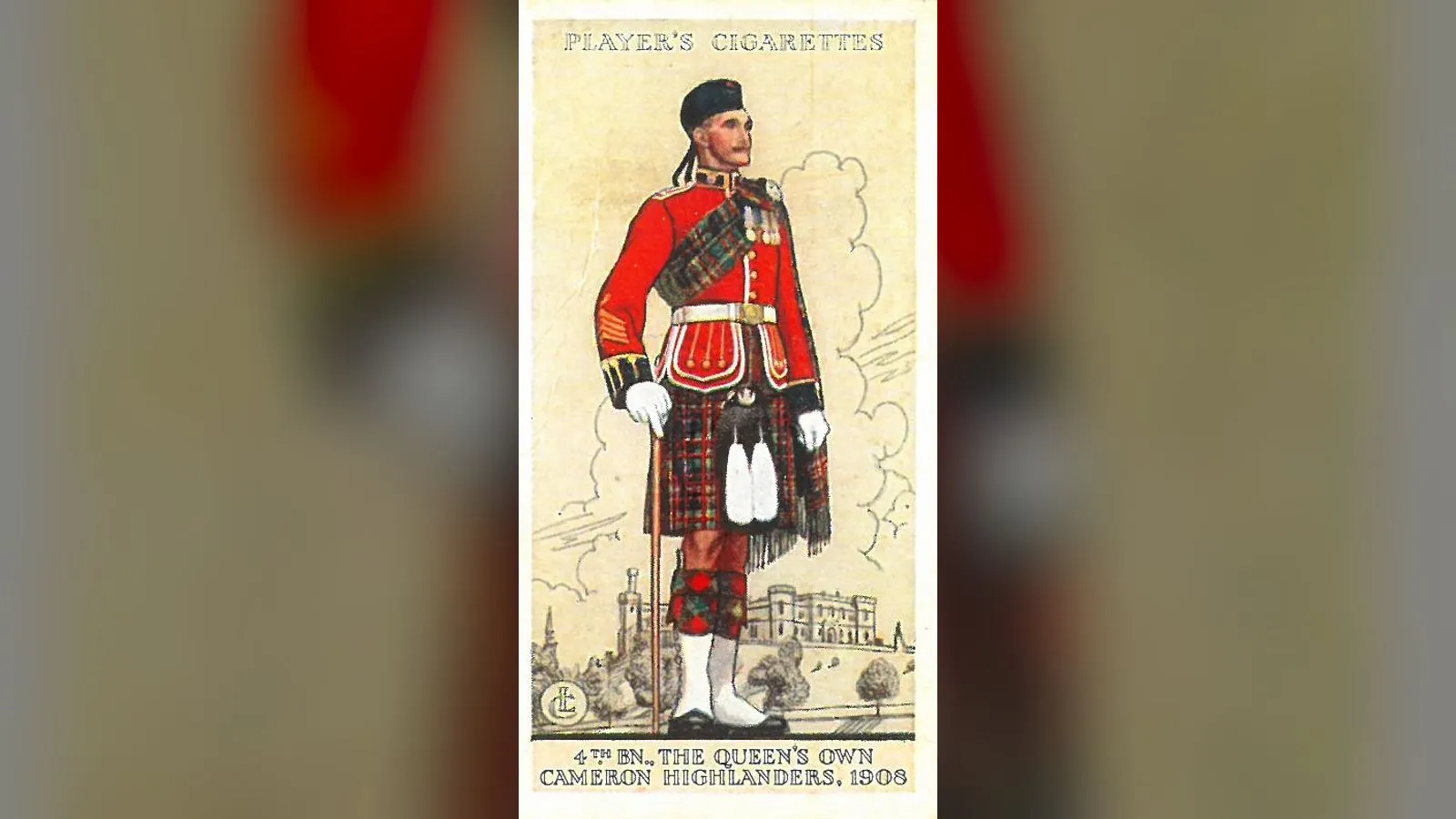

The Queen's Own Cameron Highlanders (1793–1961)
Defence Series, Card #12 of 50 · ScottishInventions.com · "Accuracy over patriotism"
TL;DR
- [Documented] The Queen's Own Cameron Highlanders were raised on 17 August 1793 at Fort William as the 79th Regiment of Foot (Cameronian Volunteers) by Sir Alan Cameron of Erracht — unusually, a chieftain of a cadet branch of Clan Cameron rather than the clan chief (Cameron of Lochiel), and raised largely at his own expense without government bounty.
- [Documented] The regiment recruited from Lochaber and the wider Highlands, wore the distinctive Cameron of Erracht tartan — the only old regimental tartan not derived from the Government (Black Watch) sett — and fought at Quatre Bras and Waterloo (1815), where it was one of only four infantry regiments named in Wellington's Waterloo Despatch.
- [Documented] It was the British Army's only single-battalion regiment after the 1881 Childers Reforms, avoiding amalgamation entirely — a distinctively different 1881 experience from the Black Watch, Seaforth and Gordon Highlanders (all formed by merging two older regiments). A second regular battalion was added in 1897.
- [Legend/Myth — corrected] The popular claim that the Camerons were "the last new kilted Highland regiment raised" is inaccurate as usually stated: the 92nd (Gordon) Highlanders were raised in 1794 and the 93rd (Sutherland) Highlanders in 1799, both later and both kilted. The defensible "last" claims are different — see below.
- [Documented] After service through both World Wars — including being the last British battalion to wear the kilt in action (May 1940) and heavy losses at Kohima (1944) — the regiment amalgamated with the Seaforth Highlanders on 7 February 1961 to form the Queen's Own Highlanders (Seaforth and Camerons). (For the Seaforths' side of that merger, see Card #10.)
Key Facts
- Period covered
- 1793–1961 (168 years as a distinct regiment)
- Raised
- 17 August 1793, Fort William, as the 79th Regiment of Foot (Cameronian Volunteers)
- Founder
- Sir Alan Cameron of Erracht (1753–1828), a cadet-branch chieftain of Clan Cameron
- Recruiting area
- Lochaber and the western/central Highlands; county regiment of Inverness-shire from 1881; depot at Cameron Barracks, Inverness (completed 1886)
- Distinctive feature
- Cameron of Erracht tartan — the only old regimental tartan not based on the Government/Black Watch sett; blue hackle
- Number
- 79th Regiment of Foot
- "Queen's Own" title
- Conferred by Queen Victoria, August 1873
- Colonel-in-Chief
- Prince Philip, Duke of Edinburgh (from 1953)
- Current status/legacy
- Amalgamated 1961 into Queen's Own Highlanders → 1994 into The Highlanders (Seaforth, Gordons and Camerons) → 2006 into the Royal Regiment of Scotland (now 4 SCOTS, cross-ref Card #23)
Scottish Impact Index (SI Score)
- Military Impact
- 7/10
- Enduring Significance
- 9/10
- Strategic Importance
- 7/10
- Military Distinctiveness
- 9/10
- Military Legacy
- 8/10
- Recognition
- 7/10
47/60
Ranked =30th of 43 in Defence
Claim Status
- Established (documented): The 1793 raising date, Alan Cameron of Erracht's founding role and cadet-branch status, the Erracht tartan's uniqueness, the Waterloo service and Wellington's dispatch mention, the single-battalion 1881 status, the 1897 second battalion, and the 1961 merger are all well-documented in institutional and primary sources (National Army Museum; The Highlanders' Museum, Fort George; Jameson's 1863 regimental history; Fairrie's 1983 regimental history).
- Shared/Traditional: The story that Cameron's mother designed the Erracht tartan is a strong regimental tradition, plausible but not independently documented to modern archival standards. The precise WWI death toll is reported variously and should be treated with care.
- Disputed / Myth (flagged): The "last new kilted Highland regiment raised" claim is inaccurate as commonly worded and is corrected in the Caveats section. The Erracht/Lochiel distinction is genuine and important: Erracht was not the clan chief.
Timeline
Alan Cameron born at Erracht, near Banavie, Lochaber.
Cameron kills a man in a duel; flees, eventually to America.
Serves the Loyalist cause in the American Revolutionary War; captured, held prisoner two years in Philadelphia.
Granted a Letter of Service to raise the 79th Regiment of Foot (Cameronian Volunteers) at Fort William.
Regiment mustered ~1,000 strong at Stirling; serves in Flanders under the Duke of York.
West Indies (Martinique); devastated by fever.
Reduced and drafted; rebuilt by Cameron with a new battalion, which by 1798 contained more non-Scots than Scots (T. M. Devine, 2011).
Helder Campaign (Holland); first battle honour at Egmont-op-Zee.
Egypt; earns the Sphinx "Egypt" badge.
Placed on the British establishment; a 2nd Battalion raised (disbanded 1815).
Title "Cameron Highlanders" confirmed.
Copenhagen expedition.
Peninsular War: Corunna, Busaco, Fuentes d'Oñoro, Salamanca, Burgos, the Pyrenees, Nivelle, Nive, Toulouse.
Quatre Bras and Waterloo; one of four regiments named in Wellington's Waterloo Despatch.
Crimean War: Alma, Balaklava, Sevastopol (as part of the Highland Brigade).
Indian Rebellion: capture of Lucknow.
Queen Victoria presents new colours at Parkhurst; adds "Queen's Own" to the title.
Childers Reforms: becomes 1st Battalion, county regiment of Inverness-shire — the Army's only single-battalion regiment.
Egypt and the Sudan: Tel-el-Kebir (1882), Nile/Ginnis (1885), Atbara and Omdurman (1898).
Cameron Barracks, Inverness, completed.
Second regular battalion raised.
Second Boer War.
First World War: expands to about 13 battalions (nine seeing action); heavy losses; three Victoria Crosses.
Second World War: Dunkirk (last kilt in action, 1940), St Valery-en-Caux, North Africa, Italy, North-West Europe, Burma (Kohima 1944).
Amalgamated with the Seaforth Highlanders to form the Queen's Own Highlanders (Seaforth and Camerons).
Details
1793: Origins and Alan Cameron of Erracht
In August 1793, Britain's war against Revolutionary France was six months old and the Army needed men. On 17 August, Alan Cameron of Erracht received a Letter of Service authorising him to raise the 79th Regiment of Foot, or Cameronian Volunteers, at Fort William. He mustered around 1,000 men — inspected at Stirling in January 1794 — drawn initially from Clan Cameron country in Lochaber but, because of competition from other regiments then recruiting, increasingly from across the Highlands. Many of the first volunteers were Gaelic-speaking; a well-known Lochaber anecdote holds that Cameron drilled recruits with hay tied to one foot and straw to the other, calling "Feur, stràbh" ("hay, straw") to teach left from right.
The Erracht/Lochiel distinction — an important point of accuracy. Alan Cameron was not the chief of Clan Cameron. The chief was Cameron of Lochiel; Erracht was a senior cadet branch, descended from Ewen Cameron, a son of Ewen Mor Cameron, XIII of Lochiel, by his second marriage. This makes the Camerons' founding genuinely different from the Gordon Highlanders (raised by the Duke of Gordon, Card #11) and the Seaforth Highlanders (raised by the Earl of Seaforth / Mackenzie chief, Card #10): as the Oxford Dictionary of National Biography notes, "every other Highland regiment was raised by Clan Chiefs, while he was merely chieftain of a cadet branch." Cameron also raised the regiment largely at his own expense, without the government bounty typical of other raisings.
Estate management, evictions and clearance-adjacent context — documented for this regiment. There is a specific, documented estate dimension here, distinct from generic Highland-regiment patterns. In the 1790s Alan Cameron of Erracht fell into a bitter rift with the young chief, Donald Cameron, 22nd of Lochiel — "the rogue Lochiel" — who had run up debts on his Grand Tour and borrowed against Cameron lands. When trustees took over the mismanaged estate, evictions of tenants from Cameron lands began around 1801 (continued by Lochiel after 1819) — the beginnings of the Cameron Clearances. Among those affected by the estate turmoil was Erracht himself. So the regiment's founding sits at the very hinge of the shift from the old clan-military economy toward estate rationalisation and clearance in Lochaber, and its founder was personally entangled in that conflict — rather than being a straightforward "clan chief profiting from his tenants" story. Present honestly: the 79th was a product of both patriotic-martial tradition and the economic dislocation of the late-eighteenth-century Highlands.
Who filled the ranks: the 1798 rebuilding
[Documented] The historian T. M. Devine, in To the Ends of the Earth (2011), uses the 79th as his first example of how quickly the Highland supply of soldiers ran out. When the regiment was reconstituted in 1798, after fever in the West Indies had destroyed its rank and file, the new battalion contained more non-Scots than Scots. Devine's wider argument is that by about 1800 "the well had run dry": decades of heavy recruitment, deaths in battle and from disease, clearance and emigration had exhausted Highland manpower, and even the most prestigious Highland regiments had to recruit from the Lowlands, the Borders, England and Ireland. In the 1850s senior officers were still complaining that not enough Scots, let alone Gaels, could be found for the kilted regiments. The Lochaber identity of the Camerons was therefore real as a regimental tradition, but it did not mean that most of its soldiers came from Lochaber.
shared Devine also explains why a regiment like the 79th grew more famous even as it became less Highland in composition. After 1815 only five kilted regiments survived, the 79th among them, yet in the Victorian period they became national icons: royal patronage helped (he cites Victoria's grant of the "Queen's Own" title in 1873 among her favours to "her" Highland regiments), but so did a press and public that, after the Crimea and the Indian Rising, turned the soldier into a hero. In the first year of the First World War, he notes, the Camerons' actions were reported in minute detail in The Scotsman and the Glasgow Herald. The cult travelled with emigrants too: after the war, Canada's "Scottish" units included the Cameron Highlanders of Ottawa.
The "last new kilted regiment" claim, examined
This is the regiment's most repeated distinctive claim, and it requires firm correction. Taken literally, "the last new kilted Highland regiment raised" is inaccurate. The 79th was raised in 1793, but two later kilted Highland regiments followed: the 92nd (Gordon) Highlanders, raised in 1794 (as the 100th, renumbered 92nd in 1798), and the 93rd (Sutherland) Highlanders, raised in 1799. The Highlanders' Museum itself lists five kilted regiments existing "by 1809": the 42nd (Black Watch), 78th (Ross-shire Buffs), 79th (Camerons), 92nd (Gordons) and 93rd (Sutherland). No authoritative institutional source actually calls the Camerons "the last" kilted regiment raised.
What is defensible and well-documented are three different "last/only" claims, which the popular version appears to conflate:
- The last Highland regiment raised in the old clan manner — by a clansman (here a cadet chieftain), largely at his own expense and with its own clan tartan rather than a government sett. This is a reasonable, qualified statement.
- The only single-battalion regiment to survive the 1881 reforms un-amalgamated (see below) — strongly documented by the National Army Museum.
- The last British regiment to wear the kilt in action — at the La Bassée canal on the retreat to Dunkirk, 25 May 1940 (again a different claim, well sourced).
We present the "last kilted regiment raised" line as a myth/conflation, and recommend using one of the precisely-worded alternatives instead.
Establishment, numbering and the distinctive 1881 experience
The regiment was numbered the 79th Regiment of Foot (there had been two earlier, unrelated English regiments to bear the number, in 1757–63 and 1778–84). It was placed on the British establishment in 1804 and had its "Cameron Highlanders" title confirmed in 1806. For most of the nineteenth century it existed as a single-battalion regiment (a short-lived 2nd Battalion in 1804–15 supplied drafts and never went abroad).
The 1881 Childers Reforms are where the Camerons' experience diverges sharply from the other Highland regiments already covered in this series. The Black Watch, Seaforth and Gordon Highlanders were each formed in 1881 by amalgamating two older numbered regiments into a two-battalion regiment. The 79th, by contrast, was not amalgamated with anyone: it simply became the 1st Battalion, The Queen's Own Cameron Highlanders, county regiment of Inverness-shire, and, in the National Army Museum's words, "avoided amalgamation with any other unit. It remained the British Army's only single-battalion regiment for the next 16 years." A proposal to turn it into a 3rd Battalion of the Scots Guards was seen off by lobbying, as was a scheme to put it into Government tartan as a battalion of the Black Watch. A second regular battalion was finally raised in 1897; the 1881 reforms also folded in the county Militia and Rifle Volunteers as reserve battalions.
Lochaber and the Cameron clan associations
The regiment's spiritual home was Lochaber — the Fort William/Loch Linnhe/Loch Lochy country of Clan Cameron in the western Highlands — even though, in practice, sustained recruiting quickly widened to the whole Highlands and to Lowland towns. From 1881 it was formally Inverness-shire's county regiment, with its depot at Cameron Barracks, Inverness (completed 1886). Its Lochaber and clan identity is quite distinct from the north-eastern Gordon Highlanders (Card #11), the Ross-shire/Mackenzie Seaforths (Card #10) and the Perthshire Black Watch (Cards #3–4). The Clan Cameron connection was reinforced across the regiment's life: successive Camerons of Lochiel served as Colonels of the Regiment in the twentieth century, and the regimental church is the Old High Church in Inverness.
The "Queen's Own" title
Queen Victoria presented the 79th with new colours at Parkhurst, Isle of Wight, on 17 April 1873, and in August 1873 directed that the regiment should be styled "The Queen's Own." It thus became the 79th Regiment, The Queen's Own Cameron Highlanders — a "royal" distinction that also changed its facings from green to blue.
Highland dress and tartan
The regiment's defining dress feature is the Cameron of Erracht tartan. By tradition it was designed in 1793 by Alan Cameron's mother, Marsali (Marjory) MacLean of Drimnin, who — not wishing the regiment to wear Black Watch tartan — created a new sett said to combine Cameron and MacDonell of Keppoch elements, in deep green, blue and black with red and yellow lines. Its historical significance is genuine and well-attested: it is the only one of the old regimental tartans not derived from the Government (Black Watch) sett. When the War Office later tried to force Government tartan on the regiment, the Camerons emphatically refused — the only regiment to do so. Pipers wore Royal Stuart tartan; in the twentieth century the regiment adopted a blue hackle (approved by King George VI in 1940, blue being chosen as the regiment was "royal"), still worn today by 4 SCOTS.
Major European and imperial campaigns
Napoleonic Wars. After Flanders (1794), the West Indies (1795–97), the Helder (1799, first honour at Egmont-op-Zee) and Egypt (1801, winning the Sphinx "Egypt" badge), the 79th fought right through the Peninsular War (1808–14): Corunna, Busaco, Fuentes d'Oñoro, Salamanca, Burgos, the Pyrenees, Nivelle, Nive and Toulouse.
Waterloo — a particularly strong, well-documented connection. The 79th moved to Belgium in 1815 and fought at Quatre Bras (16 June) and Waterloo (18 June). According to the regimental history, of the 675 men engaged, 103 were killed and a further 353 wounded — 456 casualties, or roughly 68% of the battalion. The Camerons were one of only four infantry regiments named specifically by the Duke of Wellington in his Waterloo Despatch. (Consistent with the precision established in Cards #6–11: the three kilted Highland regiments present at Waterloo were the 42nd Black Watch, the 79th Camerons and the 92nd Gordons.)
Imperial/colonial service — presented honestly as such. The regiment's Victorian and Edwardian record was substantially one of imperial campaigning: the Crimean War (Alma, Balaklava, Sevastopol, 1854–56); the suppression of the Indian Rebellion of 1857–59 (capture of Lucknow, 1858); the Anglo-Egyptian War of 1882 (Tel-el-Kebir); the Sudan campaigns (Ginnis, 1885; Atbara and Omdurman, 1898, under Kitchener, including a presence at the Fashoda Incident); and the Second Boer War (1899–1902). These were wars of imperial conquest, occupation and re-conquest, and are described here as such rather than romanticised. One dark episode: a firing party of Cameron Highlanders carried out the executions of Lieutenants Harry "Breaker" Morant and Peter Handcock in Pretoria in February 1902.
The First World War
The regiment expanded enormously — to about 13 battalions in total (the two regular battalions plus 11 New Army and Territorial battalions), of which nine saw active service, chiefly on the Western Front and in Macedonia/Salonika. The 1st Battalion, which had gone to France in August 1914, suffered catastrophic early losses: 27 officers and about 1,000 men had left Edinburgh Castle in August 1914, and, according to a Kildonan Museum caption quoted by the fact-checking body Full Fact, "by Christmas 1914, all but one officer and 27 men were killed or wounded of the 27 officers and 1,000 men whose tartans had swung down the Lawnmarket from Edinburgh Castle on 12 August." Three Cameron Highlanders won the Victoria Cross in the war: Angus Douglas-Hamilton, James Dalgleish Pollock and Ross Tollerton (a fourth, Donald Farmer, had won his in the Boer War). The North Uist Gaelic war poet Dòmhnall Ruadh Chorùna served with the 7th Battalion. Casualty figures should be treated with care: a total of 5,930 dead is often quoted (attributed to The Highlanders' Museum), but this figure is not independently confirmed by the National Army Museum, which gives no total; it should be read as an approximate, regimentally-sourced number rather than an audited one.
The Second World War (brief; cross-ref Card #21)
The 1st Battalion went to France in 1939, fought in the Battle of France, and famously became the last British unit to wear the kilt in action, holding off a German attack on the La Bassée canal on 25 May 1940 during the retreat to Dunkirk, before being evacuated. The Territorial 4th Battalion, part of the 152nd Brigade in the 51st (Highland) Division, was among the forces that surrendered under Major-General Victor Fortune to Rommel at St Valery-en-Caux on 12 June 1940 — the shared Highland Division catastrophe covered from the Division's side in Card #21. Reconstituted battalions then served across North Africa (including El Alamein, and the loss of the 2nd Battalion at Tobruk in 1942), Sicily and Italy, and North-West Europe from Normandy in 1944. The 1st Battalion went to Burma, where at Kohima (April–June 1944) it fought in the bitter battle for the Naga Village; the battalion, 674 strong on 29 April 1944, lost 96 men killed (a 14.2% fatality rate), commemorated by the Cameron memorial at Naga Village inscribed "Lochaber No More."
1961: The merger (brief; cross-ref Card #10)
Under the 1957 Defence White Paper, which reduced the infantry as National Service ended, regiments were amalgamated in pairs. On 7 February 1961, in a simple ceremony at Redford Barracks, Edinburgh, the 1st Battalion, Queen's Own Cameron Highlanders merged with the 1st Battalion, Seaforth Highlanders to form the Queen's Own Highlanders (Seaforth and Camerons). For the Seaforths' side of this same merger, and the fuller story of the combined regiment, see Card #10. The Queen's Own Highlanders in turn amalgamated with the Gordon Highlanders (Card #11) on 17 September 1994 to form The Highlanders (Seaforth, Gordons and Camerons), which in 2006 was absorbed into the Royal Regiment of Scotland as its 4th Battalion (4 SCOTS), where the Cameron of Erracht tartan and the blue hackle are still carried (cross-ref Card #23).
Did You Know?
- The only "clanless-chief" regiment. The 79th was the only Highland regiment raised not by a clan chief but by a cadet-branch chieftain, Alan Cameron of Erracht — and reputedly the only regiment ever to refuse a War Office order to adopt Government tartan.
- A tartan of its own. The Cameron of Erracht sett is the only one of the old British regimental tartans not based on the Black Watch/Government pattern.
- Named by Wellington. The Camerons were one of just four infantry regiments singled out by name in the Duke of Wellington's Waterloo Despatch.
- "Old Cia Mar Tha." Founder Alan Cameron's nickname came from the Gaelic greeting "ciamar a tha?" ("how are you?"); he was famous for his blunt defence of the kilt when the War Office proposed replacing it with trews.
- The last kilt into battle. On 25 May 1940 the 1st Battalion fought on the La Bassée canal still wearing the kilt — the last time a British unit wore it in action.
- "Lochaber No More." The regiment's Kohima memorial at Naga Village bears a kilted piper and the lament title "Lochaber No More"; local Naga people pledged in 2011 to care for it "until the sun stops shining or the wind stops blowing."
- A viral photograph with a real core. The famous 1914/1918 "before and after" photographs of a decimated Cameron battalion are partly a later reconstruction (Full Fact found "the 1914 image is real, but the 1918 image appears to have been constructed"), yet they rest on a real fact: the 1st Battalion's appalling losses in the opening months of the war.
- Royal colonel. Prince Philip, Duke of Edinburgh, was the regiment's last Colonel-in-Chief (from 1953).
FAQ
1When and where were the Queen's Own Cameron Highlanders raised?
On 17 August 1793 at Fort William, in Lochaber, as the 79th Regiment of Foot (Cameronian Volunteers). The founder, Alan Cameron of Erracht, received a Letter of Service and mustered around 1,000 men, inspected at Stirling in early 1794. It served continuously until its 1961 amalgamation.
2Who was Alan Cameron of Erracht?
A Lochaber-born soldier (1753–1828) of a senior cadet branch of Clan Cameron. After killing a man in a duel he left for America, served the Loyalist cause and was a prisoner of war for two years. He raised the 79th largely at his own expense in 1793 and remained its colonel until his death, rising to lieutenant-general.
3Was Cameron of Erracht the chief of Clan Cameron?
No — and this is an important distinction. The clan chief was Cameron of Lochiel. Erracht was a cadet-branch chieftain. This made the 79th unusual: every other Highland regiment was raised by an actual clan chief or great magnate, whereas Erracht was a lesser figure who acted, and paid, on his own initiative.
4Were the Camerons really "the last kilted Highland regiment raised"?
No, not as usually stated. The 92nd (Gordon) Highlanders were raised in 1794 and the 93rd (Sutherland) Highlanders in 1799 — both later and both kilted. The accurate "last" claims are different: the last regiment raised in the old clan manner, the only single-battalion regiment to survive the 1881 reforms, and the last British unit to wear the kilt in action (1940).
5What tartan did they wear?
The Cameron of Erracht tartan, by tradition designed in 1793 by the founder's mother, a MacLean of Drimnin. It is the only old regimental tartan not based on the Government (Black Watch) sett. Pipers wore Royal Stuart; the regiment later adopted a blue hackle.
6How did the 1881 reforms affect the Camerons differently?
Unlike the Black Watch, Seaforth and Gordon Highlanders — each formed in 1881 by merging two older regiments — the 79th was not amalgamated at all. It became a single-battalion county regiment for Inverness-shire and remained the Army's only single-battalion regiment until a second battalion was raised in 1897.
7Were the Cameron Highlanders at Waterloo?
Yes. The 79th fought at Quatre Bras (16 June 1815) and Waterloo (18 June 1815). Of 675 men engaged, 103 were killed and around 353 wounded. The regiment was one of only four infantry regiments named in Wellington's Waterloo Despatch — a particularly strong, well-documented Waterloo connection.
8When did they gain the "Queen's Own" title?
In August 1873, when Queen Victoria — having presented new colours at Parkhurst on the Isle of Wight that April — directed that the regiment be styled "The Queen's Own." Its facings changed from green to blue at the same time.
9What imperial campaigns did they fight in?
The Crimean War (1854–56), the Indian Rebellion (1857–59, including Lucknow), the Anglo-Egyptian War (1882, Tel-el-Kebir), the Sudan campaigns (1885 and 1898, including Atbara and Omdurman), and the Second Boer War (1899–1902). These were imperial wars of conquest and occupation and are described here as such.
10How many battalions did they raise in the First World War, and how many died?
About 13 battalions in total (two regular plus 11 New Army/Territorial), nine of which saw action. A figure of 5,930 dead is commonly quoted (attributed to The Highlanders' Museum) but is not independently confirmed by the National Army Museum; treat it as approximate. Three Victoria Crosses were won in the war.
11Were the Camerons' soldiers mostly Lochaber men?
Only at the very start. T. M. Devine (2011) records that when the 79th was rebuilt in 1798 after fever in the West Indies, the battalion had more non-Scots than Scots, and Highland recruitment generally had dried up by about 1800.
12What did they do in the Second World War?
They fought in France (1940), where the 1st Battalion was the last British unit to wear the kilt in action; the 4th Battalion was captured with the 51st Highland Division at St Valery-en-Caux (Card #21). Other battalions served in North Africa, Sicily, Italy and North-West Europe, while the 1st Battalion fought at Kohima in Burma (1944).
13What happened to the regiment after 1961?
It merged with the Seaforth Highlanders on 7 February 1961 to form the Queen's Own Highlanders (Seaforth and Camerons) — see Card #10. That regiment merged with the Gordon Highlanders in 1994 to form The Highlanders, absorbed in 2006 into the Royal Regiment of Scotland (now 4 SCOTS), which still carries the Cameron of Erracht tartan and blue hackle.
Sources
Primary / Institutional
- National Army Museum, "The Queen's Own Cameron Highlanders" (nam.ac.uk) — regimental overview, campaigns, 1881 single-battalion status, 1940 kilt claim.
- The Highlanders' Museum (Queen's Own Highlanders Collection), Fort George, near Inverness — holds the Cameron Highlanders' collection; pages on the regiment, Sir Alan Cameron of Erracht, and Highland dress.
- Jameson, Robert, Historical Record of the Seventy-ninth Regiment of Foot, or Cameron Highlanders (Edinburgh: William Blackwood, 1863) — early regimental record.
- Groves, J. Percy, History of the 79th Queen's Own Cameron Highlanders, 1794–1893 (W. & A.K. Johnston).
- Oxford Dictionary of National Biography, "Alan Cameron of Erracht."
Scholarly
- Fairrie, Angus, "Cuidich 'n Righ": A History of the Queen's Own Highlanders (Seaforth and Camerons) (Regimental HQ, 1983).
- Royle, Trevor, Queen's Own Highlanders: A Concise History (Mainstream, 2007).
- Stewart of Ardvorlich, John, The Camerons: A History of Clan Cameron (Clan Cameron Association, 1974).
- Kelly, Ian Stuart, Echoes of Success: Identity and the Highland Regiments — on the construction of Highland regimental identity.
- T. M. Devine, To the Ends of the Earth: Scotland's Global Diaspora, 1750–2010 (Allen Lane, 2011)
General further reading
- Commonwealth War Graves Commission — Cameron Highlanders casualty records.
- Kohima Museum, York — 1st Battalion at Kohima, 1944.
- Regimental history material at qohldrs.co.uk (Queen's Own Highlanders Regimental Association) and cabarfeidh.com.
Honest Caveats
- "The last new kilted Highland regiment raised" — corrected. As usually stated this is wrong. The 79th was raised in 1793, but the 92nd (Gordon) Highlanders (1794) and the 93rd (Sutherland) Highlanders (1799) were raised later and were also kilted. No authoritative institution actually describes the Camerons as "the last" kilted regiment raised. The claim appears to conflate three separate, defensible facts: the Camerons were the last regiment raised in the old clan manner (by a cadet chieftain, at his own expense, with its own clan tartan); the only single-battalion regiment to survive the 1881 reforms un-amalgamated; and the last British unit to wear the kilt in action (1940). Use one of those precise formulations instead.
- The Erracht/Lochiel distinction. Alan Cameron of Erracht was not the chief of Clan Cameron; the chief was Cameron of Lochiel. Erracht headed a senior cadet branch. Sources sometimes loosely call him "a cousin of Lochiel"; more precisely he was chieftain of a distinct branch, and the two families were in open enmity in the 1790s over debts and the eviction of tenants from Cameron lands. This differs from the Gordon (ducal) and Seaforth (earl/chief) foundations covered in Cards #10–11.
- Casualty and battle figures. The WWI death total (5,930) is regimentally sourced and not independently audited; the National Army Museum gives no figure. The Waterloo casualty figures (675 engaged, 103 killed, 353 wounded) are consistent across sources but, like all Napoleonic-era returns, carry some uncertainty. The Kohima figure (96 killed of 674) is well documented by the Kohima Museum. The "1914 vs 1918" battalion photographs are partly a later reconstruction, though they reflect real, severe losses.
- Regional identity versus recruitment. Do not assume the regiment's soldiers were mainly Lochaber or even Highland men after its first years: the 1798 battalion had more non-Scots than Scots (Devine, 2011).
- The tartan tradition. The story that the founder's mother designed the Erracht tartan is a strong regimental tradition rather than a strictly documented archival fact; the tartan's uniqueness (not based on the Government sett) is, however, well attested.
- Distinction from other regiments in this series. This regiment's Lochaber/Clan Cameron identity is distinct from the Perthshire Black Watch (Cards #3–4), the Ross-shire/Mackenzie Seaforths (Card #10) and the north-eastern Gordons (Card #11); its un-amalgamated 1881 experience is unique among them; and its Cameron of Erracht tartan is unlike their Government-derived setts.
Finished reading? Try the Fact Machine: three reels, one surprising Scottish connection →
Card 012 · Defence