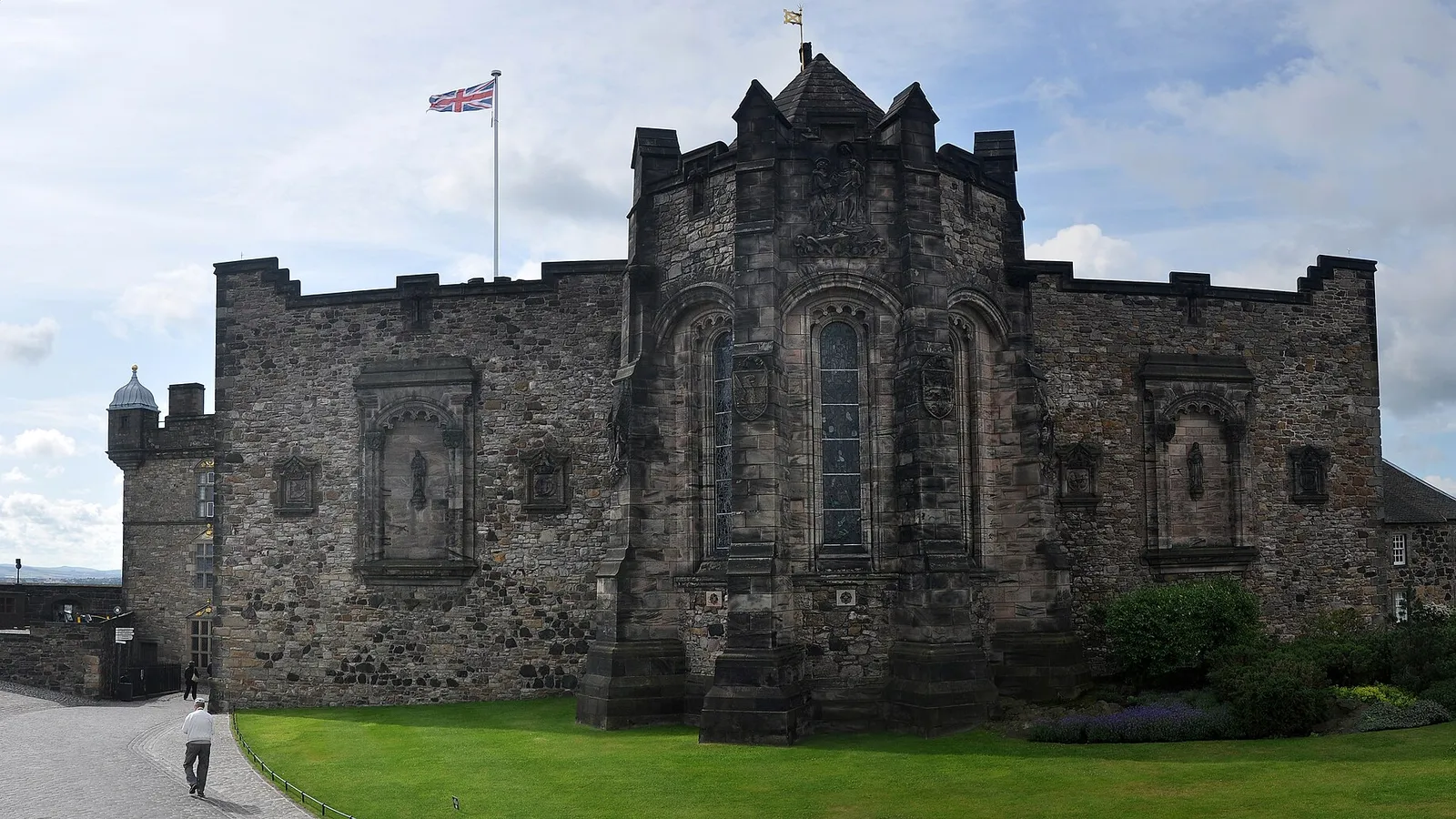

The Scottish National War Memorial: Scotland's Shrine on the Castle Rock
Contents
The Scottish National War Memorial is Scotland's principal national war memorial: a Hall of Honour and Shrine created inside the remodelled North Barracks on Crown Square, Edinburgh Castle. The memorial's official history says it was the work of "the architect Sir Robert Lorimer and 200 Scottish artists and craftsmen". It opened on 14 July 1927 and is still adding names to its Rolls of Honour today.
TL;DR
- Documented: The memorial was proposed in 1917 by the 8th Duke of Atholl and his circle. Lorimer was appointed in April 1919, his first scheme was cut back after a fierce heritage row over the castle skyline, the revised design was approved in October 1923, and the building was constructed in 1924–27 as a reconstruction of the 1755 North Barracks. It was opened by the Prince of Wales on 14 July 1927.
- Documented, with a numbers caveat: The Rolls of Honour record Scots, and anyone who served in a Scottish regiment, who died in the World Wars and in conflicts since 1945, including Iraq and Afghanistan. Headline totals differ by source. The memorial's own history says "nearly 135,000" First World War casualties, while the Imperial War Museums register lists 147,690 First World War names. The difference arises largely because some people appear more than once, so neither figure is a clean count of Scotland's war dead.
- Established significance, genuine but proportionate controversy: The building is widely judged Lorimer's masterpiece and one of the outstanding pieces of British inter-war public art. Its commissioning was openly contested between 1919 and 1923, over the skyline, the cost, "militarism" and whether the money should go to the living. The memorial's centenary falls on 14 July 2027, and a series of events is being planned. Card note: this is the dedicated card for the memorial as its own institution, an independent charity distinct from the National War Museum (Card #49). It does not repeat the brief mention of the 1927 opening in Card #24. It is also the final card of the 50-card Defence series.
Key Facts
- Period covered
- Conception 1917; design 1919–23; construction 1924–27; opened 14 July 1927; Rolls maintained continuously to the present
- Key people
- John Stewart-Murray, 8th Duke of Atholl (chair and driving force); Captain George S. C. Swinton (secretary, later Lord Lyon King of Arms); Sir Robert Lorimer (architect)
- Key artists
- Douglas Strachan (stained glass); Alice and Morris Meredith Williams (Shrine frieze, St Michael, casket figures); Phyllis Bone (animal carving, unicorn and lion); Alexander Carrick; Pilkington Jackson; Percy Portsmouth; George Salvesen; Hazel Kennedy; Thomas Hadden (ironwork); the Clow brothers (woodcarving)
- Location
- North side of Crown Square, Edinburgh Castle, on the site of the medieval St Mary's Church and the 1755 North Barracks
- Notable feature
- The Shrine, where bare Castle Rock breaks through the granite floor beneath the altar and the steel casket given by King George V and Queen Mary
- Governance
- Independent Scottish charity (SC009869), run by a Board of Trustees and a Chief Executive; the building is maintained with Historic Environment Scotland's support
- Designation
- Formerly Category A listed (LB48229, listed 14 December 1970); the listing was removed on 15 November 2019 under HES's "dual designation" project, and the memorial is now protected within the Edinburgh Castle scheduled monument (SM90130)
- Current status
- Open daily; free for "Memorial only" visits (bookable through HES); photography not permitted inside; centenary 2027
Scottish Impact Index (SI Score)
- Military Impact
- 5/10
- Enduring Significance
- 9/10
- Strategic Importance
- 5/10
- Military Distinctiveness
- 9/10
- Military Legacy
- 10/10
- Recognition
- 8/10
46/60
Ranked =32nd of 43 in Defence
Claim Status
Established (documented): The core chronology (1917 proposal, 1918 committee, 1919 appointment of Lorimer, 1923 approval, 1927 opening), the artists involved, the reuse of the North Barracks, the opening ceremony and the Rolls' eligibility criteria all rest on consistent primary and institutional sources. These are the memorial's own history compiled by Dr Diana M. Henderson, the HES designation record, the IWM War Memorials Register and peer-reviewed work by Jenny Macleod (Journal of British Studies and Scottish Historical Review, both 2010).
Shared/Traditional: Some claims are repeated by the institutions themselves but are interpretive or promotional. Examples are the "team of 200 artists and craftsmen" (a round figure that recurs in every source but is not a documented head-count), the claim that the building was "by Scottish hands, with Scottish money" (the committee's own slogan; donations in fact came "from all over the Empire"), and the line on HES's Edinburgh Castle website that "One in five Scots who enlisted during the First World War never came home." These are treated here as traditional or contested.
disputed Casualty totals are genuinely disputed. The memorial's Rolls are a record of names, not a demographic count, and historians including Hew Strachan and Patrick Watt have warned that Scottish First World War death figures are often inflated. The design history also contains dated details that different sources report differently, such as when the skyline scaffolding went up. These are flagged where they occur.
Timeline
The Duke of Atholl gathers leading Scots (among them Lt-Gen Sir Spencer Ewart, Cameron of Lochiel, Sir Hector Munro of Foulis, Lord Balfour of Burleigh and Captain George Swinton) to press for a Scottish national memorial in Edinburgh Castle; the King approves the idea — Documented
Swinton writes to Atholl on the scheme (Atholl papers, National Library of Scotland, Acc. 4714) — Documented
Ewart writes to the Colonels-in-Chief of the Scottish regiments with a plan that now includes a dedicated memorial building alongside a museum — Documented
The Secretary for Scotland appoints a Scottish National War Memorial Committee "to consider what steps should be taken towards the utilization of Edinburgh Castle" — Documented
The committee first meets in Edinburgh and sets up sub-committees, including finance, construction, records, museums and "propaganda" — Documented
Lorimer is appointed advising architect and tours the castle with Atholl; he proposes a shrine and cloisters "of a dedicatory character without actually being church or chapel" — Documented
The committee's report (Cmd. 279) endorses Lorimer; the President of the Royal Scottish Academy, Sir James Lawton Wingate, dissents, calling the scheme "too exclusively a glorification of militarism" — Documented
The government gives conditional sanction and requires scaffolding to show the effect on the skyline — Documented (the timing of the scaffolding varies between sources; see Caveats)
£120,000 has been raised, including £50,000 from A. P. Lyle of Glendelvine — Documented
Skyline controversy peaks; Atholl faces a hostile Cockburn Association meeting and promises a design that will not alter the skyline — Documented
The Ancient Monuments Board reports favourably on the revised scheme and the War Office gives final consent — Documented
The government approves Lorimer's revised designs; the project goes to tender — Documented
Construction, continuing even through the General Strike of 1926 — Documented
Opened by Edward, Prince of Wales; King George V and Queen Mary place the Rolls in the casket — Documented
Lorimer is appointed KBE following the memorial's completion — Documented
Lorimer dies, two years after the opening — Documented
Ian Hay publishes Their Name Liveth, the book of the memorial — Documented
The Rolls of Honour and the stained glass are removed to safety for fear of bombing — Documented
"A further 50,000 names were added to the Rolls of Honour" (SNWM official history); the trustees decide to leave the building itself unchanged — Documented
Listed Category A (LB48229) — Documented
Edinburgh Castle designated a scheduled monument (SM90130) — Documented
Visit of Queen Elizabeth II marks the First World War centenary; a commemorative memorial garden is inscribed "Their Name Liveth" — Documented
Separate listing removed under HES dual designation; protection continues through the scheduled monument — Documented
95th Annual Service of Commemoration — Documented
Eligibility criteria amended to include RN and RAF personnel based in Scotland at the time of death (from 2024 onwards, not retrospectively) — Documented
National Museums Scotland announces The Art of Commemoration (5 December 2026 – 14 January 2029) at the National War Museum, marking the approaching centenary — Documented
Centenary of the opening; "a series of events is being planned" — Announced (future)
Details
Origins: A Scottish Memorial "on Scottish Soil"
The memorial began as a wartime idea. In 1917, with victory far from certain, a group of well-connected Scots wanted the names of the dead permanently recorded in a national memorial in Scotland. The memorial's official history, compiled by Dr Diana M. Henderson, identifies the "moving force" as John George Stewart-Murray, 8th Duke of Atholl, known as "Bardie". He was a serving soldier who had fought in the Sudan, raised the Scottish Horse and later served at Gallipoli. His papers on the project survive in the National Library of Scotland.
The context mattered. In London, Edwin Lutyens's Cenotaph and a proposed National War Museum (which became the Imperial War Museum) were being conceived as imperial, not specifically English, memorials. Jenny Macleod's comparative study of the Scottish, Welsh and Irish national memorials shows that no English national memorial was ever proposed. Scotland's promoters supported the London projects but wanted "a truly Scottish memorial, in Scotland, recording the names of all Scots". The Duke's own phrase for the finished building, "truly Scottish, carried out by Scottish money, Scottish brains and Scottish hands", became the title of Macleod's Journal of British Studies article, which examines how the memorial came to be accepted as national. The rhetoric was partly aspirational. The memorial's own history records donations arriving "from all over the Empire".
Atholl's original vision was a museum collection, and the project's national museum strand is covered on Card #49. Over 1917–19 the emphasis shifted towards a commemorative building. Edinburgh Castle was chosen partly for symbolism and partly for practical reasons: the garrison was moving to the new Redford Barracks, which would free up accommodation, and every Scottish regiment had at some point served at the castle. Glasgow's initial concern was settled at a dinner Ewart hosted for the interested parties. The Scotsman later reported that some had wanted the memorial in Glasgow.
The committee appointed in October 1918 was deliberately representative, covering the services, the press, the church, the universities, architecture and the five cities. Its secretary, Captain George Swinton, a heraldist who became Lord Lyon King of Arms, "influenced both its design and its very being".
The Commissioning Controversy (1919–1923)
This is the most rigorously documented contested aspect of the memorial, and it was a real controversy. Lorimer's 1919 scheme for a shrine and cloisters on the site of "Billing's Buildings" (the North Barracks), together with the museum, was estimated at "a staggering £250,000". Opposition came from several directions:
- Skyline and heritage. The government's conditional sanction in January 1920 required scaffolding to show the building's effect on the castle silhouette, and "immediately the scaffolding was erected there was an outcry." The Cockburn Association led the resistance. Named critics included Professor Sir Richard Lodge, Principal Laurie of Heriot-Watt and Lady Frances Balfour, who, according to the memorial's own history, "actually demanded that the Duke of Atholl and Sir Robert Lorimer should be hanged!"
- Militarism and cost. Sir James Lawton Wingate, President of the Royal Scottish Academy, objected that the scheme was "too exclusively a glorification of militarism". Macleod's footnotes record that Sir Herbert Maxwell resigned because he preferred a small memorial with the balance spent on ex-servicemen's welfare. A 2017 Scotsman article by the former Atholl Estates archivist Jane Anderson says Lord Rosebery was among those who "felt money should be spent on the living". Macleod's Scottish Historical Review article treats Rosebery's criticisms of Lorimer's design "in detail". The full text of that article could not be consulted for this card, so his exact words are not quoted here.
- Politics and practicalities. The Ancient Monuments Board objected to the museum plans. When the Lloyd George government fell, its successor denied that any scheme had ever been sanctioned. The General Officer Commanding warned that the Irish crisis might require the castle for troops. Proposals even surfaced to move the memorial to Calton Hill or Princes Street Gardens.
- Fundraising competition. The appeal ran alongside large campaigns for the Edinburgh Royal Infirmary and the University, and alongside countless parish memorials. Innovative methods, including a "Shilling-a-head" fund, commemorative stamps and "Thistle Day", together with A. P. Lyle's £50,000 gift, had raised £120,000 by August 1922. The Scotsman's 2018 figure of "just over £117,000" and Macleod's figure of £144,000 including interest differ slightly. They probably reflect different dates and accounting bases.
The resolution was a compromise. Lorimer abandoned new cloisters and a building that would break the skyline. Instead he retained and adapted the shell of the North Barracks as the Hall of Honour and added a porched entrance and a five-sided apse on the north side, the Shrine, whose roof was no higher than the existing building. At a Cockburn Association meeting in January 1923, Atholl, who introduced himself as appearing "in character of the accused… charged with vandalism", promised a design that would not "alter the skyline in the slightest". Opposition then "crumbled": the Ancient Monuments Board reported favourably in April 1923 and the government approved the designs in October 1923. As The Planner observed in 2025, the castle skyline "is what it is today because of that meeting".
Assessment: The dispute was about form, location, cost and purpose, not about whether the dead should be commemorated. It is fair to say the compromise probably produced a better building. The constraint forced Lorimer to create an interior of great intensity inside a modest, reused shell rather than a monumental addition to the skyline. That is an interpretation, but HES records support it: Lorimer's retention of the barracks shell was itself seen as meaningful, and "its former military use was seen as an important part of the symbolism of the new building."
Lorimer's Design and Architectural Significance
Robert Lorimer (1864–1929) was Scotland's leading Arts and Crafts-influenced architect. He was known mainly for restoring and building country houses in Scots Baronial and Gothic idioms, and for the Thistle Chapel in St Giles' Cathedral (1909–11), which directly anticipated the memorial's collaborative craft approach. He also worked for the Imperial War Graves Commission in Italy, Greece, Egypt, Macedonia and Germany, and designed the naval memorials at Chatham, Portsmouth and Plymouth.
The building's style is best described precisely rather than with a single label. HES's designation record describes an "E-plan War Memorial Chapel with concrete vault and buttressed semi-octagonal apse to N; gothic detail, some drawn from Stirling Castle", with a "crenellated coped parapet with large gargoyles to entrance tower" and "openings in cusped stilted segmental arches." Writing for the Twentieth Century Society, the art historian Duncan Macmillan describes the style as "inspired by the architecture of Renaissance Scotland." "Scottish late-Gothic/Renaissance revival, realised through Arts and Crafts collaborative practice" is therefore a fair synthesis. The "Arts and Crafts" element lies above all in the method: the architect coordinated a large team of named artists and craftspeople and integrated their work into the architecture.
Visitors enter a low, groin-vaulted porch and cross into the vaulted crossing. The east and west transepts form the Hall of Honour. Northward, the apsidal Shrine rises on slim shafts beneath stilted-arched windows. Lorimer reportedly paid regular weekend visits to Blair Castle to work through "how every regiment, service and corps should be remembered". The memorial's own history also credits the Duke and Duchess of Atholl with a major part in "the subtle symbolism and the wonderful serenity and simplicity" of the interior.
Comparison with Lutyens and the wider British context. The contrast with Lutyens is instructive. Lutyens's Cenotaph (1919–20) is abstract, non-denominational and almost wordless, expressing loss by "its simplicity alone". His Irish National War Memorial Gardens in Dublin are a formal landscape with granite bookrooms for the Rolls. Sir Ninian Comper's Welsh National War Memorial in Cardiff (1928) is an open-air classical colonnade. Edinburgh took the opposite path from all three: an enclosed, richly figurative, overtly Christian (though deliberately "not church or chapel") interior filled with narrative sculpture and glass. Its closest affinities are with Lorimer's own Thistle Chapel and with the tradition of the medieval chantry, not with the abstraction of the Imperial War Graves Commission. Macleod's work places it within the wider layering of local, national and imperial identity in post-war commemoration. The Twentieth Century Society chose it as its building for 1927 in its "100 Buildings 100 Years" survey. In Macmillan's words, it is "one of the outstanding pieces of public art of its time" and "the masterpiece of its architect."
Symbolism and Artistic Elements
The symbolism operates at three levels: the site, the programme of inclusion and the iconography.
The site. The Shrine stands on the highest part of the Castle Rock. HES records "bare rock breaking through Ailsa Craig granite floor", with a "granite altar with bronze kneeling angels to corners" and a "carved central boss with hanging painted timber figure". That figure is Alice Meredith Williams's St Michael, carved by the Clow brothers and suspended above the casket. The building also occupies the site of the medieval St Mary's Church, which was converted to a munitions store in 1540 and demolished in 1755 to make way for the barracks. The layering of church, armoury, barracks and shrine is documented. Any claim that the choice of site was intended to "reconsecrate" it is interpretation.
The casket and Shrine frieze. The steel casket, a gift from King George V and Queen Mary, holds the original First World War Rolls. Its decorative angels bearing shields were designed by Alice Meredith Williams, and cast-iron sample pieces are among the highlights of the 2026 NMS exhibition. The bronze frieze encircling the Shrine, designed with Morris Meredith Williams and executed by Alice, depicts a procession of the men and women of the services. The Duchess of Atholl recorded that its figures owed much to "endless drawings of his fellow soldiers" that Morris made during "his three years in the ranks in France." Its inscriptions read: "THE SOULS OF THE RIGHTEOUS ARE IN THE HAND OF GOD…" and, poignantly, "OTHERS ALSO THERE ARE WHO PERISHED UNKNOWN; THEIR SACRIFICE IS NOT FORGOTTEN, AND THEIR NAMES, THOUGH LOST TO US, ARE WRITTEN IN THE BOOKS OF GOD." Thomas Hadden made the wrought-iron screen and gates.
The glass. Douglas Strachan (1875–1950), often regarded as the most significant Scottish stained-glass designer of the twentieth century, made the memorial's windows, his largest commission. The 1928 official guide explains that the seven Shrine windows depict "the feelings and forces deep in human nature which make first for War and then for the triumph of Peace". The sequence culminates in imagery of Christ in Majesty. Juliette MacDonald's article in the Journal of Design History (2001) remains the key scholarly study of the glass's "myth and meaning". Strachan's 1926 chalk cartoon for the "Moon" window, which he presented to Aberdeen Art Gallery in 1928, survives as an insight into his process.
The programme of inclusion. This is arguably the memorial's most distinctive feature. The Hall of Honour contains bays and memorials to each Scottish regiment and also to the Royal Navy, the Royal Marines, the flying services, the Royal Artillery, the Royal Engineers, the medical and service corps, chaplains, nursing services, the Merchant Navy, the Indian Army, the Dominions and colonies, Scottish units raised in London, Liverpool, South Africa and Tyneside, and Scots who served in English, Irish and Welsh regiments. Most notably, there is a memorial to all Scottish women. Macmillan singles out the commemoration of "the many non-combatants and uniquely… all Scottish women." Allegorical figures of the virtues, including Truth and Knowledge by Alice Meredith Williams, Courage and Justice by Alexander Carrick and Charity by Percy Portsmouth, occupy canopied niches. Pilkington Jackson modelled the Royal Marines' "Reveille" panel and Hazel Kennedy the chaplains' bronze panel.
The "humble beasts". In the east and west bays, Phyllis Bone's carvings commemorate the animals of the war: horses, mules, carrier pigeons, and the canaries and mice that tunnellers used to detect gas ("The Tunnellers' Friends"). The accompanying inscription reads: "Remember also the humble beasts that served and died." This was a considered choice by Atholl and Lorimer and was unusual among national memorials of the period. Outside, Bone's unicorn and lion of the royal arms flank the entrance.
Women artists. NMS emphasises that "women artists were heavily involved", notably Alice Meredith Williams (twelve works), Phyllis Bone and Hazel Kennedy. This is documented and remains an under-appreciated aspect of the building.
The Rolls of Honour: What They Record and How They Grow
Purpose and form. From 1919 the committee intended the names to be kept in "fairly written books", with separate memorials to each unit. Today the Trustees maintain a master Roll on a database. It is periodically extracted to printed volumes displayed on stone tables beneath each memorial in the Hall of Honour, and it can be searched free online. The original First World War Rolls lie sealed in the casket in the Shrine. They were compiled from War Office lists, Commonwealth War Graves Commission data and returns from the Dominions.
Eligibility. The current published criteria cover members of the Armed Forces of the Crown or the Merchant Navy who "were a Scot, or served in a Scottish Regiment" and who died as a direct result of wound, injury or disease sustained in a theatre of operations for which a medal has been awarded, on duty in aid of the civil power, or on duty abroad under direct orders of the Crown. Scottish civilians who died as a result of enemy action are also eligible. A "Scot" is defined as a person born in Scotland or with a Scottish-born parent, and birth-register proof is "essential" for those who did not serve in a Scottish regiment. The qualifying dates are 4 August 1914 – 31 August 1921 for the First World War and 3 September 1939 – 31 December 1947 for the Second. In 2024 the criteria were extended, for deaths from 2024 onwards, to RN and RAF personnel based in Scotland.
How names are added. The Trustees state candidly that "the Rolls of Honour are neither complete nor wholly accurate." Applications are accepted from close relatives, Regimental Headquarters or service records offices and, "in exceptional circumstances", from bona fide researchers. Applications must include documentary proof of service and CWGC acceptance as a war casualty. First World War names are still being added more than a century on. In 2025, for example, the memorial reported considering a file for Gunner Alex Cargill, killed in action in 1916, submitted by a Forfar researcher.
How many names? The totals need care:
| Source | First World War | Second World War |
|---|---|---|
| SNWM official history | "nearly 135,000" | "more than 50,000" |
| IWM War Memorials Register | 147,690 | 57,938 |
| Casket at the 1927 opening | "over 100,000" names | n/a |
| Merchant seafarers (SNWM, 2025) | 6,378 Scottish seafarers across both wars |
The discrepancy is explained, not mysterious. Wikipedia's "Scottish war memorials" article gives yet another set of totals, 148,270 names for 1914–1918 and 57,726 for 1939–1945. The Scottish Military Research Group has shown that totals of about 147,000 count entries, not people. Men who transferred between regiments, or yeomanry units converted into infantry battalions (such as the Lovat Scouts serving as the 10th Cameron Highlanders), can appear in more than one Roll. Non-Scots who served in Scottish regiments are also included. The group estimates Scotland's actual First World War dead at "probably around 100,000 – 110,000". Hew Strachan reached a similar figure of about 100,000, while noting that any calculation leads into "a methodological and statistical minefield". The Rolls are therefore best understood as an act of naming, and should not be quoted as census data.
Beyond the World Wars. After 1945, according to the memorial's official history, "a further 50,000 names were added to the Rolls of Honour", but the trustees deliberately left the building unaltered: "no Second World War Battle Honours were added to the Regimental bays." The Rolls now also include casualties from the Malayan Emergency, the Korean War, Northern Ireland, the Falklands, the Gulf War, Iraq and Afghanistan. The memorial therefore describes itself as "Scotland's place of remembrance for the First World War up until the present day." Names continue to be added.
Current Status, Visitor Protocols and Ceremonial Life
Governance. The memorial is run by "a small charitable trust" (Scottish charity SC009869). It is governed by a Board of Trustees and a Chief Executive, currently Susan Flintoff, who is named as "Chief Executive of the charity" in the National Museums Scotland press release of 14 July 2026. A Keeper of the Rolls oversees the names. The memorial relies heavily on donations and grants, including support from the Royal Edinburgh Military Tattoo, while Historic Environment Scotland helps maintain the building. It is not part of National Museums Scotland, which runs the separate National War Museum (Card #49).
Visiting. The memorial opens daily from 9.30am until 6pm or 5pm, depending on the season, with last entry an hour before the castle closes. A "Memorial only" visit is free but should be requested in advance from HES (ticketing@hes.scot). Such visits do not include the rest of the castle and are not possible between 12.30 and 13.30, when the castle is busiest, or during ceremonial events. The memorial closes for services and at Christmas. A mobility vehicle is available at certain times.
Etiquette. This is what distinguishes the memorial most clearly from the neighbouring museum. The trustees ask visitors "to remember that this is a Shrine to those who gave their lives in the service of their country" and to respect "the privacy of those paying homage by refraining from photography of any kind and maintaining a respectful silence." Stewards are on hand. Relatives can order extracts from the Roll or commemorative certificates.
Ceremonial use. An Annual Service of Commemoration marks the opening; the 95th was held on 6 June 2023, and the 98th took place in 2026. Regimental associations, ship associations and national communities hold services and wreath-layings. Examples include ANZAC services and a 2023 wreath-laying by Edinburgh's Ukrainian community on the first anniversary of the Russian invasion. The memorial also lays a wreath at the national Remembrance service in Edinburgh.
Centenary. National Museums Scotland and the memorial are jointly staging The Art of Commemoration at the National War Museum from 5 December 2026 to 14 January 2029, with original architectural drawings, artworks and archival material "from the earliest discussions held in 1917 through to its opening in 1927". A series of events is being planned for 2027. As of September 2026 the full programme has not been published, so any specific centenary event should be treated as announced, not confirmed.
Did You Know?
- The King would not open it. George V had a policy of not opening war memorials, so the Prince of Wales performed the ceremony. The King and Queen came as its first visitors and placed the Rolls in the casket themselves.
- The Women's Roll had its own ceremony. The Duchess of Atholl, wearing Voluntary Aid Detachment nursing uniform, carried the Roll of the Women's Services, and Queen Mary personally deposited it in the casket.
- The rock is left bare. The summit of the Castle Rock deliberately breaks through the Shrine's Ailsa Craig granite floor beneath the altar.
- The frieze drew on drawings from the trenches. The Duchess of Atholl recorded that the Shrine frieze drew on "endless drawings" Morris Meredith Williams made of fellow soldiers during three years in the ranks in France.
- Canaries and mice are commemorated. Phyllis Bone's "Tunnellers' Friends" carving honours the small animals used to detect gas underground, under the inscription "Remember also the humble beasts that served and died."
- A critic called for the designers to be hanged. During the 1920s skyline row, the suffragist Lady Frances Balfour called for both the Duke of Atholl and Lorimer to be hanged, rhetorically. Atholl later became a Vice-President of the Cockburn Association.
- The windows went into hiding. During the Second World War the stained glass and the Rolls were removed for safekeeping against bombing.
- One donor gave two-fifths of the early total. A. P. Lyle of Glendelvine gave £50,000 of the £120,000 raised by August 1922.
FAQ
1What is the Scottish National War Memorial?
It is Scotland's national memorial to its war dead, opened on 14 July 1927 inside Edinburgh Castle. Designed by Sir Robert Lorimer, it comprises a Hall of Honour with memorials to regiments and services and a Shrine containing a casket with the original First World War Rolls of Honour. It commemorates Scots, and those who served in Scottish regiments, who died from 1914 to the present.
2Is it the same as the National War Museum?
No. The two institutions share the Edinburgh Castle site but are separate. The National War Museum is a museum run by National Museums Scotland. The Scottish National War Memorial is a memorial and shrine run by an independent charitable trust (SC009869), with HES helping to maintain the building. The memorial keeps no general military collections; its core function is commemoration and the Rolls of Honour.
3Who designed it?
Sir Robert Lorimer (1864–1929), architect of the Thistle Chapel, was appointed in April 1919. He led what the memorial's official history calls "200 Scottish artists and craftsmen", including Douglas Strachan (glass), Alice and Morris Meredith Williams, Phyllis Bone, Alexander Carrick, Pilkington Jackson, Percy Portsmouth, George Salvesen, Hazel Kennedy and the metalworker Thomas Hadden.
4Who came up with the idea?
The 8th Duke of Atholl was the driving force from 1917, working with Captain George Swinton, Lt-Gen Sir Spencer Ewart and others. A government-appointed committee chaired by Atholl oversaw the project from October 1918. His papers on the memorial are held by the National Library of Scotland.
5Was the memorial controversial?
Yes, during its commissioning. Between 1919 and 1923 critics, led by the Cockburn Association, objected to the skyline impact of Lorimer's first scheme. Others called it too militaristic or too expensive, or argued that the money should help the living. Lorimer's scaled-down design, which reused the North Barracks, was approved in October 1923. Once opened, it was quickly accepted as the national shrine.
6How many names are on the Rolls of Honour?
The memorial cites "nearly 135,000" First World War and "more than 50,000" Second World War casualties, while the IWM register lists 147,690 and 57,938 respectively. Totals differ because some individuals appear in more than one regimental Roll and because non-Scots in Scottish regiments are included. Historians estimate Scotland's actual First World War dead at about 100,000–110,000.
7Who is eligible to be included?
Eligible people are members of the Crown's armed forces or the Merchant Navy who were Scots (born in Scotland or with a Scottish-born parent), or who served in a Scottish regiment, and who died from wounds, injury or disease sustained in a medal-qualifying theatre, in aid of the civil power, or on Crown duty abroad. Scottish civilians killed by enemy action also qualify. Specific date windows apply for both World Wars.
8Are names still being added?
Yes. Names from the First and Second World Wars are still added when evidence emerges, and casualties of later conflicts, including Iraq and Afghanistan, are recorded. Relatives, regimental headquarters and, exceptionally, researchers can apply with documentary proof. From 2024 the criteria also cover RN and RAF personnel based in Scotland.
9Can I visit, and is it free?
Yes. The memorial is open daily. A "Memorial only" visit is free but should be booked through Historic Environment Scotland (ticketing@hes.scot) and does not include the rest of the castle. It is not possible between 12.30 and 13.30 or during ceremonial events. Standard castle tickets include the memorial.
10Can I take photographs inside?
No. Visitors are asked to refrain from photography of any kind and to maintain a respectful silence, because the building functions as a shrine where people come to pay homage. This protocol sets it apart from the neighbouring museum.
11How does it compare with other national war memorials?
Unlike Lutyens's abstract Cenotaph in London, his landscaped Irish National War Memorial Gardens in Dublin, or Comper's open-air Welsh memorial in Cardiff, Edinburgh's memorial is an enclosed, richly figurative interior shrine. It combines architecture, sculpture, glass and named Rolls, and scholars regard it as one of the finest British memorials of its era.
12What is planned for the 2027 centenary?
The memorial opened on 14 July 1927. National Museums Scotland's exhibition The Art of Commemoration runs from 5 December 2026 to 14 January 2029, and the memorial says a series of events is being planned for 2027. Details were not fully published as of September 2026.
Sources
Primary and Institutional
- Scottish National War Memorial, official website: "History" (compiled by Dr Diana M. Henderson, with text by Professor Duncan Macmillan), "FAQ" (Rolls eligibility and applications), "Visiting us" and the online Roll Search (snwm.org).
- Historic Environment Scotland, designation record LB48229, "Edinburgh Castle, Scottish National War Memorial" (Category A, listed 1970, removed 2019 under dual designation), and scheduled monument SM90130, Edinburgh Castle; HES Edinburgh Castle Statement of Significance.
- Trove.scot / Canmore place record 79631 (RCAHMS records of the memorial's sculpture and glass).
- Imperial War Museums, War Memorials Register, memorial no. 2002 (inscriptions, makers, names commemorated) and no. 96991 (2014 centenary garden).
- National Museums Scotland press release, "New display explores the creation of the Scottish National War Memorial" (14 July 2026).
- National Library of Scotland, Atholl papers relating to the Scottish National War Memorial (Acc. 4714); National Records of Scotland, HH1/650–654.
- Report of the Committee… upon the Utilisation of Edinburgh Castle for the purposes of a Scottish National War Memorial, Cmd. 279 (HMSO, 1919).
Scholarly
- Jenny Macleod, "'By Scottish Hands, with Scottish Money, on Scottish Soil': The Scottish National War Memorial and National Identity", Journal of British Studies 49:1 (2010), 73–96.
- Jenny Macleod, "Memorials and Location: Local versus National Identity and the Scottish National War Memorial", Scottish Historical Review 89:1 (2010), 73–95.
- Jenny Macleod, "Britishness and Commemoration: National Memorials to the First World War in Britain and Ireland", Journal of Contemporary History (2013).
- Juliette MacDonald, "'Let Us Now Praise the Name of Famous Men': Myth and Meaning in the Stained Glass of the Scottish National War Memorial", Journal of Design History 14:2 (2001), 117–28.
- Angus Calder, "The Scottish National War Memorial", in W. Kidd and B. Murdoch (eds), Memory and Memorials: The Commemorative Century (Aldershot, 2004).
- Ian Gow, "The Scottish National War Memorial", in F. Pearson (ed.), Virtue and Vision: Sculpture and Scotland 1540–1990 (Edinburgh, 1991).
- Patrick Watt, "Manpower, Myth and Memory: Analysing Scotland's Military Contribution to the Great War", Journal of Scottish Historical Studies (2019).
- Linda Riddell, "Scottish Rolls of Honour and Rolls of Service: A Neglected Source", Scottish Historical Review 96:1 (2017).
General Further Reading
- Ian Hay, Their Name Liveth: The Book of the Scottish National War Memorial (London, 1931; revised 1985).
- F. W. Deas, The Scottish National War Memorial: Official Guide (1928; 3rd edn 1937).
- John Gifford, Colin McWilliam and David Walker, The Buildings of Scotland: Edinburgh (Penguin, 1984).
- Duncan Macmillan, "1927: Scottish National War Memorial, Edinburgh", Twentieth Century Society, 100 Buildings 100 Years.
- Scottish Military Research Group, "Lies, damned lies, and statistics" (2013), on the Rolls totals.
Scholarly/Critical
- E. W. McFarland, "The Great War", in T. M. Devine and Jenny Wormald (eds), The Oxford Handbook of Modern Scottish History (Oxford University Press, 2012) — further reading on Great War commemoration
Honest Caveats
"150,000 Scots died in the First World War" (Disputed/Myth). This figure is often derived from the memorial's Roll totals, but the Rolls count entries, including duplicates and non-Scots who served in Scottish regiments. Informed estimates cluster around 100,000–110,000, and the historical debate (Strachan, Watt and others) is unresolved. Do not cite the Roll totals as a count of Scottish deaths.
"One in five Scots who enlisted never came home" (Traditional/Contested). HES's Edinburgh Castle website states: "One in five Scots who enlisted during the First World War never came home." For context, the Glasgow Times (13 November 2018) puts enlistment at "around 700,000 in total across Scotland". The ratio depends on contested enlistment and death figures and should be treated as a commemorative formulation, not an established statistic.
"Built by 200 Scottish artists and craftsmen" (Traditional). The figure is consistently repeated by the memorial, HES and the press, and is broadly credible, but it is a round number, not a documented roster.
"Scottish money, Scottish brains and Scottish hands" (Traditional/Rhetorical). This was Atholl's own framing. It is substantially true of the artists, but donations came from across the Empire.
Date and figure discrepancies in the design story (Minor, flagged). The memorial's history places the skyline scaffolding after the government's conditional sanction of January 1920, while a 2017 archival account dates the scaffolding and the resulting outcry to December 1922. Construction is dated 1923–27 in some press sources and 1924–27 by HES. Sums raised range from about £117,000 to £144,000 depending on source and date. None of these alters the core narrative.
Lord Rosebery's criticisms (Partially verified). Macleod's peer-reviewed work documents Rosebery as a leading critic. This card has not independently verified his exact wording, and secondary sources characterise his objection mainly as a preference for spending on the living.
Exclusions from the Rolls (Handle with care). Wikipedia's "Scottish National War Memorial" article, repeated by Military Wiki, says the original aim covered deaths "from the declaration of war on 4 August 1914 to the Treaty of Versailles of 28 June 1919 (confirmed military suicides and those tried and executed excepted)". Both are tertiary sources. The memorial's own historic wording confirms an exception for suicide. Its current published criteria do not address executions, which this card has not been able to verify from a primary source. Readers should consult the Trustees directly.
"Royal Charter" (Unverified). HES's Edinburgh Castle website states that "The National War Memorial for Scotland was established by Royal Charter to commemorate the sacrifice of Scots in the Great War, Second World War and subsequent conflicts." This card found no primary confirmation of a charter and relies instead on the memorial's documented status as a registered charity.
Scope of this card. Card #24 mentioned the 1927 opening briefly within its survey of Scottish regiments in the First World War. Card #49 covered the National War Museum and the separate institutional status of the two bodies on the castle site. Card #32 covered Edinburgh Castle's fortress history. This card deals only with the memorial as an institution: its commissioning, design, symbolism, Rolls, governance and ceremonial life.
Closing Reflection: The Last Card
Fifty cards ago, this series set out to test Scotland's defence history against the evidence: battles, regiments, inventions, institutions and the myths that gather around them all. It is fitting that it ends not with a victory but with a list of names.
The Scottish National War Memorial draws the series' themes together without needing any embellishment. Courage and sacrifice are present, but the building does not glorify them. Wingate's 1919 fear of "a glorification of militarism" was answered by an interior whose windows move from the forces "which make first for War" towards "the triumph of Peace". Institutional memory is its daily work: a small charity and a Keeper of the Rolls who, a century on, still weigh evidence before adding a gunner killed in 1916. Contested history is written into its fabric. The building we have exists because citizens fought hard over what a national memorial should cost, look like and mean, and because its promoters lost some of those arguments. Honest commemoration is embodied in the trustees' own admission that the Rolls "are neither complete nor wholly accurate", and in the frieze's acknowledgement of those "who perished unknown".
Accuracy over patriotism does not diminish a place like this. Knowing that the Roll totals overstate Scotland's dead does not make a single name less real. Knowing that the memorial was argued over, compromised and paid for by a mixture of shillings and one great gift makes its achievement more human, not less. The fitting way to close the series is the one the memorial itself asks of every visitor: set the camera down, keep silence, and read the names.
Finished reading? Try the Fact Machine: three reels, one surprising Scottish connection →
Card 050 · Defence