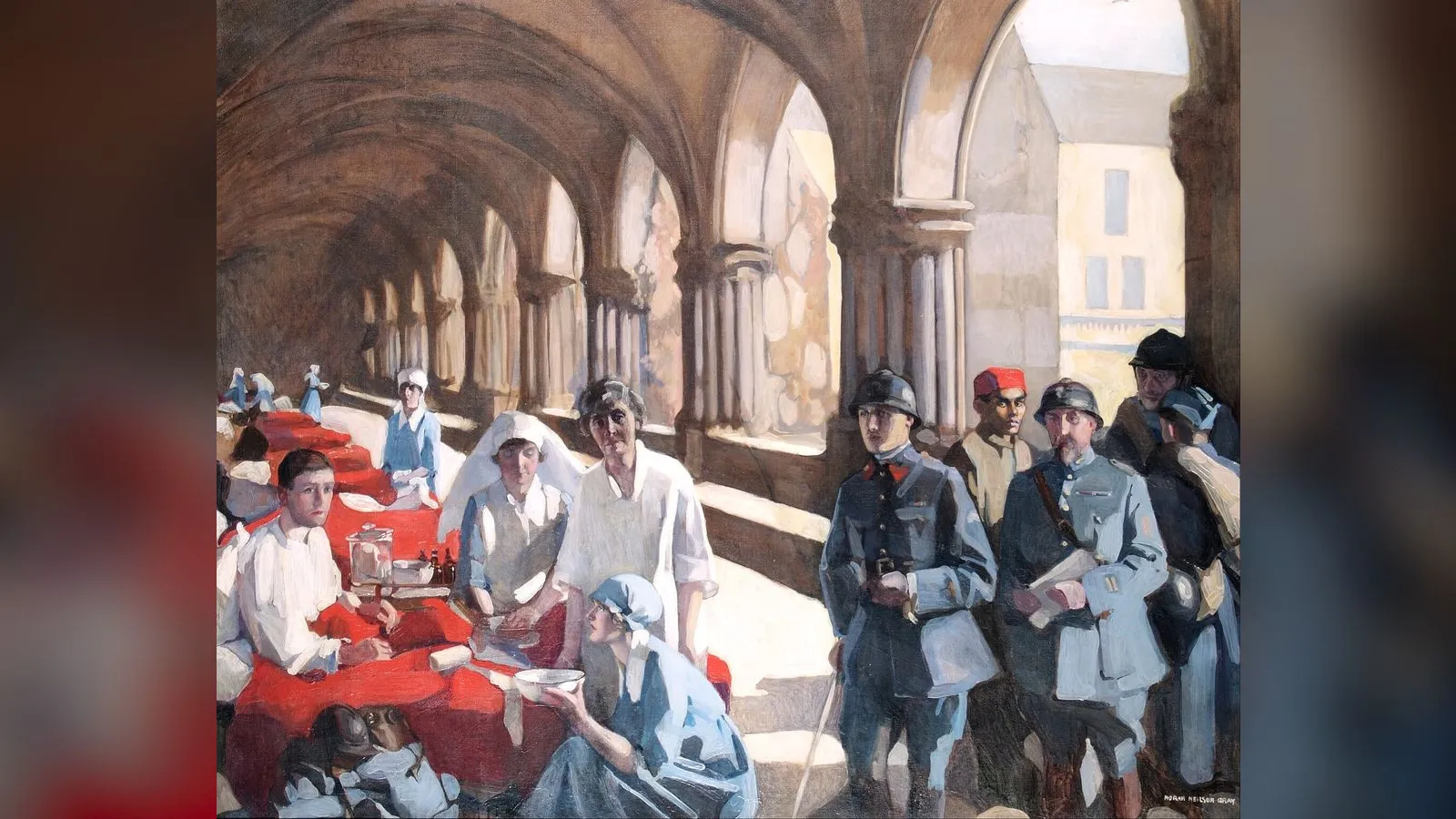

The Scottish Women's Hospitals
Contents
When the First World War began, the Edinburgh surgeon Dr Elsie Inglis offered her services to the War Office and was turned down. She and the Scottish suffrage movement founded their own medical service instead. The Scottish Women's Hospitals for Foreign Service sent 14 units, staffed almost entirely by women, to France, Serbia, Russia, Romania, Corsica, Malta and Salonika. This card tests what they achieved, the story of Elsie Inglis, and how many women took part.
TL;DR
- established The Scottish Women's Hospitals were founded in 1914, led by Dr Elsie Inglis, secretary of the Scottish Federation of Women's Suffrage Societies. Inglis's offer of help to the War Office had been refused.
- established By the end of the war they had sent 14 medical units to France, Serbia, Russia, Romania, Corsica, Malta and Salonika, funded by more than £500,000 in donations.
- established Their hospital at Royaumont Abbey near Paris ran until March 1919. In Serbia, Inglis was taken prisoner when the country was overrun in 1915, and later released.
- established Inglis led a unit with the Serbian Division in Russia and Romania, returned to Britain in November 1917 with a terminal illness, and died the day after arriving.
- shared Sources give between "more than 1,000" and 1,500–2,000 women as having served.
Key Facts
- Founded
- October 1914 (adopted by the National Union on 15 October)
- Founder
- Dr Elsie Inglis (1864–1917)
- Backing
- Scottish Federation of Women's Suffrage Societies; National Union of Women's Suffrage Societies
- First target
- £50,000
- Funds raised
- More than £200,000 by 1918 (Balfour); more than £500,000 in all
- Serbia, 1915
- Kragujevac, Mladenovac, Valjevo, Lazarevac, Kruševac and other sites
- Romania and Russia, 1916–17
- Medgidia, Braila, Galatz, Reni, Ismail; about 75–80 women sailed with Inglis
- Units
- 14
- Countries
- France, Serbia, Russia, Romania, Corsica, Malta, Salonika
- Royaumont Abbey
- About 200 beds; closed March 1919
- Women who served
- More than 1,000 (estimates up to 2,000)
- Inglis's award
- Order of the White Eagle, Serbia, 3 April 1916
- Inglis died
- November 1917
- Legacy
- Elsie Inglis Memorial Maternity Hospital, Edinburgh
A Note on Claims and Evidence
Each major claim carries one of three labels. established means supported by primary records, official bodies or several independent reliable sources. shared means the core fact is sound but sources disagree on details, dates or interpretation. traditional means widely repeated but not traceable to a primary or independent source.
The organisation's work is recorded in its own archives, many held by Glasgow's Mitchell Library, and in university and museum collections. The number of women who served depends on whether short-term volunteers and support staff are counted. Sources also differ on when Royaumont opened and when the organisation formally ended.
The nearest thing to a contemporary history of Inglis's own units is Lady Frances Balfour, in her memoir Dr. Elsie Inglis (1918). Balfour was a suffrage leader and Inglis's friend, and the book is admiring, but it prints Inglis's letters and reports from Royaumont, Serbia, Romania and Russia, with dates, places and figures. Those are used here. Balfour herself says the full history of the hospitals is beyond her book, and she covers the units Inglis did not lead, such as Royaumont after 1915, Corsica and Salonika, hardly at all. Balfour records the remark "My good lady, go home and sit still" as said to Inglis by an unnamed War Office official in 1914.
Timeline
Elsie Inglis is born at Naini Tal in India.
Her family moves to Edinburgh.
Inglis qualifies in medicine.
She opens the Hospice, a maternity hospital for the poor in Edinburgh's High Street, staffed by women, after a nursing home in George Square in 1901.
Inglis offers her services in London and is turned away by a War Office official.
The Scottish Federation adopts her scheme and the name Scottish Women's Hospitals; the National Union adopts it on 15 October.
The first units go to France.
Inglis writes from Royaumont Abbey that the wards are ready and the staff are waiting for the inspecting general.
A unit goes to Serbia.
Nurse Louisa Jordan dies of typhus in Serbia.
Inglis reaches Kragujevac, where the unit is running 550 beds in three hospitals.
Inglis opens a fountain built by the Serbs in honour of the Scottish women at Mladenovac.
The unit evacuates Kragujevac and falls back to Kruševac.
Serbia is overrun; Inglis and her staff stay at Kruševac and become prisoners.
The unit is sent north under guard through Vienna to Switzerland.
Inglis becomes the first woman awarded Serbia's Order of the White Eagle.
Inglis sails for Archangel with a unit for the Serbian Division in Russia.
The unit is driven out of Medgidia in the Dobrudja and moves to Braila and Galatz.
Inglis runs a hospital for Russian wounded at Reni on the Danube.
The unit leaves with Serbian troops on a special train to Archangel.
Inglis dies at Newcastle, the day after landing.
Royaumont closes.
The last hospital, at Vranje, is handed to the Serbian authorities.
Details
Elsie Inglis
established Elsie Inglis was born at Naini Tal in India on 16 August 1864 and moved to Edinburgh with her family in 1878. She helped found a medical college for women, qualified in 1892, and in 1904 opened the Hospice, a maternity hospital for poor women in Edinburgh's High Street, staffed only by women. She was also a leading suffragist, honorary secretary of the Scottish Federation of Women's Suffrage Societies.
Refused by the War Office
established When war broke out in 1914, Inglis offered her services to the War Office and was refused. Lady Frances Balfour, in her memoir Dr. Elsie Inglis (1918), records that in September 1914 an unnamed official told her, "My good lady, go home and sit still." In a letter of 9 October 1914 Inglis reported that Sir George Beatson of the Scottish Red Cross had warned her, "Our War Office will have nothing to say to you." With the support of the suffrage movement she set up the Scottish Women's Hospitals for Foreign Service instead, staffed by women doctors, nurses, orderlies, drivers and cooks. The Scottish Federation adopted the scheme in October 1914, and the Edinburgh suffrage offices became its headquarters. Inglis herself would have preferred the name "British Women's Hospitals", but the committee chose "Scottish". She wanted every unit run on the same lines, so that the Union Jack with the suffrage flag of red, white and green below it would stand for "efficiency and kindness and intelligence".
established Inglis insisted on a public target of £50,000 when colleagues wanted a smaller one. Her colleague Miss Mair told Balfour that more than £200,000 had come in by 1918. Other sources give more than £500,000 in total, from suffrage societies, private donors and the American Red Cross.
shared This card previously said more than £5,000 had been raised by the end of August 1914. Balfour dates Inglis's approach to the War Office to September and the adoption of the scheme to October 1914, so a total for August 1914 cannot be right as stated.
France and Serbia
established The first units went to France in November 1914, and a 200-bed hospital was set up in the medieval abbey of Royaumont near Paris, run by Dr Frances Ivens; it operated until March 1919. In 1915 units went to Serbia, where typhus was raging; within seven months the service was running 1,000 beds with 250 staff. When Serbia was overrun later in 1915, Inglis and her staff stayed with their patients and were taken prisoner. They were released in February 1916. Serbia made Inglis the first woman to receive its Order of the White Eagle.
established Inglis's letters, printed by Balfour, give the shape of the Serbian work. The first unit, under Dr Eleanor Soltau, reached Kragujevac early in 1915 and sent home for "dire necessity" of more doctors and nurses as typhus spread. By Inglis's count the epidemic killed 125 of Serbia's 425 doctors; the unit had three deaths and nine cases of illness. Inglis went out herself when Soltau fell ill with diphtheria and reached Kragujevac in May 1915. The unit, sent to nurse 300 beds, was running 550 in three hospitals: a surgical hospital in a girls' school and two fever hospitals in barracks. The Serbian army then asked for the fever staff to run a disinfecting camp under canvas at Mladenovac, where on 7 October 1915 Inglis opened a fountain the Serbs had built in the unit's honour. Dr Alice Hutchison's unit went to Požarevac and then ran a tented hospital at Valjevo, which Inglis visited in August. Shortly before the autumn offensive a surgical hospital was set up in shops and inns at Lazarevac.
established When the German, Austrian and Bulgarian invasion came in October 1915, the units fell back to Kruševac, where Sir Ralph Paget let each woman choose whether to retreat or stay. Of about 115 people in the Scottish unit there, 20 left; another party under Dr MacGregor went on towards Novi Pazar and the retreat through Montenegro. Those who stayed ran the Serbian military hospital at Kruševac, built for 400 beds and holding 900 to 1,200 wounded, and took over its sanitation and laundry. Inglis noted that they had no case of typhus. On 11 February 1916 they were sent north under guard through Belgrade and Vienna, held eight days at Bludenz, and released at Zürich.
shared Inglis counted three deaths in the first unit during the epidemic; some modern accounts give four Scottish Women's Hospitals deaths in Serbia in 1915, probably counting other units or later months.
Russia and Romania
established In 1916 Inglis led a unit to support the 1st Serbian Volunteer Division, formed in Russia from Austro-Hungarian Serbs, Croats and Slovenes taken prisoner by the Russians. The War Office had refused her request to take a unit to Mesopotamia instead. The unit was raised in six weeks and paid for by the London committee of the National Union. About 75 women sailed with Inglis at the end of August 1916, with 14 cars; one Serbian account gives 80. They went by Archangel, Moscow and Odessa. In late September they opened a hospital at Medgidia in the Dobrudja, with a field hospital at Bulbulmic about seven miles from the front.
established The Russian and Romanian retreat drove them out of Medgidia on 22 October 1916. At Braila, Inglis found 11,000 wounded (officially 7,000) and only seven doctors, one of them a surgeon, and put her trained staff to work in the town's hospitals. At Galatz, Evelina Haverfield said, Inglis and her staff operated and dressed wounds for 58 out of 63 hours. A second hospital and the transport section were at Ismail. From January to August 1917 the unit ran a hospital for Russian wounded at Reni, and its members were given the St George Medal in March 1917.
shared This card previously said that "with only seven doctors, the hospitals cared for some 11,000 men". In Inglis's own letter the seven doctors were Braila's existing staff, and 11,000 was the number of wounded she found there, not a count of the unit's patients.
established After the Russian Revolution the Serbian Division was withdrawn, and Inglis refused to leave without it. She described it as going into one battle 15,000 strong and losing 11,000 men. The unit left with Serbian troops on 29 October 1917 by special train to Archangel. Inglis, already terminally ill, returned to Britain in November 1917 and died at Newcastle the day after she landed.
The women who served
established The service drew women from Scotland and far beyond, including America, South Africa and New Zealand. Some died on service, among them Louisa Jordan, a nurse from Maryhill, who died of typhus in Serbia in March 1915. Evelina Haverfield ran an orphanage in Serbia until her death in 1920.
shared Estimates of the number who served range from more than 1,000 to 1,500 or 2,000 women, depending on who is counted.
Legacy
established By early 1919 the last hospital, at Vranje in Serbia, had been handed over to the Serbian authorities. When the organisation's affairs were wound up, its remaining funds built the Elsie Inglis Memorial Maternity Hospital in Edinburgh. In 2018 a giant sand portrait of Inglis was created on the West Sands at St Andrews as part of the commemoration of the end of the war.
Did You Know?
- Elsie Inglis was born in India.
- The War Office turned down her offer to help.
- The Scottish Women's Hospitals raised more than £500,000.
- Their hospital at Royaumont was in a medieval abbey near Paris.
- Inglis was taken prisoner in Serbia in 1915.
- She was the first woman to receive Serbia's Order of the White Eagle.
- A bed cost £50 a year to maintain, and an ambulance £350.
- The four wards at Royaumont were named after Blanche of Castile, Queen Margaret of Scotland, Joan of Arc and Millicent Fawcett.
- At Kruševac in 1915 wounded men lay on storehouse shelves in three tiers, a ward the Sisters nicknamed "the Zoo".
- Their remaining funds built a maternity hospital in Edinburgh.
FAQ
1What were the Scottish Women's Hospitals?
A medical service staffed by women, founded in 1914, that ran hospitals for the Allies in the First World War.
2Who founded them?
Dr Elsie Inglis, an Edinburgh surgeon and suffragist.
3Why did she found them?
The War Office refused her offer of help. Balfour records an official telling her to "go home and sit still".
4When were they founded?
The Scottish Federation of Women's Suffrage Societies adopted the scheme in October 1914, and the National Union of Women's Suffrage Societies on 15 October 1914.
5Where did they serve?
In France, Serbia, Russia, Romania, Corsica, Malta and Salonika.
6What was Royaumont?
A medieval abbey near Paris that became one of their largest hospitals.
7What happened in Serbia?
The units fought a typhus epidemic at Kragujevac, ran hospitals and camps at Mladenovac, Valjevo and Lazarevac, and when Serbia was overrun Inglis and her staff stayed with their wounded at Kruševac and were taken prisoner.
8What did they do in Romania and Russia?
Inglis's unit served the Serbian Division at Medgidia in the Dobrudja, worked through the retreat at Braila and Galatz in 1916, and ran a hospital at Reni on the Danube in 1917.
9How many women served?
More than 1,000; some estimates are as high as 2,000.
10How did Elsie Inglis die?
She fell terminally ill while serving in Russia and died in November 1917, the day after returning to Britain.
11What was their link to the vote?
They were backed by the women's suffrage movement and showed what women could do at a time when they could not vote.
12What was their legacy?
Their remaining funds built the Elsie Inglis Memorial Maternity Hospital in Edinburgh.
Sources and Further Reading
Primary/Institutional
- Lady Frances Balfour, Dr. Elsie Inglis (Hodder and Stoughton, 1918)
- University of St Andrews Special Collections, "Dr Elsie Maud Inglis (1864–1917) and Scottish Women's Hospitals" (st-andrews.ac.uk)
- Glasgow Life, "Ask the Archivist: Scottish Women's Hospitals" (glasgowlife.org.uk)
General
- Wikipedia, "Scottish Women's Hospitals for Foreign Service" (en.wikipedia.org)
Caveats: Myths and Disputed Claims
- Unknown: who told Inglis to "go home and sit still". Balfour (1918) records the words but not the speaker.
- Myth: the unit had seven doctors at Braila and treated 11,000 men. The seven doctors were the town's, and 11,000 was the number of wounded Inglis found there.
- Myth: funds were raised in August 1914. The scheme was adopted in October 1914.
- Myth: Inglis's Edinburgh Hospice dates from 1901. That was the George Square nursing home; the Hospice opened in 1904.
- Uncertain: how many women served. There is no single exact number.
- Uncertain: when Royaumont opened. Sources say December 1914 or January 1915.
- The organisation's end. It did not end in a single year: there were handovers in 1919 and a later winding up.
Finished reading? Try the Fact Machine: three reels, one surprising Scottish connection →
Card 033 · Defence