
The Iona Community
Contents
Legend/Myth Opener
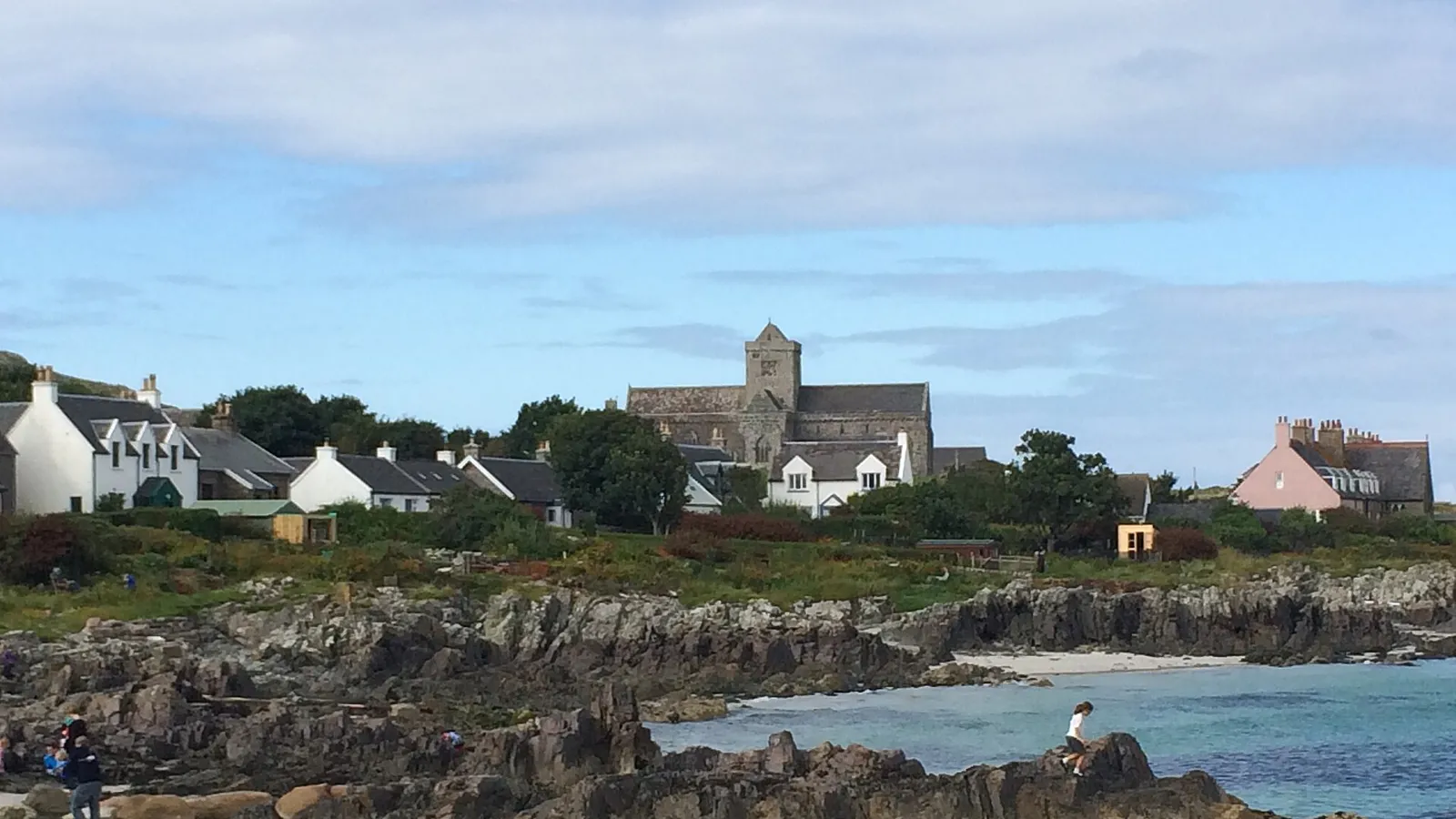
The Iona Community is sometimes assumed to be a monastic order with roots stretching continuously back to St Columba's sixth-century foundation on Iona. It is not. The modern Iona Community is a twentieth-century creation — founded in 1938 — and while it consciously draws inspiration from the island's ancient Christian heritage and rebuilt the medieval abbey buildings, it is institutionally and theologically a distinct, modern ecumenical movement rather than a lineal continuation of the early medieval monastery. (For the island's deeper history, from Columba's arrival through the medieval abbey, see this series' separate "Locations & Landmarks" card on Iona and Iona Abbey.)
TL;DR
- established The Iona Community was founded in 1938 by George MacLeod, a Church of Scotland minister, with the explicit aim of rebuilding the ruined medieval Iona Abbey using joint work parties of trainee ministers and craftsmen — this is documented in the Community's own institutional history and corroborated by independent sources.
- established The Community is ecumenical, drawing members from Presbyterian, Anglican, Roman Catholic, Lutheran, Quaker and other Christian traditions rather than belonging to a single denomination — this is a defining and consistently documented feature of its constitution.
- traditional MacLeod's founding motivation is usually described as a response to the social gap he perceived between the institutional Church and working-class, unemployed communities in Depression-era Govan, Glasgow — this is the account given consistently in biographical and institutional sources, though as with any founder narrative it reflects retrospective institutional framing.
- established The Community's Wild Goose Resource Group, founded in 1987, has produced worship material and hymns that have been translated into multiple languages and used well beyond the Community itself, including in mainstream Church of Scotland and other denominations' worship — this international reach is independently documented.
- disputed Whether the Community's consistent association with left-leaning social and political activism (peace campaigning, nuclear disarmament, social justice causes) represents a faithful outworking of Christian social teaching or a politicisation of faith is a matter on which observers across the theological and political spectrum disagree; this article presents the activism as a documented fact of the Community's practice without adjudicating that underlying debate.
Key Facts
- Category
- Detail
- Key Date(s)/Origin
- Founded 1938, Iona, Scotland
- Key Figures/Bodies
- George MacLeod (founder, later Lord MacLeod of Fuinary); Ruth Harvey (Leader from 2020)
- Key Source
- Iona Community official records (iona.org.uk); Church of Scotland historical archives; independent biographies of George MacLeod
- Status Today
- Active international dispersed community; approximately 270 Members, c. 1,800 Associate Members, and c. 1,600 Friends as of recent published figures
- Core Activities
- Rebuilt Iona Abbey (used as a residential retreat/conference centre); peace and social-justice campaigning; the Wild Goose Resource Group (worship/music)
- Relationship to Church of Scotland
- Historically and organisationally linked to the Church of Scotland (MacLeod was a Church of Scotland minister) but functions as an independent ecumenical body open to members of many denominations
A Note on Claims and Evidence
This article distinguishes documented institutional facts — the 1938 founding date, MacLeod's identity and Church of Scotland ministry, the rebuilding of the abbey, and current published membership figures — from traditional characterisations of motive and spirit, such as the standard account of MacLeod's Govan experience shaping his vision, which rests on biographical and institutional narrative rather than independently verifiable documentary proof of inner motivation. There is comparatively little legend/myth material specific to the modern Community's founding (as opposed to the much older, legend-rich history of the island and abbey itself, covered in the separate Iona and Iona Abbey card), though popular conflation of the modern Community with the ancient Columban monastery is itself a common misconception addressed in this article's opener.
Timeline
George MacLeod born, into a family with strong Church of Scotland ministerial connections.
MacLeod serves as a Church of Scotland minister in Govan, Glasgow, during the Depression, an experience formative to his later founding of the Community.
MacLeod founds the Iona Community, bringing trainee ministers and craftsmen to Iona to begin rebuilding the ruined medieval abbey buildings.
Work parties of "resident" members (ministers-in-training) and visiting craftsmen progressively rebuild the abbey's domestic ranges and other structures, funded substantially through public appeals.
Rebuilding of the main monastic buildings substantially completed, formalising Iona Abbey as a functioning retreat and conference centre once more.
George MacLeod is appointed to the House of Lords as Baron MacLeod of Fuinary, in recognition of his ministry and public standing.
The Wild Goose Resource Group is founded within the Community, producing worship music and liturgical material.
George MacLeod dies.
Ruth Harvey serves as Leader of the Iona Community.
The renovated abbey complex reopens to the public following a further multi-year restoration and closure, with a dedicated "Miracle in May" fundraising campaign securing the roughly £300,000 needed.
Details
Founding Vision: George MacLeod and Govan
The Iona Community's origins lie not on Iona itself but in Govan, the heavily industrial, working-class district of Glasgow where George MacLeod served as a Church of Scotland minister during the 1930s. The decade was one of severe economic depression and mass unemployment in Clydeside's shipbuilding and heavy-industry communities, and MacLeod — already a decorated First World War veteran who had emerged from the conflict with strong pacifist convictions — became convinced that the institutional Church, as conventionally organised, had grown distant from the daily struggles of such communities. The traditional account of the Community's founding holds that MacLeod wanted to find a way of renewing the Church's practical relevance and credibility among ordinary working people, rather than allowing it to be perceived as a middle-class institution disconnected from industrial hardship.
MacLeod's answer, formalised in 1938, was unusual and deliberately practical: he proposed bringing young men training for the Church of Scotland ministry to the island of Iona for part of their formation, where they would live and work alongside professional craftsmen to physically rebuild the ruined medieval abbey buildings — structures that had fallen into disrepair for centuries following the Reformation. The idea combined several strands at once: manual labour as spiritual and pedagogical discipline, cross-class community between ministers-in-training and working craftsmen, and the symbolic reclamation of one of Scotland's most historically resonant Christian sites. This fusion of physical reconstruction with spiritual and social purpose became the Community's founding signature and remains central to how it describes itself today.
Rebuilding Iona Abbey
The physical core of the Community's early work was the reconstruction of the abbey's ruined domestic ranges — the buildings beyond the medieval church itself, which (as the companion card on Iona and Iona Abbey details at greater length) had a history stretching back to Columba's sixth-century monastic foundation and through a substantial medieval Benedictine rebuilding. By the early twentieth century these domestic structures were largely roofless ruins. From 1938, the Community organised seasonal work parties: "resident" members (ministers-in-training undergoing part of their formation on the island) worked through the summer months alongside paid craftsmen and volunteer tradesmen, funded by public appeals and donations raised across Scotland and internationally. The main phase of reconstruction was substantially complete by around 1951, after which the rebuilt abbey functioned as a residential centre capable of hosting retreats, conferences, and the Community's own gatherings.
This work has continued intermittently in subsequent decades as maintenance and further restoration have been required of the aging structure; a major renovation programme closed the abbey for several years before it reopened to the public in June 2021, following a successful public fundraising campaign (popularly dubbed the "Miracle in May") that raised the roughly £300,000 needed to complete the project. The abbey today functions simultaneously as a historic monument, an active place of worship, and a busy retreat and conference centre run by the Community, receiving visitors and residential guests from around the world.
Ecumenism, Social Justice, and Peace Activism
From its founding, the Iona Community has defined itself as ecumenical rather than denominationally exclusive — a significant and, for 1930s Scotland, unusual choice, given that Scottish church life at the time remained heavily shaped by Presbyterian institutional boundaries and historical denominational rivalries (several of which, including the long aftermath of the 1843 Disruption, are explored elsewhere in this series). Membership today draws explicitly from Presbyterian, Anglican, Roman Catholic, Methodist, Quaker, and other Christian traditions, organised through several tiers of commitment: full "Members" who accept a formal rule of life and mutual accountability, "Associate Members," and "Friends," together numbering several thousand people dispersed across many countries rather than resident as a single physical community.
A commitment to social justice and peace activism has been central to the Community's identity since MacLeod's own pacifism and his concern for Depression-era Govan. In practical terms this has translated into organised campaigning on issues including nuclear disarmament, poverty, migration, racial justice, and — in more recent decades — environmental and interfaith concerns, often conducted through dedicated internal working groups or "cluster groups." The Community has, at various points, taken positions on contested political questions (nuclear weapons policy being a notable historical example, given Scotland's role in hosting the UK's nuclear submarine fleet) that have made it a recognisably left-of-centre voice within Scottish Christianity. Observers both sympathetic and critical have debated whether this activist orientation represents a faithful, theologically grounded outworking of Christian social teaching, consistent with strands of the broader ecumenical and liberation-theology movements active across twentieth-century Christianity, or an excessive politicisation of a religious institution; this article does not adjudicate that question but notes it as a live and genuine point of difference among Christians, both within and beyond the Community itself.
Worship, Music, and Wider Influence
Perhaps the Iona Community's most pervasive influence on contemporary Scottish and wider Christian practice has come not through its institutional activism but through its distinctive approach to worship and music. The Wild Goose Resource Group, founded within the Community in 1987 (the "wild goose" being an ancient Celtic Christian symbol for the Holy Spirit), has produced an extensive body of hymns, songs, and liturgical resources characterised by accessible, often folk-influenced musical settings and theologically engaged, socially conscious lyrics. This material has circulated far beyond the Community's own membership, finding use in mainstream Church of Scotland congregations, other Presbyterian and Anglican churches, and Christian communities internationally; it has been translated into numerous languages, including Swedish, Norwegian, Finnish, Japanese, Dutch, West Frisian, Danish, and German, according to the Community's own published record of its international reach. This combination of a contemplative yet socially and politically engaged spirituality, delivered through widely adopted worship material, represents the Community's most durable and broadly felt legacy — arguably exceeding, in terms of everyday Christian practice touched, even its better-known activist and architectural achievements.
The Community Today
Today the Iona Community continues as a dispersed, international ecumenical body, led since 2020 by Ruth Harvey. Its published figures describe a membership structure of roughly 270 full Members, around 1,800 Associate Members, and some 1,600 Friends, reflecting continued, if numerically modest by mass-denominational standards, ongoing commitment. The rebuilt abbey remains its most visible physical legacy and a significant site of Scottish religious tourism and pilgrimage, run as a working retreat centre rather than a museum. The Community's place within the wider story of twentieth-century Scottish Christianity is distinctive: rather than representing institutional continuity with any single established denomination, it stands as a deliberately boundary-crossing experiment in combining physical labour, ecumenical community, radical social engagement, and innovative worship — one that has shaped the wider Scottish and international Christian landscape disproportionately to its modest formal membership numbers.
Did You Know?
- George MacLeod was a decorated First World War combatant who emerged from that experience a committed pacifist, a biographical detail often cited as foundational to the Community's later peace activism.
- The rebuilding of Iona Abbey in the twentieth century was funded substantially through public donations rather than denominational or state funding, reflecting the Community's grassroots fundraising ethos from its earliest years.
- MacLeod was later elevated to the House of Lords as Baron MacLeod of Fuinary, an unusual honour for a minister known chiefly for a radical, ecumenical, labour-based religious community.
- The "Wild Goose" name used by the Community's influential worship and music group refers to an ancient Celtic Christian symbol for the Holy Spirit, deliberately invoking the island's much older Christian heritage even though the Community itself is a twentieth-century creation.
- Iona Community worship material has been translated into languages as varied as Japanese, West Frisian, and Finnish, giving a small Scottish religious community an outsized international footprint in contemporary Christian worship.
- The main phase of abbey reconstruction, begun in 1938, was substantially complete by around 1951 — meaning it took roughly thirteen years of seasonal work parties to restore the buildings to functional use.
- A 2018–2021 renovation of the abbey required a dedicated public appeal (the "Miracle in May") to raise approximately £300,000 before the site could reopen.
- Although closely associated historically with the Church of Scotland through its founder, the Iona Community is constitutionally open to, and includes, Roman Catholic, Anglican, Quaker, and other Christian members, making it one of Scotland's most consistently ecumenical religious institutions.
FAQ
1Who founded the Iona Community and when?
George MacLeod, a Church of Scotland minister, founded it in 1938.
2Is the Iona Community the same as the ancient monastery founded by St Columba?
No. The ancient Columban monastery dates to the sixth century; the modern Iona Community is a distinct twentieth-century ecumenical organisation, though it occupies and rebuilt the site's medieval abbey buildings and draws symbolic inspiration from that older heritage.
3What denomination is the Iona Community part of?
None exclusively — it is deliberately ecumenical, with members from Presbyterian, Anglican, Roman Catholic, Quaker, Lutheran, and other Christian traditions.
4Why did MacLeod choose to rebuild the abbey using ministers-in-training and craftsmen together?
The traditional account holds that he wanted to combine practical manual labour, cross-class community, and spiritual formation, addressing what he saw as the Church's growing distance from working-class life.
5How large is the Iona Community today?
Recently published figures describe around 270 full Members, roughly 1,800 Associate Members, and about 1,600 Friends, dispersed internationally rather than resident in one place.
6What is the Wild Goose Resource Group?
A worship and music group founded within the Community in 1987 that has produced hymns and liturgical material now used well beyond the Community itself, translated into many languages.
7Is Iona Abbey still a functioning place of worship?
Yes — the rebuilt abbey operates as an active site of worship as well as a retreat and conference centre run by the Community.
8What kinds of social and political causes has the Iona Community been involved in?
Historically and currently, causes including nuclear disarmament, poverty, migration, racial justice, environmental issues, and interfaith relations, organised through internal working groups.
9Is the Community's activism controversial?
Its consistently left-leaning social and political engagement has drawn both support and criticism from different quarters within Scottish Christianity and beyond; this is a genuine area of ongoing debate rather than a settled consensus.
10Who leads the Iona Community now?
Ruth Harvey has served as Leader since 2020.
11Can anyone visit Iona Abbey?
Yes — it is open to visitors and pilgrims and operates residential retreat and conference programmes; the 2021 reopening followed a multi-year renovation closure.
12How does the Iona Community relate to the Church of Scotland institutionally?
It has strong historical and personal ties through its founder and many members, and often operates in close relationship with the Kirk, but functions as an independent ecumenical body rather than a formal department of the Church of Scotland.
Sources and Further Reading
Primary/Institutional:
- The Iona Community, official website and "About" pages, iona.org.uk
- Church of Scotland historical and biographical records relating to George MacLeod
Scholarly/Critical:
- University of St Andrews academic journal articles on the Iona Community's theology and history (ojs.st-andrews.ac.uk)
- Encyclopaedia Britannica, "Iona Community" entry
General:
- Wikipedia, "Iona Community" and "George MacLeod"
- GIA Music and other publisher biographical notes on the Iona Community's musical and liturgical output
Caveats: Myths and Disputed Claims
- Myth: the Iona Community continues the sixth-century Columban monastery. It is a modern organisation, founded in 1938, that occupies and rebuilt the historic site.
- Tradition: MacLeod's inner motivations for founding the Community. The account is traditional and institutionally framed rather than strictly documented.
- Disputed: the Community's social and political activism. Whether it is straightforwardly correct Christian practice or an illegitimate departure from faith is genuinely contested among Christians.
- Myth: membership figures equal visitor numbers. Members, associates and friends are a different population from general visitors and pilgrims to Iona Abbey.
- Myth: the "Miracle in May" £300,000 figure is the cost of the abbey rebuilding. It relates specifically to the 2018–2021 renovation, not the original 1938–1951 rebuilding campaign; no single agreed cost or timeline covers every phase.
Finished reading? Try the Fact Machine: three reels, one surprising Scottish connection →
Card 022 · Faith