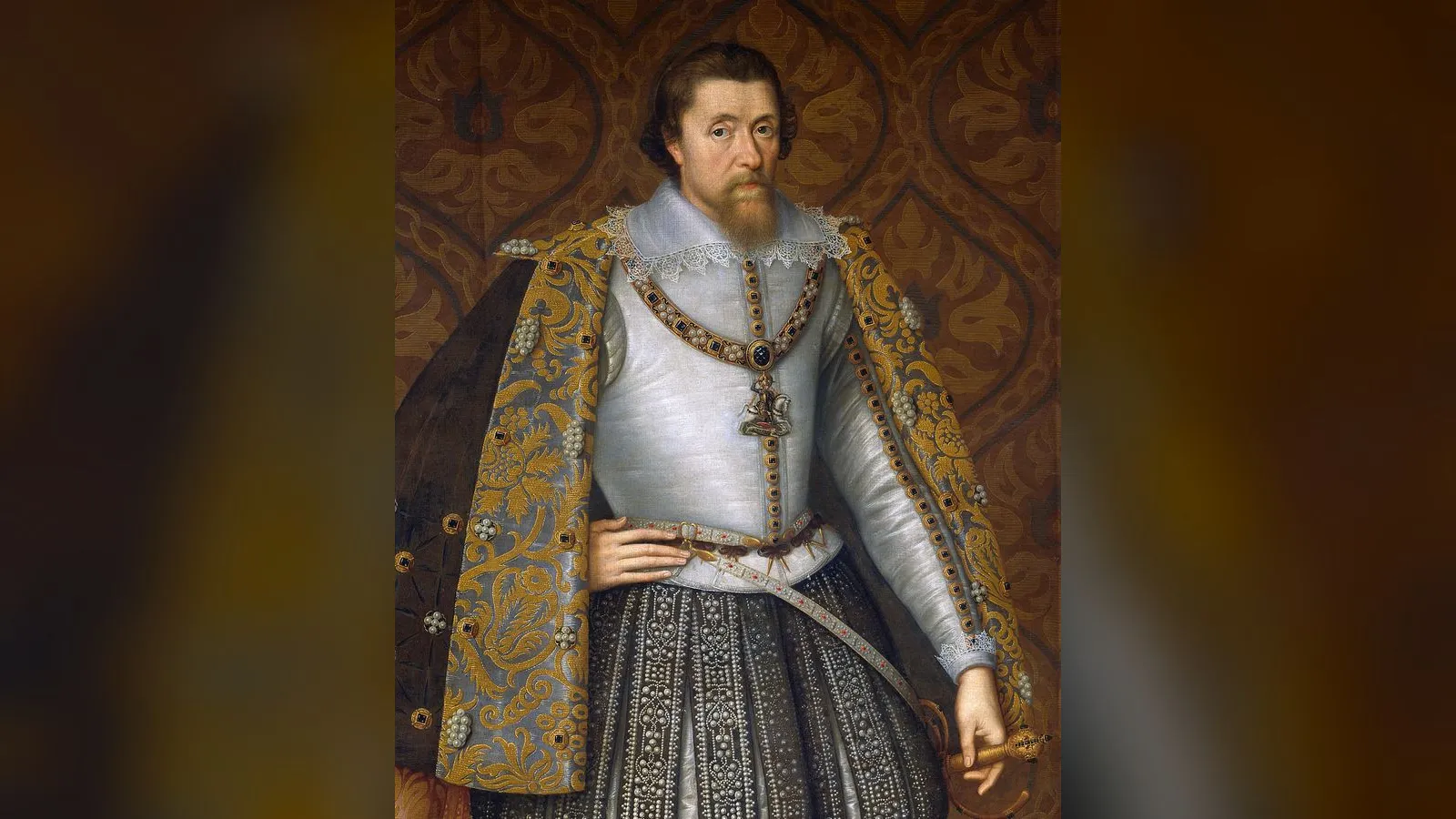

James VI and I
Contents
James VI became King of Scots at 13 months old and, in 1603, King of England as well, uniting the two crowns under one monarch for the first time. He was a published author on kingship, witchcraft and tobacco, gave his name to the King James Bible, and survived the Gunpowder Plot. He ruled Scotland shrewdly but struggled in England. This card tests his achievements against the myths and hostile caricatures that grew up around him.
TL;DR
- established James was born at Edinburgh Castle on 19 June 1566, the son of Mary, Queen of Scots and Lord Darnley. He became king on his mother's forced abdication on 24 July 1567, and four regents ruled during his childhood.
- established He was educated by the humanist George Buchanan and later wrote Daemonologie (1597), The True Law of Free Monarchies (1598) and Basilikon Doron (1599).
- established On the death of Elizabeth I on 24 March 1603 he became King of England. This was a union of crowns only; the two kingdoms kept separate parliaments, laws and churches until 1707.
- established He commissioned the King James Bible at the Hampton Court Conference in 1604; it was published in 1611. He died on 27 March 1625.
- established He was baptised by Catholic rites at Stirling Castle on 17 December 1566, with Elizabeth I as godmother by proxy. His father, though at Stirling, stayed away. He last saw his mother at Stirling on 23 April 1567, when he was ten months old.
- established In 1612 he had his mother's body moved from Peterborough Cathedral to a new tomb in Henry VII's Chapel at Westminster Abbey, larger and costlier than the one he built for Elizabeth I.
- shared The Gowrie Conspiracy of 1600, the nature of his relationships with his male favourites, and the famous description of him as "the wisest fool in Christendom" are all disputed.
Key Facts
- Born
- 19 June 1566, between 10 and 11 a.m., Edinburgh Castle
- Parents
- Mary, Queen of Scots, and Henry Stuart, Lord Darnley
- Baptised
- 17 December 1566, Chapel Royal, Stirling Castle (Catholic rites)
- Became King of Scots
- 24 July 1567, aged 13 months
- Crowned
- 29 July 1567, parish church of the Holy Rude, Stirling
- Regents
- Moray, Lennox, Mar, Morton
- Tutor
- George Buchanan
- Married
- Anne of Denmark, 1589
- Writings
- Daemonologie (1597); The True Law of Free Monarchies (1598); Basilikon Doron (1599); A Counterblaste to Tobacco (1604)
- Gowrie Conspiracy
- 5 August 1600
- King of England
- 24 March 1603; crowned 25 July 1603
- Gunpowder Plot
- 5 November 1605
- King James Bible
- Commissioned 1604; published 1611
- Plantation of Ulster
- From 1610
- Died
- 27 March 1625; buried in Westminster Abbey
Scottish Impact Index (SI Score)
- Global Influence
- 8/10
- Enduring Relevance
- 10/10
- Material Contribution
- 4/10
- Exceptional Achievement
- 6/10
- Lasting Legacy
- 7/10
- Recognition
- 7/10
42/60
Ranked =33rd of 200 in Great Scots
A Note on Claims and Evidence
Each major claim carries one of three labels. established means supported by primary records, official bodies or several independent reliable sources. shared means the core fact is sound but sources disagree on details, dates or interpretation. traditional means widely repeated but not traceable to a primary or independent source.
James's reign is richly documented in state papers, parliamentary records and his own writings. But his reputation was shaped by hostile memoirs written after his death, especially The Court and Character of King James (1650), associated with Sir Anthony Weldon. Some famous claims about him, including his "wisest fool" nickname and the lurid details of his private life, come from such sources.
For his birth, baptism and dealings with his mother, this card draws on the historian John Guy's biography of Mary, "My Heart is My Own" (2004), which works from the English and Scottish state papers. Guy's facts and dates are treated as Established. His readings of motive, such as his view that William Cecil was Mary's chief antagonist, are his own argument and are marked as such. Other historians, notably Jenny Wormald, judge Mary and her circle differently.
Timeline
James is born at Edinburgh Castle.
Fearing a kidnap, Mary moves him to Stirling Castle under the Earl and Countess of Mar.
He is baptised at Stirling by Catholic rites.
His father, Lord Darnley, is murdered at Kirk o' Field.
Mary visits him at Stirling for the last time.
Mary is forced to abdicate at Lochleven; James becomes king at 13 months old.
He is crowned in the parish church at Stirling; John Knox preaches.
The regents Moray (proclaimed 22 August 1567), Lennox, Mar and Morton govern; three die violently.
George Buchanan becomes the king's tutor.
The Ruthven Raid; James is held captive for nearly a year.
James begins his personal rule.
James tells his mother he will honour her only as "Queen Mother", ruling out any joint sovereignty.
The Treaty of Berwick allies James with Elizabeth I.
Mary, Queen of Scots, is executed at Fotheringhay Castle in England.
James leads about 3,000 men north against the Earl of Huntly.
James marries Anne of Denmark and sails to Scandinavia to bring her home.
The king's advance force under Argyll is beaten by Huntly and Erroll at Glenlivet; James keeps his army at Aberdeen until February 1595 and the earls flee abroad.
James takes part in the North Berwick witch trials.
Daemonologie is published.
The True Law of Free Monarchies and Basilikon Doron are published.
The Gowrie Conspiracy at Perth.
Elizabeth I dies; James becomes King of England.
The Hampton Court Conference agrees a new translation of the Bible.
The Gunpowder Plot is foiled.
James grants the First Charter of Virginia.
The Plantation of Ulster begins.
The King James Bible is published.
Mary's body is moved from Peterborough to Westminster Abbey.
James exposes a fraudulent witchcraft accuser at Leicester.
James dies.
Details
1. Birth and Origins: A Childhood in the "Bloody Nest"
James Charles Stuart was born on 19 June 1566 in a small chamber of Edinburgh Castle, into one of the most violent and unstable courts in Europe. His mother was Mary, Queen of Scots, the Catholic queen of a kingdom convulsed by the Protestant Reformation; his father was Henry Stuart, Lord Darnley, an ambitious and unstable young Englishman. Just three months before James's birth, Darnley had taken part in the murder of Mary's secretary, David Riccio (Rizzio), in the pregnant queen's presence — and a persistent (almost certainly unfounded) rumour even held that Riccio, not Darnley, was James's real father.
The birth. The historian John Guy, in his biography of Mary (2004), gives the details from the English ambassador's reports. Mary entered her confinement chamber at Edinburgh Castle on 3 June 1566, still afraid after Riccio's murder, and had the Earl of Argyll sleep in the room outside. On 9 June she summoned her lords to hear her will, in case she died. James was born between ten and eleven in the morning of Wednesday 19 June after a long labour. The castle guns fired a salute and, by one report, some five hundred bonfires were lit in and around Edinburgh. Two days later the English ambassador, Henry Killigrew, watched the baby at the breast of his wet nurse, Margaret Little, and judged him "a very goodly child".
The baptism. In late August 1566 Mary heard rumours that James would be kidnapped, and she moved him under an escort of five hundred musketeers to Stirling Castle, into the care of the Earl and Countess of Mar. He was baptised there by Catholic rites on 17 December 1566, aged almost six months, at the centre of a three-day festival of masques and fireworks partly scripted by George Buchanan. Guy reports that Mary borrowed £12,000 from Edinburgh merchants to pay for it. Elizabeth I was godmother, with the Countess of Argyll as her proxy, and sent a font of solid gold weighing 333 ounces. The Protestant lords, including Moray and Bothwell, waited outside the chapel door. Darnley, though in the castle, refused to appear.
The bloodshed continued. On 10 February 1567, Darnley's lodging at Kirk o' Field was destroyed by a gunpowder explosion and his strangled body was found in the garden. Mary's swift and disastrous marriage to the Earl of Bothwell, widely suspected of the murder, turned the Protestant lords against her. Mary last saw her son on 23 April 1567, when she visited Stirling and Mar refused to hand him over; the next day Bothwell intercepted her on the road to Edinburgh and took her to Dunbar. In June 1567 she was imprisoned at Lochleven Castle and, on 24 July 1567, forced to abdicate in favour of her thirteen-month-old son. She never saw James again. He was crowned James VI in a Protestant ceremony in the parish church of the Holy Rude at Stirling on 29 July 1567. The Earl of Morton swore the coronation oath on his behalf, and the sermon was preached by John Knox. Guy calls it the worst-attended coronation in Scottish history.
James's childhood was, in his biographer Alan Stewart's phrase, that of a "cradle king" — a monarch who never knew his parents and grew up a virtual prisoner in Stirling Castle, caught between warring factions. As Stewart puts it, "by the age of five, he had experienced three different regents." Four regents in all governed during his minority, and their fates illustrate just how dangerous Scottish politics were:
- James Stewart, Earl of Moray (Mary's half-brother), assassinated by gunshot at Linlithgow in January 1570.
- Matthew Stewart, Earl of Lennox (James's own paternal grandfather), shot or stabbed during a surprise raid on Stirling by Mary's supporters in September 1571; he died in the castle a few hours later. His reported last words, "If the bairn's well, all's well", referred to his grandson.
- John Erskine, Earl of Mar, who died in 1572, possibly of natural causes (poison was rumoured).
- James Douglas, Earl of Morton, the most ruthless and most effective, who crushed Mary's remaining supporters but was eventually overthrown and executed in 1581 on a charge of complicity in Darnley's murder.
The violence left lasting psychological marks: contemporaries noted James's nervousness, and the murders, raids and conspiracies of his youth shaped a king who never felt entirely safe.
2. Education: The Making of a Scholar-King
From around 1570, the young king was placed under the tutelage of George Buchanan, the most distinguished Scottish humanist of his age — a neo-Latin poet, dramatist and political theorist of European reputation — assisted by the gentler Peter Young. The education Buchanan delivered was extraordinarily intensive: James was drilled in Latin (which he reportedly knew before he could properly speak Scots), Greek, French, theology, history, rhetoric and composition. As an adult king, James paid tribute: "All the world knows that my master, George Buchanan, was a great master in Latin learning." The result was the best-educated monarch either kingdom ever had.
But the relationship was fraught. Buchanan was a harsh master who beat his royal pupil and tried to instil in him a contempt for his mother, Mary, whom Buchanan had publicly denounced in his Detectio Mariae Reginae (1571). More importantly, Buchanan held radical political views. In De Jure Regni apud Scotos (1579), he argued that kings derive their authority from the people, are bound by law, can be held to account, and — in extreme cases — may justly be deposed or even killed: a defence of tyrannicide and limited, contractual monarchy.
James absorbed Buchanan's learning but utterly rejected his politics. The mature king's own writings are, in large part, a lifelong rebuttal of his tutor: where Buchanan saw a contract between king and people, James saw kings as "little gods" answerable to God alone. The irony is profound — the most eloquent defender of absolute monarchy in the English-speaking world was schooled by one of its most eloquent critics.
James and his mother
A mother he could not remember. James grew up at Stirling in the household of the Earl and Countess of Mar and never saw Mary after April 1567. John Guy notes that Buchanan taught the boy that his mother had been a tyrant, an adulteress and the murderer of his father. Guy also records an episode from about 1577, when James, aged ten and a half, read a copy of the supposed deathbed "confession" of Bothwell, which cleared Mary, and called it a proof of her innocence. Guy regards that confession as a forgery, so the story shows what the boy wanted to believe rather than what was true.
Rejection, 1585–86. established As an adult James put his English prospects first. In March 1585 he told his captive mother that he would honour her with the title of "Queen Mother" but would not share his crown or allow her return. Mary replied in fury that there was "neither king nor queen in Scotland except me" (as quoted by Guy), and threatened to disinherit him. In July 1586 James made a separate treaty with Elizabeth at Berwick. shared Guy argues that by signing it James, "perhaps without ever fully realizing it", made his mother expendable and her execution more likely. Historians who stress Elizabeth's and Walsingham's part in the Babington plot weigh James's role less heavily. In her last letters before her execution on 8 February 1587, Mary called him her "unfortunate and deluded son" and commended him to Henry III of France only "inasmuch as he deserves it".
Atonement in stone. established Mary's embalmed body lay at Fotheringhay for about six months before a night-time burial in Peterborough Cathedral. Soon after reaching London, James commissioned two marble tombs with effigies in Henry VII's Chapel at Westminster Abbey: Elizabeth's in the north aisle and his mother's in the south. Guy gives the costs as £2,000 for Mary's tomb against £765 for Elizabeth's. In October 1612 Mary's body was exhumed and carried in procession to Westminster. James also encouraged William Camden, whose Annals praised Mary and attacked Buchanan's account of her. shared Guy reads all this as deliberate dynastic image-making that placed the Stuarts at the centre of British history; that James also felt personal remorse is plausible but not documented.
3. James as King of Scotland (1583–1603): Mastering a Turbulent Kingdom
James's personal rule is conventionally dated from 1583, when, aged seventeen, he escaped the control of the Ruthven lords (who had seized him in the "Ruthven Raid" of August 1582 and held him for nearly a year). The young king proved a far shrewder and more capable ruler of Scotland than the later caricature of the bumbling pedant suggests. Historian Jenny Wormald, the leading modern authority, argued forcefully that James was "not 'the wisest fool in Christendom'... but an intelligent and shrewd political player" who possessed "a largely charming and jovial personality" — and that he was arguably the most effective ruler Scotland ever had.
The Kirk. James's most persistent domestic struggle was with the Presbyterian Kirk and its uncompromising champion Andrew Melville, who in a famous confrontation told James to his face that he was "God's silly vassal" and that, in the kingdom of Christ, the king was "not a king, nor a lord, nor a head, but a member." James, who held that royal authority came directly from God, found this intolerable. His response was the Black Acts of 1584, which asserted royal supremacy over the Church, condemned the presbyteries and restored the authority of bishops. His enduring maxim was "No bishop, no king" — he understood that an episcopal church, with bishops appointed by and answerable to the crown, was a pillar of royal power, whereas a self-governing Presbyterian Kirk was a standing challenge to it. He achieved only partial success in Scotland (he appointed no new bishops between 1585 and 1600), but never abandoned the principle.
Marriage and the voyage to Denmark. In 1589 James married Anne of Denmark by proxy. Born on 12 December 1574 at Skanderborg Castle, Anne was the fourteen-year-old daughter of the Protestant Danish king Frederick II; the proxy marriage took place on 20 August 1589 at Kronborg Castle. When storms repeatedly drove Anne's fleet back to Norway, James did something genuinely romantic and out of character for his usual caution: he sailed personally across the autumn North Sea in October 1589 to fetch his bride, married her in person in Oslo on 23 November 1589, and spent several months at the Danish court — the first Scottish king to leave his kingdom in over a century. The Danish court was steeped in continental demonology, and this visit decisively kindled James's interest in witchcraft (see Section 7).
His writings. During the 1590s James set out his political and intellectual stall in print: Daemonologie (1597), The True Law of Free Monarchies (1598) and Basilikon Doron (1599). In The True Law he laid out the divine right of kings, warning that "the highest bench is the sliddriest to sit upon"; in Basilikon Doron, advice to his young son Henry and perhaps the best example of his prose, he gave practical guidance on kingship — including the ominous instruction to "hold no Parliaments" except when necessary, which foreshadowed his later clashes with the English Commons.
Managing the nobility. Through patience, patronage and political cunning, James gradually brought Scotland's fractious nobility to heel; by 1598 the nobility had largely accepted royal justice in their disputes.
A king who took the field. established The bookish image hides a king who led his own armies. The historians Steve Murdoch and Alexia Grosjean, in Alexander Leslie and the Scottish Generals of the Thirty Years' War (2014), note that James commanded in person on six occasions between 1587 and 1594 rather than send a deputy. In the Armada years he marched on Dumfries against the Catholic Lord Maxwell, whose castles, Lochmaben among them, fell to the royal forces, Lochmaben after an artillery bombardment. In April 1589 he led about 3,000 men north against the Earl of Huntly, whose own force shrank from a similar size to about 500 as the king approached, and destroyed Gordon houses at Slains and Strathbogie. In 1594, after an advance force under Argyll was beaten at Glenlivet on 3 October, he kept his army at Aberdeen until February 1595 and drove Huntly and Erroll abroad. Scotland had no standing army, but James repeatedly ordered wapinschaws (musters at which men showed their weapons), and from 1580 there was talk of a permanent King's Guard; in 1588 the English promised to pay for fifty "Gentlemen of Scotland" to protect him. shared Murdoch and Grosjean read this as evidence of a kingdom that could still raise armies quickly, against historians who saw Scottish military power in decline.
The Gowrie Conspiracy (1600). On 5 August 1600, while hunting near Falkland, James was lured to Gowrie House in Perth by Alexander Ruthven, brother of John Ruthven, 3rd Earl of Gowrie, on the pretext of investigating a mysterious stranger found with a pot of foreign gold. What happened next is one of Scottish history's enduring mysteries. According to James, Alexander led him to a turret, locked the door and threatened him; James cried "Treason!" from a window, and his attendants — notably the page John Ramsay — rushed in and killed both Ruthven brothers. The Ruthvens, conveniently, were owed a great deal of money by the crown and had a long history of conspiracy against it (their father had led the Ruthven Raid). Whether this was a genuine plot to kidnap or kill the king, or whether James engineered the deaths of the troublesome, creditor Ruthvens, has never been resolved. An inquiry involving hundreds of witnesses failed to settle the matter, and James's own contemporaries received his version with widespread scepticism. The aftermath was harsh: the very name Ruthven was proscribed. Murdoch and Grosjean point out that one innocent kinsman, Patrick Ruthven, sought service abroad partly so that he could keep his name; he rose to lieutenant general in the Swedish army and became Charles I's Lord General in the English Civil War.
4. The Union of the Crowns (1603): A Scottish King in London
Elizabeth I of England died at Richmond Palace on 24 March 1603, the last of the Tudors, childless. The closest legitimate heir was James, through a careful chain of descent: Henry VII's daughter Margaret Tudor had married James IV of Scotland in 1503; their line led directly to James VI, making him Henry VII's great-great-grandson. In the last years of Elizabeth's reign, her chief minister Sir Robert Cecil conducted a secret correspondence with James to ensure a smooth succession, advising him to be patient and respectful rather than press his claim. The transition was indeed seamless: James was proclaimed king in London within hours of Elizabeth's death.
James journeyed south in April 1603 to a rapturous reception from English crowds relieved that the succession crisis had passed without bloodshed. He was crowned at Westminster Abbey on 25 July 1603.
Crucially, the Union of the Crowns was a personal union only. James styled himself "King of Great Britain" from 1604 and commissioned a new Union flag in 1606, and he dreamed of a "perfect union," but England and Scotland remained entirely separate states — separate parliaments, separate legal systems, separate churches — joined only in the person of the monarch. That fuller political union would not come until the Acts of Union of 1707, more than eighty years after James's death. James left Scotland promising to return every three years; in fact he returned only once, in 1617, governing his ancient kingdom by pen from London — famously boasting that he ruled Scotland "with my pen... which others could not do with the sword."
5. James as King of England (1603–1625): The Jacobean Reign
James's English reign was far less successful than his Scottish one. He arrived with high expectations from all sides and managed to disappoint most of them.
The Millenary Petition and Hampton Court (1604). Soon after his accession, Puritan clergy presented the Millenary Petition (so called for its supposed thousand signatures) seeking reform of the Church of England. James convened the Hampton Court Conference in January 1604 to hear the disputes. He rebuffed most Puritan demands — warning that if they did not conform he would "harry them out of the land" — but the conference produced one monumental outcome: his agreement to a new translation of the Bible (see Section 6).
The Gunpowder Plot (1605). On the night of 4–5 November 1605, a group of Catholic conspirators led by Robert Catesby — not, as popular memory has it, Guy Fawkes — planned to blow up the House of Lords at the State Opening of Parliament, killing James, his family and the political establishment, and to install his young daughter Elizabeth as a Catholic puppet queen. The plot was foiled after an anonymous letter warned the Catholic Lord Monteagle to stay away; Fawkes, an explosives expert with military experience in the Spanish Netherlands, was caught guarding 36 barrels of gunpowder — amounting, per Britannica, to "about 1.5 tons (some 1,400 kg)" — in a cellar beneath the Lords. Under torture he revealed his co-conspirators; the survivors were executed. The key myth: Guy Fawkes was the hired hand and "fall guy," not the mastermind — yet it is his effigy that burns on Bonfire Night.
Parliament, money and prerogative. The defining failure of James's English reign was his relationship with Parliament. The crown's fixed revenues had not kept pace with inflation, while the costs of government rose; James, generous to a fault (especially towards his favourites), was chronically short of money and repeatedly clashed with a Commons increasingly assertive about its privileges, freedom of speech and control of taxation. James lectured Parliament on the divine right of kings; Parliament resisted. These unresolved struggles over money, religion and the limits of royal prerogative were precisely the fault lines that would erupt into civil war under his son.
The favourites. James's reign was dominated by a succession of handsome male favourites, most famously Robert Carr (created Earl of Somerset), who fell from grace after being implicated in the scandalous murder of Sir Thomas Overbury, and George Villiers (rising to Duke of Buckingham), who became the most powerful man in the kingdom and remained close to James until the king's death. The nature of these relationships is one of the most debated questions in the field (see Caveats). What is documented is the extraordinary emotional intensity: James addressed Villiers as his "wife" and "child," wrote of wanting a "new marriage" with him, and once told his Privy Council, "Christ had his John, and I have my George."
The Plantation of Ulster (1610). Following the Flight of the Earls in 1607, the lands of the rebellious Gaelic Ulster lords were forfeited to the crown. James seized the opportunity for an organised, state-sponsored colonisation, "planting" English and especially Scottish Protestant settlers across six of Ulster's nine counties. It was conceived as a joint "British" venture to pacify and "civilise" what had been Ireland's most rebellious province, and to reward James's Scottish subjects with land. The Plantation created a solid block of Protestant settlement in the north of Ireland that has endured to the present day — and with it the sectarian divisions whose consequences are still being felt.
The American colonies. James's role in the New World was as the granter of royal charters and legitimacy rather than as an active organiser. He granted the First Charter of Virginia on 10 April 1606; the settlement founded in 1607 — Jamestown — and the James River were both named in his honour, making it the first permanent English settlement in North America. He reorganised the Virginia Company's charters in 1609 and 1612, and in 1624, after years of mismanagement and the 1622 Powhatan attack, dissolved the company and made Virginia a royal colony. The Pilgrims of the Mayflower (1620) sailed under a Virginia Company patent, and their Mayflower Compact pledged loyalty to "our dread Sovereign Lord King James." In 1621 James granted a charter to the Scottish courtier-poet Sir William Alexander for "Nova Scotia" ("New Scotland") — the first recorded use of that name — though no colony was actually planted there in James's lifetime.
Foreign policy and the Spanish Match. James prided himself on being a peacemaker (Rex Pacificus), ending the long Anglo-Spanish war in 1604. The centrepiece — and ultimately the embarrassment — of his foreign policy was the proposed "Spanish Match": a marriage between his son Charles and the Spanish Infanta Maria Anna, negotiated from 1614. Deeply unpopular with Protestant opinion, it collapsed spectacularly in 1623 when Charles and Buckingham travelled incognito to Madrid (as "Thomas and John Smith") to win the Infanta directly, only to be humiliated by Spanish religious demands. They returned empty-handed — to national rejoicing — and then pushed the ageing, reluctant James towards war with Spain.
5a. Harpers at James's Courts
established The last Scottish court harpers. Keith Sanger and Alison Kinnaird, in Tree of Strings (1992), their history of the harp in Scotland, traced harpers through the royal accounts of James's minority. Under the regent Morton two harpers played regularly at court, John Baxter and Robert Galbraith, "his grace minstrellis". Galbraith was a "clairschear", a player of the wire-strung Gaelic harp, and possibly of the Galbraith family of hereditary harpers who had served James IV. In February 1574 the accounts list his winter clothing in detail: broad English cloth for a cloak, grey English worsted for coat and breeches, black silk braid, canvas for a doublet, linen for stiffening, and a hat. Between 1576 and 1578 each harper received £5 for clothes.
Irish harpers in London. After 1603 the court moved south and the Scottish harp tradition at court ended. In London, though, the wire-strung Irish harp was in fashion. Elizabeth had appointed the Irish harper Cormac MacDermott to the royal music in her last months, and he served James until his own death in 1618; Anne of Denmark kept an Irish harper of her own from 1607 to 1619. The inventory of the disgraced favourite Robert Kerr, Earl of Somerset, taken in 1615, lists "two Irish harps" and a theorbo. Sanger and Kinnaird noted that "Irish" could still mean Highland Scottish in this period, so Kerr's harps may have been clàrsachs.
traditional Ruairi Dall Ó Catháin. An Irish story, set down by the harper Arthur O'Neill in the 18th century, says that the blind harper Ruairi Dall Ó Catháin played before James, who laid a hand on his shoulder in approval; the harper retorted that a greater man, O'Neill, had done the same. Sanger and Kinnaird treated the details as embroidery but suggested a real meeting was possible, perhaps during James's only return visit to Scotland in 1617. The tune "Da mihi manum", attached to the story, first appears in the Wemyss manuscript of 1644.
6. The King James Bible: A Monument in English
Of all James's achievements, the one with the most enduring global reach is the Bible that bears his name. The project was born almost by accident at the Hampton Court Conference of January 1604, when the Puritan scholar John Reynolds proposed a new translation. James — who detested the marginal notes of the popular Geneva Bible, which he regarded as seditious and "anti-monarchical" (one note appeared to justify disobeying kings) — seized on the idea and made it his own.
The scale of the enterprise was unprecedented. James approved a list of 54 scholars (extant records name 47 who actually participated), the foremost biblical, Hebrew and Greek scholars in the land. They were organised into six companies — two each at Westminster, Oxford and Cambridge — with each company assigned a section of the text. The work was governed by a set of rules established under Archbishop Richard Bancroft as overseer: the Bishops' Bible was to be the base text, altered as little as truth allowed; old ecclesiastical words were retained; and crucially, there were to be no marginal notes except brief explanations of the Hebrew or Greek. Each company's work was reviewed by the others and finally by a committee of twelve. The new Bible was published in 1611 by the King's Printer, Robert Barker.
The translation drew heavily on its predecessors — a great deal of the New Testament preserves the wording of William Tyndale, the pioneering translator martyred in 1536. But the committees' deliberate choices — favouring short, plain, Anglo-Saxon words, and consciously imitating the rhythms of the original Hebrew and Greek — produced prose of extraordinary power and memorability. "And God said, Let there be light: and there was light" carries the weight of creation in ten one-syllable words.
The literary and cultural legacy is immense. The King James Version became the dominant English Bible for over three centuries, crossing the Atlantic with English settlers and embedding itself in the consciousness and everyday speech of the entire English-speaking world. Alongside Shakespeare, it shaped the English language more than any other single source, giving it hundreds of phrases still in daily use. It is a striking irony that an "Authorized Version" should have no surviving record of formal royal authorisation — but its triumph was complete regardless.
7. Witchcraft and Daemonologie: From Witch-Hunter to Sceptic
James's interest in witchcraft was genuine, documented and personal — and it evolved dramatically over his lifetime. Its origins lay in his 1589–90 voyage to Denmark. When storms battered the fleets carrying him and Anne, the Danish authorities blamed witchcraft, holding witch trials at Copenhagen in 1590. Back in Scotland, James set up his own tribunal, and the result was the North Berwick witch trials of 1590–91. The scale was substantial: the University of Edinburgh's Survey of Scottish Witchcraft notes that "more than 100 suspected witches in North Berwick were arrested," and according to the contemporary pamphlet Newes from Scotland (1591), the accused "wise woman" Agnes Sampson confessed to attending a sabbat with 200 witches. James attended in person and personally interrogated suspects, including Sampson, who — per Newes from Scotland — won the king's belief by whispering to him the private words he had exchanged with Anne on their wedding night.
In 1597 James published Daemonologie, a treatise in dialogue form arguing for the reality of witchcraft and the necessity of detecting and punishing witches. It drew on the North Berwick events and the Aberdeen witch-hunt of 1597 and became an influential text across Europe. Scotland's witch panic was severe and long-lasting: according to the University of Edinburgh's Survey of Scottish Witchcraft (Goodare and Yeoman), 3,837 people were accused of witchcraft in Scotland between 1563 and 1736, of whom around 2,500 — roughly two-thirds — were executed, the great majority of them women.
The link to Macbeth. When Shakespeare wrote Macbeth around 1606 — shortly after James, now patron of Shakespeare's company (renamed the King's Men), had come to the English throne — he tailored the play to his royal patron's interests. It is set in Scotland, dramatises the horror of regicide (validating James's survival of the Gunpowder Plot and his belief in divine right), flatters James's claimed ancestor Banquo, and famously features three witches whose depiction owes a clear debt to the demonology of Daemonologie and the North Berwick trials. The Porter's joke about an "equivocator" alludes directly to the Gunpowder Plot trials. Notably, Shakespeare and James diverged on one point: where James's witches were the active agents of evil deserving grisly punishment, Shakespeare's Weird Sisters merely prophesy, leaving moral responsibility with Macbeth himself.
The turn towards scepticism. This is the most important and least-known part of the story. The witch-hunting king of the 1590s became, in his English years, a notable exposer of fraudulent witchcraft and fake demonic possession. He personally investigated suspicious cases and, finding them counterfeit, debunked them:
- In the case of Anne Gunter (1604–06), a young Berkshire woman whose father drove accusations against three neighbours, James was sceptical from his first meeting with her, turned the case over to the sceptical Archbishop Richard Bancroft and his physicians, and the matter ended in the Court of Star Chamber, where Anne confessed she had been pressured by her father to "feign and counterfeit" being bewitched. The historian James Sharpe, the authority on the case, notes that James "had written a book on witchcraft, but he was not totally credulous."
- In a striking case at Leicester in 1616, a boy named John Smith had given evidence that led to nine women being hanged. James, passing through Leicester on progress that August, interviewed the boy, judged him a fraud, had him examined by Archbishop George Abbot, and secured the release of the surviving accused women. The two trial judges were publicly embarrassed by the king's exposure of the imposture.
This evolution — from the credulous interrogator of Agnes Sampson to the shrewd debunker of impostures — is one of the most rehabilitating threads in James's biography, and it should be stressed alongside the witch-hunting for which he is more notorious. It coexisted, awkwardly, with the harsher Witchcraft Act of 1604 passed early in his English reign.
8. Personality and Legacy
James was a bundle of contradictions. Intellectually, he was brilliant — genuinely learned, quick-witted, a published author across several fields (including A Counterblaste to Tobacco of 1604, which damned smoking as "a custome lothsome to the eye, hatefull to the Nose, harmefull to the braine, dangerous to the Lungs"). Politically, he could be astute (especially in Scotland) yet was often clumsy and tactless in England, lecturing where he should have charmed. Physically, he was awkward: he had weak legs and an ungainly gait that have prompted retrospective speculation about rickets, Perthes disease, cerebral palsy and other conditions (all unprovable). Contemporaries recorded that his tongue seemed too large for his mouth, making him drink and speak messily; he was said to have an aversion to naked swords (which his courtiers explained by the trauma Mary suffered when Riccio was murdered before her pregnant eyes). He loved hunting above almost all else, frequently to the neglect of government business.
His marriage to Anne of Denmark was affectionate in its early years but grew distant; she died in 1619. They had seven children, of whom three survived to adulthood: Henry, the brilliant and popular Prince of Wales, whose death in 1612 (probably of typhoid) was a national tragedy and a personal devastation; Elizabeth, the "Winter Queen," whose marriage to the Elector Palatine Frederick V drew Britain into the Thirty Years' War's politics and whose descendants would inherit the British throne as the House of Hanover; and Charles, the sickly second son who became the ill-fated Charles I.
The "wisest fool in Christendom." This famous epithet is almost always attributed to Henri IV of France. It should be treated with caution: the attribution to Henri IV is traditional but not securely documented, and historians have noted that the phrase may instead derive from the hostile memoir The Court and Character of King James (1650), associated with Sir Anthony Weldon, which records that "a very wise man was wont to say that he believed him the wisest fool in Christendom, meaning him wise in small things, but a fool in weighty affairs." Much of James's posthumous reputation as a slobbering, cowardly pedant comes from precisely this kind of hostile court memoir, and modern scholarship — led by Jenny Wormald — has substantially rehabilitated him.
James died on 27 March 1625, probably of a stroke (he had suffered from dysentery and chronic ill health), and was buried in Westminster Abbey in the vault of Henry VII — a fitting resting place for the man who had reunited the descendants of Henry's daughter Margaret with the English throne.
The legacy. James's record is genuinely mixed. On the positive side stand the peaceful Union of the Crowns, the foundation of "Great Britain" as an idea, the King James Bible, a flourishing Jacobean literary culture (Shakespeare, Donne, Jonson, Bacon), and a largely peaceful and prosperous reign. On the other side stand the Plantation of Ulster, with its long shadow over Irish history, and — above all — the unresolved constitutional, financial and religious tensions that he bequeathed to Charles I, and which would erupt within two decades of his death into the civil wars that destroyed the Stuart monarchy he so cherished. He was, in the end, neither the wisest fool nor the simple failure of legend, but a complex, gifted and deeply human king who succeeded in the kingdom he understood and struggled in the one he did not.
Did You Know?
- James VI gloried in his descent from the legendary Fergus I, recast as a king by conquest rather than election to rebut his tutor Buchanan, while expressing extreme hostility to Gaelic language and culture (Roger Mason, 2002).
- James was crowned king before his second birthday — at just thirteen months old, in July 1567, while his mother lived on in captivity in England for another twenty years until her execution in 1587.
- He sailed across the North Sea in person to fetch his bride — one of the few genuinely romantic and impulsive acts of his cautious life — and spent his Scandinavian honeymoon discussing theology and, fatefully, witchcraft.
- Jamestown, Virginia and the James River are named after him — and the Pilgrims who sailed on the Mayflower in 1620 pledged loyalty to "our dread Sovereign Lord King James."
- He wrote one of history's first anti-smoking tracts, A Counterblaste to Tobacco (1604), denouncing smoking as "lothsome to the eye, hatefull to the Nose, harmefull to the braine, dangerous to the Lungs."
- The witch-hunting author of Daemonologie later became a witch-trial sceptic, personally exposing fraudulent accusers and saving the lives of women condemned at Leicester in 1616.
- Shakespeare wrote Macbeth partly to flatter him — with its Scottish setting, its witches drawn from James's own demonology, and its noble portrayal of Banquo, James's supposed ancestor.
- He gave his name to the most printed book in the English language — yet there is no surviving record that he ever formally "authorized" the Authorized Version.
- Elizabeth I was his godmother. Her christening gift was a font of solid gold weighing 333 ounces. In June 1567 Mary, short of money to pay troops, sent it to the mint to be coined. It would not melt completely, and the confederate lords' men seized what was left when they sacked the mint.
- His mother's tomb at Westminster cost more than Elizabeth's. John Guy gives £2,000 for Mary's against £765 for Elizabeth's.
- His reign saw the last harpers at the Scottish royal court. In February 1574 the accounts itemise the winter clothes, down to the hat, of the regent Morton's clàrsach player Robert Galbraith.
- He never wanted to be remembered as English or Scottish, but British — coining the style "King of Great Britain" a full century before the political union of 1707 made it a reality.
FAQ
1How did James become king as a baby?
His mother, Mary, Queen of Scots, was forced to abdicate in his favour in July 1567.
2Who brought him up?
A series of regents governed, and he was educated by the scholar George Buchanan. He lived at Stirling Castle in the household of the Earl and Countess of Mar.
3Where and when was he baptised?
In the Chapel Royal at Stirling Castle on 17 December 1566, by Catholic rites, with Elizabeth I as godmother by proxy.
4When did he last see his mother?
At Stirling on 23 April 1567, when he was ten months old. She was abducted by Bothwell the next day and never saw him again.
5Did he try to save his mother?
Not at the cost of his English prospects. In 1585 he refused to share his crown with her, and in 1586 he made a treaty with Elizabeth. After he became King of England he moved her body to a grand tomb in Westminster Abbey in 1612.
6How did he become King of England?
Through his great-great-grandfather Henry VII, by way of Margaret Tudor's marriage to James IV.
7Did the Union of the Crowns unite Scotland and England?
Only under one monarch. The two countries stayed separate states until 1707.
8Did James write the King James Bible?
No. He commissioned it; teams of scholars translated it, drawing heavily on Tyndale.
9Was James a witch-hunter?
In the 1590s he took part in witch trials and wrote Daemonologie, but later in life he exposed fraudulent accusers.
10Did Guy Fawkes lead the Gunpowder Plot?
No. Robert Catesby led it; Fawkes was in charge of the explosives.
11What was the Gowrie Conspiracy?
A confused episode at Perth in 1600 in which the Earl of Gowrie and his brother were killed. Whether they plotted against James, or he against them, is unresolved.
12Did James ever lead an army?
Yes. He took the field in person six times between 1587 and 1594, against Lord Maxwell in the south-west and the Catholic earls in the north-east.
13Who called him "the wisest fool in Christendom"?
It is traditionally attributed to Henri IV of France, but the attribution is not securely documented.
14Why is Jamestown named after him?
It was founded in 1607 under the charter he granted to the Virginia Company in 1606.
15Were there harpers at James's court?
Yes. In Scotland the regent Morton's harpers John Baxter and Robert Galbraith played at court in the 1570s. In London James kept on Elizabeth's Irish harper Cormac MacDermott until 1618, and Queen Anne had an Irish harper of her own.
Sources and Further Reading
Specialist
- Keith Sanger and Alison Kinnaird, Tree of Strings: Crann nan Teud. A History of the Harp in Scotland (Kinmor Music, 1992), chapters 7 and 9
Scholarly/Critical
- John Guy, "My Heart is My Own": The Life of Mary Queen of Scots (Fourth Estate, 2004; US edition Queen of Scots: The True Life of Mary Stuart, Houghton Mifflin, 2004)
- Roger A. Mason, "Civil Society and the Celts: Hector Boece, George Buchanan and the Ancient Scottish Past", in Edward J. Cowan and Richard J. Finlay (eds), Scottish History: The Power of the Past (Edinburgh University Press, 2002)
- Steve Murdoch and Alexia Grosjean, Alexander Leslie and the Scottish Generals of the Thirty Years' War, 1618–1648 (Pickering & Chatto, 2014)
- Andrea Thomas, "The Renaissance", in T. M. Devine and Jenny Wormald (eds), The Oxford Handbook of Modern Scottish History (Oxford University Press, 2012)
Further reading
- Julian Goodare and Michael Lynch (eds), The Reign of James VI (Tuckwell Press, 2000)
- Alan Stewart, The Cradle King: A Life of James VI and I (Chatto & Windus, 2003)
- Jenny Wormald, "James VI and I: Two Kings or One?", History, 68 (1983)
Caveats: Myths and Disputed Claims
- Myth: Henri IV called James "the wisest fool in Christendom". The attribution is not established fact.
- Disputed: the Gowrie Conspiracy. Neither version is proven.
- Disputed: James's relationships with his favourites. Their nature is not proven.
- Myth: Rizzio was James's father. The rumour was gossip.
- Myth: James was baptised in 1567, or crowned in Stirling Castle. He was baptised in the castle's Chapel Royal in December 1566 and crowned in the town's parish church in July 1567.
- Myth: Elizabeth I named James as her successor on her deathbed. John Guy finds no solid evidence, and she had lost the power of speech.
- Disputed: retrospective medical diagnoses. They are not established fact.
- Myth: Guy Fawkes led the Gunpowder Plot. He was not its leader.
- Myth: inflated figures for Scottish witchcraft executions. The Survey of Scottish Witchcraft estimates about 2,500 executions out of 3,837 accused.
- Myth: the Union of the Crowns created a single state. It did not.
- Disputed: Ruairi Dall Ó Catháin and "Da mihi manum". The story of Ruairi Dall Ó Catháin playing for James, and the origin of "Da mihi manum", rest on an 18th-century Irish memoir and are not documented fact.
- Clarification: Weldon's portrait of James. Weldon's account of James's appearance and habits is a hostile caricature.
Finished reading? Try the Fact Machine: three reels, one surprising Scottish connection →
Card 005 · Great Scots