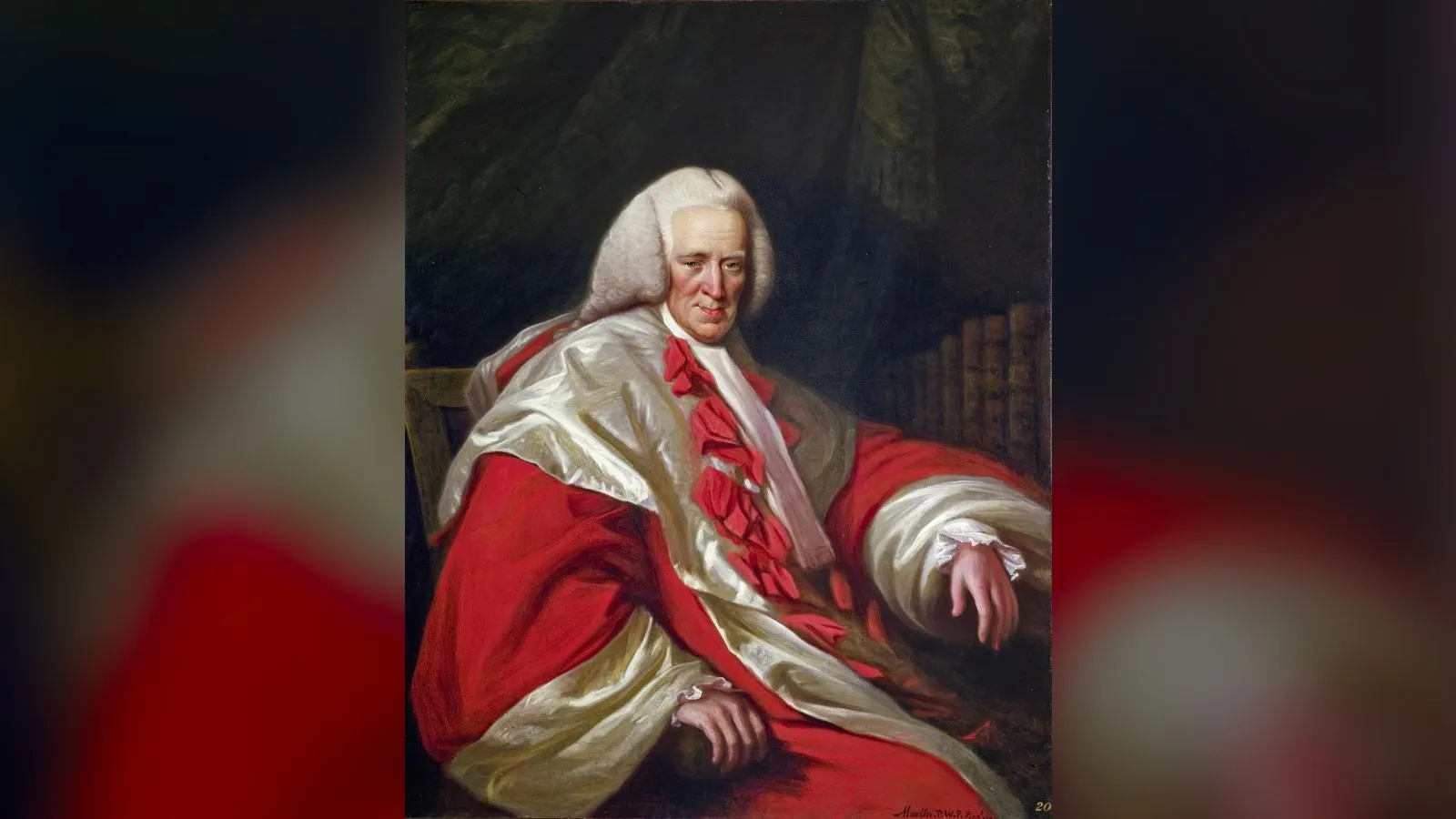

Henry Home, Lord Kames (1696–1782): Judge, Improver, Patron — and Polygenist
Henry Home, Lord Kames, was one of the most important working engines of the Scottish Enlightenment: a self-taught Border laird's son who became a senior civil and criminal judge, a major systematiser of Scots law, the author of the century's most widely used English-language textbook of criticism, an energetic patron of Adam Smith, John Millar and others, and a large-scale agricultural improver. He was also, in Sketches of the History of Man (1774), the most systematic eighteenth-century Scottish advocate of the view that humanity comprised separately originated "races" or species. That argument belongs at the centre of any honest card on him, not in a footnote.
TL;DR
- established Born 1696 at Kames, Berwickshire; educated at home by private tutors rather than at university; advocate from 1723 (some sources give January 1724); Lord of Session from 6 February 1752 and additionally a Lord of Justiciary from 15 April 1763, sitting until days before his death on 27 December 1782.
- established Author of major legal works (Historical Law-Tracts, 1758; Principles of Equity, 1760), the controversial Essays on the Principles of Morality and Natural Religion (1751), and Elements of Criticism (1762), which, according to Liberty Fund, was "published in five editions during Kames's lifetime and another forty editions over the next century," and became a standard college text in America.
- Established but needs precision: His patronage was real and specific — he sponsored Adam Smith's Edinburgh public lectures (1748–51), housed and advanced John Millar, and was a close friend and confidant of Boswell and correspondent of Hume — but the relationships differed greatly and should not be flattened into "mentor of Hume, Smith and Boswell."
- Established, with contested assessment: From 1766 he began reclaiming the peat moss of Kincardine on his wife's Blair Drummond estate, settling tenants ("moss lairds") on long leases to strip the peat into the Forth; it created fertile farmland but also depended on hard labour by poor, later largely Gaelic Highland, families and destroyed much of a raised bog now under restoration at Flanders Moss.
- Established — serious caveat: Sketches of the History of Man (1774) argued that "were all men of one species, there never could have existed, without a miracle, different kinds," invoking the Tower of Babel and "local creation"; historian Silvia Sebastiani, following Colin Kidd, writes that Kames's polygenist speculations, with John Hunter's physical anthropology and John Pinkerton's racial geography, "constituted the eighteenth-century Scottish legacy to nineteenth-century racism."
Key Facts
- Name
- Henry Home (pronounced "Hume"); judicial title Lord Kames (sometimes "Kaims")[1] | Established
- Born
- 1696, Kames House, Eccles parish, Berwickshire (exact day not recorded in standard sources)[2] | Established
- Parents
- George Home of Kames, "a country gentleman of small fortune"; mother a Walkinshaw of Barrowfield[3] | Established
- Education
- Private tutors at home (a Mr Wingate, later a Mr Anderson); no university; apprenticed to a Writer to the Signet c.1712[3][4] | Established
- Called to bar
- Faculty of Advocates, January 1723 (DNB gives 19 January 1724)[3][5] | Established (date discrepancy noted)
- Court of Session
- Ordinary Lord from 6 February 1752, title Lord Kames[3] | Established
- High Court of Justiciary
- Lord Commissioner of Justiciary from 15 April 1763[3] | Established
- Marriage
- 1741, Agatha Drummond (younger daughter of James Drummond of Blair Drummond)[3] | Established
- Blair Drummond
- Inherited by Agatha in 1766[6] | Established
- Children
- George Home Drummond (son); Jean (daughter, m. Patrick Heron 1761, divorced 1772)[7][8] | Established
- Died
- 27 December 1782, Edinburgh, aged about 86[3][9] | Established
- Buried
- Kincardine-in-Menteith churchyard (Home-Drummond plot), near Blair Drummond[2] | Established
- Key works
- Remarkable Decisions (1728); Dictionary of Decisions (1741); Essays on Morality and Natural Religion (1751); Historical Law-Tracts (1758); Principles of Equity (1760); Elements of Criticism (1762); Sketches of the History of Man (1774); The Gentleman Farmer (1776); Loose Hints upon Education (1781)[3] | Established
Scottish Impact Index (SI Score)
- Global Influence
- 4/10
- Enduring Relevance
- 8/10
- Material Contribution
- 2/10
- Exceptional Achievement
- 6/10
- Lasting Legacy
- 5/10
- Recognition
- 2/10
27/60
Ranked =118th of 200 in Great Scots
Claim Status
This card applies the Great Scots four-tier framework:
- Established / Documented — supported by primary records, contemporary publications, or consensus scholarly reference works (the Oxford DNB entry by A. J. Durie and S. Handley; the 1891 Dictionary of National Biography; Ian Simpson Ross, Lord Kames and the Scotland of His Day, Oxford, 1972; William C. Lehmann, Henry Home, Lord Kames, and the Scottish Enlightenment, The Hague, 1971; Historic Environment Scotland designation records).
- Shared / Traditional — widely repeated, plausibly true, but resting on a single memoir (usually A. F. Tytler, Lord Woodhouselee's adulatory Memoirs, 1807) or later anecdote collections.
- disputed — sources conflict on facts or on interpretation.
- Legend / Myth — popular claims that the evidence does not support.
Ross himself noted (bibliography revised 1999) that "a new critical biography of Kames is needed," so even the standard life is now over fifty years old.[10] Tytler's Memoirs was written by a protégé Kames chose as official biographer and is described by Ross as "comprehensive but adulatory."[10] Anecdotes that trace only to Tytler should be read with that in mind.
Timeline
Born at Kames, Berwickshire[2] — Established
Educated at home by tutors — Established
Indentured to a Writer to the Signet in Edinburgh[3] — Established
Admitted advocate after deciding on the bar following a meeting with Sir Hew Dalrymple, Lord President[3] — Established (date split)
Remarkable Decisions of the Court of Session, 1716–1728 makes his name[3] — Established
Essays upon Several Subjects in Law — Established
Curator of the Advocates' Library; December letter from Hume about "castrating" the Treatise — Established
Inherits Kames; marries Agatha Drummond; Dictionary of Decisions — Established
Essays upon Several Subjects concerning British Antiquities — Established
Sponsors Adam Smith's Edinburgh public lectures — Established
Essays on the Principles of Morality and Natural Religion (anonymous) — Established
Raised to Court of Session as Lord Kames (6 Feb); commissioner of forfeited/annexed estates[5] — Established
Evangelical attacks (George Anderson, John Bonar) seek censure of Kames and Hume; General Assembly declines to condemn by name — Established
Director, British Linen Company[5] — Established
Trustee for Fisheries, Arts and Manufactures[5]; in December Jonathan Edwards reports reading his Essays in New England — Established
Benjamin Franklin and his son stay at Kames House — Established
Historical Law-Tracts — Established
Principles of Equity — Established
Introduction to the Art of Thinking — Established
Elements of Criticism (3 vols) — Established
Lord of Justiciary (15 April) — Established
Agatha inherits Blair Drummond; moss reclamation begins;[11] Progress of Flax-Husbandry — Established
First "moss laird" tenant settled on Low Moss[12] — Established
Sketches of the History of Man (2 vols) — Established
The Gentleman Farmer — Established
Sits on full Court of Session bench in Knight v Wedderburn[1] — Established
Boswell collects "Materials for Writing the Life of Lord Kames" — Established
Loose Hints upon Education — Established
Dies in Edinburgh, still an active judge[3] — Established
Philosophical Society of Edinburgh, which he helped lead, becomes the Royal Society of Edinburgh; Rhode Island College (Brown) sets Elements of Criticism — Established
Samuel Stanhope Smith publishes rebuttals of Kames's polygenism[13] — Established
First American edition of Elements of Criticism, Boston — Established
Tytler's Memoirs published — Established
Details
Birth, family and an unusual education
Kames was born in 1696 at Kames House, between Eccles and Birgham in Berwickshire, a few miles from the English border.[2][14][15][16] The 1891 Dictionary of National Biography describes his father, George Home of Kames, as "a country gentleman of small fortune."[3] Mary Catherine Moran's Liberty Fund introduction adds that the family had "dual political (Whig and Jacobite) and religious (Presbyterian and Episcopalian) loyalties," and that he was taught Latin, Greek, mathematics and physics at home by "two nonjuring (and possibly Jacobite) Episcopalian clergymen."[17]
The distinctive claim in the brief is correct and deserves emphasis. Kames did not attend any university.[15][17] The DNB says he was "educated at home under a private tutor named Wingate, who taught him little," and the Scottish Philosophy site (University of Aberdeen/Library of Scottish Philosophy) states that "modest family circumstances meant that Kames, unlike his intellectual contemporaries, did not attend university."[3][18] Hume, Smith, Reid, Ferguson, Hutcheson and Millar were all university men; Kames was an autodidact who, after deciding on the bar, "set to work to repair the defects of his early education" in mathematics, natural philosophy, logic, ethics and metaphysics as well as law (DNB).[3] Tier: Established.
Around 1712 he was indentured to a Writer to the Signet in Edinburgh.[15][17] The traditional story that an errand to the house of Sir Hew Dalrymple, Lord President of the Court of Session, inspired him to aim for the bar comes from the DNB and Tytler.[3][15] Tier: Shared/Traditional — plausible, early, but anecdotal.
The date of admission is split. Most modern summaries, including the EBSCO biography and Liberty Fund, give admission to the Faculty of Advocates in January 1723; the DNB gives "called to the Scottish bar on 19 Jan. 1724" and Britannica 1724.[3][5][9][17] Editors should use "admitted advocate in 1723" with a note that some sources give 1724. Tier: Established (with documented date discrepancy).
Legal career: from reporter to double judge
Kames was "at first not very successful" at the bar (DNB). His breakthrough was as a legal writer: Remarkable Decisions of the Court of Session from 1716 to 1728 (1728), "a carefully executed work, which drew attention to Home's abilities."[3][17] He followed with essays on law (1732), the two-volume Dictionary of Decisions (1741), and served as a curator of the Advocates' Library from 1737.[1][3] Moran notes that during the 1730s he abandoned early Jacobite sympathies and embraced the Whig principles that secured the patronage of the 3rd Duke of Argyll and later the Earl of Bute.[17]
On the death of Patrick Campbell of Monzie, he took his seat as an ordinary Lord of Session on 6 February 1752, with the title Lord Kames.[2] On 15 April 1763 he was also appointed a Lord of Justiciary, replacing Sir Gilbert Elliot of Minto (DNB).[3][9][15] The Scottish Philosophy site's statement that he rose to the Justiciary in 1765 is an error.[18] Tier: Established.
Significance: the Court of Session was (and is) Scotland's supreme civil court; the High Court of Justiciary its supreme criminal court. Senior judges commonly held both commissions, so the dual appointment was a mark of seniority and trust rather than a unique distinction; the correct framing is that he sat in both of Scotland's supreme courts for two decades. He held his seat for over thirty years in total and worked "until within a few days of his death" (DNB).[3][17] As a criminal judge he had a reputation for severity; Tytler attributed this to "his innate abhorrence of vice."[3][16][19] Tier: Established.
His legal writings are foundational. Historical Law-Tracts (1758) treated law as part of the history of man, tracing it "from its first rudiments among savages … to its highest improvements in civilized society."[17] Principles of Equity (1760; enlarged 1767, 1778) is described by the EBSCO biography as "considered his most significant work by legal historians."[5] Andreas Rahmatian's Lord Kames: Legal and Social Theorist (Edinburgh University Press) presents him as one of the forefathers of comparative law, sociology of law and legal science, and notes that he is "one of the best known figures of the Scottish Enlightenment by name, and one of the least known in relation to his actual writings."[20][21] Tier: Established.
Knight v Wedderburn. Kames sat on the full bench that in 1778 upheld the Perth sheriff's finding that "the state of slavery is not recognised by the laws of this kingdom."[1][22][23] He is reported as saying "we sit here to enforce right not to enforce wrong."[22] The margin is itself disputed: Wikipedia's account of the case says the court acted "by eight votes to four," while the Judiciary of Scotland's 6 December 2022 release quotes the new plaque as recording that "on 15 January 1778 … The Court, by a majority of ten to four, found in favour of Joseph Knight's freedom." Tier: Established (decision); Shared (wording of his remark, from later case reports); Disputed (vote count). The site should not use this case to soften his race theory — he could reject chattel slavery in Scots law and still theorise human inequality.
Philosophy: the 1751 Essays and the heresy scare
Essays on the Principles of Morality and Natural Religion (1751, anonymous; revised 1758 and 1779) argued against Hume's view of justice as an "artificial" virtue, insisted that "it is not society which gives rise to justice, but justice which gives rise to society," and defended the veracity of the senses against Berkeley and Hume.[16][17] Moran judges that it "helped found the Scottish Common Sense school" later developed by Thomas Reid;[17][24] the Stanford Encyclopedia of Philosophy (which treats Kames within its entry "Scottish Philosophy in the 18th Century," not in a separate article) discusses his "providential naturalism" and "doctrines on divine goodness and human freedom."[25][26] Adam Smith cited Kames in The Theory of Moral Sentiments as "an author of very great and original genius."[17] Tier: Established.
The controversy was real but must be sized correctly. Kames argued for strict necessity and that God had implanted "a deceitful feeling of liberty."[17] Evangelicals were outraged. Hume wrote to Allan Ramsay in 1752 that "Anderson, the godly, spiteful, pious, splenetic … furious Anderson, is at present very hot in pursuit of Lord Kames." George Anderson's Estimate of the Profit and Loss of Religion (1753) urged the Kirk to excommunicate teachers of infidelity "such as Kames and Hume"; John Bonar's 1755 pamphlet addressed the General Assembly directly against "Sopho" (Kames) and Hume.[17]
Outcome: according to the Oxford DNB, "at the general assembly of the Church of Scotland in May 1755 Kames escaped censure by name as that body contented itself with generalities."[27] Moran says he "emerged relatively unscathed, the Moderate wing of the Church of Scotland voting against excommunication," though he toned down the "deceitful feeling" language in 1758 and removed it altogether in 1779.[17] The older DNB claims "a formal charge of heresy was brought against him before the presbytery of Edinburgh, which was, however, dismissed";[3] this is less precise than the modern accounts, which describe a campaign and pamphlet war that failed at Assembly level. Tier: Established (campaign and failure); Disputed (whether a formal presbytery heresy charge against Kames himself was ever lodged).
Comparison with Hume: both were targeted in the same 1755–56 campaign, and both escaped formal censure because the Moderates controlled the Assembly.[1] The difference is that Kames was a sitting judge defending natural religion who revised his text to conciliate critics, whereas Hume's scepticism was more fundamental and more lastingly damaging to his career (he never obtained a university chair). Kames was a heterodox Christian theist; Hume was not.
Elements of Criticism (1762): a genuine transatlantic textbook
Elements of Criticism argued that criticism is "a rational science" — "a subject of reasoning as well as of taste" — grounded in the psychology of emotion.[28][29] According to Liberty Fund (Peter Jones's modern edition, based on the 1785 sixth edition, the last Kames authorised), it was "the most comprehensive philosophical work on 'criticism' in English," appeared in five editions during Kames's lifetime "and another forty editions over the next century," and "in America … served as a standard text for college students of English."[30][31] Jones adds that, with Hugh Blair and George Campbell, it "entered the syllabus of American colleges founded on a Scottish model," often in abridgments.[32] The first American edition was printed in Boston in 1796; abridgments included those by A. Jamieson (London, 1823) and John Frost (Philadelphia, 1833); Thomas Jefferson owned a copy of the third edition; German translations appeared from 1763.[3][33][34] Tier: Established.
Contemporary verdicts were mixed. Samuel Johnson called it "a pretty essay … though much of it is chimerical"; Goldsmith quipped that it was "easier to write that book than to read it"; Dugald Stewart granted it "infinite merits" despite "numerous defects" (all quoted in the DNB).[35] Johnson's broader jibe — "You have Lord Kames. Keep him, ha, ha, ha! We don't envy you him" — is recorded by Boswell.[3] Tier: Established.
Kames and America: Franklin, the colleges and Blair
The literary historian Andrew Hook, in Scotland and America: A Study of Cultural Relations, 1750–1835 (1975), shows that Kames had more American connections than most of the Edinburgh literati, and that his Elements of Criticism, with Hugh Blair's Lectures, became one of the two most widely published Scottish books in the early United States.
Franklin at Kames House. established Benjamin Franklin and his son William met Kames during their Scottish tour of autumn 1759, and in early October stayed at Kames House in Berwickshire on their way south. In his letter of thanks to Lord and Lady Kames, Franklin called the six weeks in Scotland "the densest Happiness I have met with in any Part of my Life", and said Scotland would be the country he would choose to end his days in, were he not tied elsewhere.[7] In 1761 Kames invited him back. They corresponded for years, and in 1771 Franklin dined with Kames during his second Scottish visit. When the young Philadelphian John Morgan came to study medicine at Edinburgh, he carried Franklin's letters of introduction to Kames and to William Cullen. Tier: Established.
Kames on the American quarrel. established Kames defended Parliament's right to tax America in principle, but as the crisis deepened he proposed a "consolidating union" with America that would have given the colonies full representation in Parliament, and he wrote to Franklin on the subject in 1765 and 1767 (Tytler's Memoirs, as cited by Hook). Tier: Established (letters); Shared (how far his views shifted, since the account rests on Tytler).
Early American readers. established In a letter of 11 December 1755 to the Edinburgh minister John Erskine, Jonathan Edwards acknowledged receiving Kames's Essays on the Principles of Morality and Natural Religion and said he had also read Hume's Enquiry concerning the Principles of Morals. Hook calls this one of the earliest pieces of evidence of Scottish philosophy being read in America. I. Woodbridge Riley, quoted by Hook, records that Thomas Jefferson read Kames's Principles of Natural Religion in 1764; Jefferson later owned at least two Kames titles. A gift of books announced to the president of Rhode Island College (Brown) in May 1771 included a fourth edition of "Lord Kames on Criticism". Six Sketches of the History of Man, a selection from the Sketches, was printed at Philadelphia in 1776.
A college textbook. established Rhode Island College introduced Elements of Criticism in 1783, and by 1803 taught both Kames and Blair. Union College's curriculum of 1804 set Blair's Lectures in the junior year and Kames's Elements in the senior year; Brown still taught both in 1827. Hook, drawing on William Charvat (1936), finds that after the first American edition (Boston, 1796) the Elements went through nine more American editions before 1835. A reviewer in the Knickerbocker Magazine in 1833 thought any praise of the book "superfluous", given its long use. After the Princeton library fire of 1802, two Bostonians gave copies of the Elements to the college. Tier: Established.
Kames and Blair together. shared Hook argues that Kames and Hugh Blair, as the leading Scottish writers on taste and style, were "the most widely published and circulated of all the North Britons" in America. Blair outran even Kames: his Lectures on Rhetoric and Belles Lettres (1783) was printed at Philadelphia in 1784, abridged at Albany in 1788, and, counting full and abridged versions, went through fifty-six American editions between 1805 and 1823 alone. Almost every American college set one or both. Hook links this Scottish emphasis on correctness and elegance to the "genteel tradition" in American writing, and suggests it may have slowed the growth of a native American idiom; that is his own interpretation, and other critics, such as Bernard Spencer (1957), saw Kames and Blair as helping to loosen the neo-classical rules. Tier: Established (editions and curricula); Shared (cultural effect).
Patron and mentor: three very different relationships
David Hume. Kames and Hume were kinsmen (both Homes of the Berwickshire family; Hume changed the spelling) and close friends in the 1730s–40s.[1][16][36] Kames was one of the few people Hume confided in about the Treatise: in December 1737 Hume wrote to "Henry Home" that he was "castrating my work, that is, cutting off its nobler parts; that is, endeavouring it shall give as little offence as possible" before showing it to Bishop Butler.[37][38][39] But Kames was not Hume's teacher; he was fifteen years older, a friend, sounding-board and later an intellectual opponent whose 1751 Essays attacked Hume's positions.[1] "Mentor" overstates it; "early confidant, kinsman and sparring partner" is accurate. Tier: Established (friendship and correspondence); Disputed/Overstated ("mentor").
Adam Smith. This is the best-documented patronage. The Oxford DNB entry on Smith states that Smith's "first opportunity came as a result of an invitation from Henry Home, Lord Kames, to give a course of public lectures in Edinburgh on rhetoric and belles-lettres," which between 1748 and 1751 expanded into philosophy and jurisprudence and led directly to Smith's Glasgow chair in 1751.[40] Kames also introduced Smith to the Philosophical Society of Edinburgh.[41] Smith's reported remark "We must every one of us acknowledge Kames for our master" is repeated in modern scholarship but derives from Tytler's Memoirs.[42] Tier: Established (lectures patronage); Shared/Traditional (the "master" quotation).
James Boswell. Kames knew Boswell through Boswell's father, Lord Auchinleck, a fellow judge. In 1762 Boswell toured the southern counties with Lord and Lady Kames and stayed at Kames;[8] in 1764 he wrote Kames a long self-analytical letter; and he is generally identified as the "man of the first distinction in Scotland" who "had heaped kindness on me" in Boswell's confession to Rousseau.[8] That confession concerned Boswell's affair (c.1761–62, per Frederick Pottle) with Kames's married daughter Jean, Mrs Heron.[43][44] Boswell later compiled "Materials for Writing the Life of Lord Kames" (c.1778–82), an important source containing Kames's own reminiscences, but never wrote the biography.[10] Boswell was a protégé and confidant, not an intellectual disciple — and privately he could be scathing, calling the Sketches "very dear" with "a prodigious quantity of Quotation."[45] Tier: Established.
Others. John Millar lived in Kames's household for two years while qualifying as an advocate and, per Moran, owed his Glasgow chair of civil law "to Kames and Smith."[17] Kames also corresponded with and encouraged Thomas Reid, and sources list William Cullen and the naturalist John Walker among those he helped.[2] His correspondents included Benjamin Franklin.[46] He was a founding member of the Philosophical Society of Edinburgh and active in the Select Society.[2] Tier: Established (Millar); Shared (breadth of other patronage claims, which rest partly on Tytler).
Assessment: the "behind-the-scenes enabler" framing is fair for Smith and Millar, partly fair for Boswell, and misleading for Hume. It also undersells Kames as an original thinker in law, aesthetics and conjectural history; Silvia Sebastiani calls him "the patron of the most of the Scottish literati, from Adam Smith to John Millar," who "participated in their speculations."[47]
Agricultural improvement and the Blair Drummond moss
Kames was a committed improver long before 1766: a director of the British Linen Company (1754–56), a Trustee for Fisheries, Arts and Manufactures (1755), and a Commissioner for the Annexed (forfeited Jacobite) Estates,[3][5] in which capacity he secured Andrew Wight's commission to survey Scottish farming.[2][6][48] He wrote The Progress of Flax-Husbandry in Scotland (1766). During vacations, the DNB says, he supervised farm servants, "directing and even aiding their labours."[3][6] Tier: Established.
Blair Drummond. He married Agatha Drummond in 1741; she inherited the Blair Drummond estate in Menteith in 1766.[3][12][17][49] Blair Drummond was therefore hers by inheritance, not acquired by him, though he managed it. Historic Environment Scotland's Inventory entry for the designed landscape (GDL00060) states that "the present designed landscape at Blair Drummond was laid out between 1766–1782 to the design of Lord Kames," and that it has "high Historical value due to its associations with Lord Kames."[50] Tier: Established.
The moss scheme. HES records that Kames "drained the 1800 acre Moss of Kincardine of which 1500 acres lay in the Blair Drummond estate."[50] According to Archie MacKerracher, he "cut a three-mile channel right across the Carse from Blair Drummond to the Forth and diverted [a] mill lade into it," using the water to wash cut peat off the underlying carse clay. Stirling Council Archives state that "affordable leases were offered on the land, and the first tenant moved into the area in 1768."[12] According to Archie MacKerracher's Perthshire in History and Legend (1988), Kames "advertised for tenants in the Callander area and offered them a lease of eight acres for thirty-eight years," with timber for a house, a year's oatmeal, no rent for seven years and then rising low rents.[51] Tier: Established (method, 1768 start); Shared (exact lease terms, from a popular unfootnoted history).
Scale at his death is disputed: MacKerracher says "some twenty-nine tenants were living on 400 acres of cleared moss" (while misdating Kames's death to 1783),[51] while historian Fredrik Albritton Jonsson (Enlightenment's Frontier, Yale, 2013) states that "between 1766 and Kames's death in 1782, 42 tenants were brought in, settling more than 350 acres."[52] Either way, the great bulk of the clearance came later, under his son George Home Drummond: a large water-raising wheel at Mill of Torr operated between 1787 and 1839 (HES), and the Rev. Christopher Tait's 1794 paper in the Transactions of the Royal Society of Edinburgh describes the engine "which Mr Drummond has caused to be erected for raising water from the Teith."[53][54] By 1793, Jonsson reports, 115 families lived on the moss; a moss census (National Records of Scotland GD1/321/1), which Stirling Council Archives date to 1811 ("a census of the population of the Moss occurred in 1811") but the published transcription dates to 1814, counted 764 inhabitants in the widely cited transcription, though Jonsson gives 1,287 — another unresolved discrepancy. Tier: Disputed (numbers).
Who the moss lairds were. The name was a local jibe: NatureScot records that the Gaelic-speaking newcomers "were mockingly called 'The Moss Lairds' by local people."[55][56] They lived at first in huts cut from the peat itself.[51][55][56] NatureScot's Flanders Moss material says that "most of Home Drummond's tenants were families evicted from Balquhidder and Glen Lyon in the notorious Highland Clearances."[55] Census arrival dates suggest that the Kames-era settlers were a mix of Callander-district and local Menteith people, and that the Balquhidder/Glen Lyon Gaelic influx was mostly after 1782. Some scholars link Kames himself directly to evicted Highlanders: Jonsson does, and Tim Edensor ("Watery traces and absences," 2024) writes that "from 1766, Kames encouraged Gaelic speaking former crofters dispossessed during the Highland Clearances to take up thirty-eight-year leases for eight acres." Tier: Disputed — the safest wording is that Kames founded a scheme that, under his son, became a refuge for displaced Highland families.
How to assess it. The straightforward "progress" narrative needs complicating on three fronts:
- Labour and power. The scheme transferred the backbreaking cost of reclamation to poor families on long leases in return for eventual cheap land; landowners reaped the capital gain (Wikipedia's Blair Drummond page, citing an untraced source given only as "milne," says the reclamation "brought him an income of almost £2000 per year" — treat as unverified). Contemporary observers praised it as a "most useful nursery of laborers," revealing how improvers saw it.[52]
- Environment. Stirling Council Archives state that "the work carried out had silted up the Forth at Stirling and prevented ships from entering the area," and that the scheme continued until 1865.[12] NatureScot says "over a third of Flanders Moss was turned into rich farmland: the remainder dried out losing some special bog wildlife," and it is now damming ditches to restore the surviving raised bog, a National Nature Reserve since 1982.[57][58]
- Myth of the impenetrable bog. Popular accounts describe a "totally impassible" 35,000-acre swamp before Kames.[51] Research by Harrison and Tipping (Proceedings of the Society of Antiquaries of Scotland) argues that Roy's mid-18th-century map shows discrete, named mosses with settled edges — the landscape was not a trackless wilderness awaiting enlightened redemption.[59]
Fair verdict: a genuinely ingenious and agriculturally successful piece of improvement that produced some of the best farmland in the Forth valley, built on cheap labour by marginal people, with real ecological and navigational costs, mostly realised after Kames's lifetime.
The Gentleman Farmer (1776). Subtitled "Being an Attempt to Improve Agriculture by Subjecting it to the Test of Rational Principles,"[3] it covered equipment, tillage, crops and stock, and closed with appendices on the "Imperfection of Scotch husbandry" and a proposal for "a board for improving agriculture."[49] It went into a second edition in 1779, a fourth in 1798 and a sixth (with a supplement) in 1815.[3][6][60] Tier: Established. Claims that it was the most influential Scottish farming manual are shared — it was popular and respected, but practical improvers such as Andrew Wight, and later the Board of Agriculture surveys, were at least as important.
Race and polygenism: what Kames actually argued
This section should be read with the same rigour as the site's treatment of Hume.
The argument. The "Preliminary Discourse concerning the Origin of Men and of Languages" that opens Sketches of the History of Man (1774; enlarged 1778 and 1788) argues, principally against Buffon, that climate, food and state of society cannot explain physical and moral differences among peoples.[45][61] Kames concludes: "were all men of one species, there never could have existed, without a miracle, different kinds, such as exist at present."[61] Sebastiani (Cromohs, 2003) summarises that for Kames "these original tribes were different races of men, placed in proper climates," that he "conflated the terms 'race' and 'species'" as Voltaire did, and that national characters became "original characters," "racial" characters, with "the character of that greater part" having "no foundation but nature."[47] Tier: Established.
The biblical hedge. Because a plurality of origins contradicted Genesis, Kames located the miracle at the Tower of Babel: the confusion of tongues scattered humanity and fitted peoples to their climates. But in the sketch on the "Origin and Progress of American Nations" he argued more directly for a "local creation" of Native Americans.[61] Some commentators (e.g. the Theories of Race anthology) therefore say he "nicely split the difference between monogenesis and polygenesis."[62] Tier: Established (text); Disputed (whether "polygenist" is the exact label — the term itself dates from 1857).[47]
Hierarchy. Kames paired polygenism with progress: "Some nations stimulated by their own nature, or by their climate, have made a rapid progress; some have proceeded more slowly; and some continue savages." He treated Native Americans as an exception to progress, attributing their supposed stasis partly to innate "sexual frigidity" and physical and moral traits (Sebastiani).[47] Liberty Fund's editor James A. Harris notes that Kames wondered whether the "inferiority" of Black Africans "may not be occasioned by their condition," but warns that "racialist thought very easily becomes racist thought."[45][61] Kames also elevated a Nordic/Caledonian "race" of Scots ancestors as exceptionally refined, defending the Ossian poems.[63] Sebastiani reads his "Preliminary Discourse" as "an extended and assenting commentary" on Hume's notorious 1753 footnote on "species of men."[47] Some sources argue Kames was relatively "benign" compared with later racists or with monogenists like De Pauw; that comparative point is accurate but does not remove the hierarchical structure of his argument.[62][64][65] Tier: Established (texts); Disputed (degree of hierarchy/"benign" readings).
Reception. Kames was attacked on religious and scientific grounds. Samuel Stanhope Smith, later president of the College of New Jersey (Princeton), answered him in An Essay on the Causes of the Variety of Complexion and Figure in the Human Species (1787),[13] and the enlarged 1810 edition added "Strictures on Lord Kames's Discourse on the Original Diversity of Mankind."[66][67] Smith complained that Kames "judges and reasons only from what he" had read, without first-hand experience.[61] Tier: Established.
Afterlife. Polygenism "reached the height of its popularity in the mid-nineteenth century," became "the central tenet of the so-called American School of anthropology," and "was employed to argue against abolition in the nineteenth century" (Caspari, International Encyclopedia of Biological Anthropology, Wiley).[68] Silvia Sebastiani, following Colin Kidd, writes that Kames's polygenist speculations, John Hunter's study of physical anthropology and John Pinkerton's racial geography "constituted the eighteenth-century Scottish legacy to nineteenth-century racism," an indictment of the Scots' role "in the incubation of racial thought." Direct lines of citation from Kames to specific pro-slavery writers should be stated cautiously unless individually sourced; the structural contribution — a prestigious Enlightenment author arguing that human groups were distinct in origin and nature — is not in doubt. Tier: Established (Kidd's assessment and polygenism's later use); Disputed (extent of direct causal influence).
Personality: wit, coarseness and anecdote
The DNB states that "his humour was coarse, and his language on the bench often unseemly," and that "he even indulged in practical jokes";[19] Sir Walter Scott alluded to it in Redgauntlet. Physically he was "extremely tall and thin."[3] Tier: Established (reputation).
Two famous anecdotes:
- "That's checkmate for you, Matthew!" — said to Matthew Hay, his former chess partner, on a murder verdict at Ayr in September 1780. The source is Henry Cockburn's Memorials (1856), which corrected J. G. Lockhart's misattribution of the line to Lord Braxfield.[3] National Galleries of Scotland says only that he "is said to have" made the remark.[19] Tier: Shared/Traditional — early and specific, but a secondhand anecdote recorded some 75 years later.
- "Fare ye a' weel, ye bitches!" — his reported farewell to fellow judges as the court rose for Christmas 1782, days before his death (DNB).[3] Tier: Shared/Traditional.
His rivalry with Lord Monboddo was notorious and fiercely competitive.[4] His output was prodigious: around twenty-one separate works across law, philosophy, criticism, history, agriculture and education, many revised through multiple editions. The DNB judged his style "crabbed" and his learning "frequently superficial and inaccurate"[3] — a Victorian judgment worth quoting as a counterweight to hagiography.
Death and legacy
He died in Edinburgh on 27 December 1782 and was buried at Kincardine-in-Menteith, where the DNB reports "an immense white marble monument."[2][3][9] His Loose Hints upon Education (1781), notable for discussing female education, appeared in a second edition in the year of his death.[3]
Modern standing: Kames is now read less than Hume, Smith or Reid, but specialists treat him as a key figure in Scots legal theory (Rahmatian), common-sense philosophy (Moran), aesthetics (Jones), stage theory and conjectural history, and the political economy of improvement. He also belongs in any serious account of how the Scottish Enlightenment's "science of man" produced racial theory. Both halves are the real Kames.
Did You Know?
- Kames never attended university — unusual among the leading Scottish Enlightenment figures.[18]
- "Home" is pronounced "Hume"; he and David Hume were kinsmen, and Hume adopted the phonetic spelling.[1][16]
- Hume told Kames in 1737 that he was "castrating" his Treatise to avoid giving religious offence.[37]
- Adam Smith's career-making Edinburgh lectures of 1748–51 were given at Kames's invitation.[40]
- James Boswell had an affair with Kames's married daughter Jean and later confessed it to Rousseau.[43][44]
- According to Liberty Fund, Elements of Criticism ran to "another forty editions over the next century" after his lifetime and was taught in American colleges.
- The famous "checkmate" courtroom quip was once wrongly credited to Lord Braxfield.[3]
- Peat washed off the Blair Drummond moss was blamed for silting up the Forth at Stirling.[12]
- Benjamin Franklin stayed at Kames House in 1759 and told Kames that his six weeks in Scotland were "the densest Happiness" of his life.[7]
- Jonathan Edwards, the New England theologian, had read Kames's Essays by December 1755, one of the earliest known American readings of a Scottish Enlightenment philosopher.
FAQ
1
- Where was Lord Kames born?
At Kames House, in Eccles parish, Berwickshire, in 1696.[2] The house survives and is a Category A listed building.[69]
2
- Did Kames go to university?
No. He was taught at home by tutors and then trained through a legal apprenticeship and private study.[3][18]
3
- When did he become a judge?
He took his seat in the Court of Session as Lord Kames on 6 February 1752, and became a Lord of Justiciary on 15 April 1763.[2][3][9]
4
- Why does holding both posts matter?
He sat in both Scotland's supreme civil court and its supreme criminal court for two decades. This was a mark of seniority, though it was not unique among senior judges.
5
- What are his most important legal works?
Historical Law-Tracts (1758) and Principles of Equity (1760), along with his collections of Court of Session decisions.
6
- Was he tried for heresy?
Not successfully. Evangelical ministers campaigned in 1753–56 to have him and Hume censured.[1] The General Assembly of May 1755 avoided naming him, and the Moderates blocked excommunication.[17][27]
7
- Was he Hume's mentor?
Not really. He was Hume's older kinsman, friend and confidant, and later criticised Hume's philosophy.
8
- How did he help Adam Smith?
He invited and sponsored Smith's Edinburgh public lectures of 1748–51. Those lectures led to Smith's Glasgow professorship.[40]
9
- Did Blair Drummond belong to him?
It came to his wife, Agatha Drummond, by inheritance in 1766.[49][55] He managed it and redesigned its landscape.[6][50]
10
- Who were the "moss lairds"?
They were tenant families who cleared peat from the Blair Drummond moss on long leases with rent-free years. Many later settlers were Gaelic-speaking Highlanders who had been displaced, and "moss laird" was originally a mocking local nickname.[51][55][57]
11
- What did Kames argue about race?
In Sketches of the History of Man (1774) he argued that human "races" were distinct in origin and nature and could not be explained by climate.[47] He explained this through the Tower of Babel and "local creation."[61][70]
12
- Did he support slavery?
He sat on the 1778 bench that held slavery was not recognised in Scots law.[1][22] His race theory, however, contributed to a tradition later used to defend racial hierarchy and slavery.
13
- Was Kames read in America?
Widely. Jonathan Edwards read his Essays by 1755 and Jefferson by 1764. After 1783 Elements of Criticism became a standard college text, usually paired with Hugh Blair's Lectures on Rhetoric. Andrew Hook (1975) counts ten American editions of the Elements between 1796 and 1835.
14
- Did Kames know Benjamin Franklin?
Yes. Franklin and his son stayed at Kames House in October 1759, Franklin dined with him again in 1771, and the two corresponded for years, including on how Britain should govern America.
Sources
Primary / Institutional
- Henry Home, Lord Kames: Essays on the Principles of Morality and Natural Religion (1751, 1758, 1779; Liberty Fund ed. M. C. Moran, 2005); Historical Law-Tracts (1758); Principles of Equity (1760); Elements of Criticism (1762; Liberty Fund ed. P. Jones, 2005); Sketches of the History of Man (1774; Liberty Fund ed. J. A. Harris, 2007); The Gentleman Farmer (1776).
- A. F. Tytler, Lord Woodhouselee, Memoirs of the Life and Writings of the Honourable Henry Home of Kames (1807).
- James Boswell, "Materials for Writing the Life of Lord Kames" (c.1778–82), in Private Papers of James Boswell from Malahide Castle, vol. 15.
- Henry Cockburn, Memorials of His Time (1856).
- Rev. Christopher Tait, "An Account of the Peat-Mosses of Kincardine and Flanders," Transactions of the Royal Society of Edinburgh 3 (1794).
- National Records of Scotland GD1/321/1, Census of the Inhabitants of Blair Drummond Moss.
- Historic Environment Scotland: GDL00060 (Blair Drummond designed landscape); LB8414 (Blair Drummond House); LB4115 (Kames House); LB8410 (Kincardine Graveyard).
- Stirling Council Archives, "The Drummonds of Blair Drummond" (Document of the Month, January 2023).
- NatureScot, Flanders Moss NNR leaflet and management plan.
- Judiciary of Scotland, Knight v Wedderburn plaque announcement (2022).
Scholarly
- Ian Simpson Ross, Lord Kames and the Scotland of His Day (Oxford: Clarendon Press, 1972).
- William C. Lehmann, Henry Home, Lord Kames, and the Scottish Enlightenment (The Hague, 1971).
- A. J. Durie and S. Handley, "Home, Henry, Lord Kames," Oxford Dictionary of National Biography.
- Dictionary of National Biography (1891), "Home, Henry, Lord Kames."
- Alexander Broadie, "Scottish Philosophy in the 18th Century," Stanford Encyclopedia of Philosophy.
- Andreas Rahmatian, Lord Kames: Legal and Social Theorist (Edinburgh University Press).
- Silvia Sebastiani, "Race and national characters in eighteenth-century Scotland: the polygenetic discourses of Kames and Pinkerton," Cromohs 8 (2003).
- Colin Kidd, The Forging of Races (Cambridge, 2006) and related work.
- Fredrik Albritton Jonsson, Enlightenment's Frontier (Yale, 2013).
- Rachel Caspari, "Polygenism," International Encyclopedia of Biological Anthropology (Wiley).
- Samuel Stanhope Smith, An Essay on the Causes of the Variety of Complexion and Figure in the Human Species (1787; 1810).
- F. A. Pottle, James Boswell: The Earlier Years (1966).
- Andrew Hook, Scotland and America: A Study of Cultural Relations, 1750–1835 (Blackie, 1975).
- William Charvat, The Origins of American Critical Thought, 1810–1833 (Philadelphia, 1936).
General
- Britannica, "Henry Home, Lord Kames."
- Library of Scottish Philosophy / scottishphilosophy.org, "Henry Home, Lord Kames."
- National Galleries of Scotland, portrait by David Martin (1794).
- Archie MacKerracher, Perthshire in History and Legend (1988).
- jamesboswell.info biographical entries (Kames; Jean Home).
Honest Caveats
- Myth: Kames was "mentor" to Hume. Overstated. He was a friend, kinsman and confidant, and later a critic.
- Myth: Kames was tried and acquitted of heresy. Oversimplified. There was a pamphlet campaign and Assembly manoeuvring, but no formal condemnation. The older DNB's "formal charge … before the presbytery" is not confirmed in modern accounts.
- Error: Justiciary appointment in 1765. The correct date is 15 April 1763.[3]
- Disputed: 1723 vs 1724 for his call to the bar. Most sources say 1723; the DNB and Britannica say 1724.[3][5][9][17]
- Disputed: the Knight v Wedderburn vote. Wikipedia's account gives "eight votes to four"; the Judiciary of Scotland's 6 December 2022 plaque release says "a majority of ten to four."
- Myth: the moss lairds were all Clearance victims recruited by Kames. Most Gaelic Highland settlers arrived under his son, after 1782.[55]
- Myth: the Carse was an impenetrable 35,000-acre bog. Mid-18th-century mapping shows discrete mosses with settled margins.[59]
- Disputed: moss scale at his death. Sources give 29 tenants on 400 acres, or 42 tenants on over 350 acres. The census total is given as 764 or 1,287.[51][52]
- Caution: anecdotes. "Checkmate, Matthew" and "Fare ye a' weel, ye bitches" are traditional, recorded decades later.
- Caution: "Kames was relatively benign on race." The comparative point has some basis, but it must not be used to minimise his argument for innate, original human difference.
- Caution: "moss lairds" was a mocking local nickname, not a title of honour.
- Caution: "forty editions" of Elements of Criticism. Liberty Fund's figure covers all editions over a century. For America specifically, Hook (following Charvat) counts the Boston edition of 1796 and nine more before 1835; abridged and school versions make exact totals uncertain.
- Caution: Kames as a "friend of America". He corresponded warmly with Franklin and favoured American representation in Parliament, but he upheld Parliament's right to tax the colonies.
Sources
- Henry Home, Lord Kames, 1696-1782
- Henry Home, Lord Kames
- https://en.wikisource.org/wiki/Dictionary_of_National_Biography,_1885-1900/Home,_Henry
- Henry Home, Lord Kames - New World Encyclopedia
- Henry Home
- Dictionary of National Biography, 1885-1900/Home, Henry - Wikisource, the free online library
- Founders Online: Benjamin Franklin to Lord Kames, 3 January 1760
- Henry Home - Lord Kames - author of Elements of Criticism
- Henry Home, Lord Kames
- Selected Bibliography: Henry Home, Lord Kames ...
- Moss Census 1814
- The Drummonds of Blair Drummond - Stirling Archives
- Pre-Adamic Man
- Eccles, Berwickshire - Wikishire
- Henry Home, Lord Kames: Biography on Undiscovered Scotland
- Kames, Henry Home, Lord - Enlightenment and Revolution
- Amazonaws
- Henry Home, Lord Kames (1696-1782)
- Henry Home, Lord Kames, 1696 - 1782. Scottish judge and author by David Martin
- Lord Kames: Legal and Social Theorist
- Lord Kames :
- Joseph Knight (slave)
- Knight v. Wedderburn is Upheld - African American Registry
- In this Book
- Table of Contents (Stanford Encyclopedia of Philosophy)
- Scottish Philosophy in the 18th Century (Stanford Encyclopedia of Philosophy)
- Essays on the Principles of Morality and Natural Religion:,1779 & 1782
- Elements of Criticism (2-vol set) by Henry Home, Lord Kames, Paperback
- Henry Home Elements of Criticism, Volumes 1 & 2 — Rarewaves.com
- Elements of Criticism (2-vol set) by Henry Home Kames
- Elements of Criticism (2-vol set) (Natural Law and Enlightenment Classics): Home Lord Kames, Henry, Jones, Peter: 9780865974661: Amazon.com: Books
- elements of criticism volume 1
- Elements of Criticism.,HOME, Henry, Lord Kames.,1762
- Elements of criticism : with the author's last corrections and additions : Kames, Henry Home, Lord, 1696-1782 : Free Download, Borrow, and Streaming : Internet Archive
- Elements of Criticism: Home, Lord Kames Henry: 9780898759419: Amazon.com: Books
- David Hume 9781501301391, 9780826429803 - DOKUMEN.PUB
- 20 The Context, Aims, and Structure of Hume’s First Enquiry Peter Millican
- Of Miracles
- Eighteenth Century - Bishop Butler
- Smith, Adam (bap. 1723, d. 1790), moral philosopher and political economist
- Adam Smith - Teacher in a Box
- (PDF) The ‘final causes’ of Scottish nationalism: Lord Kames on the political economy of enlightened husbandry, 1745-82: Lord Kames on the political economy of enlightened husbandry, 1745-82
- Jean Home - Daughter of Henry Home, Lord Kames
- At Home and among Friends: Domestic Relations and Sociability
- sketches of the history of man book i
- The Gentleman Farmer. Being an Attempt to improve Agriculture, By subjecting it to the Test of Rational Principles by [HOME, Henry, Lord Kames]
- Cromohs 2003 - Sebastiani - Race and national characters in eighteenth-century scotland: the polygenetic discourses of Kames and Pinkerton
- AM27Intro
- The Gentleman Farmer - Lord Henry Home Kames - Google Books
- BLAIR DRUMMOND (GDL00060) - Portal
- “The Moss Lairds”, excerpted from Perthshire in History and Legend, pp
- Enlightenment's Frontier: The Scottish Highlands and the Origins of Environmentalism 9780300163742 - DOKUMEN.PUB
- Blair Drummond House, Mill Of...
- XIV. An Account of the Peat-Mosses of Kincardine and Flanders in Perthshire
- West Moss-side Organic Farm
- History - General 2 — The Carse of Stirling Partnership
- Flanders Moss NNR - visiting the reserve leaflet
- The Management Plan for Flanders Moss National Nature Reserve - 2016-2026
- harrison & tipping: early historic settlement of the forth valley
- The Gentleman Farmer: Being an Attempt to Improve Agriculture by Subjecting it to the Test of Rational Principles
- Kames on Progress and Providence - Online Library of Liberty
- Lord Kames (Henry Home) — Theories of Race
- Central Washington University Central Washington University ScholarWorks@CWU
- Lorehaven : Let's Talk About Race and Racism. Part 5: Scientific Racism
- Hume's Revised Racism Revisited
- Samuel Stanhope Smith — Theories of Race
- Samuel Stanhope Smith - Princeton & Slavery Project
- Polygenism - Caspari - Major Reference Works - Wiley Online Library
- Kames, Eccles, Scottish Borders
- Historical definitions of race - wikidoc
- Blair Drummond from The Gazetteer for Scotland
- History in Structure
- Moss Lairds
- List of listed buildings in Kincardine-in-Menteith, Stirling
Finished reading? Try the Fact Machine: three reels, one surprising Scottish connection →
Card 024 · Great Scots