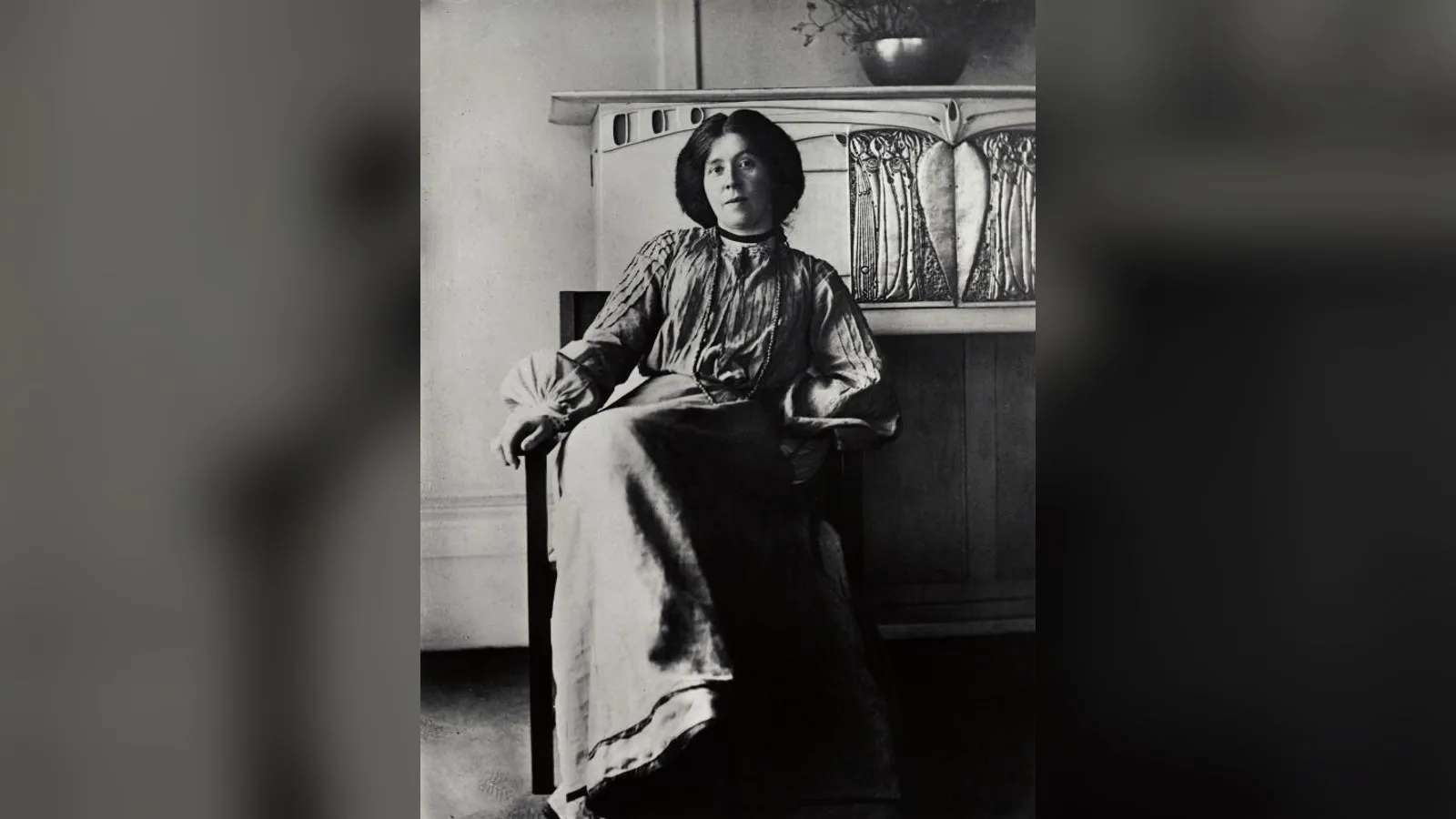

Margaret Macdonald Mackintosh (1864–1933)
Contents
TL;DR
- established Margaret Macdonald Mackintosh was a leading figure of the Glasgow Style and European Art Nouveau in her own right — a painter, designer, and gesso-panel artist whose work was exhibited across more than forty international venues between 1895 and 1924, not simply the wife and assistant of a famous architect.
- established Her husband, Charles Rennie Mackintosh, credited her explicitly and in writing with central importance to his own architectural work, telling her "you are half if not three-quarters in all my architectural work" and reportedly stating, "Margaret has genius, I have only talent" — a remarkable, specific act of attribution rarely matched by husbands of her era.
- established Despite this contemporary recognition and real international acclaim, including direct influence on Vienna Secession artists such as Gustav Klimt and Josef Hoffmann, her reputation was substantially overshadowed by her husband's for most of the 20th century, a pattern modern scholarship has actively worked to correct.
- established Her masterpiece, the gesso triptych "The Seven Princesses" (1907), was hidden in a bricked-up basement room in Vienna during the First World War for safekeeping and lay undiscovered for decades, found only by accident by construction workers in 1990.
- established Poor health ended her significant creative output after 1921, and she died in London in 1933, outliving her husband by five years.
Key Facts
- Born
- 5 November 1864, Tipton, Staffordshire, England
- Died
- 7 January 1933 (aged 68), Chelsea, London
- Category
- Culture / Art & Design
- Known for
- Gesso panels; the Glasgow Style; "The Seven Princesses" (1907)
- Education
- Glasgow School of Art (from 1890)
- Spouse
- Charles Rennie Mackintosh (m. 1900)
- Key group
- "The Four" / "The Glasgow Four," with sister Frances Macdonald, Herbert MacNair, and Charles Rennie Mackintosh
Scottish Impact Index (SI Score)
- Global Influence
- 5/10
- Enduring Relevance
- 7/10
- Material Contribution
- 3/10
- Exceptional Achievement
- 7/10
- Lasting Legacy
- 5/10
- Recognition
- 4/10
31/60
Ranked =84th of 200 in Great Scots
A Note on Claims and Evidence
Margaret Macdonald Mackintosh's biography, exhibition record, and major works are documented through institutional collections (Glasgow Museums, the Hunterian, Vienna's Museum of Applied Arts), contemporary exhibition catalogues, and her husband's own surviving correspondence, and are treated here as established. Her precise individual contribution to specific jointly credited architectural interiors is not always separable from Mackintosh's own work in the surviving documentary record, and this article notes that limitation rather than asserting more precision than the evidence supports.
Timeline
Born in Tipton, Staffordshire, England, to a colliery manager and engineer.
Moves with her family to Glasgow; enrols with her sister Frances at Glasgow School of Art.
Meets Charles Rennie Mackintosh and Herbert MacNair, likely through art school director Francis Newbery; the four begin exhibiting together as "The Four."
"The Four" exhibit together publicly for the first time as students, earning the unflattering nickname "The Spook School" for their gaunt, linear, Beardsley-influenced style.
Margaret and Frances Macdonald open a joint studio at 128 Hope Street, Glasgow, producing book illustrations, embroidery, gesso panels, leaded glass, and metalwork.
Joins the Scottish Society of Watercolour Painters.
Marries Charles Rennie Mackintosh; "The Four" exhibit at the Vienna Secession, directly influencing Viennese Art Nouveau.
Collaborates on the Rose Boudoir for the Turin International Exhibition; creates "The White Rose and the Red Rose."
Produces the gesso triptych "The Seven Princesses," "The Opera of the Winds," and "The Opera of the Sounds" for the Waerndorfer villa commission in Vienna.
Collaborates on the Willow Tearooms interiors in Glasgow.
Creates "Ophelia."
Exhibits at the International Art Exhibition in Vienna.
Creates "The Mysterious Garden."
Ceases producing significant new work due to declining health.
Dies in Chelsea, London, aged 68.
"The Seven Princesses" panels, hidden in Vienna during the First World War, are accidentally rediscovered by construction workers.
"The White Rose and the Red Rose" sells at auction for approximately £2.65 million.
Details
An English birth, a Glasgow artistic education
Margaret Macdonald was born in 1864 in Tipton, Staffordshire, England, the daughter of a colliery manager and engineer — notably, not a native Glaswegian, though she became one of the defining figures of a specifically Glasgow artistic movement. She and her younger sister, Frances, attended Orme Girls' School in Newcastle-under-Lyme before the family relocated to Glasgow around 1890, where both sisters enrolled as day students at Glasgow School of Art, concentrating on design work across a genuinely wide range of media: metalwork, embroidery, and textiles among them. She joined the Scottish Society of Watercolour Painters in 1898, establishing an independent professional footing within Glasgow's artistic community distinct from any connection to Mackintosh.
"The Spook School" and an independent studio
Around 1892, Margaret and Frances met Charles Rennie Mackintosh and fellow student Herbert MacNair, probably through the encouragement of the school's director, Francis Newbery, who recognised a shared artistic sensibility among the four. By 1894 they were exhibiting together as students, developing a distinctive style of gaunt, elongated, linear figures influenced by the English illustrator Aubrey Beardsley — a style so unusual for its time that it earned the group the dismissive nickname "The Spook School," though they became more lastingly known simply as "The Four." In 1896, before her marriage and well before Mackintosh's own architectural reputation was established, Margaret and Frances opened their own joint studio at 128 Hope Street, Glasgow, producing book illustrations, embroidery, gesso panels, leaded glass, and repoussé metalwork — a genuine independent professional practice, not an apprenticeship under male collaborators. Margaret's work drew on an unusually wide range of literary and symbolic sources, including the Bible, Homer's Odyssey, the poetry of William Morris and Dante Gabriel Rossetti, and the Symbolist plays of Maurice Maeterlinck; notably, she did not keep sketchbooks of observational drawing, reflecting an artistic practice built on imagination and literary/symbolic transformation rather than direct study from nature.
A marriage, and an explicitly acknowledged creative partnership
Margaret married Charles Rennie Mackintosh in 1900, and what followed was an unusually well-documented case of a husband publicly and specifically crediting his wife's creative importance to his own celebrated work — a notable departure from the far more common historical pattern of female collaborators going uncredited entirely. Mackintosh wrote to her directly that "you are half if not three-quarters in all my architectural work," and is reported to have said, even more strikingly, "Margaret has genius, I have only talent." These are not vague later tributes but direct statements from the artist most responsible for Margaret's later historical eclipse, making the subsequent marginalisation of her reputation a particularly clear case study in how even explicit contemporary acknowledgment did not protect a woman artist's standing in the historical record that followed. Together, the couple produced significant interior design schemes including the House for an Art Lover (1900), the Rose Boudoir for Turin's 1902 International Exhibition, and the Willow Tearooms (1902–03) in Glasgow — collaborative work in which, as with many Mackintosh interiors, precise individual attribution of specific elements is not always clearly separable in the surviving record, though scholars consistently credit Margaret's decorative and symbolic sensibility as integral rather than supplementary.
The gesso panels and "The Seven Princesses"
Margaret became particularly renowned in her own right for her gesso panels — relief works built up in a plaster-like medium, then painted and often inlaid with glass beads, string, and other materials — which represented a genuinely original contribution to the broader European gesso revival movement rather than a derivative technique. Her acknowledged masterpiece is "The Seven Princesses" (1907), a three-panel triptych depicting a scene from Maurice Maeterlinck's play of the same name, created alongside two companion panels, "The Opera of the Winds" and "The Opera of the Sounds" (sometimes referenced as "The Opera of the Seas"), as part of a major commission for the Vienna villa of the patron Fritz Waerndorfer. Other significant works include "The May Queen" (1900), "Oh ye, all ye that walk in Willowwood" (1903), "The White Rose and the Red Rose" (1902) — which sold at auction in 2023 for approximately £2.65 million, a striking late-career market validation of her individual standing as an artist — "Ophelia" (1908), and "The Mysterious Garden" (1911).
Genuine international recognition in her own lifetime
Margaret's international reputation during her working life was substantial and well documented, not a retrospective invention of modern scholarship. When "The Four" exhibited at the 1900 Vienna Secession, Margaret's work directly influenced major figures of the Viennese avant-garde, including Gustav Klimt and Josef Hoffmann — a genuine instance of a Scottish-based woman artist shaping the direction of one of Europe's most significant art movements at the time. She continued to exhibit in Vienna, including at the 1909 International Art Exhibition, and across her working life, from 1895 to 1924, contributed to more than forty exhibitions across Europe and North America, establishing real, substantial international renown independent of her husband's architectural career.
Historical marginalisation, and a hidden masterpiece rediscovered
Despite this considerable contemporary standing, Margaret's artistic reputation was substantially overshadowed by her husband's in the decades that followed both their deaths, as Charles Rennie Mackintosh became established as Scotland's most celebrated architect and designer while Margaret's own, independently significant body of work receded from broader public consciousness — a pattern widely recognised today as a specific instance of the more general historical marginalisation of women artists working in collaborative partnerships with famous husbands. The physical fate of her most important work dramatises this neglect vividly: "The Seven Princesses" panels were hidden in a bricked-up basement room in Vienna during the First World War for safekeeping, and the hiding place was then effectively forgotten, with the panels remaining undiscovered for decades until construction workers found them entirely by accident in 1990 — a genuinely remarkable gap between a major artist's original acclaim and the physical survival and recognition of her defining work. Her gesso panels and other works are now held permanently in major institutional collections, including Glasgow's Kelvingrove Art Gallery and Vienna's Museum of Applied Arts, and modern scholarship has actively worked to reassess and restore her standing as a major, independently significant figure of the Glasgow Style, Art Nouveau, and Symbolist movements, rather than treating her solely as her husband's collaborator or muse.
Later life, decline, and death
Margaret's significant creative output ceased after 1921, a decline attributed to poor health rather than any loss of ambition or recognition. She outlived Charles Rennie Mackintosh, who died in 1928, by five years, dying in Chelsea, London, on 7 January 1933, at the age of 68.
Did You Know?
- Margaret Macdonald was English by birth, born in Staffordshire, before her family moved to Glasgow and she became central to a specifically Glaswegian artistic movement.
- She and her sister Frances opened their own independent studio in Glasgow in 1896, before Margaret's marriage to Charles Rennie Mackintosh.
- Mackintosh is reported to have said of his wife, "Margaret has genius, I have only talent."
- Her gesso masterpiece, "The Seven Princesses," was hidden in a bricked-up Vienna basement during the First World War and wasn't rediscovered until 1990, by accident.
- Her work directly influenced Vienna Secession artists including Gustav Klimt and Josef Hoffmann.
- She exhibited at more than forty international venues across Europe and North America during her working life.
- One of her paintings, "The White Rose and the Red Rose," sold for around £2.65 million at auction in 2023.
- "The Four," the group she belonged to, were nicknamed "The Spook School" for their unusual, gaunt, elongated artistic style.
FAQ
1What is Margaret Macdonald Mackintosh best known for?
Her gesso panels, especially the triptych "The Seven Princesses" (1907), and her central role in the Glasgow Style and European Art Nouveau movements, both independently and in collaboration with her husband, Charles Rennie Mackintosh.
2Did Margaret Macdonald Mackintosh have her own independent artistic career?
Yes — she trained and began exhibiting before her marriage, opened her own studio with her sister in 1896, and continued to exhibit internationally in her own right throughout her career.
3What did Charles Rennie Mackintosh say about his wife's talent?
He wrote that she was "half if not three-quarters" of all his architectural work, and is reported to have said, "Margaret has genius, I have only talent."
4Was Margaret Macdonald Mackintosh overshadowed by her husband?
Yes, in the decades after both their deaths her reputation receded significantly behind his, despite real contemporary acclaim; modern scholarship has worked to reassess and restore her independent standing.
5What happened to her masterpiece, "The Seven Princesses"?
The panels were hidden in a bricked-up basement room in Vienna during the First World War for safekeeping and were not rediscovered until construction workers found them by accident in 1990.
6Did Margaret Macdonald Mackintosh influence other famous artists?
Yes — her work directly influenced major figures of the Vienna Secession, including Gustav Klimt and Josef Hoffmann, after she exhibited there in 1900.
7What is a gesso panel?
A relief artwork built up in a plaster-like medium called gesso, then painted and often inlaid with materials like glass beads and string — a technique Margaret Macdonald Mackintosh became particularly renowned for.
8Who was "The Four"?
A Glasgow School of Art-connected artistic group comprising Margaret Macdonald, her sister Frances Macdonald, Herbert MacNair, and Charles Rennie Mackintosh, nicknamed "The Spook School" for their distinctive style.
9When did Margaret Macdonald Mackintosh die?
7 January 1933, in Chelsea, London, aged 68 — five years after her husband's death in 1928.
Sources and Further Reading
Institutional
- Glasgow Museums, collection records for Margaret Macdonald Mackintosh
- Glasgow School of Art Archives & Collections
- Mackintosh Architecture (University of Glasgow), biographical catalogue entry
Scholarly / Critical
- Scholarly reassessment of Margaret Macdonald Mackintosh's independent artistic significance within the Glasgow Style and Art Nouveau
- Documentation of the 1990 rediscovery of "The Seven Princesses" panels in Vienna
General
- Wikipedia, "Margaret Macdonald Mackintosh" (overview, cross-checked against institutional sources above)
- Undiscovered Scotland, biography of Margaret Macdonald
- The Scotsman, "Into the mysterious world of artist Margaret Macdonald Mackintosh"
Caveats: Myths and Disputed Claims
- Myth: Margaret Macdonald Mackintosh was primarily her husband's assistant or muse. She had an independent artistic education, studio and exhibition record before and throughout her marriage, and her husband explicitly credited her with central creative importance to his own celebrated work.
- Disputed: who did what in joint interiors. The precise division of creative credit within specific jointly produced interior schemes (such as the Willow Tearooms) is not always clearly separable in the surviving documentary record; her contribution was significant, but it cannot be measured more precisely than the evidence allows.
- Myth: her reputation has always matched her husband's. Despite real contemporary international acclaim, her standing was substantially overshadowed for most of the 20th century, and her rehabilitation as a major independent artist is a comparatively recent development in scholarship.
Finished reading? Try the Fact Machine: three reels, one surprising Scottish connection →
Card 108 · Great Scots