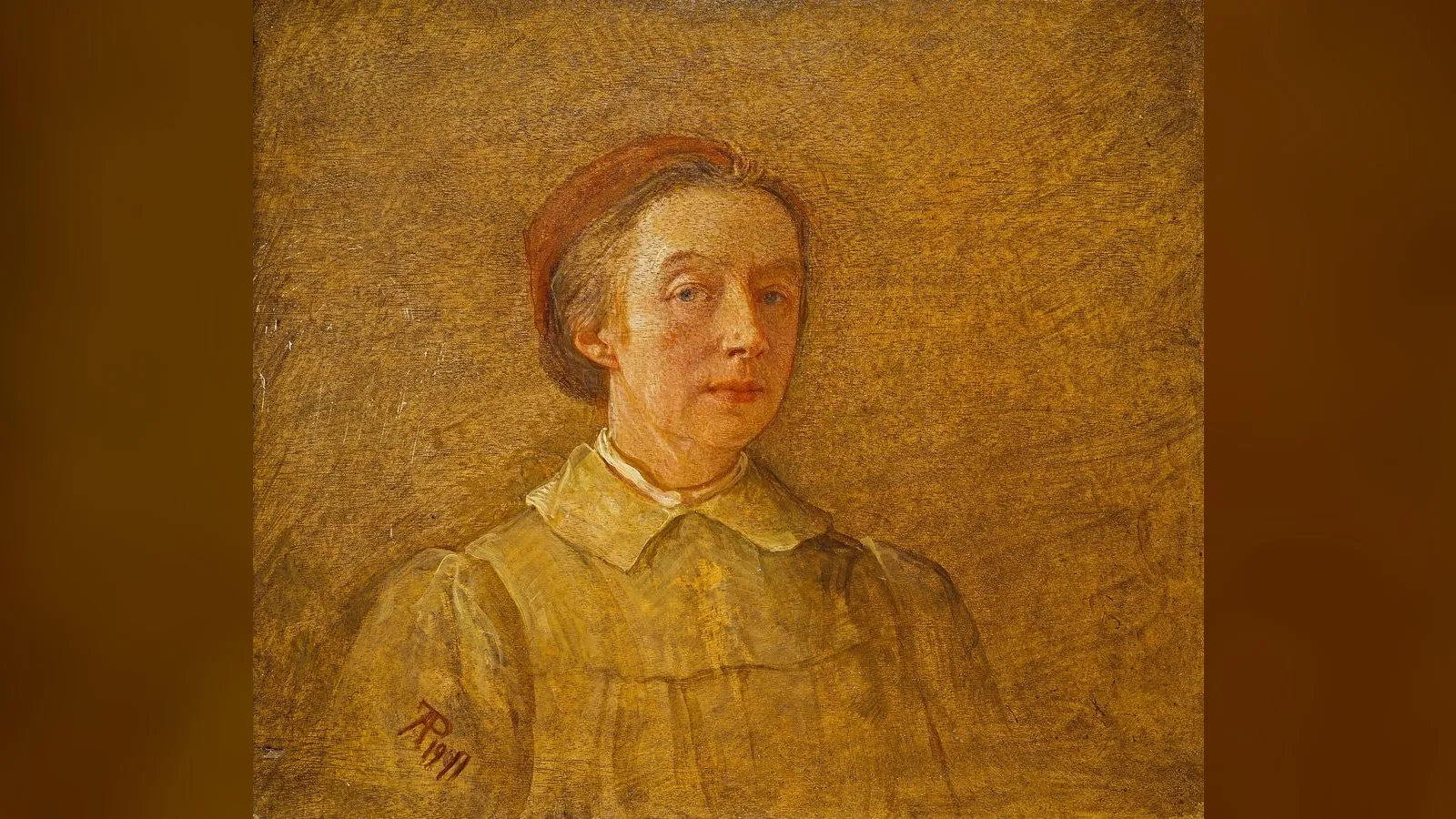

Phoebe Anna Traquair (1852–1936)
Contents
TL;DR
- established Phoebe Anna Traquair was an Irish-born, Edinburgh-based artist widely described by National Museums Scotland as "the first important professional woman artist of modern Scotland," working across an extraordinary range of media — murals, embroidery, enamel, jewellery, bookbinding, and illuminated manuscripts — at a scale and ambition rarely matched by women artists of her era.
- established Her magnum opus, the murals filling the former Catholic Apostolic Church at Mansfield Place in Edinburgh (1893–1901), has been described as "Edinburgh's Sistine Chapel" and remains her most celebrated single achievement, now preserved as the Mansfield Traquair Centre.
- established Unlike the Arts and Crafts movement's most famous figure, William Morris, who typically designed work for others to execute, Traquair personally designed and physically produced each of her own embroidered and decorative works herself — a distinction scholars treat as significant to understanding the depth of her individual craftsmanship.
- established Despite real international recognition in her own lifetime, including exhibitions at the 1893 Chicago World's Fair and the 1904 St Louis World's Fair, her reputation faded substantially after her death and was not seriously revived until the early 1990s, decades later.
- established In 1920 she became an honorary member of the Royal Scottish Academy, a genuinely notable professional achievement for a woman artist of her generation, working within an institutional art world still dominated almost entirely by men.
Key Facts
- Born
- 24 May 1852, Kilternan, County Dublin, Ireland
- Died
- 4 August 1936 (aged 84), Edinburgh
- Category
- Culture / Art
- Known for
- Multi-media Arts and Crafts work; murals at Mansfield Place Church; the Song School murals
- Training
- School of Design of the Royal Dublin Society (1869–1872)
- Spouse
- Ramsay Heatley Traquair, palaeontologist
- Honours
- Honorary member, Royal Scottish Academy (1920)
Scottish Impact Index (SI Score)
- Global Influence
- 3/10
- Enduring Relevance
- 6/10
- Material Contribution
- 2/10
- Exceptional Achievement
- 6/10
- Lasting Legacy
- 3/10
- Recognition
- 2/10
22/60
Ranked =156th of 200 in Great Scots
A Note on Claims and Evidence
Traquair's biography, training, major works, and exhibition record are well documented through institutional sources, including National Museums Scotland, the National Galleries of Scotland, and the National Library of Scotland, and are treated here as established.
Timeline
Born Phoebe Anna Moss in Kilternan, County Dublin, Ireland, the sixth of seven children of a physician.
Studies at the School of Design of the Royal Dublin Society.
Marries Ramsay Heatley Traquair, a Scottish palaeontologist.
Moves with her husband to Edinburgh, where she will remain for the rest of her life.
Completes her first professional commission, murals for the Mortuary Chapel of the Royal Hospital for Sick Children, Edinburgh.
Produces The Salvation of Mankind, a complex series of embroidered panels on religious themes.
Paints murals for the Song School of St Mary's Cathedral, Edinburgh, winning her national recognition.
Exhibits at the World's Fair in Chicago.
Creates her magnum opus: murals filling the former Catholic Apostolic Church at Mansfield Place, Edinburgh.
Produces The Progress of a Soul, four six-foot silk-embroidered panels.
Restores and reinstalls her Mortuary Chapel murals after the original building is redeveloped.
Completes a painted panel at Kellie Castle, Fife, based on Botticelli's Primavera.
Four panels from The Progress of the Soul are exhibited at the World's Fair in St Louis.
Returns to mural painting with a chancel commission at St Peter's Church, Clayworth, Nottinghamshire.
Elected an honorary member of the Royal Scottish Academy.
Completes her final mural, decorating the Manners family chapel at All Saints' Church, Thorney Hill, in the New Forest.
Dies in Edinburgh, aged 84; buried at Colinton Parish Church graveyard, with a gravestone she designed herself, carved by sculptor Pilkington Jackson.
Her reputation undergoes serious critical and public revival, decades after her death.
Details
An Irish childhood shaped by Pre-Raphaelite influence
Phoebe Anna Moss was born in 1852 in Kilternan, County Dublin, Ireland, the sixth of seven children of the physician Dr William Moss and his wife Teresa. Her early artistic sensibility was shaped significantly by her elder brother, William Richardson Moss, an avid collector of work by the Pre-Raphaelite painter Dante Gabriel Rossetti — a family connection that fostered a lasting fascination with Rossetti and the poet and artist William Blake, influences that would run through her work for the rest of her career. She received formal artistic training at the School of Design of the Royal Dublin Society between 1869 and 1872, a solid technical grounding that underpinned the remarkable versatility she would later display across an unusually wide range of media.
Marriage, Edinburgh, and an unusual scientific collaboration
In 1873, Phoebe Moss married Ramsay Heatley Traquair, a Scottish palaeontologist, and the couple relocated to Edinburgh in 1874, where she would remain for the rest of her life. The marriage produced three children: Ramsay, who became an architect, Harry, and Hilda. In a striking and specific example of her technical skill being applied outside purely decorative art, Traquair contributed detailed palaeontological drawings to her husband's own scientific research on fossil fish — drawings now preserved in the special library collections of National Museums Scotland, demonstrating that her draughtsmanship served scientific documentation as well as artistic expression.
A first major commission in an unlikely setting
Traquair's first significant professional commission came in 1884–1886: murals for the Mortuary Chapel of the Royal Hospital for Sick Children in Edinburgh, a modest windowless room, formerly a coalhouse, where the bodies of deceased children could be left, in the period's own phrase, "reverently and lovingly" before burial — a genuinely difficult and emotionally weighty space for an artist's first major undertaking. Her central mural depicted "Three Maidens (Divine Powers)," bordered by images of writers, artists, and critics she admired, including Edward Burne-Jones, William Bell Scott, Noel Paton, and John Ruskin, the last a considerable influence on her artistic thinking. When the original building was redeveloped in 1894, Traquair personally restored and reinstalled the murals between 1896 and 1898, ensuring this early, emotionally significant work survived the structural change to its original setting.
The Song School murals and growing national recognition
Traquair's murals for the Song School of St Mary's Cathedral, Edinburgh, produced between 1888 and 1892, won her genuine national recognition and represent her most sophisticated narrative composition up to that point. Within the tunnel-vaulted interior, the east wall depicted the cathedral's clergy and choir, the south wall showcased figures she admired including Rossetti, William Holman Hunt, and George Frederic Watts, the north wall presented birds and choristers singing together, and the west wall depicted the four beasts singing the Sanctus — an ambitious, multi-part decorative scheme unified by a consistent artistic vision. She also produced an accompanying handwritten and illustrated book reproducing the medallions from the wall borders, extending the project's reach beyond the physical mural itself.
"Edinburgh's Sistine Chapel": the Mansfield Place murals
Traquair's acknowledged masterpiece, and the work that confirmed her international reputation, is the extraordinary mural scheme filling the former Catholic Apostolic Church on Mansfield Place, Edinburgh, produced between 1893 and 1901. The scale and ambition of this undertaking — a vast, densely decorated interior now preserved as the Mansfield Traquair Centre — earned it the frequently repeated description "Edinburgh's Sistine Chapel," a comparison that reflects both its physical scale and the sustained, deeply personal artistic vision Traquair brought to filling an entire ecclesiastical interior with her own imagery over nearly a decade of sustained work.
A genuinely unusual range of media, and genuinely personal execution
What distinguishes Traquair's career most sharply, even within a movement defined by craftsmanship, is the sheer breadth of media she worked across at a serious professional level: large-scale murals, silk embroidery, enamel work, jewellery (she produced hundreds of individual pieces), bookbinding, and illuminated manuscripts, including a notable illuminated version of Elizabeth Barrett Browning's Sonnets from the Portuguese, now held by the National Library of Scotland. Her embroidered work included The Salvation of Mankind (1886–1893) and The Progress of the Soul (1895–1905), four six-foot silk panels blending classical mythology with Christian spiritual themes, exhibited internationally at the 1904 World's Fair in St Louis following her earlier appearance at the 1893 Chicago World's Fair. A specific and telling point of comparison, noted by scholars, is her working method relative to William Morris, the movement's most famous figure: where Morris characteristically designed work that others then executed, Traquair personally designed and physically produced her own embroidered and decorative pieces herself — a meaningful distinction that underscores the genuinely personal, hands-on nature of her craftsmanship rather than a studio-management model of production. She also collaborated with the architect Robert Lorimer on an elaborately decorated piano case featuring scenes from Rossetti's poem "Willowwood," the Biblical Song of Songs, and the myth of Psyche and Pan, and completed a painted panel at Kellie Castle in Fife (1897) based on Botticelli's Primavera, later covered over in the late 1940s and restored by the National Trust for Scotland in 1996.
Later work, honours, and a long posthumous obscurity
Traquair returned to mural painting later in her career with a chancel commission at St Peter's Church, Clayworth, Nottinghamshire, in 1904, and completed her final mural between 1920 and 1922, decorating the Manners family chapel at All Saints' Church, Thorney Hill, in the New Forest — sustained major commissions well into her sixties and seventies. In 1920 she was elected an honorary member of the Royal Scottish Academy, a genuinely significant professional milestone for a woman working in an institutional art world still overwhelmingly dominated by men. Despite this real contemporary recognition, Traquair's reputation faded substantially in the decades following her death, and she remained comparatively little known — National Museums Scotland notes she stayed largely overshadowed by William Morris's far greater fame despite her own comparable range and ambition — until a serious critical and public revival of interest in her work began only in the early 1990s, more than fifty years after she died.
Death and a self-designed final resting place
Phoebe Anna Traquair died in Edinburgh on 4 August 1936, at the age of 84. She was buried at Colinton Parish Church graveyard alongside her husband and the ashes of their son, Harry Moss Traquair, and in a final, characteristically personal act of design, she created her own gravestone, carved by the sculptor Pilkington Jackson — a fitting last work from an artist who had spent her career insisting on hands-on authorship of her own output across so many different media.
Did You Know?
- Phoebe Anna Traquair is described by National Museums Scotland as "the first important professional woman artist of modern Scotland."
- Her first major commission was for a former coalhouse converted into a children's hospital mortuary chapel.
- Unlike William Morris, who typically had others execute his designs, Traquair personally designed and physically made each of her own embroidered works herself.
- Her magnum opus, the Mansfield Place Church murals in Edinburgh, is often called "Edinburgh's Sistine Chapel."
- She contributed detailed scientific drawings to her husband's own palaeontological research on fossil fish.
- She exhibited at both the 1893 Chicago World's Fair and the 1904 St Louis World's Fair.
- She designed her own gravestone, which was carved by sculptor Pilkington Jackson after her death.
- Her reputation faded for decades after her death and wasn't seriously revived until the early 1990s.
FAQ
1What is Phoebe Anna Traquair best known for?
Her extraordinary murals filling the former Catholic Apostolic Church at Mansfield Place, Edinburgh, often called "Edinburgh's Sistine Chapel," and her wide-ranging work across embroidery, enamel, jewellery, and manuscript illumination.
2Was Phoebe Anna Traquair Scottish or Irish?
Irish by birth, born in County Dublin; she moved to Edinburgh in 1874 and spent the rest of her life and career there.
3Why is Phoebe Anna Traquair historically significant?
She is widely regarded as the first important professional woman artist of modern Scotland, working at a scale and across a range of media unusual for a woman artist of her era.
4What media did Phoebe Anna Traquair work in?
An unusually wide range: large-scale murals, silk embroidery, enamel work, jewellery, bookbinding, illuminated manuscripts, and watercolour painting.
5How does Traquair's working method compare to William Morris's?
Unlike Morris, who typically designed work for others to execute, Traquair personally designed and physically produced her own embroidered and decorative works.
6Where can Phoebe Anna Traquair's work be seen today?
At the Mansfield Traquair Centre in Edinburgh (her former Catholic Apostolic Church murals), the Song School of St Mary's Cathedral, Edinburgh, Kellie Castle in Fife, and in collections held by National Museums Scotland and the National Library of Scotland.
7Was Phoebe Anna Traquair recognised in her own lifetime?
Yes, substantially — she exhibited internationally, including at World's Fairs in Chicago and St Louis, and became an honorary member of the Royal Scottish Academy in 1920.
8Why did her reputation decline after her death?
Despite genuine contemporary acclaim, her work remained comparatively overshadowed, particularly by William Morris's fame, until a serious revival of interest began in the early 1990s.
9When did Phoebe Anna Traquair die?
4 August 1936, in Edinburgh, at the age of 84.
Sources and Further Reading
Institutional
- National Museums Scotland, "Who was Phoebe Anna Traquair?"
- National Galleries of Scotland, artist records and self-portrait holdings
- National Library of Scotland, digital collection of Traquair's illuminated manuscripts
Scholarly / Critical
- Art UK, "Phoebe Anna Traquair: the great Arts and Crafts artist you should know"
- Scholarship on Traquair's place within the Scottish Arts and Crafts movement
General
- Wikipedia, "Phoebe Anna Traquair" (overview, cross-checked against institutional sources above)
- National Trust for Scotland, Kellie Castle restoration records (1996)
Caveats: Myths and Disputed Claims
- Myth: Phoebe Anna Traquair was primarily a muralist who occasionally worked in other media. She sustained equally serious, professionally significant practices across murals, embroidery, enamel, jewellery, bookbinding and manuscript illumination throughout her career.
- Myth: her obscurity reflects lesser achievement. Traquair's comparative historical obscurity relative to figures like William Morris reflects the gendered dynamics of art-historical recognition in her era and after, not a lesser degree of contemporary accomplishment or acclaim.
- Myth: her gravestone was a conventional memorial commissioned by her family. She designed it herself, a final, characteristic act of personal authorship consistent with her career-long insistence on hands-on creation of her own work.
Finished reading? Try the Fact Machine: three reels, one surprising Scottish connection →
Card 116 · Great Scots