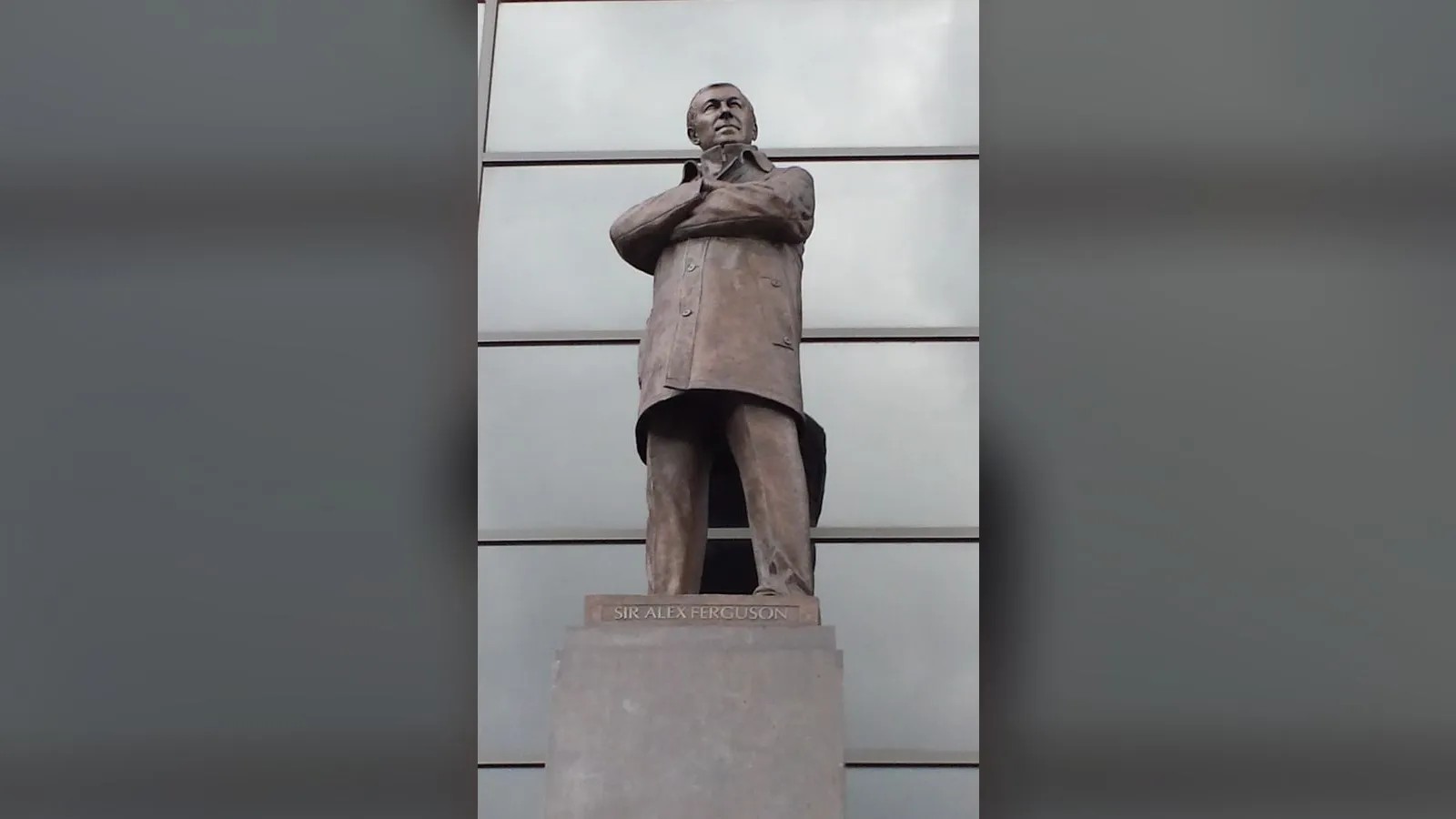

Sir Alex Ferguson (b. 1941)
Contents
TL;DR
- established Ferguson won 38 trophies across nearly 27 years managing Manchester United (1986–2013), including 13 Premier League titles and two UEFA Champions League titles — a body of work widely regarded as among the greatest in football management history.
- established Before Manchester United, he transformed Aberdeen into a genuine European force, winning the 1983 European Cup Winners' Cup by defeating Real Madrid in the final — a remarkable achievement for a club outside Scotland's traditional "Old Firm" of Celtic and Rangers.
- established His early Manchester United tenure came close to failure: a humiliating 1989 defeat prompted fans to unfurl a banner reading "Three years of excuses and it's still crap... ta-ra Fergie," and Ferguson later described that period as "the darkest period I have ever suffered in the game"; a single FA Cup goal in January 1990 is widely credited with saving his job.
- established In 2003, he kicked a loose boot in a dressing-room altercation that struck player David Beckham above the eye, requiring stitches — a well-documented flashpoint that accelerated Beckham's departure from the club.
- established In May 2018, aged 76, he suffered a brain hemorrhage requiring emergency surgery; Manchester United confirmed the procedure "went very well," and he subsequently made a substantial recovery, though the incident was a serious medical emergency reported here plainly rather than glossed over.
Key Facts
- Born
- Alexander Chapman Ferguson, 31 December 1941, Govan, Glasgow
- Playing career
- Forward; Queen's Park, St Johnstone, Dunfermline Athletic, Rangers, Falkirk, Ayr United
- Known for
- Manager of Manchester United, 1986–2013
- Major clubs managed
- East Stirlingshire, St Mirren, Aberdeen, Manchester United, Scotland (national team)
- Honours
- OBE (1985); Knighted (1999); 13 Premier League titles; 2 Champions League titles
- Spouse
- Cathy Holding (m. 1966)
Scottish Impact Index (SI Score)
- Global Influence
- 8/10
- Enduring Relevance
- 8/10
- Material Contribution
- 7/10
- Exceptional Achievement
- 6/10
- Lasting Legacy
- 7/10
- Recognition
- 8/10
44/60
Ranked =25th of 200 in Great Scots
A Note on Claims and Evidence
Ferguson's playing and managerial career, trophies, and major public incidents are extensively documented through club records, contemporary reporting, and his own published memoirs, and are treated as Established. His account of religious discrimination at Rangers reflects his own stated view, given decades later, and is reported as such. His 2018 health emergency is reported plainly and seriously, consistent with house style's commitment to giving such events their proper weight rather than treating them as a footnote to a celebratory career summary.
Timeline
Born in Govan, Glasgow, the son of a shipyard plater's helper.
Playing career across six Scottish clubs, including a joint-top-scorer season at Dunfermline Athletic (1965–66); earns four Scotland caps.
Transfers from Rangers; later states he believed his exclusion from the 1969 Scottish Cup final squad was connected to his marriage to a Catholic.
Begins managerial career at East Stirlingshire, then St Mirren.
Dismissed by St Mirren — the only club ever to sack him — following a contractual dispute; joins Aberdeen the same year.
Wins three Scottish league titles and four Scottish Cups with Aberdeen.
Wins the European Cup Winners' Cup with Aberdeen, defeating Real Madrid in the final.
Awarded the OBE.
Briefly manages Scotland at the World Cup following Jock Stein's death; appointed Manchester United manager in November.
United's form collapses; fans display a banner calling for his dismissal; Ferguson later calls this period the darkest of his career.
An FA Cup win, sparked by a single Mark Robins goal, is widely credited with saving his job; United go on to win the FA Cup.
United win the inaugural Premier League title, ending a 26-year league drought.
Wins the historic Treble (Premier League, FA Cup, Champions League); knighted in the Queen's Birthday Honours.
The "boot incident" with David Beckham in the dressing room.
The Rock of Gibraltar racehorse ownership dispute with shareholders John Magnier and J.P. McManus disrupts his pre-season planning.
Wins a second Champions League title.
Retires at the end of the season, having won the Premier League in his final campaign; Manchester United's longest-serving manager.
Suffers a brain hemorrhage requiring emergency surgery, aged 76; makes a substantial recovery.
Details
A Govan childhood and a playing career before management
Ferguson grew up in a Govan tenement, the son of a shipyard worker, and trained as a toolmaker, serving as a trade union shop steward before football became his full-time career. As a player, he had a respectable rather than exceptional career as a forward across six Scottish clubs, including a standout 1965–66 season at Dunfermline Athletic in which he was joint top scorer in Scotland, and he earned four caps for the Scotland national team. He has stated in a later documentary that he believed his 1969 exclusion from Rangers' Scottish Cup final squad was connected to his marriage to a Catholic, Cathy Holding — a serious allegation of sectarian discrimination reported here as his own stated account, given decades after the events in question.
Aberdeen: breaking the Old Firm's grip
Ferguson's management career began modestly at East Stirlingshire and St Mirren — the latter ending in the only sacking of his career, following a tribunal that found him to have behaved "particularly petty" and "immature" toward office staff during a contractual dispute. His subsequent fourteen years at Aberdeen (1978–1986) represented a genuine footballing achievement: he won three Scottish league titles and four Scottish Cups, breaking the dominance of Celtic and Rangers, and capped the era with the 1983 European Cup Winners' Cup, defeating a Real Madrid side in the final — a result that announced Ferguson as a manager of serious European calibre well before his Manchester United fame.
Near-failure, then transformation, at Manchester United
Ferguson's early years at Manchester United, beginning in November 1986, were marked by genuine struggle rather than steady building toward success. His first match ended in a 2–0 defeat, and results through 1989 were poor enough that fans unfurled a banner reading "Three years of excuses and it's still crap... ta-ra Fergie" after a humiliating 5–1 derby defeat. Ferguson later described this period candidly as "the darkest period I have ever suffered in the game." His job is widely considered to have been saved by a single moment — a Mark Robins goal in a January 1990 FA Cup tie against Nottingham Forest — after which United went on to win the FA Cup that season. The arrival of Eric Cantona in 1992 and the breakthrough of a talented group of young players (the "Class of '92," including David Beckham, Ryan Giggs, Gary Neville, Paul Scholes, and Nicky Butt) helped build the foundation for a run of sustained dominance, despite pundit Alan Hansen's famously mistaken 1995 verdict that "you can't win anything with kids." Over the following two decades, Ferguson's United won 13 Premier League titles and two Champions League titles, including the dramatic 1999 Treble, sealed by two stoppage-time goals against Bayern Munich in the Champions League final — a result Ferguson summed up with the now-famous line, "Football, bloody hell."
Discipline, the "hairdryer," and real conflict
Ferguson's management style was built on intense discipline and psychological pressure, epitomised by the so-called "hairdryer treatment" — forceful, close-range verbal rebukes of underperforming players. This approach produced real, well-documented conflict at points. In February 2003, following a FA Cup defeat to Arsenal, Ferguson kicked a loose boot in the Manchester United dressing room that struck David Beckham above the eye, requiring stitches — an incident both men have since discussed publicly, and one widely understood to have accelerated Beckham's departure from the club that summer. Separately, the 2005–06 "Rock of Gibraltar" dispute — a bitter disagreement over the ownership and stud rights to a champion racehorse Ferguson co-owned with major Manchester United shareholders John Magnier and J.P. McManus — disrupted his pre-season transfer planning and became entangled with the broader, contentious takeover of the club by the Glazer family.
Retirement, health, and legacy
Ferguson repeatedly considered retiring before finally doing so at the end of the 2012–13 season, having won the Premier League title in his final campaign and having become Manchester United's longest-serving manager. In May 2018, aged 76, he suffered a brain hemorrhage requiring emergency surgery; the club confirmed the procedure had gone well, and he subsequently made a substantial recovery, continuing to make public appearances in the years since — a serious medical crisis this article reports plainly rather than treating as incidental to his managerial legacy.
Did You Know?
- He is the only manager ever sacked by St Mirren, following a tribunal dispute early in his career.
- His 1983 European Cup Winners' Cup win with Aberdeen came against Real Madrid — a major European scalp for a club outside Scotland's traditional "Old Firm."
- A single goal by a young Mark Robins in a 1990 FA Cup tie is widely credited with saving Ferguson's Manchester United job during his darkest early period there.
- He won 13 Premier League titles across his Manchester United tenure — more than any other manager in the competition's history.
- The 2003 "boot incident" that cut David Beckham above the eye required stitches and became one of English football's most famous dressing-room flashpoints.
- He trained as a toolmaker and served as a trade union shop steward before becoming a full-time footballer.
- He survived a serious brain hemorrhage in 2018, aged 76, after retiring from management.
- His famous phrase "Football, bloody hell," said after United's dramatic 1999 Champions League win, has become one of the sport's most quoted managerial reactions.
FAQ
1What is Alex Ferguson most famous for?
Managing Manchester United from 1986 to 2013, during which the club won 38 trophies, including 13 Premier League titles and two Champions League titles — one of the most successful tenures in football management history.
2Did he succeed immediately at Manchester United?
No — his early years were genuinely difficult, including a period he later called "the darkest" of his career, before a turnaround beginning around 1990.
3What happened with David Beckham in 2003?
Ferguson kicked a loose boot during a post-match dressing-room exchange, and it struck Beckham above the eye, requiring stitches — a widely reported incident that is understood to have accelerated Beckham's exit from the club.
4Did he manage any club before Manchester United?
Yes — East Stirlingshire, St Mirren (the only club to sack him), and Aberdeen, where he won major domestic and European honours, including the 1983 European Cup Winners' Cup.
5What happened to him in 2018?
He suffered a brain hemorrhage requiring emergency surgery, aged 76. The surgery went well, and he subsequently made a substantial recovery.
6Was he ever Scotland's national team manager?
Briefly, in 1985–86, taking over after Jock Stein's death and leading the team at the 1986 World Cup, before stepping down.
7Has he spoken about discrimination he faced?
Yes — he has said he believed his 1969 exclusion from a Rangers Scottish Cup final squad was connected to his marriage to a Catholic, a serious allegation he has made in his own words.
8Is he still involved in football?
He stepped back from day-to-day involvement following his retirement and 2018 health crisis, though he remains a significant public figure connected to Manchester United and football more broadly.
Sources and Further Reading
Primary/Institutional
Scholarly/Critical
General
Caveats: Myths and Disputed Claims
- Myth: the 2003 Beckham boot incident was a deliberate, targeted assault. Contemporary and later accounts, including from Beckham himself, describe Ferguson kicking a boot in frustration that struck Beckham accidentally, rather than a planned act — though its seriousness (requiring stitches) is not in dispute.
- His account: religious discrimination at Rangers. Ferguson's account of religious discrimination at Rangers is his own stated recollection, given publicly decades after the events described, not independently adjudicated fact.
- Often omitted: his 2018 brain haemorrhage. Shorter career retrospectives sometimes leave it out in favour of purely celebratory trophy summaries.
Finished reading? Try the Fact Machine: three reels, one surprising Scottish connection →
Card 130 · Great Scots