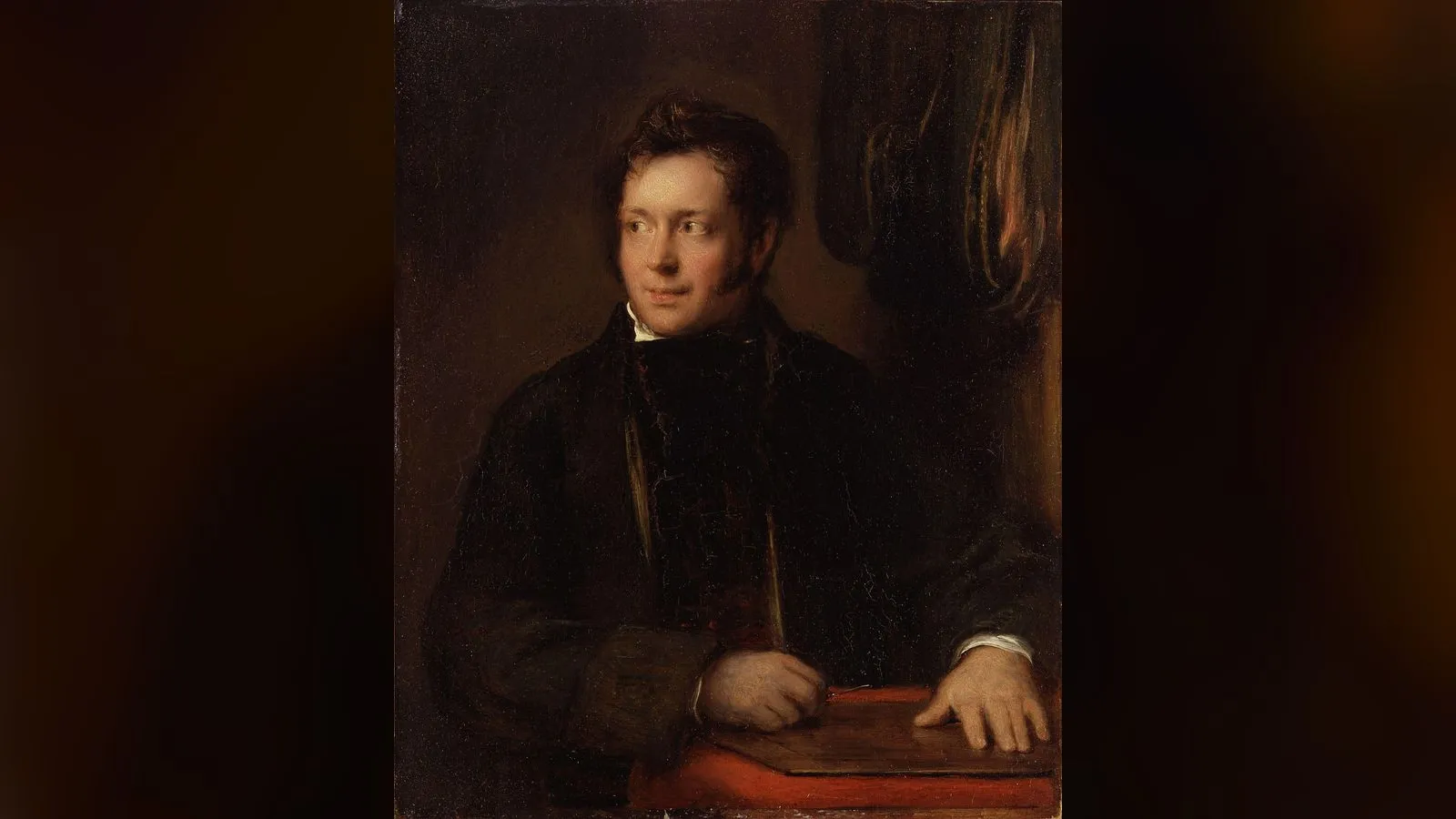

Sir David Wilkie (1785–1841)
Contents
TL;DR
- established Sir David Wilkie was Scotland's leading genre painter of the early 19th century, celebrated as a "people's painter" for vivid, closely observed scenes of ordinary rural and domestic life, most famously The Village Politicians (1806) and The Chelsea Pensioners Reading the Waterloo Dispatch (1822).
- established He rose to the very top of the British art establishment, succeeding Henry Raeburn as Royal Limner for Scotland in 1823 and Sir Thomas Lawrence as Principal Painter in Ordinary to the monarch in 1830, a post he held under both William IV and Queen Victoria, and was knighted in 1836.
- disputed His dramatic later-career shift away from the precise, detailed genre scenes that made his reputation, toward looser, richly coloured historical and Orientalist subjects influenced by Velázquez and his Mediterranean travels, divided contemporary critics and patrons sharply, and remains a genuinely debated chapter of his career rather than a simple decline or improvement.
- established He died at sea off Gibraltar on 1 June 1841, aged 55, during the return leg of a journey through the Middle East, and was buried at sea — a death commemorated in an extraordinary tribute by the great English painter J. M. W. Turner, whose 1842 painting Peace – Burial at Sea depicts the scene.
- established His godson was the novelist Wilkie Collins, named directly after him, and Collins's novel The Moonstone opens with the same historical battle depicted in one of Wilkie's own late paintings — a genuine, documented literary-artistic connection.
Key Facts
- Born
- 18 November 1785, Pitlessie, Fife
- Died
- 1 June 1841 (aged 55), at sea off Gibraltar
- Category
- Culture / Art
- Known for
- The Village Politicians; The Chelsea Pensioners Reading the Waterloo Dispatch; genre painting of rural Scottish and British life
- Training
- Trustees' Academy, Edinburgh; Royal Academy Schools, London
- Royal roles
- Royal Limner for Scotland (1823); Principal Painter in Ordinary (from 1830)
- Honours
- Knighted 1836
Scottish Impact Index (SI Score)
- Global Influence
- 4/10
- Enduring Relevance
- 7/10
- Material Contribution
- 3/10
- Exceptional Achievement
- 6/10
- Lasting Legacy
- 4/10
- Recognition
- 3/10
27/60
Ranked =118th of 200 in Great Scots
A Note on Claims and Evidence
Wilkie's biography, major works, royal appointments, and death are extensively documented through institutional records (including the Royal Academy, the Royal Collection, and Tate), contemporary accounts, and Allan Cunningham's detailed 1843 biography, and are treated here as established. The critical assessment of his later stylistic shift toward historical and Orientalist subjects is a genuine and longstanding matter of art-historical disagreement and is presented as disputed, with both contemporary and later critical views represented rather than resolved.
Timeline
Born in Pitlessie, Fife, son of a parish minister.
His father reluctantly consents to his pursuit of art.
Studies at the Trustees' Academy, Edinburgh, under John Graham.
Paints Pitlessie Fair, an ambitious composition of around 140 figures drawn from his own community.
Moves to London; enrols at the Royal Academy Schools; sells The Village Recruit for £6.
Exhibits The Village Politicians at the Royal Academy to major acclaim, establishing his reputation.
Paints The Blind Fiddler, commissioned by lifelong patron Sir George Beaumont.
Elected an Associate of the Royal Academy at an unusually young age.
Becomes a full Royal Academician.
Paints Blind-Man's Buff, commissioned by the Prince Regent (later George IV).
Tours the continent, visiting Paris and the Louvre; begins Distraining for Rent.
Paints Sir Walter Scott and His Family ("The Abbotsford Family").
Paints The Chelsea Pensioners Reading the Waterloo Dispatch for the Duke of Wellington, commanding 1,200 guineas; travels to Scotland for George IV's state visit.
Appointed Royal Limner for Scotland, succeeding Henry Raeburn.
Travels through Paris, Italy, and Spain, undergoing a profound stylistic transformation influenced by Velázquez and Italian and Spanish masters.
Succeeds Sir Thomas Lawrence as Principal Painter in Ordinary to King William IV, continuing under Queen Victoria.
Knighted.
Paints Queen Victoria Presiding at Her First Council.
Departs on a journey through the Netherlands, Germany, Constantinople, Syria, Smyrna, Jerusalem, and Alexandria.
Dies at sea off Gibraltar, aged 55, after falling ill at Malta on the return voyage; buried at sea.
J. M. W. Turner exhibits Peace – Burial at Sea, commemorating Wilkie's death.
Allan Cunningham publishes a detailed biography of Wilkie, preserving his journals and critical writings.
Details
A minister's son who taught himself to see ordinary life
David Wilkie was born in 1785 in Pitlessie, Fife, the son of a parish minister, and showed an early, persistent artistic inclination that his father only reluctantly permitted him to pursue in 1799. Through the patronage of David Leslie, 6th Earl of Leven, he gained a place at the Trustees' Academy in Edinburgh, studying under John Graham, and developed a habit — noted by contemporaries as unusually dedicated — of sketching at fairs and marketplaces, capturing the characteristic figures and small human incidents of everyday rural life. He drew particular inspiration from earlier Scottish genre painters Alexander Carse and David Allan, whose influence shaped the direction his own work would take. By 1803 he had already won a premium at the Academy for a mythological subject, but it was his close observation of real Scottish life — not classical or historical subject matter — that would define his career.
A rapid rise from a £6 sale to national acclaim
Wilkie's breakthrough came with Pitlessie Fair (1804), an ambitious composition featuring around 140 figures drawn directly from his own neighbourhood and family circle — remarkable ambition and scale for a young, largely self-formed painter. Moving to London in 1805, he initially sold work for modest sums (The Village Recruit fetched just £6), but his fortunes changed dramatically within a year: The Village Politicians, exhibited at the Royal Academy in 1806, attracted major attention and firmly established his reputation as a genre painter of real skill and insight. The Blind Fiddler (1807), commissioned by Sir George Beaumont, who became Wilkie's lifelong friend and patron, confirmed this early success. He was elected an Associate of the Royal Academy in 1809 at an unusually young age and became a full Academician by 1811, a swift ascent through the institution's ranks that reflected genuine, widely recognised talent rather than patronage alone.
The people's painter: precision, warmth, and Dutch influence
Across the following decade and a half, Wilkie produced the body of work for which he remains best known: closely observed, technically meticulous scenes of rural and domestic British life, including The Card Players, Rent Day, and The Ale-House Door (later retitled The Village Festival), the latter purchased by the major collector John Julius Angerstein for 800 guineas. His technique drew clearly on Dutch genre painters, particularly David Teniers and Adriaen van Ostade, combining a sharp, precise, spirited touch with subdued colouring and a clear, silvery grey tonal range, applied with real discipline to scenes of ordinary English and Scottish life. His most celebrated and enduring single work, The Chelsea Pensioners Reading the Waterloo Dispatch (1822), commissioned by the Duke of Wellington himself for 1,200 guineas, remains his best-known painting today and still hangs at Apsley House — a work capturing a moment of shared national emotion with the same observational warmth he had brought to village fairs and family gatherings years earlier.
A dramatic, genuinely contested stylistic transformation
Between 1814 and 1828, extensive continental travel — through France, the Netherlands, and Belgium, and then, decisively, through Italy and Spain between 1825 and 1828 — fundamentally altered Wilkie's artistic direction. Exposure to the Louvre's masterworks, and above all to the paintings of Diego Velázquez during his Spanish travels, produced what contemporary and later critics alike have described as nothing short of a complete change of style. Wilkie abandoned the precisely finished, detailed genre scenes that had made his reputation in favour of a looser, broader technique, with richer, more forceful colour and a far freer handling of paint, applied increasingly to historical and what would now be called Orientalist subject matter drawn from his travels, including The Defence of Saragossa and various scenes from the Spanish guerrilla resistance to Napoleon.
The public and critical reception of this shift was genuinely divided, not a matter of simple acclaim or simple rejection. Many contemporary critics and patrons missed the familiar, closely observed genre subjects of his earlier career and were considerably less willing to follow him into grander historical scenes — a reaction that had real substance, since Wilkie's greatest and most consistent success had indeed come as a genre painter. At the same time, later assessment of individual works from this period, such as The Bride at Her Toilet (1838), has credited them with genuine development and growing mastery of complex colour handling, even where draftsmanship and formal precision sometimes suffered by comparison with his earlier work. This article does not resolve which assessment is correct, since the disagreement reflects a genuine difference in critical values — precision and intimacy versus breadth and ambition — rather than a question with a single settled answer.
Royal favour at the highest level
Alongside this artistic evolution, Wilkie's institutional standing continued to rise. In 1823 he succeeded Henry Raeburn as Royal Limner for Scotland, and in 1830 succeeded the celebrated portraitist Sir Thomas Lawrence as Principal Painter in Ordinary — first to King William IV and then, following Victoria's accession, to the young Queen herself, for whom he painted Queen Victoria Presiding at Her First Council (1838). He was knighted in 1836, confirming his position at the very top of the British artistic establishment. Not every royal commission went smoothly: his painting of George IV's 1822 state visit to Scotland, The Reception of the King at the Entrance of Holyrood Palace, proved a genuinely difficult and uncongenial commission that strained his health during its execution and was considered unsatisfactory once finished — a reminder that royal favour did not guarantee artistic satisfaction, for either the painter or his patrons.
A final journey east, illness, and death at sea
In autumn 1840, at the age of 55, Wilkie embarked on an ambitious journey through the Netherlands and Germany to Constantinople, where war in Syria delayed him and he painted the young Sultan Abdülmecid I, before continuing on to Smyrna and Jerusalem, where he remained five weeks, and finally to Alexandria, where he completed a portrait of Muhammad Ali Pasha — his final finished work. The return voyage proved fatal: Wilkie fell seriously ill at Malta and remained incapacitated for the remainder of the journey, dying at sea off Gibraltar on the morning of 1 June 1841, at the age of 55. In accordance with the practical necessities of a death at sea, his body was committed to the deep in the Bay of Gibraltar rather than returned for burial on land.
His death was commemorated in an extraordinary and unusual tribute: the celebrated English Romantic painter J. M. W. Turner, a contemporary rather than a close personal associate, painted Peace – Burial at Sea, first exhibited in 1842, depicting the scene of Wilkie's burial with a deliberately restrained palette of white, blue, and black, conceived explicitly as a visual counterpart to the theme of peace, in contrast to a companion piece on the theme of war shown the same year. The painting, now held at Tate Britain as part of the Turner Bequest, stands as a rare instance of one major 19th-century British painter publicly and movingly memorialising another through his own art.
A lasting literary connection
Wilkie's legacy extends into literature in a specific, documented way: his godson was the novelist Wilkie Collins, named directly after him (Collins's full name combined Wilkie and his own father, the painter William Collins, a fellow Royal Academician and friend of Wilkie's). The connection runs deeper than naming alone — Collins's novel The Moonstone opens with an account of the historical battle depicted in one of Wilkie's own late paintings, General Sir David Baird Discovering the Body of Sultan Tippoo Sahib (1839), a genuine and specific artistic inheritance passed from painter to novelist godson.
Did You Know?
- David Wilkie's first notable London sale, The Village Recruit, fetched just £6 — a fraction of the sums his later work would command.
- The Chelsea Pensioners Reading the Waterloo Dispatch earned Wilkie 1,200 guineas directly from the Duke of Wellington and still hangs at Wellington's own home, Apsley House.
- His later-career stylistic shift toward historical and Orientalist subjects, influenced by Velázquez, genuinely divided contemporary critics — some considered it a loss, others a development.
- He died at sea off Gibraltar in 1841 and was buried in the Bay of Gibraltar rather than on land.
- J. M. W. Turner commemorated Wilkie's death with the painting Peace – Burial at Sea (1842), now at Tate Britain.
- Wilkie's godson, novelist Wilkie Collins, was named directly after him.
- Collins's novel The Moonstone opens with the same historical battle depicted in one of Wilkie's own late paintings.
- Wilkie succeeded both Henry Raeburn (as Royal Limner for Scotland) and Sir Thomas Lawrence (as Principal Painter in Ordinary) in two of the most prestigious posts in British art.
FAQ
1What is Sir David Wilkie best known for?
His vivid genre paintings of ordinary rural and domestic life, especially The Village Politicians (1806) and The Chelsea Pensioners Reading the Waterloo Dispatch (1822).
2How did David Wilkie die?
He died at sea off Gibraltar on 1 June 1841, aged 55, after falling ill at Malta during the return leg of a journey through the Middle East, and was buried at sea.
3Did another famous painter commemorate David Wilkie's death?
Yes — J. M. W. Turner painted Peace – Burial at Sea (1842), depicting Wilkie's burial, now held at Tate Britain.
4Was David Wilkie's later work well received?
This is genuinely disputed. His shift toward looser, more colourful historical and Orientalist subjects divided contemporary critics; some saw it as a decline from his earlier precision, others as genuine artistic development.
5What royal positions did David Wilkie hold?
Royal Limner for Scotland (from 1823, succeeding Henry Raeburn) and Principal Painter in Ordinary to the British monarch (from 1830, succeeding Sir Thomas Lawrence), serving under William IV and Queen Victoria.
6Is David Wilkie connected to the novelist Wilkie Collins?
Yes — Collins was Wilkie's godson and was named directly after him; Collins's novel The Moonstone opens with the same historical battle depicted in one of Wilkie's late paintings.
7Was David Wilkie knighted?
Yes, in 1836, in recognition of his standing as one of Britain's leading painters.
8Where did David Wilkie travel in his final years?
Through the Netherlands, Germany, Constantinople, Syria, Smyrna, Jerusalem, and Alexandria, painting portraits including the Ottoman Sultan Abdülmecid I and Muhammad Ali Pasha.
9What influenced David Wilkie's later painting style?
Extensive travel through Italy and Spain between 1825 and 1828, and particularly his exposure to the work of Diego Velázquez.
Sources and Further Reading
Institutional
- Tate, artist biography and collection records for Sir David Wilkie
- Royal Academy of Arts, membership and exhibition records
- National Portrait Gallery, biographical entry for Sir David Wilkie
- Royal Collection Trust, records of Wilkie's royal commissions
Scholarly / Critical
- Allan Cunningham, The Life of Sir David Wilkie (1843), the principal early biography, drawing on Wilkie's own journals
- Art-historical commentary on the critical reception of Wilkie's late stylistic shift
General
- Wikipedia, "David Wilkie (artist)" (overview, cross-checked against institutional sources above)
- Wikipedia, "Peace – Burial at Sea," on Turner's commemorative painting
- Art UK, "Wilkie, David, 1785–1841"
Caveats: Myths and Disputed Claims
- Disputed: Wilkie's later style. Whether his later shift towards historical and Orientalist subjects represented artistic decline or genuine development is a long-standing, unresolved critical disagreement.
- Myth: Wilkie's burial at sea was a planned or symbolic choice. His burial at sea near Gibraltar was a practical necessity following his death during an ocean voyage, though it later became the subject of Turner's memorial painting.
- Myth: Wilkie was purely a genre painter throughout his career. His later decades were dominated by historical, royal and Orientalist subject matter, a substantial and deliberate departure from the genre scenes that first made his name.
Finished reading? Try the Fact Machine: three reels, one surprising Scottish connection →
Card 111 · Great Scots