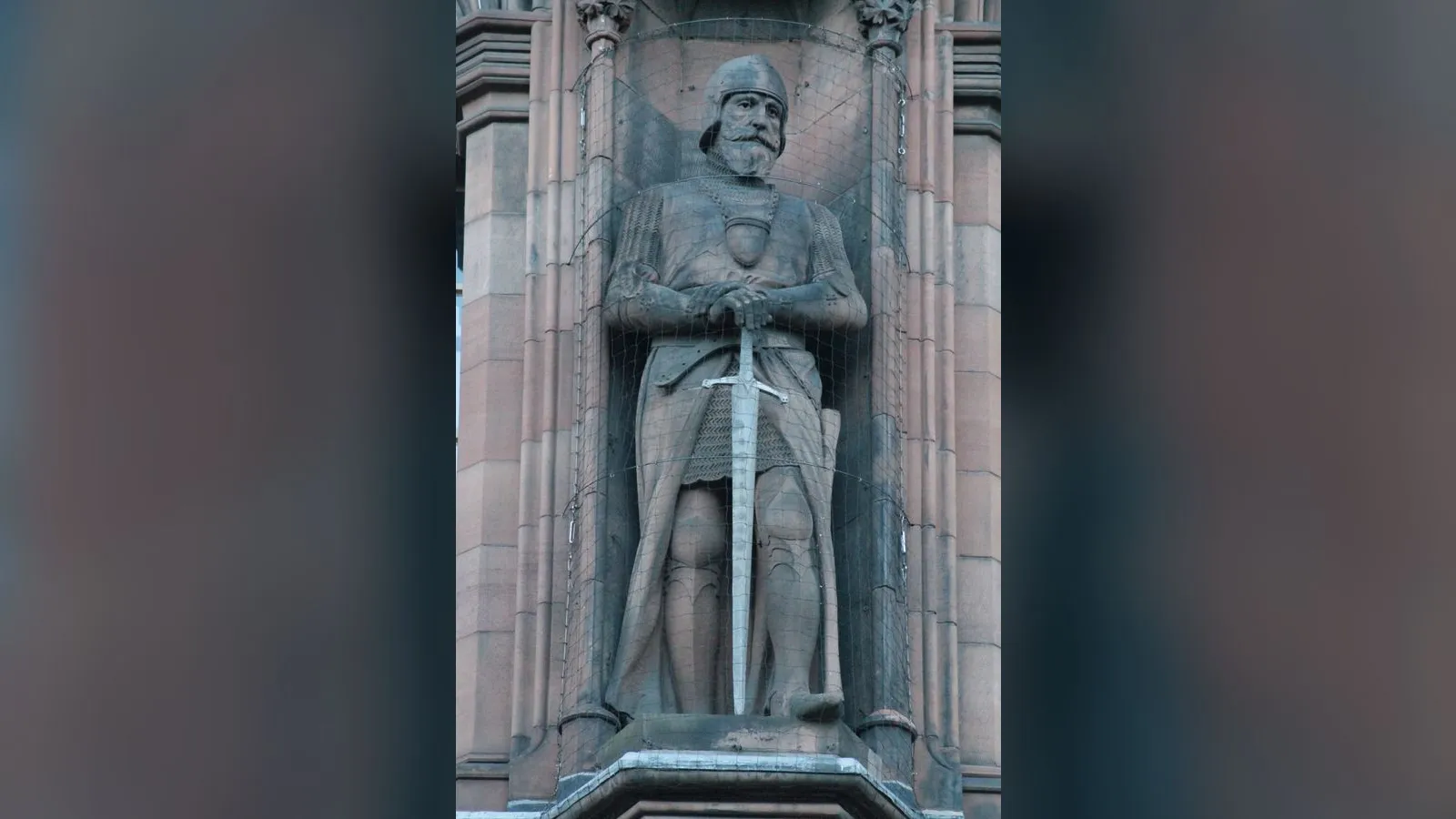

Sir James Douglas, "the Black Douglas"
Contents
Sir James Douglas was Robert the Bruce's most trusted commander: "Good Sir James" to the Scots and "the Black Douglas" to the English, who feared him more than any other Scottish raider. He won back his own castle, took Roxburgh by night, fought at Bannockburn and nearly captured the young Edward III. After Bruce's death he carried the king's heart on crusade and was killed in Spain in 1330. This card tests which of his famous exploits are documented, and which come mainly from John Barbour's poem The Brus.
TL;DR
- established James Douglas was born around 1286, the son of Sir William Douglas "le Hardi", who joined Wallace's rising in 1297 and died a prisoner in the Tower of London. The Douglas lands were given to an English supporter.
- established Educated in Paris, James joined Robert the Bruce around 1306 and became one of his leading commanders.
- established He recaptured Douglas Castle in 1307 (the "Douglas Larder"), took Roxburgh Castle in February 1314, fought at Bannockburn, and led the 1327 Weardale campaign that helped force England to make peace in 1328.
- established After Bruce's death in 1329 he carried the king's embalmed heart on crusade and was killed fighting the Moors at Teba in Spain on 25 August 1330.
- shared The origin of the name "Black Douglas" is disputed, and many dramatic details of his life come from Barbour's The Brus, written about 45 years after his death.
Key Facts
- Born
- c.1286
- Father
- Sir William Douglas "le Hardi", died in the Tower of London, c.1298
- Educated
- Paris
- Joined Bruce
- c.1306
- Douglas Larder
- 1307 (some sources 1308)
- Roxburgh Castle taken
- February 1314 (dates vary)
- Bannockburn
- 24 June 1314
- Weardale campaign
- July–August 1327
- Treaty of Edinburgh–Northampton
- 1328
- Died
- 25 August 1330, Battle of Teba, Spain
- Main source
- John Barbour, The Brus, c.1375
Scottish Impact Index (SI Score)
- Global Influence
- 3/10
- Enduring Relevance
- 8/10
- Material Contribution
- 2/10
- Exceptional Achievement
- 5/10
- Lasting Legacy
- 3/10
- Recognition
- 3/10
24/60
Ranked =143rd of 200 in Great Scots
A Note on Claims and Evidence
Each major claim carries one of three labels. established means supported by primary records, official bodies or several independent reliable sources. shared means the core fact is sound but sources disagree on details, dates or interpretation. traditional means widely repeated but not traceable to a primary or independent source.
Douglas's career is confirmed in outline by English chronicles such as Lanercost and by the continental chroniclers Jean le Bel and Froissart. But most of the vivid detail comes from Barbour's The Brus, a patriotic poem composed around 1375 for the Stewart court. Historians treat its broad narrative as reliable and its dramatic episodes with caution. Several dates, including those of the Douglas Larder and the capture of Roxburgh, differ between sources.
Timeline
James Douglas is born.
His father joins Wallace's rising and is imprisoned in the Tower of London.
His father dies in prison; the Douglas lands are forfeited to Robert Clifford.
Douglas joins Robert the Bruce.
Douglas retakes Douglas Castle: the "Douglas Larder".
Douglas captures Roxburgh Castle by night.
Douglas fights at Bannockburn.
Douglas leads raids deep into northern England.
The Weardale campaign; Douglas raids the English camp and nearly captures Edward III.
The Treaty of Edinburgh–Northampton recognises Scottish independence.
Robert the Bruce dies.
Douglas sets out with Bruce's heart.
Douglas is killed at Teba in Spain.
John Barbour writes The Brus.
Details
1. Origins and Family
James Douglas was born around 1286 — the exact date is unrecoverable because medieval Scottish records were so heavily destroyed, but historians fix it before late 1288 (when his father remarried). He was the eldest son of Sir William Douglas, nicknamed "le Hardi" ("the Bold" or "the Hardy"), and Elizabeth Stewart, a daughter of Alexander Stewart, 4th High Steward of Scotland. (Some older popular sources call her "Elizabeth Stewart of Bonkill" and a sister of Walter Stewart; the genealogy of the Stewart connection is sometimes muddled in popular accounts, but the family's close kinship to the High Stewards is not in doubt and proved politically important.) The Douglas family took its name and its principal lands from Douglasdale in Lanarkshire, around 20 miles south of Glasgow; the name itself derives from Gaelic dubh glas, "dark water/stream," after the Douglas Water.
William the Hardy was a turbulent, combative figure. In 1297 he became the first nobleman to join William Wallace's rising against Edward I, having earlier been imprisoned and forced to submit to English authority. After Wallace's success at Stirling Bridge, William was again taken prisoner; he was committed to the Tower of London on 12 October 1297 and died there, most sources say in early 1298, as a result of his harsh imprisonment — a specific and widely repeated tradition gives 24 January 1298, "due to mistreatment." Dates of 1298 and 1302 both appear in popular sources, but the weight of evidence supports 1298. (Note: the persistent claim that William was "hung, drawn and quartered" is a confusion with William Wallace's fate; the sources indicate William Douglas died in prison, not by execution.)
With his father dead a traitor in English eyes, the young James lost everything: the Douglas lands were granted to Robert Clifford, an English supporter of Edward I. James had been sent abroad for safety in the early years of the war and was educated in Paris. He returned to Scotland in the household of William Lamberton, Bishop of St Andrews, who took him on as a squire (some sources say "carver"). Lamberton presented James at the English-occupied court — probably around 1304, after the fall of Stirling Castle — to petition for the return of his inheritance. When Edward I learned whose son the young man was, he reacted with anger and the petition was refused. That refusal, as more than one historian has observed, helped push James Douglas decisively toward rebellion.
2. The "Black Douglas" Nickname — Etymology and Uncertainty
The origin of the by-name "Black Douglas" is genuinely disputed, and a careful article should present the competing theories rather than asserting one:
- Dark colouring. The most commonly repeated explanation is that James had a dark or swarthy complexion and black hair. This finds some support in John Barbour's portrait (see section 6), which describes him as "sumdeill gray" (somewhat grey/swarthy) in the face with black hair. However, scholars caution that linking the by-name directly to complexion is "tenuous" and "unsubstantiated."
- English fear and opprobrium. A second view holds that the English applied "the Black" as a term of dread for what they saw as his dark, ruthless deeds — Barbour records that the English called him "the blak Dowglas." Crucially, "the Black" appears essentially only in English sources; Scottish chronicles almost always call him "the Good" ("the Guid"). This asymmetry is the strongest clue to the name's meaning: it was a name his enemies gave him.
- Heraldry. A third, weaker theory connects the name to the family's colours. The Douglas arms are usually blazoned "argent, on a chief azure, three mullets [stars] of the field" (silver with a blue band bearing three silver/white stars) — not a black-and-silver scheme — so the heraldic explanation does not fit the actual Douglas blazon well and should be treated with scepticism. (The famous crowned/bloody heart was added to the Douglas arms only after James's death, in memory of his carrying Bruce's heart.)
There is also a celebrated English nursery rhyme/lullaby in which "the Black Douglas" is a bogeyman used to frighten children: "Hush ye, hush ye, little pet ye / Hush ye, hush ye, do not fret ye / The Black Douglas shall not get ye." This should be flagged carefully: while it captures a genuine medieval reality (Douglas terrified the northern English, and contemporary chronicles confirm this), the specific verse as we have it is associated with Sir Walter Scott in the 19th century, and there is no solid evidence the rhyme survives verbatim from the 14th century. Treat it as an evocative tradition, very possibly later in its surviving form, not as a documented contemporary text.
Finally — and this matters for accuracy — readers should not confuse James Douglas with the later "Black Douglases." James was the founder of the senior Douglas line, but the term "the Black Douglases" is normally used by historians for the 15th-century Earls of Douglas, an over-mighty magnate dynasty destroyed by James II in the 1450s and distinguished from the "Red Douglases" (Earls of Angus). James the Good belongs to the early 14th century; the political faction called "the Black Douglases" is a later development of his family.
3. Meeting Robert the Bruce and the Alliance
Robert the Bruce killed his rival John "the Red" Comyn before the high altar of the Greyfriars church in Dumfries on 10 February 1306 and had himself crowned King of Scots at Scone on 25 March 1306. Tradition — drawn from Barbour — has it that James Douglas intercepted Bruce on the road (often placed near Ericstane/Moffat, on the way to the coronation), riding a horse borrowed from Bishop Lamberton, and offered his service; he is said to have been present at the coronation and fought with Bruce at the disastrous Battle of Methven in June 1306.
It is worth being honest that Barbour's version — the instant, romantic pledge of loyalty — is a patriotic simplification. Douglas's motives were a mixture of personal grievance (the Cliffords held his ancestral lands) and hard political calculation: a landless, disinherited young noble had little to lose and much to gain by backing Bruce. What is not in doubt is that, once committed, Douglas became utterly loyal. He shared Bruce's lowest moments — defeat, flight and outlawry — and rose to become arguably the king's most important commander. The relationship combined feudal service, kinship (through the Stewart connection) and genuine personal devotion; it became one of the great partnerships of Scottish history.
4. Military Career and the Wars of Independence (1306–1328)
The Douglas Larder (1307). In 1307 Douglas returned to his own Douglasdale to strike at the English garrison holding Douglas Castle. According to Barbour, on Palm Sunday — which fell on 19 March 1307 — when the garrison left the castle to attend mass at the church of St Bride, Douglas and a small band of local supporters fell on them with the war-cry "Douglas! Douglas!" The garrison were killed or captured; the prisoners were beheaded, the castle's food stores and wine were heaped together in the cellar with the bodies and dead horses, the lot was set ablaze, and the well was poisoned with salt and carcasses. The grim episode became known as "the Douglas Larder." Because Douglas could not hope to hold the castle, the point was scorched-earth deterrence. Two cautions: (1) the date is disputed — some historians prefer Palm Sunday 1308 (17 April), though Barbour's 1307 is defensible; (2) the lurid detail rests heavily on Barbour, and this was reportedly the first of three assaults Douglas made on his own castle before it was finally destroyed.
Guerrilla warfare. Through 1307–08 Douglas used Selkirk Forest as a base for highly mobile raids, ambushes and "secret war," tying down English forces in the south while Bruce campaigned in the north. He helped win the Battle of the Pass of Brander against the MacDougalls (1308) by leading a flanking party over the mountain. His men typically rode small, hardy horses (hobbins), dismounting to fight — the "hobelars" who would terrify northern England.
Roxburgh Castle (February 1314). One of the most celebrated exploits in Scottish military history. On the night of Shrove Tuesday — most accounts give 19 February 1314, though sources differ between 19 and 27 February and Historic Environment Scotland has dated the event to 1313 — Douglas and a small force covered themselves in black cloaks and crawled on hands and knees toward the great border fortress. In the dark, a sentry mistook the dark shapes for cattle/oxen left out late. The Scots reached the walls undetected, threw up rope ladders with grappling hooks, and overwhelmed the garrison, who were celebrating before the Lenten fast. The castle was then slighted (destroyed) in line with Bruce's policy of denying strongholds to the English. (The cattle-disguise detail comes essentially from Barbour, though other chroniclers confirm the surprise night assault.)
Bannockburn (24 June 1314). Douglas fought at Bruce's great victory. Traditional Scottish accounts (following Barbour) say he commanded the left/vanguard division nominally under the young Walter Stewart; he was knighted around the time of the battle (many scholars think he was made a knight banneret, entitled to fight under his own banner). Modern historians caution that contemporary English accounts describe the Scottish army in three divisions, so the idea that Douglas commanded a separate division of his own may be a later embellishment; he more likely acted as a sub-commander attached to the king's force. After the English collapse, Douglas requested and received the honour of pursuing the fleeing Edward II. He chased the king so relentlessly — Barbour says the fugitives had no leisure even "to make water" — that Edward barely escaped, reaching Dunbar and a ship. Douglas's force was far too small to attack the royal party directly.
Border war and raids (1314–1322). After Bannockburn, Douglas became the master of the "war of the borders," raiding deep into northern England as far as Yorkshire. He won notable fights at Skaithmuir (1316) — which he reckoned his hardest ever — and Lintalee, helped take Berwick in 1318 (the first time it had been Scottish since 1296), and shared in the Scottish victories at Myton (1319, the "Chapter of Myton," so called for the many clergy killed) and Old Byland (1322), which sent Edward II and Queen Isabella fleeing. He was made Lieutenant/Guardian of the realm in the king's absences and was named in the succession/guardianship provisions for the heir. In all, Douglas and his colleagues captured or destroyed a string of major castles — Douglas, Roxburgh and others — as part of Bruce's deliberate policy of slighting fortresses; popular accounts credit Douglas with taking or destroying many castles over his career, and his by-name became a byword for the fall of English strongpoints.
The Weardale Campaign (1327). After Edward II was deposed and the teenage Edward III installed under Isabella and Mortimer, the Scots resumed raiding. In July–August 1327 a fast-moving Scottish army under Douglas, Moray and the Earl of Mar ran rings around a large, lavishly equipped English army in Weardale. On the night of 3–4 August, Douglas led a daring raid right into the English camp at Stanhope Park, cutting tent-ropes and reaching the very tent of the young king before escaping — Edward III very nearly captured. The Scots then slipped away unmolested. The campaign was a strategic humiliation for England and ruinously expensive: it cost the English crown roughly £70,000 (against a total annual royal income of about £30,000), and the north of England was so thoroughly looted that extensive tax exemptions had to be granted. Contemporary English opinion judged the campaign "to the great shame, dishonour, and scorn of all England," and Edward III is said to have wept in frustration at the Scots' escape.
The Treaty of Edinburgh–Northampton (1328). With the English exchequer exhausted and unable to stop the raids, Isabella and Mortimer's government sued for peace. The treaty was signed in Edinburgh by Bruce on 17 March 1328 and ratified by the English Parliament at Northampton on 1 May 1328; it renounced English claims of overlordship and recognised Robert the Bruce as king of an independent Scotland — and was so resented in England that it became widely known as the turpis pax, "the shameful peace." It was the diplomatic fruit of the military pressure men like Douglas had applied for two decades.
5. The Heart of Bruce
Robert the Bruce died on 7 June 1329 at Cardross, probably of a long illness often described as leprosy. He had long wished to go on crusade and never been able to. On his deathbed he asked that his heart be taken on crusade after his death. The sources differ on the exact wish: the contemporary Walloon/French chronicler Jean le Bel says Bruce wanted his heart presented at the Church of the Holy Sepulchre in Jerusalem, while Barbour says more modestly that the heart should be carried in battle against "God's foes." Since Jerusalem had been in Muslim hands since 1187, the second version is the more practical and probably more accurate.
Sir James Douglas was chosen for the task. Bruce's embalmed heart was placed in a silver (and enamelled) casket, which Douglas wore around his neck. Early in 1330 he set out from Berwick; according to the contemporary chronicler Jean le Bel, his company consisted of one knight banneret, six ordinary knights and twenty esquires. They sailed first to Sluys in Flanders, then on to Spain, where King Alfonso XI of Castile was campaigning against the Muslim Emirate of Granada — Douglas carried a safe-conduct from Edward III and a letter of introduction to Alfonso. Douglas and his company joined Alfonso's army at the siege of the castle of Teba in Andalusia.
Douglas was killed at Teba on 25 August 1330. The sources disagree on exactly how. Froissart and the Gran Crónica de Alfonso XI suggest he was killed making a premature or over-extended attack, possibly in fighting over access to water; Barbour describes a grand but vaguely located battle in which Douglas, having outrun his men in pursuit of a feigned-retreating enemy, was cut off and surrounded while trying to rescue a comrade (Sir William St Clair), and killed alongside several companions including the brothers Logan. The famous dying cry — throwing the casket ahead of him with words like "Go first, brave heart, as thou wast wont, and I will follow thee or die" — is a later, poetic embellishment and should not be presented as documented fact.
After the battle, Douglas's bones (the flesh boiled off, in the medieval custom for transporting the dead over long distances) and Bruce's heart were recovered and brought back to Scotland by Sir William Keith of Galston, who had missed the battle with a broken arm. Douglas's bones were buried at St Bride's Kirk in Douglas, Lanarkshire. Bruce's heart was interred at Melrose Abbey. (The tradition that Sir Simon Locard/Lockhart of the Lee was in the company is not supported by the early sources and should be treated as later legend.)
The heart's modern story is well documented. A conical lead casket was found beneath the Chapter House floor at Melrose in 1921, photographed, and reburied. It was rediscovered during a Historic Scotland excavation in 1996, examined (but not opened — an endoscope confirmed a heart-shaped object inside), and on 22 June 1998 it was reburied at Melrose Abbey. On 24 June (the anniversary of Bannockburn) the Scottish Secretary of State, Donald Dewar, unveiled a memorial stone over the site; its inscription, taken from Barbour's The Brus, reads "A noble hart may have nane ease, gif freedom failye." Historic Scotland was careful in its claims: "It is not possible to prove absolutely that it is Bruce's heart. But it is reasonable to assume that it is" — there are no records of any other heart buried at Melrose, though the practice of heart-burial was common and the Chapter House is an unusual spot for a king.
6. The Sources — John Barbour's "The Brus"
The single most important source for Douglas's life is John Barbour's epic poem The Brus (or The Bruce), composed around 1375 — roughly 45 years after Douglas's death. Barbour (c.1320–1395) was Archdeacon of Aberdeen and a member of the household of King Robert II, the first Stewart king and Bruce's grandson. He received royal rewards (a gift of £10 in 1377 and a pension) for the work. This patronage matters: the poem was, in part, designed to glorify Bruce and the Stewart dynasty's heroic forebears. Its avowed twin heroes are Bruce and "Good Sir James" Douglas, "the flowers of Scottish chivalry."
What this means for reliability: The Brus is a patriotic romance as much as a history, and it idealises chivalry, loyalty and freedom. Modern scholars (A.A.M. Duncan, whose 1997 Canongate edition is standard; and others) treat the broad narrative as broadly reliable — the campaigns, castle names, the sequence of events, the major battles — because Barbour drew on a now-lost life of Douglas and on chronicle material, and wrote within living memory of some participants. But the dramatic specifics should be handled with care: the exact words of speeches, deathbed commands, the precise numbers of armies (Barbour is prone to exaggeration), miraculous escapes, and one-on-one combats are where poetic licence is greatest. Where Barbour can be checked against English sources (such as the Vita Edwardi Secundi or the Lanercost Chronicle), the outline usually holds, but the colour does not always.
7. Character and Reputation
Douglas's reputation is a study in contradictions, captured neatly by his two names. To Scots he was "Good Sir James"; to the English he was "the Black Douglas." Barbour gives one of the earliest character portraits in Scottish literature, and its details are worth quoting with their source clearly flagged. In Book I, Barbour writes that Douglas "wes nocht so fayr" (was not so handsome), was "sumdeill gray" in the face with "blak har" (black hair), "weill maid" with "banys gret, and schuldrys braid" (great bones and broad shoulders) and a lean body; that when content he was "lufly, and meyk and sweyt in cumpany" (lovable, meek and sweet in company) but wore "all othir contenance" in battle; and — a striking, humanising detail — that "in spek wlispyt he sumdeill, / Bot that sat him rycht wondre weill" (in speech he lisped somewhat, but it became him wondrously well). Barbour twice likens him to Hector of Troy, noting Hector too "wlispyt." These are Barbour's words, written decades later and admiringly, so they are best presented as Barbour's portrait rather than as forensic fact.
The fear he inspired in England, by contrast, is corroborated by hostile contemporary sources. The Lanercost Chronicle, written from the much-raided English border, treats Douglas with dread; Barbour records that the English thought him "mair fell than wes ony devill in hell" ("more fierce than any devil in hell"). His was the name with which (in later tradition) northern mothers frightened their children. He was beloved by his own people and terrifying to the enemy population — both reputations earned, and both, in part, deliberately cultivated as instruments of war. (One caution: the oft-repeated line that Edward II personally called Douglas "the most terrible" of Scotland's commanders is not a documented quotation; Douglas was genuinely the most-feared Scottish raider in English eyes, but the specific royal quote should not be presented as fact.)
8. Legacy
James Douglas's family's rise was the true making of the house of Douglas. War, as historian Michael Brown argues in The Black Douglases (the standard modern academic study of the family), was the making of the dynasty: the lands, lordships and prestige Douglas won in the border wars launched his kin toward becoming the greatest magnate dynasty of late-medieval Scotland. His descendants and collaterals became Earls of Douglas (the "Black Douglases") and Earls of Angus (the "Red Douglases"); the Black Douglases grew so powerful they were eventually destroyed by James II in the 1450s. The crowned/bloody heart of Bruce, which the family put on its shield in memory of James's last journey, became the enduring emblem of the Douglases.
Culturally, James Douglas is one of the central figures of Scottish historical memory — second only to Bruce and Wallace among the heroes of the Wars of Independence. He is a co-hero of Barbour's Brus, the foundational text of Scottish literature; he features in Sir Walter Scott (Castle Dangerous, Tales of a Grandfather) and in modern film (portrayed by Aaron Taylor-Johnson in Outlaw King, 2018). The Douglas Larder and the cattle-disguised storming of Roxburgh endure as emblems of Scottish guerrilla ingenuity and audacity, and the journey of Bruce's heart remains one of the most romantic stories in the national tradition. In the Spanish town of Teba, where he fell, his sacrifice is still honoured: Teba and Melrose have been twinned since 1987, a monolith commemorating Douglas stands in the town, the central square has been renamed the Plaza Douglas with a granite monument to Bruce and Douglas, and the town holds annual "Douglas Days" each August.
Did You Know?
- David Hume of Godscroft's History of the Houses of Douglas and Angus (published 1643–44) is ostensibly a family history, but David Allan calls it "really a full-scale history of Scotland". Douglas genealogies of the 1620s claimed the name went back to AD 767, probably to outdo English rivals at the Stuart court (Allan, 2002).
- The English used "the Black Douglas" as a bogeyman to scare children — the rhyme "Hush ye, hush ye … the Black Douglas shall not get ye" is the medieval equivalent of "the bogeyman will get you." (Its surviving form is linked to Sir Walter Scott, so flag it as tradition.)
- Douglas and his men captured the mighty Roxburgh Castle by crawling up to the walls on hands and knees disguised as cattle in the dark.
- The "Douglas Larder" got its grim name because Douglas piled the slain English garrison together with the castle's food, drink and dead horses before burning the lot and poisoning the well.
- According to Barbour, Douglas had a slight lisp — and the poet thought it suited him "wondrously well."
- After Bannockburn, Douglas chased the fleeing King Edward II so hard that (Barbour says) the English had no time even to relieve themselves.
- In 1327 Douglas led a midnight raid right into the English camp and reached the tent of the teenage Edward III, who barely escaped capture; the Weardale fiasco cost England around £70,000 against an annual royal income of about £30,000.
- Douglas died carrying Robert the Bruce's heart in a silver casket on his way to (notionally) the Holy Land — fighting Moors in Spain.
- Bruce's heart was dug up at Melrose Abbey in 1921, lost track of, rediscovered in 1996, and finally reburied in 1998 beneath a stone reading "A noble hart may have nane ease, gif freedom failye."
- The Spanish town of Teba, where Douglas fell, has been twinned with Melrose since 1987 and holds annual "Douglas Days."
FAQ
1Why was he called "the Black Douglas"?
Nobody knows for certain. Explanations include his dark colouring and English fear of his deeds; the name appears mainly in English usage.
2What was the Douglas Larder?
His recapture of Douglas Castle in 1307, when, according to Barbour, he piled the dead garrison with the castle's stores and burned them.
3How did he take Roxburgh Castle?
According to Barbour, his men crept up to the walls at night disguised as cattle and climbed in with rope ladders.
4Did he fight at Bannockburn?
Yes, though whether he commanded a division of his own is uncertain.
5What happened at Weardale?
In 1327 his army outmanoeuvred a much larger English force, and he led a night raid that nearly reached Edward III.
6Why did he go to Spain?
He was carrying Robert the Bruce's heart on crusade, as Bruce had wished.
7How did he die?
Fighting the Moors at Teba on 25 August 1330; accounts differ on exactly how.
8Where is Bruce's heart now?
A heart in a lead casket is buried at Melrose Abbey. It is reasonable to assume it is Bruce's, but it is not proven.
9Is the "Hush ye, hush ye" lullaby medieval?
Its surviving form is linked to Sir Walter Scott; its medieval origin is unproven.
10Is he one of "the Black Douglases"?
Historians usually use that name for his 15th-century descendants, the Earls of Douglas.
Sources and Further Reading
Scholarly/Critical
- David Allan, "Pedigree and Propaganda in Seventeenth-Century Scotland", in Edward J. Cowan and Richard J. Finlay (eds), Scottish History: The Power of the Past (Edinburgh University Press, 2002)
Further reading
- John Barbour, The Bruce, ed. A. A. M. Duncan (Canongate, 1997)
- Michael Brown, The Black Douglases: War and Lordship in Late Medieval Scotland, 1300–1455 (Tuckwell Press, 1998)
Caveats: Myths and Disputed Claims
- Disputed: the origin of the name "Black Douglas". There is no single certain origin.
- Myth: the "Hush ye, hush ye" lullaby is medieval. It is not.
- Disputed: the dates of the Douglas Larder and the Roxburgh capture. Neither is certain.
- Disputed: whether Douglas commanded his own division at Bannockburn. It is not certain.
- Myth: Douglas gave a "brave heart, lead on" speech. It is not historical.
- Disputed: the Melrose heart. It is not proven to be Bruce's.
- Myth: Douglas's father was executed. He died in prison.
- Myth: Edward II called Douglas the most terrible Scottish commander. No such quotation is documented.
Finished reading? Try the Fact Machine: three reels, one surprising Scottish connection →
Card 009 · Great Scots