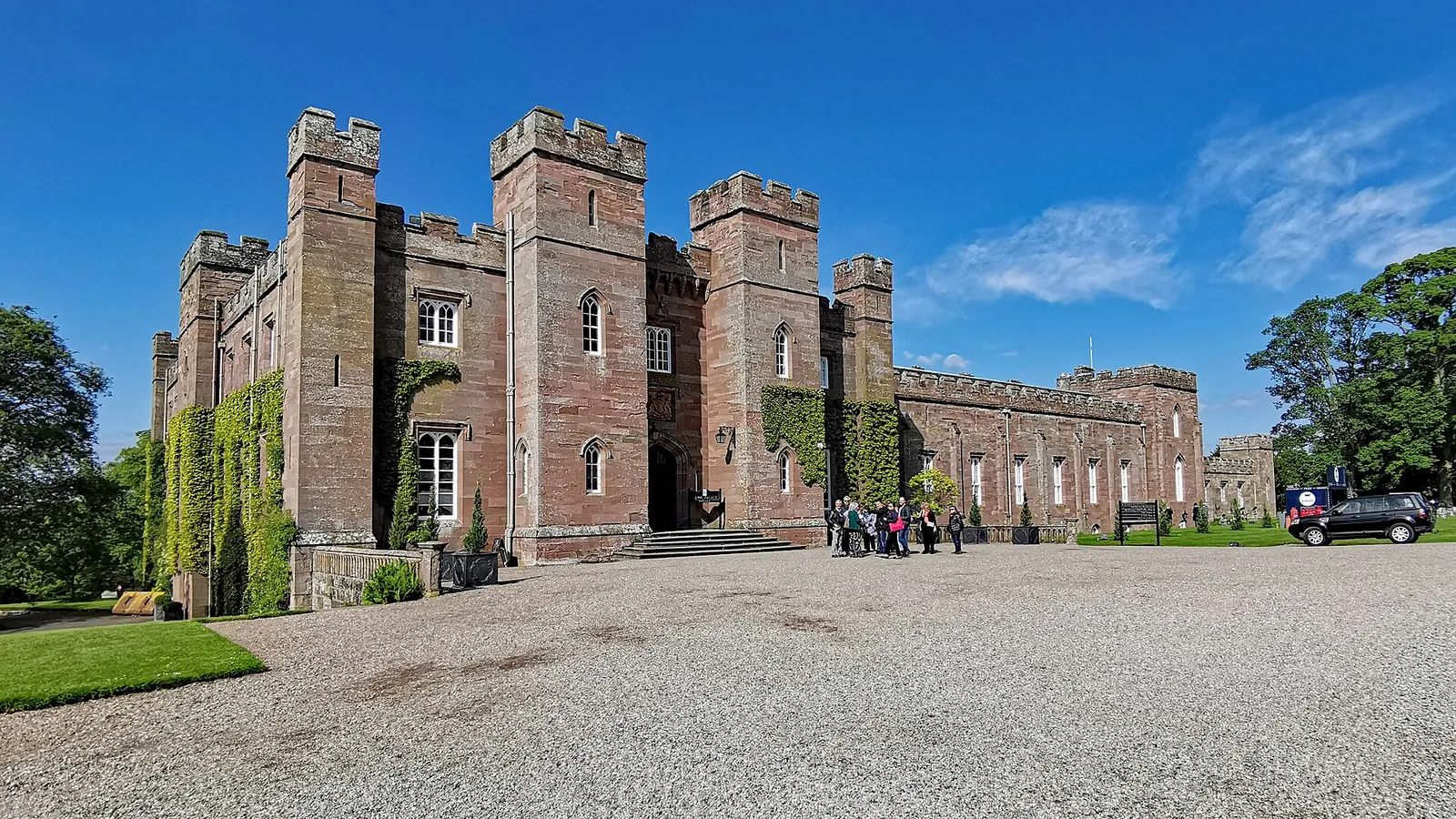

Scone Palace & Moot Hill
Contents
TL;DR
- traditional Kenneth MacAlpin is traditionally said to have been enthroned at Moot Hill in 843, marking the beginning of its role as Scotland's royal crowning place — this rests on later chronicle tradition compiled well after the event rather than contemporary ninth-century documentation.
- established Numerous Scottish monarchs, including Macbeth (1040), Robert the Bruce (1306), and Charles II (1651, the last monarch crowned there), were inaugurated at Moot Hill — this is recorded across multiple medieval and early modern chronicle and state sources.
- [Legend] The Stone of Destiny's supposed origin as "Jacob's Pillow," carried from the Holy Land via Spain and Ireland to Scotland, is a medieval legend with no historical or geological support — the stone is now understood by scholars to be of local Scottish sandstone origin.
- established In 1296, Edward I removed what he believed was the Stone of Destiny from Scone and installed it in Westminster Abbey's coronation throne, where it remained, with a brief 1950 removal, until its official return to Scotland in 1996 — this sequence is documented through English and Scottish state records.
- established The stone now at Moot Hill is a modern replica; the original Stone of Destiny moved from Edinburgh Castle to Perth Museum in 2024, and this collection's dedicated Stone of Destiny card covers that object's full, separately contested history in depth.
Key Facts
- Location
- Scone, near Perth, Perthshire, Scotland
- Era/Period
- Traditional royal site from 9th century; present palace largely 19th-century rebuild on earlier site
- Type
- Historic coronation mound (Moot Hill) and country house/palace
- Managed/Owned by
- Privately owned, seat of the Earls of Mansfield
- Visitor status
- Open seasonally, paid admission
- Key feature
- Moot Hill, topped by a replica of the Stone of Destiny and a small chapel
A Note on Claims and Evidence
Scone's significance rests on a genuinely long tradition of royal inauguration, but the earliest parts of that tradition are recorded only in chronicles compiled generations after the events they describe, and the Stone of Destiny itself carries centuries of accumulated legend layered over its documented medieval and modern history. The documented tier covers inaugurations from the high medieval period onward, including Robert the Bruce's 1306 crowning and Charles II's 1651 coronation, along with Edward I's 1296 removal of a stone from Scone and its documented later movements. The traditional tier covers earlier claims, such as Kenneth MacAlpin's 843 enthronement, recorded only in later chronicle compilations. The legend-myth tier covers the "Jacob's Pillow" origin story for the Stone, which this article does not present as fact. Because the Stone of Destiny has its own dedicated card elsewhere in this collection, this article keeps its treatment of the Stone brief and focused on Scone's role as a site, cross-referencing rather than duplicating that deeper material.
Timeline
Kenneth MacAlpin is traditionally said to be enthroned at Moot Hill in 843, beginning its role as a royal inauguration site.
Moot Hill becomes established as the principal site for the inauguration of Scottish kings.
Macbeth is inaugurated at Scone.
John Balliol (1292) and Robert the Bruce (1306) are both inaugurated at Scone.
Edward I removes a stone believed to be the Stone of Destiny from Scone, transporting it to Westminster Abbey, where it is incorporated into the English coronation throne.
Charles II is crowned at Scone, the last monarch inaugurated there.
The Stone remains at Westminster (with a notable brief unauthorised removal by Scottish nationalists in 1950) until its official return to Scotland in 1996.
The Stone is displayed in the Crown Room at Edinburgh Castle alongside the Honours of Scotland.
The present Scone Palace is largely rebuilt in its current form on the site of an earlier residence, remaining the seat of the Earls of Mansfield.
The Stone of Destiny is moved from Edinburgh Castle to the newly opened Perth Museum, where it remains the primary exhibit; a replica stone remains atop Moot Hill at Scone.
Scone Palace and Moot Hill operate as a privately owned, seasonally open visitor attraction near Perth.
Details
Moot Hill and the tradition of royal inauguration
Moot Hill, a modest earthen mound within the grounds of Scone Palace, holds an outsized place in Scottish political history as the traditional site where Scottish kings were made — not crowned in the continental sense of an anointing ceremony initially, but inaugurated through older Gaelic and Pictish rituals of kingship. Tradition credits Kenneth MacAlpin, often described as uniting the Picts and Scots, with being enthroned at Scone in 843, though this rests on chronicle accounts compiled well after the fact rather than any contemporary ninth-century record, and this article treats it as traditional rather than firmly established. What is more securely documented is the sustained pattern of royal inaugurations at Scone across the following centuries — Macbeth in 1040, John Balliol in 1292, and, in a moment of particular political weight during the Wars of Scottish Independence, Robert the Bruce in 1306, asserting his own claim to the Scottish throne at the traditional site of royal legitimacy even as Scotland's independence remained bitterly contested.
The stone Edward I took
Scone's deep association with the Stone of Destiny stems directly from this inauguration tradition: the stone was, by tradition, the object upon which Scottish kings sat or stood during their inauguration ceremony at Moot Hill. In 1296, during his campaign to subdue Scotland, Edward I removed the stone he believed to be this object and had it transported south to Westminster Abbey, where it was built into a specially constructed coronation throne used for English, and later British, monarchs for centuries afterward. This act was explicitly intended as a symbolic assertion of English dominance over Scottish kingship, removing not just a physical object but the ritual anchor of Scottish royal legitimacy. The stone's subsequent history — including a dramatic unauthorised removal by Scottish nationalist students in 1950, its temporary recovery and return to Westminster, and its eventual official repatriation to Scotland in 1996 — is a rich and separately contested story in its own right, covered fully on this collection's dedicated Stone of Destiny card rather than repeated at length here.
Legend versus likely origin
Medieval and early modern legend attached an extravagant pedigree to the Stone, with some traditions claiming it was "Jacob's Pillow" from the Book of Genesis, supposedly transported from the Holy Land via Spain and Ireland before reaching Scotland. This origin story has no historical or archaeological support and should never be presented as plausible fact; modern geological analysis instead indicates the stone is of local Scottish sandstone, almost certainly quarried in the vicinity of Scone itself, which considerably undercuts any claim to exotic biblical origin while leaving its genuine ritual significance to medieval Scottish kingship entirely intact.
Scone today versus Edinburgh Castle and Perth
A persistent source of visitor confusion is the question of where "the real Stone of Destiny" actually is. The straightforward answer is that it is not at Scone at all: following its 1996 return to Scotland, the Stone was displayed in the Crown Room at Edinburgh Castle alongside the Honours of Scotland until 2024, when it moved to the newly opened Perth Museum, where it remains the primary exhibit today. What sits atop Moot Hill at Scone is a modern replica, placed there to mark the historic significance of the site itself rather than to claim possession of the genuine artefact. This article deliberately keeps that distinction clear and brief, pointing readers to the dedicated Stone of Destiny card in this collection for the object's own full, separately contested history rather than duplicating that material here.
The palace and its modern life
Scone Palace itself, distinct from the ancient Moot Hill mound in its grounds, is a largely nineteenth-century rebuilding of an earlier residence on the same site, and remains the private seat of the Earls of Mansfield, the Murray family. Its combination of genuine deep historical association — through Moot Hill's documented centuries of royal inauguration — with a comparatively modern country-house building and a now-seasonal, paid visitor operation makes Scone a useful illustration of how physical fabric and symbolic significance can diverge considerably at a historic Scottish site: the palace building itself is not ancient, even though the ground it stands on carries one of the longest continuous claims to political and ceremonial significance anywhere in Scotland.
Did You Know?
- The stone currently sitting atop Moot Hill at Scone is a modern replica, not the historic Stone of Destiny, which is now displayed at Perth Museum.
- Robert the Bruce chose to be inaugurated at Scone in 1306 specifically to assert the legitimacy of his kingship through the site's traditional association with Scottish royal authority.
- The "Jacob's Pillow" legend claiming a biblical Holy Land origin for the Stone of Destiny has no historical or geological support; the stone is believed to be of local Scottish sandstone.
- Edward I's 1296 removal of the stone from Scone was a deliberate political act intended to symbolically strip Scotland of its royal legitimacy, not simply the seizure of a valuable object.
- Charles II, crowned at Scone in 1651, was the last monarch inaugurated there — a striking endpoint given the site's centuries-long prior use.
- A group of Scottish nationalist students removed the Stone from Westminster Abbey in 1950 in a famous unauthorised act, though it was later recovered and returned.
- Scone Palace itself, as a building, is largely a 19th-century structure, considerably younger than the ancient royal significance of the Moot Hill mound in its grounds.
- The Stone of Destiny moved to Perth Museum only in 2024, after nearly three decades on display at Edinburgh Castle.
FAQ
1Is the Stone of Destiny at Scone Palace?
No, a modern replica sits atop Moot Hill at Scone; the genuine Stone is displayed at Perth Museum as of 2024.
2Who was crowned at Scone?
Numerous Scottish monarchs, including Macbeth (1040), Robert the Bruce (1306), and Charles II (1651, the last to be crowned there).
3Why did Edward I take the Stone from Scone?
As a deliberate political act during his 1296 campaign to subdue Scotland, symbolically removing the ritual basis of Scottish royal legitimacy.
4Is the "Jacob's Pillow" story about the Stone true?
No, this is a medieval legend with no historical or geological support; modern analysis suggests the stone is local Scottish sandstone.
5Who owns Scone Palace today?
It remains the private seat of the Earls of Mansfield (the Murray family).
6Is Scone Palace itself ancient?
No, the current palace building is largely a 19th-century rebuilding on the site of an earlier residence; it is the Moot Hill mound in the grounds that carries the ancient royal association.
7When did Kenneth MacAlpin's enthronement at Scone supposedly happen?
Traditionally dated to 843, though this rests on later chronicle tradition rather than contemporary record.
8Where is the Stone of Destiny now?
At Perth Museum, since 2024, having previously been displayed at Edinburgh Castle from 1996.
9Can visitors see Moot Hill today?
Yes, it is part of the Scone Palace grounds, open seasonally to paying visitors.
10Is there a separate card about the Stone of Destiny in this collection?
Yes — its full, separately contested history is covered on a dedicated Stone of Destiny card, which this article cross-references rather than duplicates.
11Did the Stone ever leave Westminster before 1996?
Yes, briefly in 1950, when Scottish nationalist students removed it in an unauthorised act before its recovery and return.
12What does "Moot Hill" mean?
The name likely relates to its use as a meeting or assembly site, and tradition also links it to nobles depositing soil from their own lands as a gesture of allegiance to the king.
Sources and Further Reading
Primary/Institutional
- Scone Palace, official "Coronation Site" and "Moot Hill" visitor information — scone-palace.co.uk
- Perth Museum, official information on the Stone of Destiny display
Scholarly/Critical
- Historic UK, "The Stone of Destiny," historical overview
- Academic and geological analyses of the Stone of Destiny's sandstone composition
General
- Country Life, "The tale of Scone Palace, and the mystery of the Stone of Scone"
- History Hit, "Scone Palace: History and Facts"
- Wikipedia, overview coverage of Scone Palace and the Stone of Destiny
Caveats: Myths and Disputed Claims
- Tradition: Kenneth MacAlpin's enthronement at Scone in 843. This rests on later chronicle tradition, not documented contemporary fact.
- Legend: the Stone of Destiny was "Jacob's Pillow" from the Holy Land. This is a medieval legend unsupported by evidence; the stone is believed to be local Scottish sandstone.
- Myth: the genuine Stone of Destiny is at Scone Palace. The stone atop Moot Hill is a modern replica; the real stone is at Perth Museum as of 2024.
- Myth: Scone Palace is an ancient building. The present structure is largely a 19th-century rebuild, distinct from the genuinely ancient Moot Hill mound in its grounds.
Finished reading? Try the Fact Machine: three reels, one surprising Scottish connection →
Card 006 · Locations