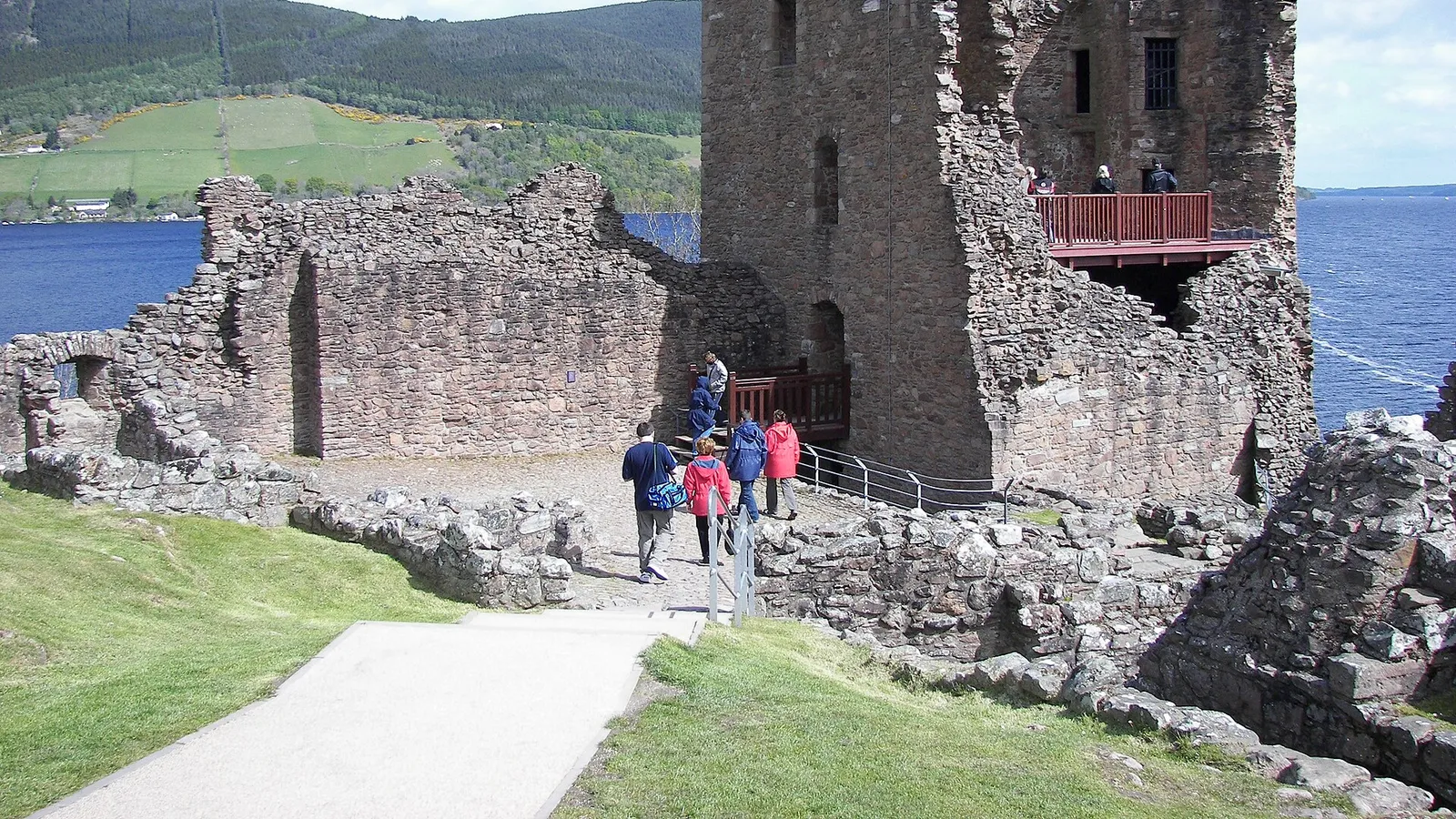

Urquhart Castle & Loch Ness
Contents
TL;DR
- established The present castle ruins date mainly from the 13th to 16th centuries, built on the site of an earlier fortification — confirmed by excavation and documentary grants from Scottish kings.
- traditional Vitrified stone and 1983 excavation findings suggest an earlier fort occupied the site between the 5th and 11th centuries, possibly linked to St Columba's 6th-century mission in the area — this rests on archaeological inference rather than a documented foundation date.
- established Clan Grant held the castle from 1509 after James IV granted it to John Grant on condition of repair, and defended it against repeated MacDonald raids through the 16th century — recorded in royal charters and clan history.
- established The castle was deliberately part-demolished in 1689–90 by its own Williamite garrison to deny it to Jacobite forces, and further collapsed in a 1715 storm, leaving it a ruin by the 19th century — documented in contemporary military and estate records.
- [Legend] Loch Ness's modern fame rests heavily on the Loch Ness Monster legend, a cultural phenomenon with no scientifically verified evidence, which this card treats only in passing — the dedicated "Loch Ness Monster" card in this collection covers that folklore in full.
Key Facts
- Location
- Strone Point, Loch Ness, Highland, Scotland
- Era/Period
- Possible early medieval fort (5th–11th c.); present ruins 13th–16th century
- Type
- Ruined medieval castle on a loch-side promontory
- Managed/Owned by
- Historic Environment Scotland (since 1913 transfer to state care)
- Visitor status
- Open year-round, paid admission; one of Scotland's most-visited castles (466,420 visitors in 2025)
- Setting
- Overlooks Loch Ness, Scotland's largest loch by volume
Scottish Impact Index (SI Score)
- National Significance
- 8/10
- Historical Continuity
- 9/10
- Human & Economic Importance
- 8/10
- Landscape / Architectural Distinctiveness
- 10/10
- Cultural & Historical Legacy
- 9/10
- Recognition
- 10/10
54/60
Ranked =20th of 43 in Locations
A Note on Claims and Evidence
Urquhart Castle sits at the intersection of solid medieval documentation and a landscape saturated with legend it did not itself generate. The documented tier covers the castle's recorded ownership from the 13th century onward — royal grants, clan records, and the 1689–90 demolition and 1715 storm damage are all independently attested. The traditional tier covers the earlier fort suggested by 1983 excavations and vitrified stone, plausible but not pinned to a confirmed date or occupant. The legend-myth tier belongs almost entirely to Loch Ness itself rather than the castle — the Loch Ness Monster — which this article deliberately does not treat as fact, nor dwell on, since it is covered in depth on this collection's separate Loch Ness Monster card.
Timeline
Vitrified stone and 1983 excavation findings suggest an early medieval fort on the site, tentatively linked to the era of St Columba's 6th-century mission in the region.
Present castle begins to take shape on the site of the earlier fortification.
First firm documentary reference: Edward I captures the castle during the Wars of Scottish Independence.
Alexander II grants the castle to Thomas de Lundin following suppression of the MacWilliam rebellions; his family holds it until 1275.
James IV grants the castle and surrounding estates to John Grant in perpetuity, on condition he repair and rebuild it; Clan Grant becomes its dominant power.
The "Great Raid" by the MacDonalds devastates the castle and estate.
An inventory records the castle as virtually empty, reflecting its declining strategic and residential importance.
Williamite defenders blow up the gatehouse to prevent Jacobite reoccupation after the Glorious Revolution conflicts.
A storm causes the partial collapse of the Grant Tower, hastening the castle's decline into picturesque ruin.
An earthquake of magnitude 5.1, centred probably south-west of Inverness, damages the town and is felt across almost all of Scotland.
Another Inverness earthquake, attributed by Roger Musson to a secondary fault of the Great Glen system.
Responsibility for the castle passes to state heritage authorities (predecessor to Historic Environment Scotland).
Castle receives Category A listed building status and scheduled monument designation.
Managed by Historic Environment Scotland with a dedicated visitor centre; one of Scotland's most-visited heritage sites, its loch-side setting inseparable in public imagination from the Loch Ness Monster legend.
Details
A promontory with a long strategic history
Urquhart Castle occupies Strone Point, a promontory jutting into Loch Ness roughly midway along its length — a position that made it one of the largest castles in the Highlands by area and a key control point along the Great Glen, the geological fault line running from Inverness to Fort William. Archaeological evidence, including vitrified stone identified from the early twentieth century onward and more systematically investigated in 1983 excavations, suggests an earlier fortification occupied the site centuries before the medieval castle took shape, potentially connected to the broader early medieval settlement of the region associated with St Columba's missionary activity in the 6th century. This earlier phase remains traditional rather than firmly dated, since no single excavation has produced a secure foundation date.
Clan Grant and the Highland power struggle
The documented castle takes shape from the thirteenth century, with its first unambiguous appearance in the historical record coming in 1296, when Edward I captured it during the Wars of Scottish Independence — a reminder that the Great Glen was contested ground from the outset of recorded conflict in the region. Ownership passed through several hands, including the de Lundin family and the Comyns, before a decisive turn in 1509: James IV granted the castle and the estates of Glen Urquhart and Glenmoriston to John Grant, on the explicit condition that he repair and rebuild the fortification. Clan Grant's tenure that followed was not peaceful — the 1545 "Great Raid" by the MacDonalds devastated the castle and estate, part of the broader, often violent competition for control of Highland territory that characterised the sixteenth century.
Decline into ruin
By the mid-seventeenth century the castle's role had diminished sharply; an inventory from 1647 found it largely empty, no longer serving as an active residence or garrison of consequence. Its final military episode came during the Glorious Revolution, when Williamite forces under Ludovic Grant held it against Jacobite opponents; upon withdrawing, the defenders themselves blew up the gatehouse specifically to deny its use to Jacobite forces — an act of deliberate self-demolition rather than destruction by an enemy. A 1715 storm then brought down part of the Grant Tower, and by the nineteenth century the castle had settled into the romantic, roofless ruin that attracted early tourists and artists drawn to the picturesque Highland landscape.
From ruin to heritage site
Responsibility for the castle passed into state care in 1913, beginning its transformation from a decaying private ruin into a managed heritage asset. Twentieth-century listing and scheduling designations (1971 and 1981) formalised its protected status, and Historic Environment Scotland's stewardship today includes a purpose-built visitor centre developed after public consultation, positioning the castle as one of the most visited paid heritage attractions in Scotland — a status owed as much to its location on Loch Ness as to the castle's own considerable medieval history.
The loch beside it
Loch Ness itself, the largest Scottish loch by volume, is central to the site's modern fame, and Urquhart Castle's photogenic ruins are now inseparable in popular imagination from the loch's best-known cultural export: the Loch Ness Monster. This card treats that legend only briefly and deliberately does not repeat its claims as fact — sighting reports, photographic hoaxes, and sonar investigations are matters of cultural phenomenon and tourism folklore rather than established zoology, and the collection's dedicated Loch Ness Monster card addresses that material, its history, and its evidentiary status in full. What can be said plainly here is that the castle's medieval and early-modern history stands independently of the monster legend, which postdates the castle's active history by centuries and originates in twentieth-century media attention rather than any documented connection to the site itself.
The fault beneath the loch
established Urquhart Castle stands on one of the great structural lines of Britain. The Great Glen Fault runs north-east to south-west in an almost straight line from the Moray Firth to Loch Linnhe, and the chain of lochs along it, Loch Ness among them, marks its course. It continues south-west through Loch Linnhe and the Firth of Lorn into north-west Ireland, where it is called the Leannan Fault, and north-east towards Shetland, where it links with the Walls Boundary Fault.
shared The fault is a strike-slip fault: the rocks on either side moved sideways past each other rather than up and down. Geologists recognise several phases of movement. The first, probably between 430 and 390 million years ago, at the end of the Silurian and into the Early Devonian, moved the north-western side to the south-west. A second phase in the Carboniferous moved it the other way, and a final phase in the Late Cretaceous to early Tertiary has been estimated at about 104 kilometres. How far the two sides moved in total is not agreed, and some estimates are far larger.
established Loch Ness itself is the work of ice exploiting that weakness: glaciers during the Quaternary ice ages eroded the shattered rock along the fault zone into a long, deep trench. NatureScot gives Loch Ness's volume as 7,452 million cubic metres, the greatest of any Scottish loch and more than all the lakes of England and Wales combined.
shared The fault zone is not entirely quiet. It has produced occasional moderate tremors over the past 150 years, and the seismologist Roger Musson attributes the 1901 Inverness earthquake to a secondary fault of the Great Glen system. The British Geological Survey records an earlier earthquake on 13 August 1816, of magnitude 5.1, with its epicentre probably south-west of Inverness; it caused considerable damage in the town and was felt across almost all of Scotland.
Did You Know?
- Loch Ness holds more fresh water than all the lakes of England and Wales combined, about 7,452 million cubic metres.
- The Great Glen Fault continues into Ireland, where it is known as the Leannan Fault.
- The vitrified stone found at Urquhart — rock fused by intense heat — is a feature associated with early medieval fort-building techniques whose exact purpose remains debated among archaeologists.
- Clan Grant held Urquhart on the explicit condition, set by James IV in 1509, that they repair and rebuild the castle — heritage obligations are not a modern invention.
- The castle's own defenders, not an attacking enemy, blew up its gatehouse in 1689–90 to prevent Jacobite reoccupation.
- A natural storm in 1715, not warfare, caused the partial collapse of the Grant Tower that helped shape the castle's present ruined silhouette.
- By 1647, the once-formidable castle was recorded as virtually empty — a striking fall from its earlier strategic importance.
- Urquhart is one of the largest castles in the Highlands by ground area, reflecting the scale of its medieval ambitions.
- The site's connection to St Columba's 6th-century mission is suggestive rather than confirmed, resting on archaeological inference about an earlier fort phase.
- Despite the global fame of the Loch Ness Monster, Urquhart Castle's own documented history has no confirmed connection to the legend, which is a later cultural phenomenon associated with the loch rather than the castle.
FAQ
1How old is Urquhart Castle?
The present ruins date mainly from the 13th to 16th centuries, though archaeological evidence suggests an earlier fort may have existed on the site from as early as the 5th century.
2Who owned Urquhart Castle for the longest period?
Clan Grant, who held it from 1509 following a grant by James IV.
3Why is the castle in ruins?
It was deliberately part-demolished by its own garrison in 1689–90 to prevent Jacobite reoccupation, and further damaged by a storm in 1715.
4Does Urquhart Castle have a confirmed connection to the Loch Ness Monster?
No. The castle's documented history is independent of the later Loch Ness Monster legend, which this collection treats as cultural folklore on its own dedicated card.
5Who manages Urquhart Castle today?
Historic Environment Scotland.
6Is Urquhart Castle one of the most visited castles in Scotland?
Yes — it recorded over 466,000 visitors in 2025, among the highest figures for any Scottish castle.
7What is the connection to St Columba?
It is a traditional, suggestive link based on the possible dating of an early fort on the site to the era of Columba's 6th-century mission, not a confirmed historical fact.
8What was the "Great Raid"?
A devastating 1545 attack on the castle and estate by the MacDonalds, part of ongoing Highland clan conflict.
9Is there a visitor centre?
Yes, Historic Environment Scotland operates a dedicated visitor centre with exhibits, catering, and event facilities.
10Was the castle ever recaptured by the English after 1296?
Ownership and control changed hands multiple times during the Wars of Scottish Independence and subsequent conflicts; 1296 marks its first documented capture, not its last contested moment.
11Why is Loch Ness so significant to Scotland's tourism identity?
Partly due to its scale as the largest loch by volume, and heavily due to the Loch Ness Monster legend, a major driver of visitor interest in the wider region.
12Can visitors access the loch directly from the castle?
Yes, the castle's promontory setting gives direct loch-side access and views, a key part of its visitor appeal.
Sources and Further Reading
Primary/Institutional
- Historic Environment Scotland, "Urquhart Castle: History and Overview" — historicenvironment.scot
- Historic Environment Scotland blog, "Welcome Back Urquhart"
Scholarly/Critical
- Canmore (RCAHMS) site records for Urquhart Castle, including 1983 excavation findings
- Academic and heritage-body assessments of vitrified stone and early medieval fort archaeology in the Great Glen
General
- NatureScot, "Freshwater lochs" (nnr.nature.scot)
- British Geological Survey, historical earthquake record for 13 August 1816, Inverness (earthquakes.bgs.ac.uk)
- Wikipedia, "Great Glen Fault"
- Wikipedia, "Urquhart Castle" — en.wikipedia.org/wiki/Urquhart_Castle
- A Scottish Castle A Day, Urquhart Castle feature
- VisitScotland, Loch Ness and Urquhart Castle visitor information
Caveats: Myths and Disputed Claims
- Uncertain: the date of the early fort. A fort of the 5th–11th century, suggested by vitrified stone and 1983 excavations, is plausible but not precisely dated or attributed.
- Traditional: a link with St Columba's mission. The association between Urquhart Castle and St Columba is suggestive and traditional, not a documented, established fact.
- Folklore: the Loch Ness Monster. No sighting, photograph or sonar claim is verified fact; Nessie is a cultural and folkloric phenomenon associated with the loch.
- Myth: the castle was ruined purely by enemy destruction. Its gatehouse was demolished by its own Williamite garrison, and further damage came from a natural storm in 1715, not an attack.
- Disputed: how far the Great Glen Fault slid. The 104-kilometre estimate applies to one late phase of movement; the total displacement is disputed, so "about 100 kilometres" is not settled fact.
Finished reading? Try the Fact Machine: three reels, one surprising Scottish connection →
Card 004 · Locations