
The Poll Tax in Scotland: The Year Scotland Went First
Contents
TL;DR
On 1 April 1989, Scotland replaced domestic rates with the Community Charge, a flat-rate tax on almost every adult that was quickly nicknamed the "poll tax". England and Wales followed a year later. It was unpopular from the start. Hundreds of thousands of Scots refused to pay, the anti-poll tax movement fought warrant sales street by street, and the tax helped bring down Margaret Thatcher in 1990. It was replaced by the Council Tax in 1993. Its political effects in Scotland lasted much longer: it hardened opposition to Conservative rule and strengthened the case for a Scottish Parliament. Scotland stopped collecting poll tax arrears only in 2015.
Key Findings
- Scotland went first. The Community Charge was introduced in Scotland on 1 April 1989 under the Abolition of Domestic Rates Etc. (Scotland) Act 1987, a year before England and Wales.
- The idea started with a Scottish rates crisis. The 1985 Scottish rates revaluation raised domestic rates by an average of about 24%, with much bigger rises in places such as Perth and Kinross. Scottish Conservatives, alarmed for their seats, pressed hard for reform.
- "Guinea pig" is half true. Scotland was used to introduce the tax first, but Scottish Conservatives themselves asked for early action. Calling Scotland a "testing ground" is a fair description of what happened, but it misreads why it happened.
- Non-payment was on a mass scale. One estimate puts Scottish non-payers at about 880,000 of roughly 4 million liable adults. On 15 January 1990, Strathclyde Regional Council alone issued 250,000 summary warrants.
- Warrant sales were the flashpoint. Anti-poll tax unions physically blocked attempts to seize and sell non-payers' goods. Tommy Sheridan was jailed for defying a court order to stay away from one.
- The tax had a national ending. Riots in London on 31 March 1990, the day before the tax began in England, and the tax's unpopularity contributed to Thatcher's fall in November 1990. Abolition was announced in March 1991, and the Council Tax replaced the Community Charge from April 1993.
- The debt lasted a quarter of a century. In 2015 the Scottish Parliament voted 98–15 to stop councils collecting roughly £425 million of remaining arrears.
Quick Facts
- Official name
- Community Charge
- Popular name
- Poll tax
- Legislation (Scotland)
- Abolition of Domestic Rates Etc. (Scotland) Act 1987; Royal Assent 15 May 1987
- Introduced in Scotland
- 1 April 1989
- Introduced in England and Wales
- 1 April 1990
- Trigger
- 1985 Scottish rates revaluation (average rise about 24%)
- Average Scottish local tax bill
- £399 (rates, 1988/89) to £467 (1989/90) (IFS estimate)
- Estimated Scottish non-payers
- About 880,000 (one widely cited estimate)
- Strathclyde summary warrants
- 250,000 issued on 15 January 1990
- Abolition announced
- 21 March 1991
- Replaced by
- Council Tax, from 1 April 1993 (Local Government Finance Act 1992)
- Warrant sales abolished
- Abolition of Poindings and Warrant Sales Act 2001
- Arrears written off
- Community Charge Debt (Scotland) Act 2015, about £425m; passed 98–15
Claim Status
established
- the dates of introduction in Scotland (1989) and in England and Wales (1990);
- the legislation;
- the 1985 revaluation crisis;
- mass non-payment and the resistance to warrant sales;
- replacement by the Council Tax;
- the 2015 write-off.
shared non-payment figures. These vary with the date, the area and the definition (late payment, partial payment or outright refusal), so any single number is an estimate.
disputed how far the tax caused the Conservatives' long decline in Scotland and the drive for devolution. It clearly contributed, but Conservative support was already falling before 1989, and the devolution movement had deeper roots.
Myth (in part): that Scotland was chosen as a guinea pig against the wishes of Scottish Conservatives. The early start was in large part a response to Scottish Conservative demands for relief from the rates.
Why Replace the Rates?
For centuries, local services in Britain were funded by rates, a property tax based on the notional rental value of a home. Rates were simple to collect but widely disliked: a pensioner living alone in a large house could pay far more than a household of several earners in a smaller one. Rateable values were also meant to be revalued periodically, and every revaluation produced losers.
In 1985 Scotland held a statutory rates revaluation, the first for years. England had postponed its own. Domestic rates in Scotland rose by an average of about 24%, and some areas were hit far harder: rises of around 70% were reported in Perth and Kinross. Many of the worst-hit households were in Conservative-voting suburbs and small towns, the party's remaining Scottish heartland.
The reaction inside the party was intense. The Scottish Conservative chairman warned Thatcher that the fallout "could devastate Conservative support in Scotland". The Scottish Secretary, George Younger, predicted severe political damage. Michael Forsyth, MP for Stirling, published The Case for a Poll Tax the same year. At the Scottish Conservative conference in May 1985, Thatcher committed publicly to replacing the rates.
A ministerial review led by Kenneth Baker and William Waldegrave was already working on alternatives. Its answer, published in the Green Paper Paying for Local Government on 28 January 1986, was a flat-rate Community Charge paid by almost every adult. Students, the unemployed and those on low incomes would still pay at least 20%. The principle was "accountability": if every voter paid towards local services, voters would punish high-spending councils at the ballot box.
Scotland First
The Scottish legislation came first. The Abolition of Domestic Rates Etc. (Scotland) Bill had its second reading on 9 December 1986, when the new Scottish Secretary, Malcolm Rifkind, called it a "radical reforming measure". Under pressure from Conservative MPs, the plan to phase the tax in gradually from 1989 to 1992 was replaced by a single "clean break" in 1989. Each adult, rather than each household, was made liable. The Act received Royal Assent on 15 May 1987, weeks before the general election.
That election was a disaster for the Conservatives in Scotland. They lost more than half their Scottish seats, falling from 21 to 10, even as Thatcher won a large UK majority. Critics called this the "democratic deficit": Scotland was about to receive a new tax devised by a government it had overwhelmingly rejected. The charge that Scotland was being used as a "guinea pig" became central to the opposition's argument.
Was it fair? Partly. Scotland did experience the tax a full year before England, and ministers did learn from the Scottish rollout. But the early start was not imposed on unwilling Scottish Conservatives. It was largely what they had asked for after the 1985 revaluation. The irony is that a reform meant to rescue the party in Scotland did more than anything else to sink it.
1 April 1989
The Community Charge came into force across Scotland on 1 April 1989. Every adult had to be entered on a new community charge register, which campaigners warned could be used to track people. Councils set their own charge levels. The Institute for Fiscal Studies estimated that the average Scottish household's local tax bill rose from about £399 under the rates to £467 in the first year. Large households of adults on modest incomes, often in working-class areas, were among the biggest losers.
Opposition organised before the first bill landed:
- The SNP launched a "Can Pay, Won't Pay" campaign in 1988, urging mass non-payment even by those who could afford it.
- Labour, the dominant party in Scotland, officially refused to back illegal non-payment. Its conference rejected the tactic, and it campaigned instead to "Stop It". Many Labour members defied the line, and a group of activists and MPs, known as the "Committee of 100", pledged not to pay.
- The STUC, churches and local groups joined the opposition.
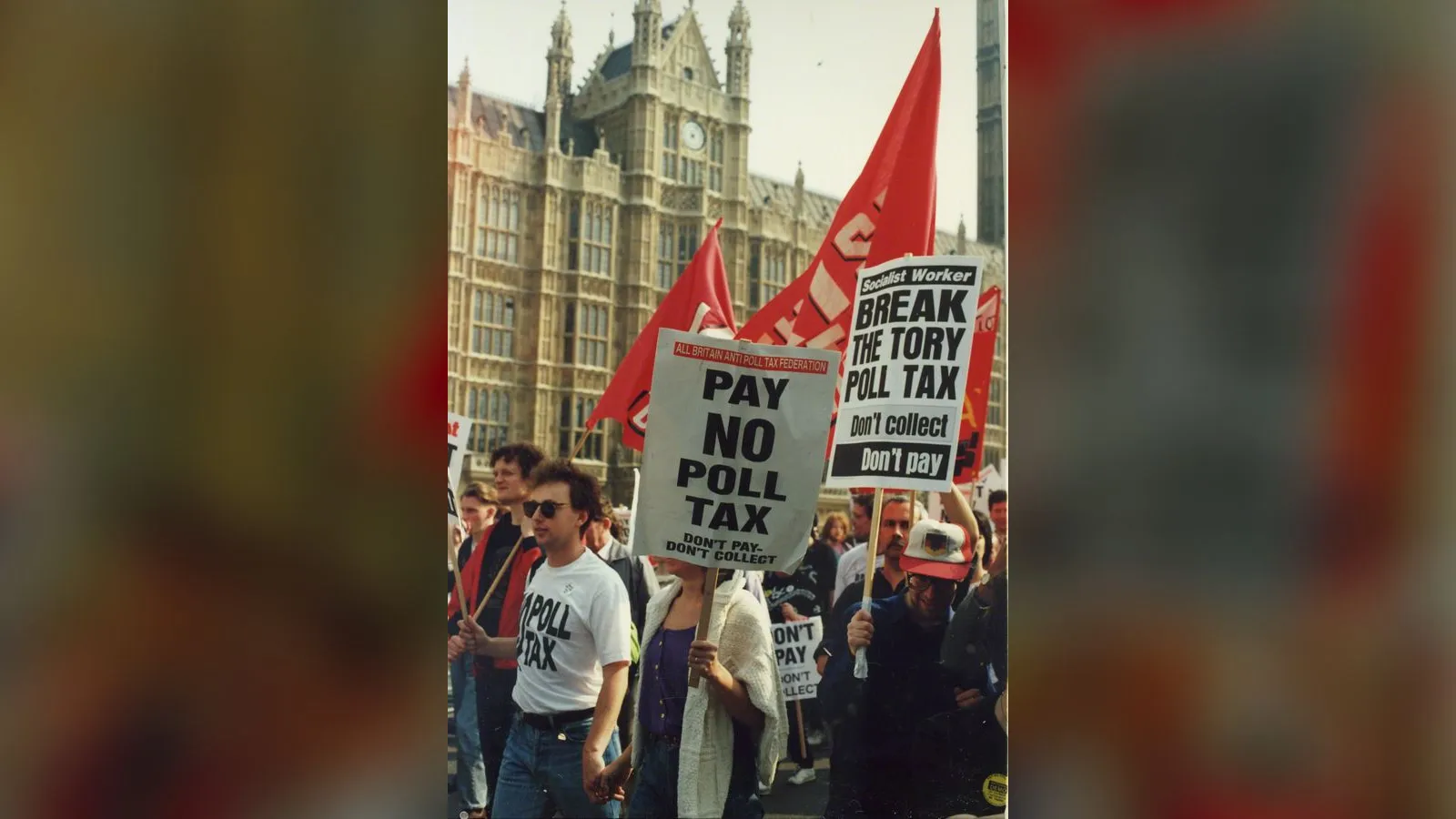
- Anti-poll tax unions sprang up in schemes and estates across Scotland. Federations such as the Strathclyde Anti-Poll Tax Federation coordinated them, and the All Britain Anti-Poll Tax Federation was founded on 25 November 1989.
Can't Pay, Won't Pay
Non-payment spread fast. Figures vary with how and when they were measured. One widely cited estimate is that about 880,000 of Scotland's roughly 4 million liable adults refused to pay. Some refused on principle; many simply could not afford it. Councils fell behind on collection. On 15 January 1990, Strathclyde Regional Council, the largest local authority in Britain, issued 250,000 summary warrants in a single batch against people who had not paid.
A summary warrant allowed sheriff officers to use Scotland's distinctive debt-recovery powers:
- arrestment of wages or bank accounts;
- poinding (pronounced "pinding"), valuing and listing a debtor's household goods;
- the warrant sale that followed, at which those goods could be auctioned, sometimes in the debtor's own home.
Warrant sales were rare, but they were deeply humiliating, and they became the movement's main target. Anti-poll tax unions set up phone trees. When sheriff officers arrived, crowds gathered to block doors, stage sit-ins, or turn up at sales and refuse to bid. Very few poll tax warrant sales were ever completed.
Tommy Sheridan, a young Glasgow activist from Pollok, became the movement's public face. In 1991 Glasgow Sheriff Court ordered him to stay away from a warrant sale. He went anyway and was jailed for six months. While in prison he stood in the 1992 general election, and weeks later he was elected to Glasgow District Council for the Pollok ward. A decade later, as a member of the Scottish Parliament, he promoted the bill that became the Abolition of Poindings and Warrant Sales Act 2001. It ended the warrant sale as a means of debt recovery in Scotland.
There were costs to the protest as well. Non-payers built up debts, and many later paid with interest or had money taken from their wages and benefits. Councils lost income, which hit the services the tax was meant to fund. Some campaigners argued that this burden fell hardest on the poorest communities.
The Tax Comes South and Falls
England and Wales moved to the Community Charge on 1 April 1990. On 31 March 1990, the day before, a huge demonstration in London ended in the Trafalgar Square riot: 113 people were injured and 340 arrested. A large anti-poll tax march took place in Glasgow on the same day, largely peacefully.
Across Britain the tax was a political catastrophe. Local charges came in far higher than ministers had predicted, Conservative councillors lost seats, and the party fell well behind in the polls. In November 1990 Michael Heseltine challenged Thatcher for the leadership, and she announced her resignation on 22 November 1990. The poll tax was not the only cause of her fall, but it is widely regarded as one of the most important.
Her successor, John Major, moved quickly. On 21 March 1991 Michael Heseltine, now Environment Secretary, announced that the Community Charge would be abolished. The Local Government Finance Act 1992 replaced it with the Council Tax, a property-band tax with discounts for single adults, from 1 April 1993. The poll tax lasted four years in Scotland and three in England and Wales.
The Long Tail of Debt
Abolishing the tax did not cancel the debts owed under it. Scottish councils were legally required to keep pursuing arrears, and they did so for more than twenty years. By 2013 only small sums were still being recovered each year, while the total outstanding, with interest and penalties, stood at about £425 million.
The issue came back in 2014. The independence referendum produced a huge rise in voter registration, and ministers feared councils might use the expanded electoral roll to trace old poll tax debtors. The Scottish Government introduced the Community Charge Debt (Scotland) Bill. Holyrood passed it on 19 February 2015 by 98 votes to 15, ending councils' duty and power to collect the arrears. It received Royal Assent in March 2015. Supporters called it overdue justice. Critics, including some council leaders and opposition politicians, argued that it rewarded people who had broken the law at the expense of those who had paid.
Legacy
The poll tax is remembered in Scotland as more than a failed tax.
- It cemented the "democratic deficit." For many Scots it became the clearest example of a government with ten Scottish MPs imposing policy on a country that had voted against it, and first at that. The Claim of Right (1988) and the Scottish Constitutional Convention (first meeting in 1989), which drew up the blueprint for devolution, grew up in the same years. Historians debate how much the poll tax caused the push for a parliament and how much it simply accelerated a movement already under way. Few doubt it mattered.
- It damaged the Scottish Conservatives for a generation. The party was reduced to 11 Scottish seats in 1992 and to none in 1997. The poll tax was not the only reason, but it is remembered as the moment the relationship broke.
- It changed Scottish law. Warrant sales, the movement's main target, were abolished by Holyrood in 2001.
- It turned activists into politicians. Campaigners from the anti-poll tax unions, most famously Tommy Sheridan, went on to shape the Scottish left in the early years of devolution.
Accuracy note. The poll tax was a UK government policy, introduced first in Scotland partly at the request of Scottish Conservatives. Both the "guinea pig" story and its denial contain some truth. What is not in dispute is that Scots experienced it first, resisted it in very large numbers, and that it left a lasting mark on Scottish politics.
Timeline
Scottish rates revaluation — Average domestic rise about 24%
Thatcher pledges to replace rates — Scottish Conservative conference
Green Paper Paying for Local Government — Community Charge proposed
Second reading of the Scottish bill — Rifkind: "radical reforming measure"
Abolition of Domestic Rates Etc. (Scotland) Act — Royal Assent
General election — Scottish Conservatives fall from 21 to 10 seats
SNP "Can Pay, Won't Pay" campaign; Claim of Right — Non-payment campaigns begin
Community Charge introduced in Scotland — A year before England and Wales
All Britain Anti-Poll Tax Federation founded —
Strathclyde issues 250,000 summary warrants —
Trafalgar Square riot; Glasgow march — 113 injured, 340 arrested in London
Community Charge introduced in England and Wales —
Thatcher announces resignation —
Abolition announced —
Tommy Sheridan jailed for six months — Elected councillor in 1992
Council Tax replaces the Community Charge — Local Government Finance Act 1992
Abolition of Poindings and Warrant Sales Act — Warrant sales ended in Scotland
Community Charge Debt (Scotland) Bill passed — 98–15; about £425m arrears written off
Did You Know?
- "Poll" is an old word for "head". A poll tax is literally a head tax, the same principle as the hated poll taxes of the fourteenth century that helped spark the Peasants' Revolt of 1381.
- Poinding, the Scots legal term for valuing a debtor's goods before a warrant sale, is pronounced "pinding".
- Scotland's 1985 rates revaluation went ahead while England's equivalent had been postponed. That difference set the whole poll tax story in motion.
- Scottish councils were still chasing poll tax debts in 2014, 21 years after the tax was abolished.
Honest Caveats
- Non-payment figures are estimates. They vary by source, date and definition. The 880,000 figure is a widely cited estimate, not an official audited total.
- The IFS figures are averages of total local tax bills. They are model estimates based on survey households, not actual bills.
- The "guinea pig" question involves interpretation. Released government papers and contemporary accounts support both the "testing ground" view and the account that Scottish Conservatives demanded early relief.
- Causation is debated. Historians differ on how far the poll tax, rather than deindustrialisation and broader politics, explains the Conservative collapse and the rise of support for devolution in Scotland.
FAQ
1Why is it called the poll tax?
"Poll" means head. The Community Charge was a flat charge on each adult rather than on property, so critics called it a head tax, or poll tax.
2Was Scotland used as a guinea pig?
Scotland got the tax a year early, so in that sense yes. But the early start was largely a response to Scottish Conservative demands after the painful 1985 rates revaluation, not something forced on them.
3How many Scots refused to pay?
Estimates vary. One widely cited figure is about 880,000 out of roughly 4 million liable adults. Strathclyde alone issued 250,000 summary warrants in January 1990.
4What was a warrant sale?
A Scottish debt-recovery process. Sheriff officers valued a debtor's household goods (poinding) and could then auction them. Anti-poll tax campaigners blocked many attempts, and Holyrood abolished warrant sales in 2001.
5Did the poll tax bring down Thatcher?
It was a major factor. Its unpopularity, the 1990 riots and Conservative losses fed the leadership challenge of November 1990 that ended her premiership.
6When did Scotland stop collecting poll tax debts?
In 2015. The Community Charge Debt (Scotland) Act ended collection of about £425 million in remaining arrears.
7What replaced the poll tax?
The Council Tax, from 1 April 1993. It is a property-band tax with a discount for single-adult households, and it is still in use.
Related
- Devolution and the Scottish Parliament
- Red Clydeside
- Who Owns Scotland? — Concentrated Land Ownership
- The Scottish Office
- Parliament of Scotland
Sources
Primary/Institutional
- Abolition of Domestic Rates Etc. (Scotland) Act 1987, legislation.gov.uk. https://legislation.gov.uk/ukpga/1987/47/contents
- Global Nonviolent Action Database, "British win repeal of Poll Tax, 1989–1990" (Swarthmore College). https://nvdatabase.swarthmore.edu/content/british-rebel-against-poll-tax-1987-1990
- Community Charge Debt (Scotland) Act 2015, legislation.gov.uk. https://www.legislation.gov.uk/asp/2015/3
- Margaret Thatcher Foundation archive, Scottish Office papers on the Community Charge (1988). https://archive.margaretthatcher.org/
- Institute for Fiscal Studies, "The switch from domestic rates to the community charge in Scotland", Fiscal Studies (August 1989). https://ifs.org.uk/journals/switch-domestic-rates-community-charge-scotland
- Law Society of Scotland, "Holyrood approves end of poll tax debt collection". https://lawscot.org.uk/news-and-events/legal-news/holyrood-approves-end-of-poll-tax-debt-collection/
Scholarly/Critical
- M. Lavalette and G. Mooney (eds), Class Struggle and Social Welfare (Routledge, 2000), chapter on the anti-poll tax movement.
General
- Wikipedia, "Abolition of Domestic Rates Etc. (Scotland) Act 1987". https://en.wikipedia.org/wiki/Abolition_of_Domestic_Rates_Etc._(Scotland)_Act_1987
- British Association for Local History, "The Scottish rates revaluation of 1985: the spark that lit the poll tax fire" (2025). https://www.balh.org.uk/blog-the-scottish-rates-revaluation-of-1985-the-spark-that-lit-the-poll-tax-fire-2025-03-06
- Wikipedia, "Poll tax (Great Britain)". https://en.wikipedia.org/wiki/Poll_tax_(Great_Britain)
- libcom.org, "1989–1990: Opposition to the Poll Tax". https://libcom.org/history/1989-1990-opposition-poll-tax
- Wikipedia, "All Britain Anti-Poll Tax Federation". https://en.wikipedia.org/wiki/All_Britain_Anti-Poll_Tax_Federation
- Wikipedia, "Tommy Sheridan". https://en.wikipedia.org/wiki/Tommy_Sheridan
- Public Finance, "Holyrood agrees to write off historic poll tax debts" (20 February 2015). https://www.publicfinance.co.uk/node/14750
- LabourList, "The Tories used Scotland as a testing ground for the poll tax" (2014). https://labourlist.org/2014/12/the-tories-used-scotland-as-a-testing-ground-for-the-poll-tax
Finished reading? Try the Fact Machine: three reels, one surprising Scottish connection →
Card 001 · Shadow