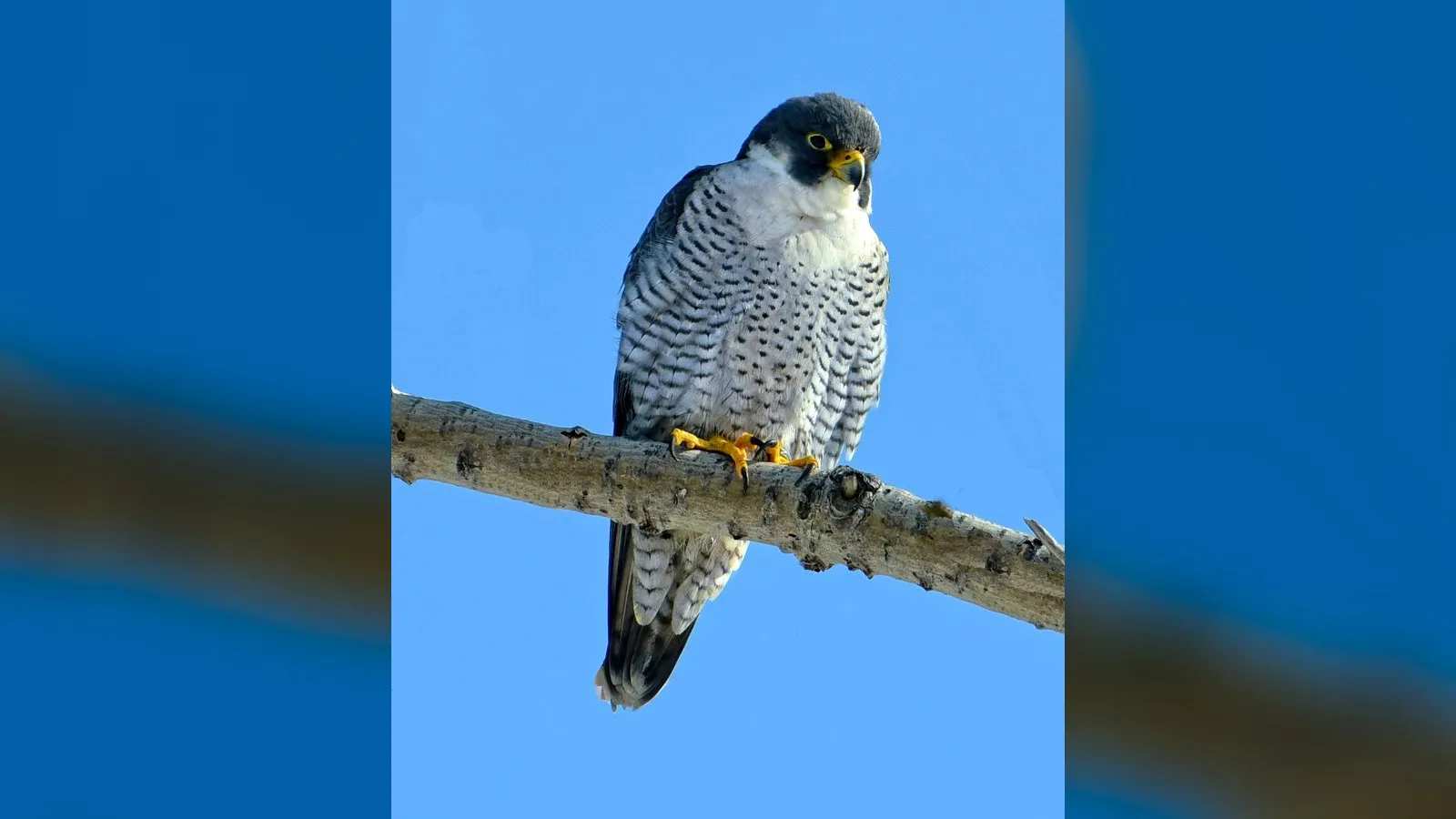

Peregrine Falcon (Falco peregrinus)
Contents
TL;DR
- disputed The catastrophic British peregrine falcon population crash of the late 1950s and 1960s is popularly attributed to DDT, but specialist ornithological analysis attributes the sudden, severe mortality specifically to cyclodiene pesticides (aldrin, dieldrin, heptachlor) used as seed dressings — compounds directly toxic enough to kill adult birds outright, unlike DDT, which mainly caused reproductive failure through eggshell thinning — this article states this corrective argument directly rather than repeating the popular DDT-only narrative uncritically.
- established Supporting this corrective account, the population crash's timing coincides precisely with cyclodiene introduction rather than earlier DDT use, and the population began recovering immediately once cyclodiene use was restricted — a specific, documented evidential pattern this article presents as the basis for the more accurate attribution.
- established Following pesticide restrictions, Scotland's peregrine population substantially recovered over subsequent decades, becoming one of Britain's genuine conservation success stories, including thriving in some urban areas where the species has adapted to nesting on tall buildings.
- established A 2024 survey by the Cairngorms National Park Authority found the estimated number of breeding peregrine pairs within the Park had declined by 56% since 2002, with fewer than half of territorial pairs successfully fledging young that year — a severe, specific, recent decline this article states directly rather than presenting the species' recovery as complete or secure.
- established This Cairngorms decline shows a clear documented correlation with the intensity of grouse moor management, with peregrine breeding site occupancy decreasing substantially as management intensity increases — contributing factors identified include upland land management practices, decreased prey availability, wildlife crime, and more recently avian flu outbreaks, though researchers state these broader factors cannot fully explain the specific, severe decline observed on intensively managed grouse moors.
Key Facts
- Scientific name
- Falco peregrinus
- Category
- Birds
- Historical crash cause (revised)
- Cyclodiene pesticides (not primarily DDT)
- Cairngorms National Park decline (2002–2024)
- 56%
- UK-wide decline (2014 survey, Scotland)
- 9%
- Key contributing factors (Cairngorms)
- Land management, prey decline, wildlife crime, avian flu
- Scottish survey totals (occupied territories)
- 446 (1961), 388 (1962), 366 (1971), 442 (1981), 639 (1991), 592 (2002)
- Winter population (2007 estimate)
- 2,000–2,500 birds
- Gaelic name
- Seabhag-ghorm
Scottish Impact Index (SI Score)
- Scottish Significance
- 8/10
- Ecological Persistence
- 9/10
- Ecological Importance
- 9/10
- Biological Distinctiveness
- 8/10
- Conservation Significance
- 8/10
- Recognition
- 9/10
51/60
Ranked =19th of 42 in Wildlife
A Note on Claims and Evidence
The revised cyclodiene-rather-than-DDT attribution is drawn from specialist peer-reviewed ornithological analysis building on the original research of Derek Ratcliffe, and is treated as the more evidentially supported account, while this article notes the popular DDT narrative remains widely repeated. The Cairngorms National Park decline figures and their correlation with grouse moor management intensity are drawn from the Cairngorms National Park Authority's own 2024 survey.
Timeline
Some of the first laws in Britain to protect wild birds, passed in Scotland, concern the preservation of native "hawks" for falconry.
The king is said to have paid £189 for a single falcon.
The Scottish fine for stealing a hawk is raised to £100.
Thomas Pennant finds a bounty of a shilling on the head of a peregrine in Upper Deeside.
Keepers on the Glen Garry estate in the Highlands kill 98 peregrines.
Despite heavy persecution the peregrine is still common in much of its range, especially in the west from Sutherland to Wigtownshire and on St Kilda and the west coast islands.
Eight peregrines are trapped at a single site, North Point, Gairloch.
The Destruction of Peregrine Falcon Order, made to protect military message pigeons, leads to as many as 600 peregrines being killed in Britain.
Peregrine falcons are well-established across Scotland and Britain more broadly.
A sudden, catastrophic population crash occurs, now attributed by specialist analysis primarily to cyclodiene pesticides used as agricultural seed dressings, which proved directly toxic enough to kill adult birds, rather than to DDT's more gradual reproductive-failure effects.
Organochlorine residues in prey cause the collapse of most European populations north of the Mediterranean; in Scotland numbers hold up only in the northern and eastern Highlands, where peregrines live mainly on red grouse.
The first national survey records 446 occupied Scottish territories in 1961 and 388 in 1962.
shared Birds Britannica puts the British population at about 350 pairs; this cannot be squared with the 388 Scottish territories recorded that year and is best read as an approximate low point.
The Scottish count reaches its low, 366 occupied territories.
Derek Ratcliffe links broken eggs at peregrine eyries to eggshell thinning, using old egg collections, including illegal ones opened to him by Desmond Nethersole-Thompson.
Interference at nests near keepered moors is estimated to cut peregrine productivity by almost a quarter in south-east Scotland and almost a fifth in central Scotland.
The Scottish population peaks at 639 occupied territories.
Peregrines on grouse moors in North-east, central and south-west Scotland decline by up to 31%, a fall associated with increased illegal persecution.
The last occupied territory in Shetland is abandoned.
The British population reaches about 1,400 pairs. The Scottish survey estimates 592 pairs, a 9% fall since 1991.
The peregrine population begins recovering immediately, a recovery pattern specialist researchers cite as key evidence supporting the cyclodiene attribution over the popular DDT narrative.
Scotland's peregrine population substantially recovers, becoming one of Britain's recognised conservation success stories, including establishing breeding populations in some urban areas on tall buildings.
A baseline count establishes the number of breeding peregrine pairs within what is now the Cairngorms National Park.
A UK-wide survey records a 9% decline in Scotland's peregrine population.
A Cairngorms National Park Authority survey finds the estimated number of breeding pairs has fallen by 56% since 2002, with fewer than half of territorial pairs successfully fledging young that year, and identifies a clear correlation between this decline and the intensity of grouse moor management in affected areas.
Details
A popular narrative corrected by specialist evidence
This article states directly, rather than repeating uncritically, that the popular attribution of Britain's catastrophic 1950s–60s peregrine crash to DDT is not the most evidentially supported account. Specialist ornithological analysis, building on the original research of Derek Ratcliffe, attributes the sudden, severe adult mortality specifically to cyclodiene pesticides — aldrin, dieldrin, and heptachlor — used as agricultural seed dressings, which were directly toxic enough to kill adult birds outright, unlike DDT's primary effect of causing reproductive failure through eggshell thinning. This article names this corrective account because the evidential timing — the crash coinciding with cyclodiene introduction rather than earlier DDT use, and recovery beginning immediately once cyclodiene use was restricted — supports it more precisely than the popular narrative, which specialist researchers suggest gained wider currency partly because of DDT's prominence in Rachel Carson's influential Silent Spring and the memorability of its name, rather than because the underlying evidence most strongly supports it.
A genuine recovery, honestly bounded
This article credits Scotland's substantial peregrine population recovery following pesticide restrictions as a genuine conservation success, including the species' documented adaptation to urban nesting on tall buildings in some areas. This article names this recovery directly because it represents real, measurable conservation progress from a near-catastrophic historical low point.
A severe, recent decline stated with its real scale
This article does not present the peregrine's recovery as complete or secure: a 2024 Cairngorms National Park Authority survey found the estimated number of breeding pairs within the Park had fallen by 56% since 2002, with fewer than half of territorial pairs successfully fledging young that year. This article states this figure directly because it represents a severe, specific, and recent reversal within part of the species' Scottish range, not a historical episode safely in the past.
A decline correlated with land management intensity
This article names the documented correlation behind the Cairngorms decline directly: peregrine breeding site occupancy decreases substantially as the intensity of grouse moor management increases in the surveyed area. Contributing factors identified include upland land management practices, decreased prey availability, wildlife crime, and more recently avian flu outbreaks — but this article states plainly that researchers themselves note these broader factors cannot fully account for the specific, severe decline observed on intensively managed grouse moors, pointing toward management intensity itself as a significant contributing factor rather than simply one item on an undifferentiated list of possible causes.
Pesticides and the peregrine
T. C. Smout lists the devastation caused by organochlorine insecticides (DDT and its allies) in the 1950s and 1960s among the main episodes in Scotland's modern agricultural pollution, noting that it fell "particularly to peregrine falcons and other raptors at the head of the food chain". This came on top of the earlier persecution of predators by gamekeepers, most of which, following Richard Lovegrove's research, he dates to before about 1840.
established Mark Cocker and Richard Mabey, in Birds Britannica (2005), give an account that fits the two-cause picture above. They record that cyclodiene seed dressings (dieldrin, aldrin and heptachlor) built up in seed-eating birds and poisoned raptors outright, while DDT was a secondary factor whose role was uncovered by Derek Ratcliffe. From the late 1940s Ratcliffe had noticed peregrines breaking their own eggs, and in 1966 he suggested thinner shells as the cause. Egg collecting was illegal by then, so to compare old and new shells he needed access to private collections. His friend Desmond Nethersole-Thompson, a former collector who lived and worked in the Highlands, opened "the door of the underworld" for him, one of the oddest alliances in conservation history. The study proved the link between DDT, thin shells and nest failure.
A Scottish falconer's bird
established Peregrines were the falconer's bird of choice for centuries, and Scotland protected them early. Birds Britannica records that some of the first conservation laws in Britain, passed in Scotland in the twelfth century, concerned the preservation of native "hawks". In 1621 the Scottish fine for stealing a falcon was raised to £100, a measure of the trained bird's value, and James IV is said to have paid £189 for a single bird. Falconers' terms survive in everyday English: the cock peregrine is a "tiercel", from the French for "a third", because he was thought to be a third smaller than the female. The book gives "perry" as a vernacular name.
established A much-repeated story, first told by the Scottish naturalist William Macgillivray, concerned the remains of a black grouse and a pheasant found in a peregrine eyrie on the Bass Rock in the Firth of Forth. The remains implied that the female falcon had carried about her own body weight for at least three miles. In south Scotland, as in inland Wales and northern England, pigeons make up 50 to 80 per cent of the prey items taken.
From prized hawk to vermin
established Once guns replaced the falcon on the glove, the peregrine became a competitor. On the Glen Garry estate in the Highlands keepers killed 98 peregrines between 1837 and 1840. The naturalist Lord Lilford, a grouse shot himself, protested in the nineteenth century against "the extermination, of many of our most interesting native birds in favour of the Grouse", naming the golden eagle, peregrine, merlin and buzzard. Derek Ratcliffe wrote that the keepers' war on the peregrine was "waged with unremitting vigour throughout the nineteenth century", and that the carnage was greatest on the grouse moors of the north and west. In 1940 a Destruction of Peregrine Falcon Order, made to protect the pigeons that carried military messages, led to as many as 600 birds being killed. The pesticide crash followed soon after: by 1962 Britain had about 350 pairs, and coastal southern Scotland had few falcons left. With protection and the withdrawal of the chemicals the population climbed to about 1,400 pairs by 2002.
established Persecution did not end with the recovery. One study cited in the book estimated that in the early 1980s interference at nests, especially near keepered grouse moors, cost almost a quarter of peregrine productivity in south-east Scotland and almost a fifth in central Scotland. The Cairngorms findings above suggest the same pressure persists.
The Scottish record: The Birds of Scotland (2007)
established Persecution and survival. The Scottish Ornithologists' Club's The Birds of Scotland (2007), in the species account by Jon Hardey, records that the peregrine was still common around 1870, especially in the west, despite "an extraordinary level of persecution". Pairs were trapped or shot each year at many traditional eyries: eight birds were trapped at North Point, Gairloch, in spring 1884 alone. Yet such sites were often soon taken over by new pairs. W. R. P. Bourne's chapter on the early history of Scottish birds notes that in 1769 Pennant found a shilling paid for a peregrine's head in Upper Deeside. By the mid-twentieth century the bird bred in most mainland counties, missing only from Renfrewshire, Lanarkshire, parts of Lothian, Kinross and Fife.
established The pesticide years in Scotland. The account describes the 1956–65 collapse as caused by persistent organochlorine residues taken in with prey, which killed birds outright at high doses and thinned eggshells at lower ones. It does not separate cyclodienes from DDT, but its picture fits the two-cause account above. Peregrines vanished from large areas of Scotland. Only in the northern and eastern Highlands, where resident birds fed mainly on red grouse, did numbers hold up, and coastal north Scotland stayed low for longer, probably because of marine pollutants. National surveys, held about every ten years since 1961, found 446 occupied territories in 1961, 388 in 1962, 366 in 1971, 442 in 1981 and a peak of 639 in 1991.
established After the peak. By 2002 the count had fallen 9% to 592 pairs, from 542 occupied sites among 867 visited, plus an estimate for unvisited ones. On grouse moors in North-east, central and south-west Scotland numbers fell by up to 31% between 1991 and 2000, a trend associated with increased illegal persecution. Lowland quarries, coastal cliffs and city buildings partly made up the loss. Coastal birds increased in the Outer Hebrides, Orkney and along the Moray Firth but declined in Argyll and the north and west Highlands. In Shetland no territory has been occupied since 1999, a loss linked to PCBs and mercury and to competition with fulmars for ledges. On Canna, by contrast, one or two pairs have bred for at least 80 years.
established Pigeons, grouse and other threats. Hardey names pigeon fanciers and gamekeepers as the groups that still persecute peregrines. Breeding success is lower on grouse moors and near pigeon lofts than elsewhere. He cites research finding that peregrines do not take a significant number of racing pigeons, although fanciers regard them as a major threat. Egg collectors and falconers had depressed breeding in some areas but were no longer thought significant. Pollutants still mattered: PCBs, mercury, organochlorines found in feral pigeons near eyries, and new flame retardants in peregrine eggs. Increasing rainfall may also leave exposed cliff sites empty.
established Breeding, diet and movement. Clutches average 3.63 eggs, incubated for 28 to 33 days, and young fledge at five to six weeks; Scottish pairs fledged about 1.1 young a year in 1997–2002. Nests have moved onto power stations, bridges, gas towers, church towers, pylons and high-rise windowsills. Recorded prey runs from goldcrest to geese. On Ailsa Craig the males usually take kittiwakes and the females razorbills, and a mole and a brown trout have both been found at Scottish eyries. Most Scottish birds are sedentary: 73% of ringing recoveries fall within 99 km of the ringing site, and no Scottish-ringed peregrine has been found outside the British Isles. Five Scandinavian-ringed birds have been recovered in Scotland, but winter immigrants appear to be very scarce.
Did You Know?
- Specialist analysis attributes Britain's catastrophic 1950s–60s peregrine crash primarily to cyclodiene pesticides, not DDT as popularly believed.
- Cyclodienes were directly toxic enough to kill adult peregrines outright, unlike DDT's main effect of causing reproductive failure.
- The peregrine population began recovering immediately once cyclodiene pesticide use was restricted.
- Peregrine falcons have adapted to nest on tall buildings in some Scottish urban areas.
- A 2024 survey found Cairngorms National Park's breeding peregrine population had fallen by 56% since 2002.
- Fewer than half of territorial peregrine pairs in the Cairngorms successfully fledged young in 2024.
- Peregrine breeding site occupancy in the Cairngorms decreases substantially as grouse moor management intensity increases.
- In 1621 the fine in Scotland for stealing a falcon was raised to £100.
- A peregrine eyrie on the Bass Rock once held the remains of a black grouse and a pheasant, implying the female had carried about her own weight for at least three miles.
- In 1940 the government ordered peregrines destroyed to protect carrier pigeons used by the armed forces; as many as 600 were killed.
- The male peregrine is called a "tiercel" because he was thought to be a third smaller than the female.
FAQ
1Did DDT cause the historical peregrine crash?
This is the popular belief, but specialist analysis attributes the crash primarily to cyclodiene pesticides, which were more directly toxic to adult birds than DDT.
2Why is DDT still widely blamed?
Partly because of its prominence in Rachel Carson's Silent Spring and the memorability of the name, rather than because the evidence most strongly supports it over cyclodienes.
3Has the peregrine population recovered in Scotland?
Substantially, following pesticide restrictions — it is considered one of Britain's genuine conservation success stories, including adapting to urban nesting.
4Is the population currently secure?
Not uniformly — a 2024 survey found the Cairngorms National Park's breeding population had fallen 56% since 2002.
5What is causing the Cairngorms decline?
A documented correlation with grouse moor management intensity, alongside land management practices, reduced prey availability, wildlife crime, and avian flu — though researchers state these broader factors alone cannot fully explain the specific decline observed.
6How severe is the recent breeding success rate?
Poor — fewer than half of territorial peregrine pairs in the Cairngorms successfully fledged young in 2024.
7Is this decline unique to the Cairngorms?
A 2014 UK-wide survey recorded a milder 9% decline across Scotland overall, making the Cairngorms figure notably more severe than the national trend at that time.
8How was the eggshell-thinning link discovered?
Derek Ratcliffe noticed peregrines breaking their own eggs and in 1966 proposed thinner shells as the cause. He proved it by comparing modern eggs with old ones, including illegal collections he reached through the former collector Desmond Nethersole-Thompson.
9How low did the peregrine population fall?
Birds Britannica gives about 350 pairs in Britain in the early 1960s, and about 1,400 by 2002. In Scotland the national surveys found a low of 366 occupied territories in 1971.
10Did Scotland protect peregrines in the past?
Yes, as falconry birds. Laws in twelfth-century Scotland protected native hawks, and in 1621 the fine for stealing one was raised to £100.
11Why did gamekeepers kill peregrines?
Because they take grouse. On the Glen Garry estate alone keepers killed 98 between 1837 and 1840, and nest interference near grouse moors was still cutting productivity in the 1980s.
12When were there most peregrines in Scotland?
In recorded surveys, in 1991, when 639 territories were occupied. The Birds of Scotland (2007) records a 9% fall to 592 pairs by 2002, with steeper losses on grouse moors.
13Do peregrines threaten racing pigeons?
Pigeon fanciers believe so, and some persecute the birds, but research cited in The Birds of Scotland (2007) found peregrines do not take a significant number of racing pigeons.
14Are peregrines legally protected?
Yes — they are a protected species under UK and Scottish wildlife law.
Sources and Further Reading
Primary/Institutional
- Forrester, R. W., Andrews, I. J. et al. (eds), The Birds of Scotland (Scottish Ornithologists' Club, 2007), account by Jon Hardey; also the chapter "The early history of Scottish birds" by W. R. P. Bourne
- Peregrine — British Trust for Ornithology
- Scottish Raptor Study Group: Peregrine Falcon
Scholarly/Critical
- T. C. Smout, "Land and Sea: The Environment", in T. M. Devine and Jenny Wormald (eds), The Oxford Handbook of Modern Scottish History (Oxford University Press, 2012)
- Mark Cocker and Richard Mabey, Birds Britannica (Chatto & Windus, 2005)
- It was not DDT — British Birds
- Massive decline in Cairngorms National Park Peregrine population linked to intensive grouse moor management — Raptor Persecution UK
General
Caveats: Myths and Disputed Claims
- Myth: DDT alone caused the peregrine crash. Specialist analysis attributes it primarily to cyclodiene pesticides.
- Myth: DDT played no part. It caused eggshell thinning and breeding failure, while cyclodienes killed adult birds outright. Both are documented.
- Not a Scottish figure: about 1,400 pairs. That is the peregrine's 2002 British total, not a current Scottish figure.
- Two separate falls. The Scottish surveys recorded a 9% drop between 1991 and 2002, and the 2014 survey another decline from 2002.
- Myth: the peregrine has disappeared from Scotland's coasts generally. It has gone from Shetland (since 1999) but increased on several other coasts.
- Unresolved: the Cairngorms decline. Researchers state the broader identified factors cannot completely explain the severity of the decline observed on intensively managed grouse moors.
Finished reading? Try the Fact Machine: three reels, one surprising Scottish connection →
Card 028 · Wildlife