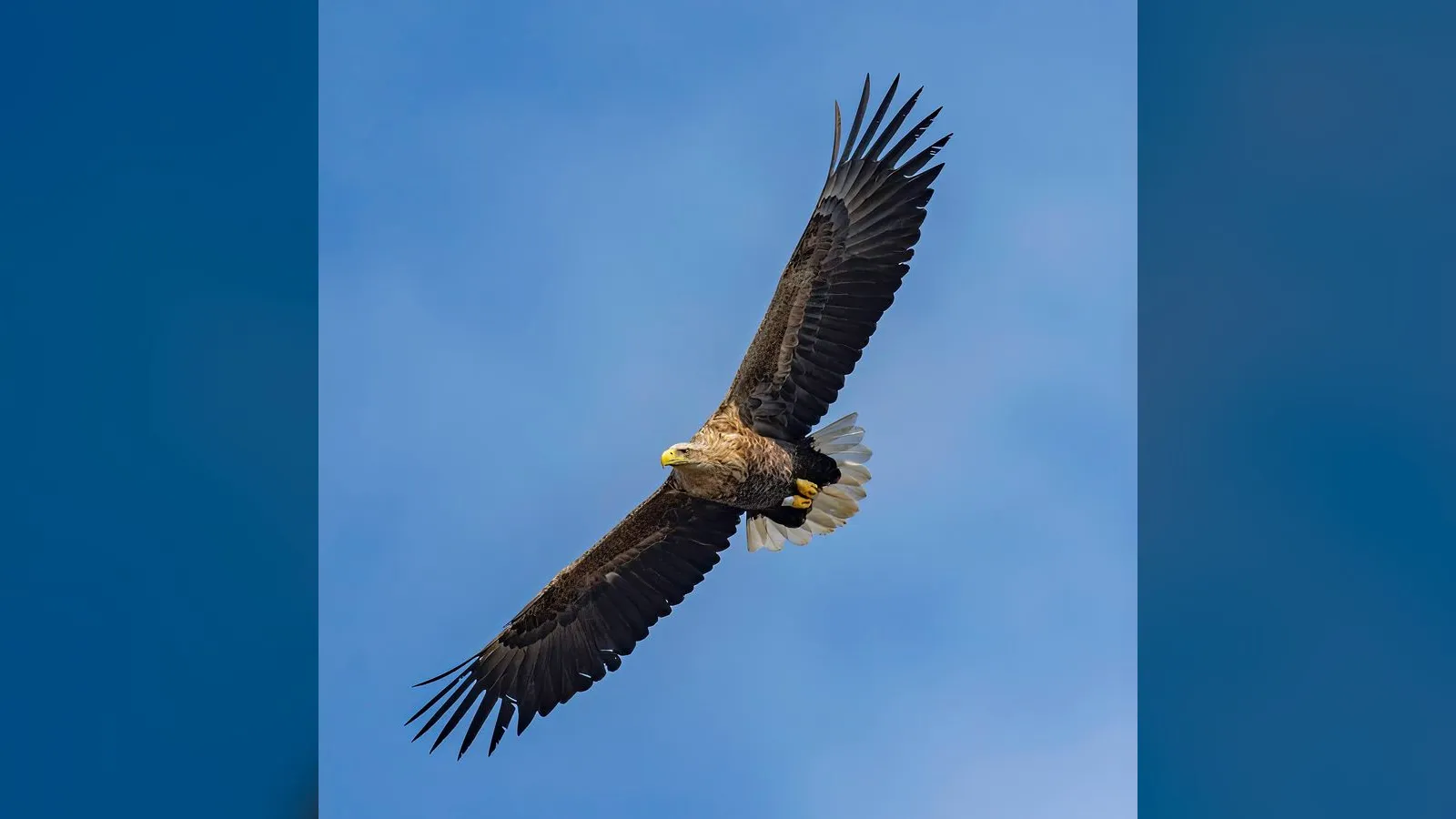

White-tailed Eagle (Haliaeetus albicilla)
Contents
TL;DR
- established The white-tailed eagle, Britain's largest bird of prey, was driven to extinction in Scotland by sustained persecution, a direct, documented human cause, not a natural decline. shared The last breeding pair was on Skye in 1916; the last native bird, a lone white female in Shetland, was shot in 1918 according to The Birds of Scotland (2007), though Birds Britannica records only that she failed to return.
- established Following two failed early attempts in 1959 and 1968, the species was successfully reintroduced to Scotland from 1975 onward via the Isle of Rum, with subsequent reintroduction phases on Wester Ross (1993 and 1998) and the east coast (2007–2012, led by the RSPB) — a sustained, multi-decade reintroduction effort rather than a single successful release.
- established The population has grown to around 150 breeding pairs across Scotland, with documented range expansion into areas unoccupied by the species for well over a century, including renewed breeding in Fife in 2013 and in Orkney in 2018 after more than 150 years' absence.
- disputed Scottish Natural Heritage reversed its own long-standing official position to confirm that white-tailed eagles do prey on healthy lambs, not only weak or already-dead animals — a genuine, documented institutional correction this article states directly, while noting that the overall scale and economic significance of this predation relative to other causes of lamb loss remains contested between farming and conservation interests.
- established A formal mitigation scheme, including call-off contractors, financial support of up to £1,500 annually per affected land manager, and trials of diversionary feeding and nest manipulation, represents a genuine, funded institutional response to the documented conflict between eagle recovery and livestock farming, rather than an unaddressed grievance.
Key Facts
- Scientific name
- Haliaeetus albicilla
- Also known as
- Sea eagle
- Category
- Birds
- Extinct in Scotland
- Last breeding pair Skye, 1916; last native bird Shetland, 1918
- Vernacular names
- Sea eagle; erne (from the Anglo-Saxon earn, "eagle"); Gaelic iolaire-mhara
- Population in 2004
- 32 territorial pairs, about 250–300 birds (The Birds of Scotland, 2007)
- First successful reintroduction
- 1975, Isle of Rum
- Current population
- Approximately 150 breeding pairs
- Key conservation issue
- Livestock predation conflict with farmers
Scottish Impact Index (SI Score)
- Scottish Significance
- 10/10
- Ecological Persistence
- 7/10
- Ecological Importance
- 10/10
- Biological Distinctiveness
- 10/10
- Conservation Significance
- 10/10
- Recognition
- 10/10
57/60
Ranked =2nd of 42 in Wildlife
A Note on Claims and Evidence
Extinction and reintroduction dates, population figures, and range expansion data are drawn from Scottish Raptor Study Group, RSPB, and NatureScot records. The lamb predation question is treated as genuinely Disputed: NatureScot's own documented reversal confirming healthy-lamb predation is Established fact, but the broader question of its overall scale and economic significance relative to other causes of lamb mortality remains an active, unresolved disagreement between farming and conservation interests, which this article presents from both documented positions rather than settling.
Timeline
At Isbister on South Ronaldsay, Orkney, people place the remains of white-tailed eagles in a chambered tomb alongside their own dead.
Martin Martin records the Skye story of an infant, afterwards known as Neil Eagle, carried across Loch Portree by an eagle and found unharmed.
After the Highland Clearances turn much of the region over to sheep, bounties and shooting drive the species toward extinction in Scotland; keepers on the Glen Garry estate kill 27 sea eagles between 1837 and 1840.
The bounty on an eagle in Mull reaches 10s 6d.
Shetland's population falls from up to five pairs to a single pair on Yell, and the male dies in 1910.
The last breeding pair in Britain nests at Dunvegan Head, Skye.
The last native bird, a white female in Shetland known to islanders for some 30 years, disappears; The Birds of Scotland (2007) says she was shot.
Only seven vagrant white-tailed eagles are recorded in Scotland, probably from Scandinavia.
Early reintroduction attempts at Glen Etive (three birds) and Fair Isle (four birds) both fail.
The first successful reintroduction programme begins on the Isle of Rum.
Released birds make their first breeding attempt.
First successful breeding of reintroduced birds, on the Isle of Mull, produces the first British-born chick in 69 years.
A second release phase at Letterewe, Wester Ross, frees 58 more Norwegian birds.
Scottish-bred eagles nest for the first time, producing young two years later.
32 territorial pairs on the west coast and the Hebrides; wild-bred birds make up nearly 60% of territory-holders.
The RSPB leads an east-coast reintroduction, releasing 85 individuals.
First breeding in Fife in nearly 200 years.
Outer Hebrides population reaches 25 pairs.
Successful breeding resumes in Orkney after more than 150 years' absence.
Five territorial pairs established in the Cairngorms.
First Loch Lomond sighting in over a century.
NatureScot reverses earlier position, formally confirming healthy-lamb predation, and expands the Sea Eagle Management Scheme, including increased funding announced in 2024.
Details
Extinction driven directly by human persecution
This article states the cause of the white-tailed eagle's Scottish extinction plainly: sustained persecution, worsened by the increasing availability of firearms, drove the species to extinction. The last breeding pair was on Skye in 1916, and the last native bird, an albino female in Shetland, vanished in 1918; she is usually said to have been shot. This is presented as a direct, documented human cause rather than an ambiguous natural decline, consistent with giving historical wildlife loss its full, accurate causal weight.
A reintroduction effort built on persistence through failure
This article credits the species' recovery as the product of sustained, repeated institutional effort rather than a single successful release. Two early reintroduction attempts, at Glen Etive in 1959 and Fair Isle in 1968, both failed before the first successful programme began on the Isle of Rum in 1975. This article includes the earlier failures directly, since the eventual recovery's real significance lies in persistence across multiple attempts and decades, not from any single intervention.
A documented, multi-phase, multi-decade recovery
Following the Rum programme's first confirmed breeding success on Mull in 1985, a second release phase in Wester Ross (1993–1998) and an RSPB-led east-coast release of 85 birds (2007–2012) extended the species' range deliberately and incrementally across Scotland. This article presents the resulting population of roughly 150 breeding pairs, and the specific, dated instances of range expansion into areas unoccupied for a century or more — Fife in 2013, Orkney in 2018, the Cairngorms in 2020, Loch Lomond in 2021 — as concrete evidence of a genuinely successful, sustained conservation programme, not a static population figure.
An official reversal on a contested question
This article states directly a genuinely significant institutional correction: Scottish Natural Heritage (now NatureScot) had long maintained that white-tailed eagles took only weak or already-dead livestock, but subsequently reversed this position, formally acknowledging in its own action plan that healthy lambs are sometimes taken and that, where alternative food is scarce, predation can extend beyond the lambing season. This article treats this reversal as Established fact in itself — the admission is documented and official — while treating the broader dispute over the overall scale and economic significance of this predation as genuinely unresolved: farming representatives, citing specific monitored losses, argue the impact is substantial and concentrated on west coast farmers who see little of the tourism benefit that eagle recovery brings elsewhere, a tension this article presents from both documented sides rather than adjudicating.
A funded, practical institutional response
This article notes that the predation conflict has not been left unaddressed: a formal Sea Eagle Management Scheme, including call-off contractors who assess eagle activity on affected land, financial support of up to £1,500 annually per affected land manager, and ongoing trials of diversionary feeding, nest manipulation, and altered grazing practices, represents a genuine, funded, evolving institutional response, with further funding increases announced as recently as 2024.
The Victorian slaughter of predators: the historian's figures
Smout draws on the work of Richard Lovegrove to argue that most of the damage to Scotland's predators was done before about 1840, with Victorian gamekeepers after about 1870 mainly engaged in "mopping-up operations". The Dumfries fur market, held every February, shows the scale in the south-west: in 1831, 600 polecat and 226 otter skins were offered for sale; by 1869 there were none of either. In the Highlands the evidence comes from estate vermin returns. Smout accepts that bounty records can be inflated, but notes that owners usually demanded heads or wings as proof, so a figure such as 143 pine martens and 295 eagles killed at Langwell and Sandside in Sutherland between 1819 and 1826 should not be dismissed. As a result some predators became extinct in Scotland (polecat, red kite, osprey, sea eagle) and others were greatly reduced (wild cat, pine marten, otter, hen harrier, golden eagle). Only well into the second half of the twentieth century was there even limited recovery.
Bounties, shepherds and the last Skye eagles
established Mark Cocker and Richard Mabey, in Birds Britannica (2005), record that the sea eagle's reputation as a lamb-killer gave "no grounds for tolerance". Its range once took in Ireland, north-west England and much of mainland Scotland and the outer isles. Orkney crofters paid a reward of a chicken, or eightpence, from each household in the parish to anyone who killed one. The Highland Clearances of the early nineteenth century, and the turning of much of the region over to sheep, made things worse for a bird believed to eat lambs. A bounty of up to five shillings for an adult's beak could add a good deal to a shepherd's income. On Skye, where eyewitnesses saw 40 white-tailed eagles gathered on one carcass, keepers claimed 57 eagles shot on a single estate.
established Hugh Macpherson's A History of Fowling tells of Angus Macleod, a Skye shepherd who lived to 104 and could recall killing more eagles "than any man of his acquaintance". He shot the parents, then climbed down to the eyrie and pushed in tar-soaked rags to burn or smoke out the young. The last breeding pair in Britain was on Skye in 1916. In Shetland a lone albino female returned to her nest cliffs for several barren years; when she failed to appear, the species' 70-year absence began.
Sea eagles in Scottish prehistory and story
established At Isbister on South Ronaldsay, Orkney, archaeologists found a Neolithic chambered tomb holding the remains of about 342 people. The bones show no gnawing by ground predators, which suggests the bodies were laid out on platforms to be picked clean by birds. Alongside the human bones lay 35 carcasses of large birds of prey, two-thirds of them white-tailed eagles. Cocker and Mabey suggest the people who built the tomb had a ritual, perhaps spiritual, attachment to the eagles. The site is now popularly known as the Tomb of the Eagles.
traditional Scottish writers recorded stories of eagles carrying off children. In the seventeenth century Sir Robert Sibbald included children in the bird's diet. Martin Martin told of an infant on Skye, left in a field on the north side of Loch Portree, who was carried by an eagle to the south side and found unharmed by people herding sheep; the boy was known afterwards as Neil Eagle. Either eagle species could have been involved. A later Shetland tale, dated to 1790 and recorded from a Fetlar resident in the 1960s by the ornithologist Bobby Tulloch, has an eagle carrying a baby girl from Unst to an eyrie on Fetlar, where she was saved by her thick shawl. Cocker and Mabey doubt it: the rescue would have taken about four hours, it was set at harvest time when no eagle should have a chick in the nest, and it ends with the baby marrying her teenage rescuer.
Lambs: the long argument
established The lamb question is old. In 2005 Cocker and Mabey wrote that research suggested the eagles' impact was "marginal". An Argyll study they cite examined 252 dead lambs: three-quarters had never suckled and only 7 per cent seemed healthy before death. They also noted that occasional "rogue" eagles can become habitual predators of live stock, and that management payments were already offered to crofters with breeding eagles. NatureScot's later acknowledgement that healthy lambs are sometimes taken, described above, refines rather than overturns that picture.
The Rum releases in more detail
established The first attempt, in Argyll in 1959, failed. So did the second: in July 1968 four young eagles were released on Fair Isle, but by the next summer three had died or left, and the last, a male, was found in a cave with his feathers fouled by oil vomited over him by fulmars. Between 1975 and 1985, 82 Norwegian eagles (39 males and 43 females) were released on Rum, in a joint effort involving UK conservation bodies, Eagle Star insurance, the RAF and the Norwegian Air Force, with Norwegian conservationists organising the capture of the donated birds. Eight were later found dead, one of them from illegal persecution. The first breeding attempt came in 1983, and in 1985 a pair raised the first British-born chick for 69 years. Growth was slow at first: in 2001, 17 occupied eyries fledged only 11 young. Birds Britannica counted 23 pairs holding territory by 2005, but the closer monitoring reported in The Birds of Scotland (2007) found 31 territorial pairs in 2003 and 32 in 2004, so the lower figure is out of date. The figures above for the present population show how far the species has come since.
The Scottish record: The Birds of Scotland (2007)
established How the eagle was lost. The Scottish Ornithologists' Club's The Birds of Scotland (2007), in the species account by John A. Love, notes that the white-tailed eagle is far more approachable and tolerant of people than the golden eagle, and its habit of feeding on carrion made it easy to poison. Love's research, using place names such as Erne's Heugh and Creag na h-iolaire, sportsmen's accounts and museum eggs and skins, found nearly 100 known Scottish nest sites. A few pairs survived in the south-west, at the Mull of Galloway and Cairnsmore of Fleet, but by the nineteenth century it was mainly a bird of the north and west coasts and Shetland. The Highland Clearances pushed people to the coast, where the noisy, conspicuous eagles' nests were well known, and as the bird grew rare its eggs became prized by collectors. The golden eagle, shyer and nesting in the high glens, held on long enough to gain respite during the two World Wars, and then moved into empty sea eagle territories, sometimes onto the same ledges. The last pairs nested on the Shiant Islands, Ardnamurchan, Rum and the Skye headlands, ending at Dunvegan Head in 1916. The account dates the species' earliest Scottish record to bones in a Bronze Age cairn on North Ronaldsay, and notes its portrayal on Pictish symbol stones such as the one from the Knowe of Burrian in Orkney.
established Building the new population. All but one of the birds released in Scotland were fledglings taken under licence from northern Norway: 82 on Rum in 1975–85 and 58 at Letterewe in 1993–98. At least 10% were later found dead, mostly as immatures. By 1993 there were only about eight established pairs, rearing two to seven young a year, nearly all from the same three pairs. Numbers then rose: 18 pairs in 1998, and in the bumper year of 2003, 26 young from 25 clutches laid by 31 territorial pairs. By 2004 there were 32 territories, 168 young had fledged in the wild, and the population, estimated at 250 to 300 birds, appeared self-sustaining. Adult survival was put at 97% a year and immature survival at 75%.
established Breeding and wandering. Scottish birds usually lay two eggs in late March, the earliest recorded on 29 February, and incubate for 38 to 40 days. Unlike golden eagle chicks, the siblings rarely fight. One brood of triplets fledged in 1997. Young birds may turn up anywhere in Scotland in their first two or three years; one flew over the centre of Glasgow in March 1996. A Letterewe bird known as "Red 7" travelled to Orkney and Shetland in 1994, reached Norway that October and began breeding there in 2001. The Rum female nicknamed "Blondie", released in 1979, moved to Mull, helped raise the first Scottish eaglet in 1985 and stayed on the island until her death 21 years after her release.
established Persecution after reintroduction. Killing did not stop with the return. Of about 25 dead birds reported up to 2004, at least six were persecuted, mostly by illegal poisoning, and two-thirds of the poisoned birds were breeding adults. The youngest Scottish pair, a three-year-old male and four-year-old female that reared a chick in 2000, were both poisoned, the male in 2002 and the female the next year. Egg collectors took four clutches in the same period. Analysed eggs held traces of PCBs, DDT and mercury, but not at levels thought to cause serious infertility.
Did You Know?
- The white-tailed eagle is Britain's largest bird of prey, with a wingspan that can exceed two metres.
- The last native Scottish white-tailed eagle was an albino female in Shetland, last seen in 1918.
- Of four young eagles released on Fair Isle in 1968, the last, a male, was found in a cave with his plumage fouled with oil vomited over him by fulmars.
- Orkney crofters once paid anyone who killed a sea eagle a chicken, or eightpence, from every household in the parish.
- Keepers on Skye once claimed 57 eagles shot on a single estate, while eyewitnesses on the island reported 40 white-tailed eagles gathered on one carcass.
- Two reintroduction attempts failed, in 1959 and 1968, before the successful 1975 Rum programme.
- The species returned to breed in Orkney in 2018, more than 150 years after its earlier local extinction there.
- NatureScot formally reversed its earlier position to confirm that white-tailed eagles do sometimes take healthy lambs, not only weak or dead animals.
- Affected farmers can receive up to £1,500 annually through the Sea Eagle Management Scheme.
- Love's research into place names and old records identified nearly 100 historical white-tailed eagle nest sites in Scotland.
- A wing-tagged eagle released in Wester Ross in 1993 flew to Norway and began breeding there in 2001.
- The species is also widely known as the "sea eagle" for its strong association with coastal and island habitats.
FAQ
1Why did white-tailed eagles become extinct in Scotland?
Sustained human persecution: shooting, bounties and the destruction of eyries, driven mainly by the bird's reputation as a lamb-killer. The last breeding pair was on Skye in 1916 and the last native bird disappeared from Shetland in 1918.
2When were they successfully reintroduced?
The first successful programme began on the Isle of Rum in 1975, after two earlier attempts failed.
3How many are in Scotland now?
Approximately 150 breeding pairs, with ongoing range expansion into areas unoccupied for over a century.
4Do white-tailed eagles really kill healthy lambs?
Yes — NatureScot reversed its earlier position and formally confirmed this in its own action plan, though the overall scale of the impact remains disputed between farmers and conservationists.
5Is there support for affected farmers?
Yes — the Sea Eagle Management Scheme offers call-off contractor assessments and up to £1,500 annually per affected land manager.
6Where are white-tailed eagles found in Scotland today?
Across the west coast, Outer Hebrides, and increasingly the east coast, Orkney, and parts of the Highlands and Loch Lomond area.
7Are they the same as golden eagles?
No — they are a distinct, larger species, sometimes confused with golden eagles but generally found closer to coasts and large bodies of water.
8When was the last native sea eagle seen in Scotland?
The last breeding pair nested on Skye in 1916. A lone albino female in Shetland survived a little longer; she was last seen in 1918 and is usually said to have been shot.
9What is the Tomb of the Eagles?
A Neolithic chambered tomb at Isbister on South Ronaldsay, Orkney, where the bones of about 342 people were found with 35 large birds of prey, two-thirds of them white-tailed eagles.
10Did eagles really carry off babies in Scotland?
Stories survive from Skye and Shetland, including Martin Martin's account of "Neil Eagle" at Loch Portree, but none can be verified, and the Shetland version has details that do not fit eagle biology.
11Why did earlier reintroductions fail?
Both were very small. The 1959 Argyll attempt failed, and of the four young eagles released on Fair Isle in 1968, none stayed to breed. They provided lessons for the much larger Rum programme, which released 82 birds over ten years.
12Where did the reintroduced eagles come from?
Almost all were fledglings taken under licence from northern Norway: 82 released on Rum in 1975–85 and 58 at Letterewe in Wester Ross in 1993–98.
13Are reintroduced sea eagles still persecuted?
Some are. The Birds of Scotland (2007) records at least six of about 25 dead birds reported up to 2004 as persecution victims, mostly poisoned, and four clutches taken by egg collectors.
14Is the farmer-conservation dispute resolved?
No — it remains an active, ongoing disagreement over the scale and economic impact of predation, addressed through an evolving funded mitigation scheme rather than settled consensus.
Sources and Further Reading
Primary/Institutional
- Forrester, R. W., Andrews, I. J. et al. (eds), The Birds of Scotland (Scottish Ornithologists' Club, 2007), account by John A. Love
- White-tailed Eagle — Scottish Raptor Study Group
- White-tailed Eagle Action Plan — Questions and Answers — NatureScot
- White-tailed Eagle — BTO
Scholarly/Critical
- T. C. Smout, "Land and Sea: The Environment", in T. M. Devine and Jenny Wormald (eds), The Oxford Handbook of Modern Scottish History (Oxford University Press, 2012)
- Mark Cocker and Richard Mabey, Birds Britannica (Chatto & Windus, 2005)
- White-tailed Eagle: A successful conservation story — Scottish Ornithologists' Club
- SNH admits that sea eagles take healthy lambs — The Scottish Farmer
General
Caveats: Myths and Disputed Claims
- Disputed: the impact on sheep farming. It is established fact, confirmed by NatureScot, that healthy lambs are sometimes taken, but the overall scale of this predation's impact on Scottish sheep farming as a whole remains genuinely disputed.
- Myth: chemical pesticides caused the sea eagle's Scottish extinction. The species was gone by 1918, decades before modern pesticides, and was killed off by shooting, bounties and the destruction of eyries.
- Last pair and last bird. The last breeding pair was at Dunvegan Head, Skye, in 1916; the last native bird was a lone white female in Shetland in 1918. The Birds of Scotland (2007) says she was shot; Birds Britannica records only that she failed to return.
- Not the mid-2000s total: 23 territorial pairs. Birds Britannica gives 23 territorial pairs, but monitoring recorded 32 in 2004.
- Folklore: eagle baby-snatching stories. They are folklore, and the best-documented one, from Fetlar, fails on several points.
Finished reading? Try the Fact Machine: three reels, one surprising Scottish connection →
Card 002 · Wildlife