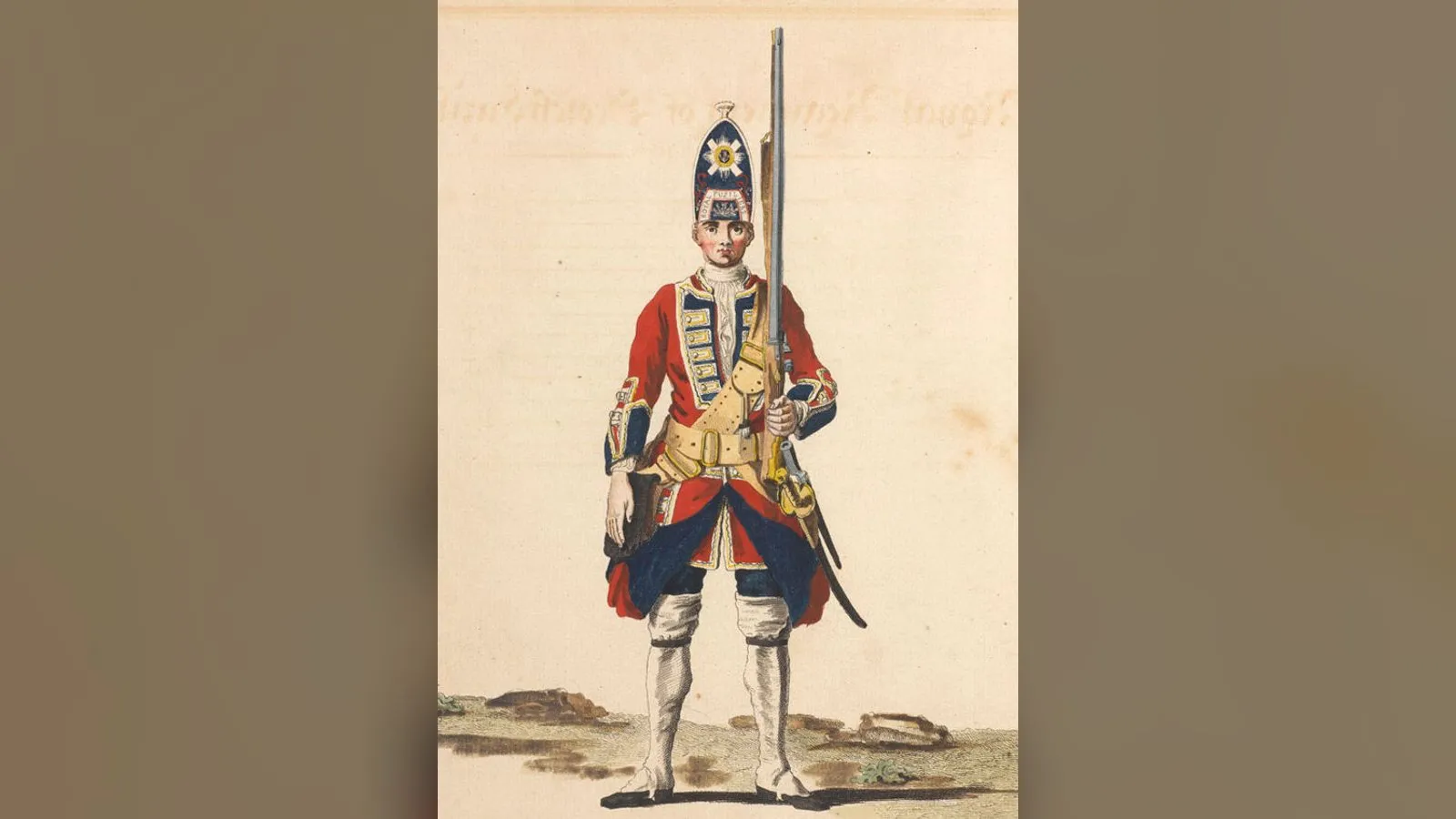

The Royal Highland Fusiliers (1959–2006): Scotland's Lowland–Highland Fusilier Synthesis
Contents
The Royal Highland Fusiliers (Defence Series, Card #14) existed as a regiment from 1959 to 2006, formed from the Royal Scots Fusiliers and the Highland Light Infantry and now the 2nd Battalion of the Royal Regiment of Scotland. This card tests how the 1959 merger and its dress dispute actually played out, what the regiment's operational record was, and which popular claims about it belong to other units.
TL;DR
- established The Royal Highland Fusiliers (RHF) was formed on 20 January 1959 by amalgamating The Royal Scots Fusiliers (raised 1678 — see Card #6) and The Highland Light Infantry (City of Glasgow Regiment) (formed 1881 — see Card #9), taking the full title The Royal Highland Fusiliers (Princess Margaret's Own Glasgow and Ayrshire Regiment).
- established Its most distinctive feature is a genuine Lowland–Highland dress synthesis: the merged regiment wore the HLI's Mackenzie tartan trews (not the kilt), retained the Royal Scots Fusiliers' flaming-grenade cap badge and white hackle, and mounted the HLI's crowned monogram on the grenade — a compromise imposed after a bitter public dispute in which both antecedent colonels resigned rather than accept it.
- established Across nearly five decades the RHF served in Aden, Malta, West Germany (BAOR), Cyprus, Gibraltar, Singapore/Malaysia, Northern Ireland, the 1991 Gulf War, Belize, Bosnia, Kosovo/Macedonia and Iraq, alternating operational tours with Cold War garrison duty.
- established It carried unique traditions, most famously holding "the distinction among British infantry regiments of carrying three Colours on parade" — adding the Assaye Colour inherited from the 74th Highlanders.
- established On 28 March 2006 the RHF became The Royal Highland Fusiliers, 2nd Battalion, The Royal Regiment of Scotland (2 SCOTS), uniquely retaining its historic name as a battalion subtitle (see Card #23).
Key Facts
- Period covered
- 1959–2006 (lineage continues as 2 SCOTS)
- Formed
- 20 January 1959, Edinburgh
- Antecedents
- Royal Scots Fusiliers (Card #6); Highland Light Infantry (Card #9)
- Full title
- The Royal Highland Fusiliers (Princess Margaret's Own Glasgow and Ayrshire Regiment)
- Recruiting area
- Glasgow and Ayrshire (West of Scotland)
- Key institution
- The Royal Highland Fusiliers Museum, 518 Sauchiehall Street, Glasgow
- Notable feature
- Mackenzie tartan trews + white hackle + flaming grenade badge; only regiment to carry three Colours
- Colonel-in-Chief
- Princess Margaret (1959–2002); Prince Andrew (2003–2022)
- Motto
- Nemo Me Impune Lacessit
- Current status
- 2nd Battalion, The Royal Regiment of Scotland (2 SCOTS) since 2006
A Note on Claims and Evidence
Each major claim carries one of three labels. established means supported by primary records, official bodies or several independent reliable sources. shared means the core fact is sound but sources disagree on details, dates or interpretation. traditional means widely repeated but not traceable to a primary or independent source.
The core claims of this card are Established (documented). The date and circumstances of the 1959 merger, the regiment's full title, the dress compromise, the operational deployments and the 2006 re-designation are all confirmed by primary and institutional sources: the National Army Museum, the Royal Highland Fusiliers Museum, and the verbatim record of the House of Commons (Hansard) for the 1957 dress dispute.
A small number of details warrant care and are flagged as Shared/Traditional or disputed in the Caveats section — principally the exact count of RHF dead since 1959, occasional secondary-source conflation of the RHF with the (separate, English) Royal Regiment of Fusiliers, and the precise nature of the regiment's 1991 Gulf War role. Following the site's "accuracy over patriotism" standard, operational service in politically sensitive contexts (notably Northern Ireland) is presented as factual record without adjudicating contested political questions.
Timeline
Duncan Sandys' Defence White Paper (Cmnd. 124) sets in train the reduction of the infantry; thirty regiments to amalgamate into fifteen pairs. RSF and HLI are paired.
In the Commons, Secretary of State for War John Hare confirms the Army Council's insistence that the new regiment wear trews, not the kilt; both regimental colonels resign in protest.
The Royal Highland Fusiliers (Princess Margaret's Own Glasgow and Ayrshire Regiment) formed in Edinburgh; the two regular 1st battalions combine at Redford Barracks. Princess Margaret becomes first Colonel-in-Chief.
First deployment: Aden (Singapore Lines); regimental band plays at Somaliland independence ceremonies in Hargeisa.
Malta.
West Germany (Iserlohn), the first of many BAOR postings.
Cyprus, as British battalion of the UN peacekeeping force (UNFICYP).
Granted the Freedom of Iserlohn — the first British regiment so honoured by a West German town.
Gibraltar frontier duties after Franco closed the border.
Three off-duty RHF soldiers murdered by the Provisional IRA near Belfast ("the Three Scottish Soldiers").
Singapore/Malaysia.
Seven postings to Northern Ireland during the Troubles.
Belize.
Gulf War (Operation Granby); battle honour "Gulf 1991" awarded.
Bosnia (Operation Grapple).
Company deployments to Bosnia, Macedonia and Kosovo.
Falkland Islands garrison company; battalion to Cyprus.
Alternating Cyprus and Iraq (Operation Telic).
Re-designated 2nd Battalion, The Royal Regiment of Scotland (2 SCOTS).
Details
Brief recap: the two antecedent regiments (see Cards #6 and #9)
established The RHF drew together two very different West of Scotland lineages, both treated in full on their own cards.
established The Royal Scots Fusiliers (Card #6) was raised in 1678 by Charles Erskine, Earl of Mar, becoming a fusilier regiment in 1685; it was numbered the 21st Foot, recruited in Ayrshire and south-west Scotland, and was a Lowland regiment that wore trews throughout its history.
established The Highland Light Infantry (City of Glasgow Regiment) (Card #9) was formed in the 1881 Cardwell–Childers reforms from the 71st (Highland) Light Infantry and the 74th (Highland) Regiment. Despite the "Highland" in its name, it recruited in Glasgow and was the one Highland regiment issued the Lowland uniform of trews rather than the kilt — a status it accepted in 1881 and did not reverse until 1947. This card does not re-narrate those origins; readers wanting the seventeenth- and eighteenth-century detail should consult Cards #6 and #9.
The 1959 merger: circumstances and controversy
established The immediate cause was the 1957 Defence White Paper produced by Duncan Sandys, which cut the infantry of the line and grouped surviving regiments into brigades, reducing regular battalions by amalgamating pairs. The RSF and HLI were selected to merge — a logical pairing, as both were West of Scotland regiments within the Lowland Brigade, recruiting from Ayrshire and Glasgow respectively.
established The amalgamation was fiercely contested — not over whether to merge, but over dress. The Army Council ruled that the new regiment, as part of the Lowland Brigade, must wear trews rather than the kilt. This was unacceptable to the HLI, which had regained the kilt only in 1947 and prized it. The dispute reached the House of Commons. On 11 December 1957 the Secretary of State for War, John Hare, explained that other colonels of both the Highland and Lowland Brigades regarded a kilted regiment within the Lowland Brigade as unacceptable, and that common promotion and posting rolls made mixed dress impractical. He put the matter in stark historical terms, telling the House: "From 1809 to 1947, the Highland Light Infantry—before that they were the 71st Foot—wore trews. In other words, if my mathematics are right, in only ten years out of the 148 have the Highland Light Infantry worn the kilt."
established When the two colonels — Major-General Hakewill Smith (RSF) and Major-General Urquhart (HLI) — refused to accept the trews decision, they took the dramatic step of recommending disbandment rather than compromise. As Hare recorded to the Commons: "Both officers in their replies reaffirmed their view that the amalgamated regiment should wear the kilt. They recommended that, if this was not acceptable to the Army Council, the two regiments should be disbanded. Accordingly, they offered their resignations. On 2nd December, I informed both colonels that I proposed to recommend to Her Majesty the Queen that their resignations should be accepted..."
established The merger duly took place in Edinburgh on 20 January 1959, the two regular battalions combining at Redford Barracks to form 1 RHF. The new regiment received the full title The Royal Highland Fusiliers (Princess Margaret's Own Glasgow and Ayrshire Regiment), with Princess Margaret as its first Colonel-in-Chief.
The Lowland–Highland dress and identity synthesis (core new content)
established The RHF's identity is a carefully balanced compromise between two regiments that, unusually, both rejected the kilt — making it one of the British Army's most distinctive "trewsed" Scottish regiments. The synthesis worked element by element:
- Trews, not kilt. The regiment adopted Mackenzie tartan trews — the HLI's tartan (the blue-and-green "government"/Black Watch sett with added white and red overstripes). This honoured both antecedents' non-kilted tradition while adopting the specific tartan of the HLI rather than the RSF's Hunting Erskine (worn by the RSF from 1948). The kilt was, however, retained for the Pipes and Drums.
- The flaming grenade cap badge was taken directly from the Royal Scots Fusiliers, preserving the fusilier identity. Onto this grenade was mounted the crowned HLI monogram — so the single badge fused both parents visually.
- The white hackle, the fusilier plume, was inherited from the Royal Scots Fusiliers and worn on the khaki Tam o' Shanter (with a Mackenzie tartan patch) in the field, or with the blue Glengarry in barracks.
- Full dress detail included the blue Glengarry with red tourie and red-white-green dicing, black silk cockade, and black Highland brogues with white spats.
- Regimental peculiarities of dress included officers' red "infantry" piping on the epaulettes of their greatcoats — a detail inherited from the RSF and, curiously, referenced by Boris Pasternak in Doctor Zhivago.
established The Pipes and Drums preserved the Highland flavour that the line companies gave up: pipers wore the all-blue Cameron-pattern Glengarry with Dress Erskine tartan kilt, drummers wore the kilt with the diced Glengarry, and buglers wore Mackenzie trews. Band members wore a distinct badge with the flaming grenade on the saltire and the star of the Order of the Thistle; the Drum Major wore Mackenzie trews, a scarlet fusilier doublet and a bearskin with grenade badge and white hackle.
established The net effect was a regiment that read unmistakably as fusilier (grenade, hackle, "The British Grenadiers" among its marches) and unmistakably as West of Scotland Lowland-Highland (Mackenzie trews, Glasgow and Ayrshire recruiting), resolving the 1957 quarrel by giving each antecedent ownership of specific, visible items.
Post-1959 Cold War and operational service
established The RHF's service pattern was typical of a late-Cold-War infantry battalion: recurring BAOR tours in West Germany interleaved with imperial/postcolonial deployments, UN peacekeeping, and — from the 1970s — Northern Ireland.
established Aden and the Mediterranean (1960–1965). The regiment's first deployment was to Aden in 1960 (Singapore Lines), with the band playing at the Hargeisa independence ceremonies. Malta followed in 1961.
established West Germany and Cyprus. In 1963 the RHF moved to Iserlohn — the first of postings that, in the National Army Museum's words, saw it sent "to West Germany, where it spent 16 of the next 40 years." In 1965 it served six months in Cyprus as the British battalion of UNFICYP. In 1967, as the National Army Museum records, "the regiment was granted the freedom of Iserlohn, becoming the first British infantry regiment to receive that honour from a town in West Germany."
established Gibraltar, the Far East and home. A six-month Gibraltar frontier tour followed in 1968 after Franco closed the Spain–Gibraltar border, then a two-year posting to Singapore/Malaysia from 1971.
established Northern Ireland (Operation Banner). The National Army Museum records that "between 1974 and 1991, the regiment was sent on seven postings to Northern Ireland," alongside earlier tours in the early 1970s. The regiment's most infamous single loss came on 10 March 1971, when three off-duty, unarmed RHF soldiers — Dougald McCaughey (23) and brothers John (17) and Joseph (18) McCaig — were lured from Mooney's bar in Cornmarket, Belfast, and shot dead by the Provisional IRA near Squire's Hill while stationed at Girdwood Park Barracks. Known in the regiment as "the Three Scottish Soldiers," they were, per the Three Scottish Soldiers Campaign for Justice, "the first off-duty soldiers to be killed during the Troubles in Northern Ireland." The killings prompted public protest, contributed to the political crisis that led to the resignation of Northern Ireland Prime Minister James Chichester-Clark, and led the Army to raise the minimum age for service in Northern Ireland to 18. Consistent with this card's editorial standard, these events are recorded as documented operational facts; the card takes no position on the wider contested politics of the conflict.
shared The Gulf War (1991). Deploying from Oakington Barracks, Cambridge (its home station from 1989), the 1st Battalion served in the Gulf during Operation Granby from roughly January to May 1991, in a rear-area security and prisoner-of-war guard role rather than as a frontline armoured battlegroup, with sub-units in the Al Jubail / Wadi al Batin / Kuwait City area. The regiment received the battle honour "Gulf 1991," which appears among its battle honours in The Journal of the Royal Highland Fusiliers. No RHF combat fatalities are recorded in the sources consulted; the widely reported "friendly fire" losses of 26 February 1991 were sustained by the (separate, English) Royal Regiment of Fusiliers and attached Queen's Own Highlanders, not the RHF — a common source of confusion addressed in the Caveats.
established The Balkans and Iraq. After moving to Fallingbostel in 1993, the RHF deployed to Bosnia (Operation Grapple) in 1994 as an armoured infantry battalion equipped with Warrior vehicles, patrolling around Gornji Vakuf, Novi Travnik and Maglaj. Company-level deployments returned to the Balkans in 1999 (Bosnia, Macedonia, Kosovo). In 2003 a company garrisoned the Falklands while the battalion moved to Cyprus, thereafter alternating Cyprus with Iraq service under Operation Telic (2003–2006 and beyond as 2 SCOTS).
Traditions distinctive to the merged regiment
established While much of the RHF's ceremonial was inherited, several features became emblematic of the merged regiment itself:
- Three Colours. The RHF held "the distinction among British infantry regiments of carrying three Colours on parade" — the Queen's Colour, the Regimental Colour, and the Assaye Colour, the last "awarded by the Governor General in Council in India on behalf of the British East India Company to the 74th Highland Regiment for distinguished service at the Battle of Assaye in India in 1803." At Assaye, every officer present with the 74th was killed or wounded save Quartermaster James Grant; on Assaye Day the Colour is traditionally carried by the Quartermaster in Grant's memory.
- The fused cap badge (grenade + crowned HLI monogram) was created specifically for the 1959 regiment and had no exact predecessor.
- Drill and language peculiarities: the RHF retained the full, long "Attention" command on parade rather than the abbreviated modern "'shun," and referred to the Commanding Officer's disciplinary orders as "haul up," a phrase said to derive from the antecedents' historic role escorting prisoners to the colonies.
- Royal connection: Princess Margaret served as Colonel-in-Chief from 1959 until her death in 2002, giving the regiment its "Princess Margaret's Own" subtitle; Prince Andrew succeeded her in 2003.
- The regimental museum occupies a category B-listed 1903 building at 518 Sauchiehall Street, Glasgow, designed by John Keppie of the Glasgow architectural firm Honeyman, Keppie and Mackintosh (the practice of which Charles Rennie Mackintosh was a partner); it also serves as regimental headquarters and holds the collections of all three antecedent lineages.
2006: integration into the Royal Regiment of Scotland (see Card #23)
established Under the Delivering Security in a Changing World review, Scotland's single-battalion regiments were consolidated into one large regiment. On 28 March 2006 the RHF became The Royal Highland Fusiliers, 2nd Battalion, The Royal Regiment of Scotland (2 SCOTS), moving to Glencorse Barracks, Penicuik. Distinctively, the Royal Regiment of Scotland retained the former regimental names as battalion subtitles, so the RHF's identity persists within 2 SCOTS, which continues to wear the white hackle. The full story of the 2006 formation is told on Card #23.
Did You Know?
- The RHF held "the distinction among British infantry regiments of carrying three Colours on parade," thanks to the Assaye Colour inherited from the 74th Highlanders.
- Both antecedent colonels resigned rather than accept trews in place of the kilt in 1957 — and formally recommended disbandment instead. The dress dispute reached the floor of the House of Commons.
- The regiment's dress fuses two parents in one badge: the Royal Scots Fusiliers' flaming grenade carries the Highland Light Infantry's crowned monogram.
- In 1967 the RHF became "the first British infantry regiment to receive that honour from a town in West Germany" — the Freedom of Iserlohn.
- A dress detail of RHF officers — red infantry piping on greatcoat epaulettes — is mentioned by Boris Pasternak in Doctor Zhivago.
- Its Colonel-in-Chief from 1959 to 2002 was Princess Margaret, giving the regiment its "Princess Margaret's Own" subtitle.
- The regimental museum stands in a 1903 building on Sauchiehall Street, Glasgow, designed by John Keppie of Honeyman, Keppie and Mackintosh — the firm in which Charles Rennie Mackintosh was a partner.
- The RHF's regimental quick march is "Whistle o'er the Lave o't", paired with the fusilier "The British Grenadiers."
FAQ
1When and how was the Royal Highland Fusiliers formed?
It was formed on 20 January 1959 in Edinburgh by amalgamating the Royal Scots Fusiliers (raised 1678) and the Highland Light Infantry (formed 1881). The two regular 1st battalions combined at Redford Barracks to form the 1st Battalion, Royal Highland Fusiliers, under the 1957 Defence White Paper reductions.
2What was the regiment's full title?
The Royal Highland Fusiliers (Princess Margaret's Own Glasgow and Ayrshire Regiment). The "Princess Margaret's Own" element reflects Princess Margaret's role as first Colonel-in-Chief; "Glasgow and Ayrshire" reflects the recruiting areas of the HLI and RSF respectively.
3Did the Royal Highland Fusiliers wear the kilt or trews?
Trews. The regiment wore Mackenzie tartan trews, following the non-kilted tradition of both antecedents. The kilt (Dress Erskine tartan) was retained only for the Pipes and Drums. The decision to wear trews rather than the kilt caused a major dispute in 1957.
4Why did the RHF wear trews and not the kilt?
As part of the Lowland Brigade, the Army Council ruled a kilted regiment would be inappropriate, and common promotion and posting rolls within the brigade made mixed dress impractical. Both antecedents had also worn trews for most of their histories. The two colonels resigned in protest, but the trews decision stood.
5What tartan did the Royal Highland Fusiliers wear?
The Mackenzie tartan — the blue-and-green "government" sett with added white and red overstripes — which had been the Highland Light Infantry's tartan. Pipers wore Dress Erskine tartan kilts.
6Did the RHF keep the white hackle and grenade badge?
Yes. Both came from the Royal Scots Fusiliers. The white hackle was worn on the Tam o' Shanter and Glengarry, and the flaming-grenade cap badge was retained, with the Highland Light Infantry's crowned monogram mounted on it.
7Where did the Royal Highland Fusiliers serve during the Cold War?
Chiefly in West Germany (BAOR) — Iserlohn from 1963, later Hemer, Berlin and Fallingbostel, spending 16 of its next 40 years in Germany — interspersed with Aden, Malta, Cyprus (UN peacekeeping), Gibraltar, Singapore and Malaysia.
8Did the Royal Highland Fusiliers serve in Northern Ireland?
Yes. The National Army Museum records seven postings between 1974 and 1991, plus earlier tours during Operation Banner. On 10 March 1971 three off-duty RHF soldiers were murdered by the Provisional IRA near Belfast — an event of major political significance in the early Troubles.
9Did the RHF fight in the Gulf War?
Yes. The 1st Battalion deployed on Operation Granby in 1991, principally in rear-area security and prisoner-of-war guard duties rather than as a frontline armoured battlegroup, and received the battle honour "Gulf 1991."
10What makes the RHF unique among British regiments?
It held the distinction of carrying three Colours on parade (the Queen's, Regimental and Assaye Colours), and it embodies an unusual Lowland–Highland fusilier identity combining Mackenzie trews with the fusilier grenade badge and white hackle.
11What happened to the Royal Highland Fusiliers in 2006?
On 28 March 2006 it became the 2nd Battalion, The Royal Regiment of Scotland, retaining its historic name as "The Royal Highland Fusiliers, 2nd Battalion, The Royal Regiment of Scotland (2 SCOTS)." See Card #23 for the full formation of the Royal Regiment of Scotland.
12Where is the Royal Highland Fusiliers Museum?
At 518 Sauchiehall Street, Glasgow (near Charing Cross), in a 1903 building designed by John Keppie of Honeyman, Keppie and Mackintosh. It doubles as regimental headquarters and tells the story of the RHF and its antecedents; admission is free.
Sources and Further Reading
Primary/Institutional
- Hansard, House of Commons, "Royal Scots Fusiliers and Highland Light Infantry," 11 December 1957 (verbatim record of the trews/kilt dispute).
- The Royal Highland Fusiliers Museum, Glasgow (rhf.org.uk) — regimental history pages and The Journal of the Royal Highland Fusiliers.
- National Army Museum (nam.ac.uk) — regimental histories of the RHF, RSF and HLI.
- Imperial War Museum — Operation Grapple (Bosnia, 1994) photographic collections featuring 1st Battalion RHF.
- Army Museums Ogilby Trust — Royal Highland Fusiliers Regimental Museum listing.
Scholarly/Critical
- Matthew Grant, "Home Defence and the Sandys Defence White Paper, 1957," Journal of Strategic Studies 31:6 (2008).
- David French, Military Identities: The Regimental System, the British Army and the British People, c.1870–2000 (Oxford University Press, 2005) — discusses the RSF/HLI amalgamation dress dispute.
- John Buchan, The History of the Royal Scots Fusiliers 1678–1918.
- L.B. Oatts, Proud Heritage: The Story of the Highland Light Infantry (4 vols).
Further reading
- National Army Museum online features on the Troubles (1969–2007) and the Gulf War.
- The Royal Regiment of Scotland (see Card #23) for the post-2006 story.
Caveats: Myths and Disputed Claims
- Myth: the RHF suffered the M62 coach bombing and the 1991 Gulf "friendly fire" deaths. The most common error in secondary sources is conflating the Scottish Royal Highland Fusiliers (RHF) with the English Royal Regiment of Fusiliers (RRF). The 1974 M62 coach bombing and the Gulf "friendly fire" deaths of 26 February 1991 involved the RRF (and, in the Gulf case, attached Queen's Own Highlanders), not the RHF.
- Disputed: the RHF's role in the 1991 Gulf War. Regimental sources confirm the "Gulf 1991" battle honour and the deployment, but detail on the exact tasking is thin. The best-supported account places 1 RHF in a rear-area and prisoner-of-war guard role; claims in some AI-generated or enthusiast sources of frontline combat against the Republican Guard are unsupported.
- Disputed: the number of RHF dead since 1959. A 2025 Glasgow City Council debate cited "23 servicemen" who died since the regiment's formation; the figure comes from civic and press reporting rather than a definitive regimental roll of honour.
- Disputed: the number of Northern Ireland tours. The National Army Museum gives "seven postings between 1974 and 1991", while other sources describe "five tours in the 1970s"; the difference reflects how tours are counted and dated rather than a genuine contradiction.
- Myth: the regiment was formed in 1958. A few sources give 1958 (reflecting when the decision took effect administratively or when dress changed); the formal formation date is 20 January 1959, as confirmed by the regiment and the National Army Museum.
- Myth: Charles Rennie Mackintosh designed the RHF museum building. The 1903 category B-listed building on Sauchiehall Street was designed by John Keppie of the firm Honeyman, Keppie and Mackintosh, of which Mackintosh was a partner.
- Myth: "Highland" in the name made the RHF a kilted Highland regiment. The RHF was a West of Scotland Lowland Brigade regiment wearing trews; the "Highland" element is inherited from the HLI — precisely the point at issue in the 1957 dispute.
Finished reading? Try the Fact Machine: three reels, one surprising Scottish connection →
A Defence story