
The Royal Regiment of Scotland: The 2006 Convergence — Defence Series Card #23
Contents
The Royal Regiment of Scotland is Scotland's single large line infantry regiment, formed on 28 March 2006 from the six remaining Scottish infantry regiments. This card tests why it was created, how each old regiment maps onto its battalions, how contested the reform was, and how far the structure has shrunk since.
TL;DR
- established This is the capstone card of the individual-regiment sequence. On 28 March 2006 the six remaining single-battalion Scottish infantry regiments profiled across Cards #5–#14 were amalgamated into one large multi-battalion regiment, the Royal Regiment of Scotland (SCOTS) — the threads deferred by ten previous cards converge here.
- established The battalion map is precise and documented: 1 SCOTS (Royal Scots [#5] + King's Own Scottish Borderers [#7]); 2 SCOTS (Royal Highland Fusiliers [#14]); 3 SCOTS (Black Watch [#3–4]); 4 SCOTS (The Highlanders — Seaforth [#10], Gordons [#11], Camerons [#12]); 5 SCOTS (Argyll & Sutherland Highlanders [#13]); plus reserves 6 SCOTS (52nd Lowland, linking to Card #22) and 7 SCOTS (51st Highland, linking to Card #21).
- shared It was genuinely controversial. A "Save the Scottish Regiments" campaign opposed the mergers, and the announcement's timing — while the Black Watch was under fire at Camp Dogwood in Iraq — inflamed opposition. This card presents the MOD's stated rationale and critics' concerns evenhandedly, per the site's standard for contested topics.
- established The structure has shrunk repeatedly since 2006: the eight original battalions became five regular battalions in August 2006 (Royal Scots + KOSB merger), 5 SCOTS was reduced to Balaklava Company in 2012–13, and 1 SCOTS left the regiment to become 1 RANGER in December 2021.
- established The Foot Guards and cavalry were never part of this reform. As Cards #15 (Scots Guards) and #16 (Royal Scots Dragoon Guards) established, the 2006 amalgamation was a line-infantry-only measure; the Scots Guards and SCOTS DG were untouched by it.
Key Facts
- Period/dates covered
- 2004 defence review → 28 March 2006 formation → present day (20th anniversary marked 2026)
- Key institution
- The Royal Regiment of Scotland (SCOTS), British Army; Regimental Headquarters, Edinburgh Castle
- Notable feature
- The only large regiment formed in the 2004–2006 reorganisation to retain its predecessor regimental titles as formal battalion subtitles ("golden thread")
- Cap badge
- Common badge (saltire, lion rampant, Crown of Scotland) with battalion-distinct hackle colours
- Current status/legacy
- Scotland's only line infantry regiment and the senior line infantry regiment of the British Army; three regular battalions, two Army Reserve battalions, and one incremental (public-duties) company
Scottish Impact Index (SI Score)
- Military Impact
- 8/10
- Enduring Significance
- 8/10
- Strategic Importance
- 8/10
- Military Distinctiveness
- 8/10
- Military Legacy
- 9/10
- Recognition
- 8/10
49/60
Ranked =25th of 43 in Defence
A Note on Claims and Evidence
Each major claim carries one of three labels. established means supported by primary records, official bodies or several independent reliable sources. shared means the core fact is sound but sources disagree on details, dates or interpretation. traditional means widely repeated but not traceable to a primary or independent source. This card also follows the "accuracy over patriotism" standard.
- established The formation date (28 March 2006); the policy origin in the 2004 white paper Delivering Security in a Changing World; Geoff Hoon's Commons announcement of 16 December 2004; the battalion-to-predecessor mapping; the August 2006 Royal Scots/KOSB merger; the 2012–13 reduction of 5 SCOTS to Balaklava Company; and the December 2021 conversion of 1 SCOTS to 1 RANGER. All are supported by MOD/Army sources, Hansard, and the National Army Museum.
- shared Battalion hackle-colour symbolism and the "golden thread" narrative of preserved identity — genuinely observed, but partly a matter of regimental interpretation.
- disputed The merits of the 2006 reorganisation. The controversy is real and is treated evenhandedly here — this card sets out the MOD's stated rationale and the critics'/campaigners' concerns without adjudicating which side was right.
Timeline
Delivering Security in a Changing World: Future Capabilities published; sets out reduction of infantry from 40 to 36 battalions and a move to large, multi-battalion regiments.
"Save the Scottish Regiments" campaign gathers momentum; petitions presented (including a petition of more than 10,000 signatures to save the King's Own Scottish Borderers, spearheaded by Dumfries MP Russell Brown); the Scottish Parliament debates the issue (23 September 2004).
1st Battalion The Black Watch deploys to Camp Dogwood in the "Triangle of Death," Iraq; casualties heighten the political temperature.
Geoff Hoon announces the infantry reorganisation to the Commons (Official Report, cols 1195–1218), confirming the amalgamation of Scotland's regiments into the Royal Regiment of Scotland. The Scottish Parliament passes a motion critical of the plans the same day, defeating the Scottish Executive.
The Royal Regiment of Scotland is formed with six regular and two reserve battalions.
Royal Scots Battalion and KOSB Battalion amalgamate to form 1 SCOTS (Royal Scots Borderers); regular battalions fall to five.
Under Army 2020, 5 SCOTS (Argylls) is reduced to Balaklava Company for public duties.
Under Future Soldier, 1 SCOTS is disbanded and reformed as 1st Battalion, The Ranger Regiment.
20th anniversary; King Charles III unveils a bronze lion sculpture in Edinburgh's West Princes Street Gardens.
Details
Background and policy rationale (2004–2006)
established The Royal Regiment of Scotland was a product of the Labour government's 2004 defence white paper Delivering Security in a Changing World: Future Capabilities, published on 21 July 2004, which set out a reduction in regular infantry from 40 to 36 battalions and a shift towards large, multi-battalion regiments. Reductions were enabled principally by the drawdown of the permanent infantry commitment to Northern Ireland.
established The specific announcement affecting Scotland came in a Commons statement by Secretary of State for Defence Geoff Hoon on 16 December 2004 (Official Report, cols 1195–1218). The Ministry of Defence's stated rationale rested on several documented pillars. First, the abolition of the "arms plot" — the system by which battalions periodically changed role and location — which the Army Board had concluded no longer represented the best way to deliver operational capability; in future, battalions would be fixed by role and largely by location. Second, the argument, recorded in the parallel House of Lords statement that day, that "the move to larger, multi-battalion regiments is the only sustainable way in which to structure the infantry for the long term," allowing manpower to be moved between battalions to smooth recruiting inequalities without disbanding cap badges. Third, chronic recruiting and retention difficulties among the small single-battalion Scottish regiments, and the inefficiencies of maintaining many separate small units. The MOD's case that change was necessary to enhance operational efficiency through economies of scale and to resolve recruiting problems was endorsed by the then Chief of the General Staff, General Sir Mike Jackson, who delegated the manner of the Scottish reduction to the Council of Scottish Colonels.
established By 2004 there were six Scottish infantry regiments: the Royal Scots, the King's Own Scottish Borderers, the Royal Highland Fusiliers, the Black Watch, the Highlanders (Seaforth, Gordons and Camerons), and the Argyll and Sutherland Highlanders. The reorganisation was modelled partly on the Australian and Canadian systems: like the Royal Australian Regiment, the Scottish Division would become a single large regiment of many battalions.
established Foot Guards and cavalry were explicitly outside this reform. As Card #15 (Scots Guards) and Card #16 (Royal Scots Dragoon Guards) established, the 2004–2006 reorganisation was a line-infantry measure. The Scots Guards (Foot Guards) and the Royal Scots Dragoon Guards (Royal Armoured Corps cavalry) were untouched; a contemporary comment captured it plainly — the reorganisation "was of the Scottish Infantry so SCOTS DG, being cavalry, managed to escape the modernizers." This distinction should be borne in mind whenever "Scotland's regiments" are discussed as a single bloc.
The controversy — examined evenhandedly
shared The reorganisation was genuinely and intensely contested, and the site's standard requires setting out both sides fairly.
shared Critics' and campaigners' concerns. A public campaign, "Save the Scottish Regiments," mobilised across Scotland and beyond. According to The Courier, the campaign to retain the old regiments "gathered more than 100,000 signatures" and warned that the new regiment would struggle to recruit; its spokesman Jeff Duncan said at the time, "There is no affinity with this regiment, which is taking away the heart and soul of our fighting men." (A well-documented individual component was a petition of more than 10,000 signatures to save the King's Own Scottish Borderers, presented to the Government by Dumfries MP Russell Brown; the precise aggregate national total is harder to verify independently — see Caveats.) Campaigners and regimental associations argued that historic identities — cap badges, names, local recruiting areas — were irreplaceable and that merging them into a single entity would erode morale and the "golden thread" of tradition. The Scottish Parliament debated the issue on 23 September 2004, and on 16 December 2004 passed a motion critical of the plans, defeating the Labour–Liberal Democrat Scottish Executive on the day of Hoon's Commons statement. The timing was central to the anger: the confirmed amalgamation was announced while 1st Battalion The Black Watch was deployed at Camp Dogwood, near the Fallujah–Karbala corridor later dubbed the "Triangle of Death," where it suffered fatalities (three soldiers and an interpreter were killed by a car bomb on 4 November 2004). The SNP accused Hoon of "stabbing the soldiers in the back." Critics also noted that the Colonel of the Black Watch, Lieutenant-General Alistair Irwin, was a member of the Army Board when the large-regiment options were considered. Objections were not confined to nationalists: the Prince of Wales (later King Charles III), then Colonel-in-Chief of the Black Watch, later wrote — in his foreword to Victoria Schofield's regimental history Highland Furies (2012) — "No one was more dismayed than I was when the announcement came in 2004 that the Black Watch were to merge with other Scottish regiments and I took no pleasure in knowing that I would therefore be not just the third, but the last Colonel-in-chief."
established The MOD's response and rationale. Ministers and the Army leadership maintained that the reform served the Army's own long-term interest, not administrative convenience. They argued the arms-plot's abolition made fixed-role battalions more operationally effective; that large regiments allowed manpower to flow between battalions and ended the recurring threat of outright disbandment for under-strength units; and that identities would be preserved through "golden threads" — retained accoutrements such as the Black Watch red hackle, antecedent names carried as battalion subtitles, and continued regional recruiting. Hoon rejected claims that the Black Watch's Camp Dogwood deployment was politically motivated, saying UK commanders ordered the move only after careful consideration of a US request. Reflecting two decades later in an interview with BFBS Forces News ("I regret how small the Army has become," 2026), Hoon said he had known there would be "significant controversy" but insisted the Army needed "to reorganise and to consolidate in certain parts of the country," while conceding, "I accept that perhaps we did not communicate this as well as we could."
shared Notably, a peer-reviewed analysis of the December 2004 reorganisation ("Reorganising the Infantry: Drivers of Change and What This Tells Us about the State of the Defence Debate Today") argues that "the government undertook reforms that were in the army's interest rather than its own" — a reading that complicates any simple "cuts for cuts' sake" narrative while leaving the underlying dispute unresolved. This card does not adjudicate between these positions.
The formation structure — systematically cross-referenced
established The Royal Regiment of Scotland was formed on 28 March 2006 with six regular and two Territorial (Army Reserve) battalions. Uniquely among the large regiments created after the 16 December 2004 announcement, it retained the former regimental titles prominently as battalion subtitles. Verified against MOD, Army and National Army Museum sources, the mapping is as follows:
- 1 SCOTS — The Royal Scots Borderers. Initially, on 28 March 2006, the Royal Scots and the King's Own Scottish Borderers each maintained their identity as separate named battalions (the Royal Scots Battalion and the KOSB Battalion). They amalgamated on 1 August 2006 into a single battalion, 1 SCOTS. This draws together Card #5 (Royal Scots) and Card #7 (King's Own Scottish Borderers). Hackle: black. (Precision note: the two did not merge instantly on 28 March; the single battalion dates from 1 August 2006.)
- 2 SCOTS — The Royal Highland Fusiliers. From the Royal Highland Fusiliers, itself a 1959 merger of the Royal Scots Fusiliers and the Highland Light Infantry — connecting Card #14 (Royal Highland Fusiliers), and by lineage Cards #6 and #9. Hackle: white.
- 3 SCOTS — The Black Watch. From the Black Watch (Royal Highland Regiment) — connecting Cards #3–4 (Black Watch). Hackle: red.
- 4 SCOTS — The Highlanders. From The Highlanders (Seaforth, Gordons and Camerons), itself formed in 1994 by merging the Queen's Own Highlanders (Seaforth and Camerons) with the Gordon Highlanders — connecting Card #10 (Seaforth), Card #11 (Gordon) and Card #12 (Queen's Own Cameron Highlanders) via their 1961 and 1994 mergers. Hackle: blue.
- 5 SCOTS — The Argyll and Sutherland Highlanders. From the Argyll and Sutherland Highlanders — connecting Card #13. Hackle: green.
- 6 SCOTS — 52nd Lowland. The reserve battalion formed from the 52nd Lowland Volunteers — connecting Card #22 (52nd Lowland Division). Based in Glasgow; paired with 2 SCOTS.
- 7 SCOTS — 51st Highland. The reserve battalion formed from the 51st Highland Volunteers — connecting Card #21 (51st Highland Division). Based in Perth; paired with 3 SCOTS.
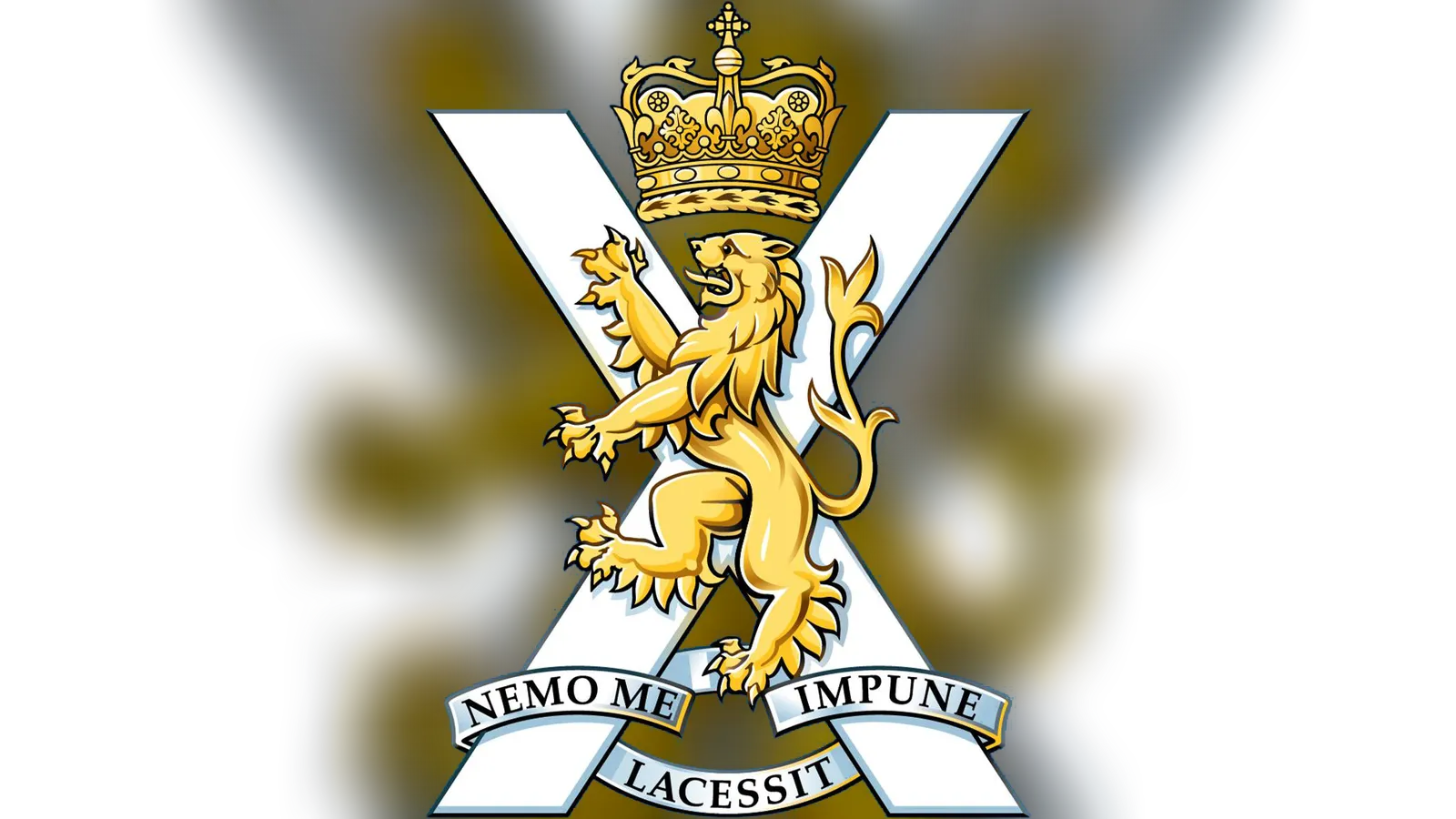
established The regiment shares a common cap badge — a silver saltire surmounted by a gilt lion rampant, ensigned with the Crown of Scotland, over the motto Nemo Me Impune Lacessit ("No One Provokes Me With Impunity"), shared with the Order of the Thistle. The badge was approved by the Lord Lyon King of Arms, with matriculation authority issued on 26 September 2005. Common items also include the tartan (Government 1A, inherited from the Argylls' Sutherland sett), tactical recognition flash, stable belt and Glengarry; individual identity is maintained through the distinctive battalion hackles worn on the Tam o'Shanter and through each battalion's pipes and drums continuing to wear their antecedent regiments' ceremonial dress and tartans.
Post-2006 developments and reductions
established The regiment has contracted steadily since 2006:
- 1 August 2006: the Royal Scots/KOSB merger reduced the regular battalions from six to five. (The Council of Scottish Colonels had recommended this pairing, citing the Royal Scots' long-term poor recruiting record and high reliance on Commonwealth recruits.)
- 2012–2013 (Army 2020): 5 SCOTS was reduced from a battalion to Balaklava Company, a single incremental company for state ceremonial and public duties in Scotland, based at Redford Barracks, Edinburgh — while retaining the Argyll and Sutherland Highlanders name, connection and history. This confirms and completes the forward-reference made on Card #13.
- 1 December 2021 (Future Soldier): 1 SCOTS (Royal Scots Borderers) was disbanded and reformed as 1st Battalion, The Ranger Regiment (1 RANGER) within the new Army Special Operations Brigade — having been part of the Specialised Infantry Group since 2017. This severed the direct Royal Scots/KOSB regular-army line; the regiment now comprises three regular battalions (2, 3, 4 SCOTS), two reserve battalions (6, 7 SCOTS) and Balaklava Company (5 SCOTS).
shared These reductions coincided with a documented, and much-debated, recruiting shortfall. Regimental manpower was reported at 3,190 in April 2012 and 3,020 in October 2013, and by the late 2010s the regiment was reported as significantly under strength. Per FOI figures reported by The Press and Journal, the regiment "was 489 troops short of its 2,059 personnel 'requirement'" in the most recent year cited, and its actual strength had "shrunk by 28% over the last five years, from 2,180 troops in 2015 to 1,570"; SNP defence spokesman Stewart McDonald called it a "recruitment crisis." The Army attributed difficulties partly to a wider, UK-wide recruitment crisis; critics linked them to the 2006 loss of local identity, though direct causation is contested and unresolved.
Modern identity, traditions and operational role
established Despite contraction, SCOTS has been one of the British Army's most heavily deployed regiments. Since 2006 its battalions have served on Operation TELIC (Iraq, 2005–2008), Operation HERRICK (Afghanistan, 2008–2013), and in Bosnia, Northern Ireland, Sierra Leone, Cyprus and elsewhere, as well as on later NATO commitments in Europe and operations against Daesh (Operation SHADER) in Iraq. Battalion-level examples include 1 SCOTS at Sangin (2009–10) and on HERRICK 17 (2012); 3 SCOTS in Babaji, Helmand (2009); 4 SCOTS as Combined Force Lashkar Gah (2011); and 2 SCOTS on Iraqi and UN training tasks. Scottish soldiers were among the last British troops to die in Afghanistan: on 30 April 2013, Corporal William Savage and Fusilier Samuel Flint (2 SCOTS) and Private Robert Hetherington (7 SCOTS) were killed by an IED in Nahr-e Saraj.
established The regiment preserves antecedent identities through the hackle system, retained pipes and drums, and its museum in Edinburgh Castle. Its mascot, a Shetland pony named Cruachan (currently Cruachan IV), continues an Argyll tradition. King Charles III is Colonel-in-Chief; the Princess Royal is Deputy Colonel-in-Chief. At the 20th-anniversary commemoration in 2026, the King noted that the regiment's battalions had "consistently ranked among the most operationally deployed in the British Army," and remembered "the 23 officers and soldiers who have been killed in action since 2006."
Did You Know?
- The Royal Regiment of Scotland is the only large regiment created after the December 2004 reorganisation to keep its predecessor regiments' titles as formal battalion subtitles — the visible expression of the "golden thread."
- Each regular battalion wears a different-coloured hackle on the Tam o'Shanter to signal its lineage: 1 SCOTS black, 2 SCOTS white (Royal Highland Fusiliers), 3 SCOTS red (Black Watch), 4 SCOTS blue (Highlanders), 5 SCOTS green (Argylls). After 1 SCOTS left in 2021, its black hackle became the regimental hackle worn by all SCOTS not assigned to a specific battalion.
- The regiment's cap badge was formally approved by the Lord Lyon King of Arms, Scotland's heraldic authority, with matriculation authority issued on 26 September 2005 — a Scottish legal-heraldic pedigree rather than merely a military design.
- Along with The Rifles, SCOTS is one of only two line infantry regiments to maintain its own regular military band within the Royal Corps of Army Music.
- The 2004 controversy inspired the acclaimed verbatim play "Black Watch" by Gregory Burke, first staged at the 2006 Edinburgh Festival Fringe and based on interviews with soldiers who served on Operation TELIC before the amalgamation.
- The regiment's motto, Nemo Me Impune Lacessit, is shared with the Order of the Thistle, Scotland's highest order of chivalry.
- 1 SCOTS's transfer to become 1st Battalion, The Ranger Regiment in 2021 made it the seed of a US Green Beret–style special-operations unit — a striking second life for the Royal Scots/KOSB lineage.
- In 2026, the King unveiled a bronze lion sculpture by Edinburgh artist Kenny Hunter, cast in six sections to represent the six historic regiments united in 2006.
FAQ
1When was the Royal Regiment of Scotland formed, and why?
It was formed on 28 March 2006 as part of the British Army's infantry reorganisation set out in the 2004 white paper Delivering Security in a Changing World. The Ministry of Defence merged Scotland's six single-battalion infantry regiments into one large multi-battalion regiment, citing the end of the "arms plot," a move to fixed-role battalions, and recruiting efficiencies through economies of scale.
2Which regiments became the Royal Regiment of Scotland?
Six regiments: the Royal Scots, the King's Own Scottish Borderers, the Royal Highland Fusiliers, the Black Watch, the Highlanders (Seaforth, Gordons and Camerons), and the Argyll and Sutherland Highlanders, plus two Territorial battalions from the Scottish Division's reserve (52nd Lowland and 51st Highland).
3Which battalion did each old regiment become?
1 SCOTS: Royal Scots + King's Own Scottish Borderers. 2 SCOTS: Royal Highland Fusiliers. 3 SCOTS: Black Watch. 4 SCOTS: The Highlanders. 5 SCOTS: Argyll and Sutherland Highlanders. 6 SCOTS: 52nd Lowland (reserve). 7 SCOTS: 51st Highland (reserve).
4Were the Scots Guards and the Royal Scots Dragoon Guards part of this?
No. The 2006 reorganisation affected only the Scottish line infantry. The Scots Guards (a Foot Guards regiment) and the Royal Scots Dragoon Guards (armoured cavalry) were not amalgamated into SCOTS and continue as separate regiments — a point established on Cards #15 and #16.
5What was the "Save the Scottish Regiments" campaign?
A public campaign, active from 2004, opposing the mergers. According to The Courier it gathered more than 100,000 signatures; it held rallies, presented petitions, and predicted the new regiment would struggle to recruit and would erode local ties and regimental identity. It drew support from veterans, regimental associations, politicians across parties and members of the public.
6Why was the timing so controversial?
The confirmed amalgamation was announced on 16 December 2004 while 1st Battalion The Black Watch was deployed at Camp Dogwood in a dangerous part of Iraq, where soldiers were killed. Critics argued it was insensitive and politically driven; the SNP accused Defence Secretary Geoff Hoon of "stabbing the soldiers in the back."
7What did the Ministry of Defence say in its defence?
The MOD argued the reform served the Army's long-term operational effectiveness: abolishing the arms plot to fix battalions by role, using large regiments to move manpower between battalions and avoid disbandments, and resolving chronic recruiting problems. It promised to preserve "golden threads" of identity — retained hackles, antecedent names and regional recruiting.
8Has the regiment got smaller since 2006?
Yes. The Royal Scots and KOSB battalions merged into 1 SCOTS on 1 August 2006 (six regular battalions to five); 5 SCOTS was reduced to Balaklava Company in 2012–13; and 1 SCOTS left in December 2021 to become 1st Battalion, The Ranger Regiment. It now has three regular battalions, two reserve battalions and one incremental company.
9What is Balaklava Company?
It is the successor to 5 SCOTS (Argyll and Sutherland Highlanders), reduced in 2012–13 to a single incremental company based at Redford Barracks, Edinburgh, performing state ceremonial and public duties in Scotland — including Royal Guard duties at Balmoral — while retaining the Argylls' name and history.
10Where has the regiment served?
Since 2006, on Operation TELIC (Iraq), Operation HERRICK (Afghanistan), and in Bosnia, Northern Ireland, Sierra Leone and Cyprus, plus NATO commitments in Europe and counter-Daesh operations. It has been among the most frequently deployed regiments in the British Army.
11What are the regiment's symbols?
A common cap badge (saltire, lion rampant, Crown of Scotland) and motto Nemo Me Impune Lacessit; the Government 1A tartan; battalion-specific hackles; and battalion pipes and drums in antecedent dress. King Charles III is Colonel-in-Chief.
12Is the Royal Regiment of Scotland still Scotland's only line infantry regiment?
Yes. It is both the senior line infantry regiment of the British Army and the only Scottish line infantry regiment, recruiting from across Scotland (and, given recruiting pressures, from the Commonwealth) with Regimental Headquarters at Edinburgh Castle.
Sources and Further Reading
Primary/Institutional
- Ministry of Defence / British Army — official Royal Regiment of Scotland pages (army.mod.uk) and battalion news releases and casualty notices (gov.uk).
- The Royal Regiment of Scotland official website (theroyalregimentofscotland.org) — history, identity, cap badge heraldry.
- Hansard, UK Parliament — Delivering Security in a Changing World: Future Capabilities debate (21 July 2004); Army Restructuring / infantry reorganisation statement (16 December 2004, Commons Official Report cols 1195–1218; parallel Lords statement).
- Scottish Parliament Official Report — "Scotland's Regiments" debate (23 September 2004) and defence debate (16 December 2004).
- National Army Museum (nam.ac.uk) — Royal Regiment of Scotland and antecedent-regiment histories.
Scholarly/Critical
- "Reorganising the Infantry: Drivers of Change and What This Tells Us about the State of the Defence Debate Today" (peer-reviewed analysis of the December 2004 reorganisation).
- "Britain and Defence Transformation: A Model of Success or a Warning of its Dangers?", Defence Studies 6(2), 2006.
Further reading
- The Courier, "The Royal Regiment of Scotland: A history of Scotland's super regiment."
- Forces News (BFBS), "I regret how small the Army has become: Hoon on controversial infantry reforms 20 years on."
- Victoria Schofield, The Highland Furies: The Black Watch 1739–1899 (2012), with a foreword by the then Prince of Wales.
- Gregory Burke, Black Watch (National Theatre of Scotland, 2006) — verbatim drama on the Iraq deployment and amalgamation.
- Regimental association sites: The Royal Scots, The Black Watch, The Argyll and Sutherland Highlanders Museum, The Royal Highland Fusiliers.
Caveats: Myths and Disputed Claims
- Myth: the Royal Scots and KOSB merged on 28 March 2006. On 28 March 2006 they entered the new regiment as separate named battalions; they amalgamated into the single 1 SCOTS on 1 August 2006. Several popular sources blur this.
- Myth: in December 2004 a Westminster vote defeated the government on the regiments. The defeat on 16 December 2004 was at the Scottish Parliament (Holyrood), where MSPs backed a motion critical of the plans; there was no Commons division overturning the reform. On the same day at Westminster, SNP MP Annabelle Ewing was removed from the Commons chamber for calling Hoon a "back-stabbing coward".
- Disputed: the "100,000 signatures" figure. This aggregate is reported by The Courier and widely repeated, but is difficult to verify against a single authoritative tally; the best-documented component is the 10,000-plus-signature petition to save the King's Own Scottish Borderers presented by MP Russell Brown. The six-figure total is a reported figure, not an audited one.
- Disputed: one old regiment per battalion. The battalion pattern given on earlier cards is accurate, with two clarifications: 2 SCOTS' lineage runs through the 1959 Royal Highland Fusiliers merger (Royal Scots Fusiliers and Highland Light Infantry), and 4 SCOTS' lineage runs through the 1994 Highlanders merger (Queen's Own Highlanders, itself a 1961 Seaforth and Cameron merger, with the Gordon Highlanders).
- Disputed: whether the 2006 merger caused later recruiting shortfalls. The reorganisation was genuinely contested. Claims that the merger definitively caused later recruiting shortfalls, and counter-claims that it had no effect, are both unproven; the causation remains disputed.
Finished reading? Try the Fact Machine: three reels, one surprising Scottish connection →
Card 023 · Defence