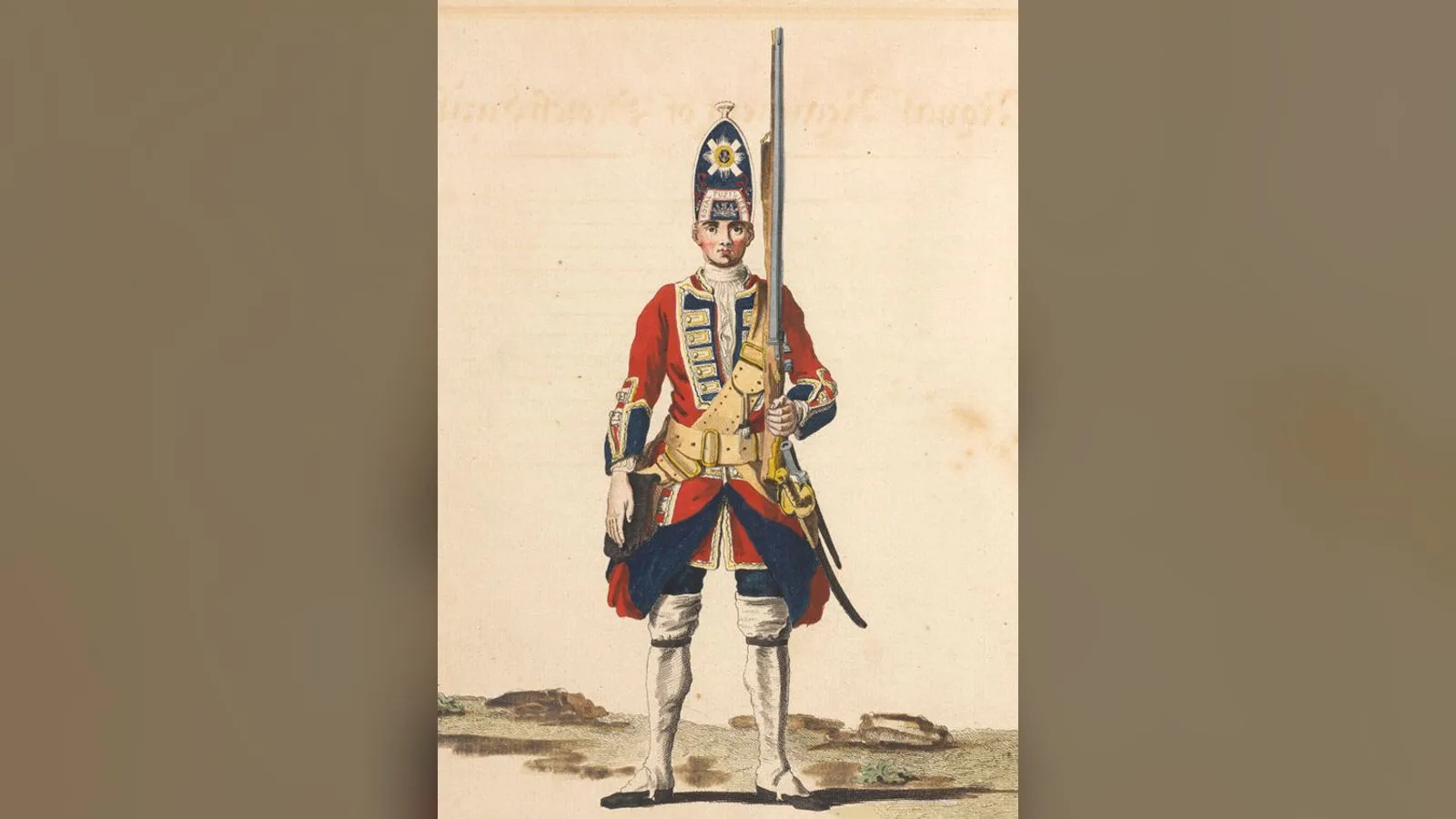

The Royal Scots Fusiliers
Contents
The Royal Scots Fusiliers were raised in 1678 as the Earl of Mar's Regiment of Foot, numbered the 21st Foot, and served for 281 years before merging with the Highland Light Infantry in 1959. This card tests what "fusilier" meant, when the regiment became one, where its Ayrshire identity came from, and how its record differs from the separate and older Royal Scots.
TL;DR
- established The Royal Scots Fusiliers were raised in September 1678 by Charles Erskine, 5th Earl of Mar, as "The Earl of Mar's Regiment of Foot" to help put down Covenanter unrest in Scotland — a genuinely separate regiment from the Royal Scots (Card #5), raised 45 years later and never sharing its lineage.
- shared "Fusilier" denotes troops originally armed with the flintlock "fusil" rather than the matchlock musket, because matchlocks' burning slow-match was dangerous near open gunpowder barrels at the artillery train; the National Army Museum dates the regiment's fusilier status to 1685, and it first appears as a fusilier unit on an Army list of 1691.
- established Numbered the 21st Regiment of Foot in the 1751 reforms, granted "Royal" status about 1712–13, and formally titled The Royal Scots Fusiliers in 1881, with its regimental depot at Ayr — the root of its Ayrshire association.
- shared The regiment fought from Blenheim (1704) through the Crimea, the Boer War, and both World Wars; it raised 18 battalions in the First World War, in which roughly 5,600 of its men died (the regiment's own memorial itemises 5,963).
- established On 20 January 1959 it amalgamated with the Highland Light Infantry to form the Royal Highland Fusiliers — the endpoint of the RSF's own direct lineage and the handoff to Card #14.
Key Facts
- Period/dates covered
- 1678–1959 (281 years of continuous service)
- Key institution
- The British Army; heritage now held by the Royal Highland Fusiliers Regimental Museum, 518 Sauchiehall Street, Glasgow
- Fusilier identity
- Flaming-grenade cap badge, white hackle, raccoon-skin fusilier cap for other ranks / officers' bearskin
- Dress
- Lowland regiment wearing trews, not the kilt
- Nickname
- "The Earl of Mar's Grey Breeks"
- Home
- Ayrshire county regiment with depot at Ayr
- Current status/legacy
- Lineage continues via the Royal Highland Fusiliers (1959–2006, Card #14) and today as the Royal Highland Fusiliers, 2nd Battalion, The Royal Regiment of Scotland (2 SCOTS), which still wears the white hackle of the RSF
Scottish Impact Index (SI Score)
- Military Impact
- 7/10
- Enduring Significance
- 9/10
- Strategic Importance
- 7/10
- Military Distinctiveness
- 7/10
- Military Legacy
- 8/10
- Recognition
- 6/10
44/60
Ranked =35th of 43 in Defence
A Note on Claims and Evidence
Each major claim carries one of three labels. established means supported by primary records, official bodies or several independent reliable sources. shared means the core fact is sound but sources disagree on details, dates or interpretation. traditional means widely repeated but not traceable to a primary or independent source.
The core claims on this card are established. The 1678 founding date, the founding colonel (the 5th Earl of Mar), the fusilier designation, the 1751 numbering as the 21st Foot, the campaign record, and the 1959 merger are all documented in institutional sources (National Army Museum, Imperial War Museums, The National Archives) and the standard regimental history by John Buchan. Two points require careful framing, handled in the Caveats section: (1) the exact date at which the regiment became a "fusilier" unit is genuinely uncertain — the National Army Museum gives 1685, it is first recorded as such on an Army list of 1691, and some sources cite 1689/1695; and (2) First World War death figures vary between the commonly cited 5,600 and the itemised memorial total of 5,963. Unlike the Royal Scots (Card #5), the RSF makes no ancient-origins or "bodyguard" foundation claim, so there is no legend-tier lineage myth to adjudicate here.
Timeline
Raised by Charles Erskine, 5th Earl of Mar, as The Earl of Mar's Regiment of Foot, on the Scottish establishment.
Service against Covenanters at Bothwell Bridge and during Argyll's Rising.
National Army Museum dates the regiment's conversion to a fusilier unit to this year.
Sent to London during the Glorious Revolution; transfers to the English establishment.
Nine Years' War in Flanders (Walcourt, Steenkirk, Landen).
First appears on an Army list as a fusilier unit ("O'Farrell's Fusiliers").
War of the Spanish Succession under Marlborough: Schellenberg, Blenheim, Ramillies, Oudenarde, Lille, Malplaquet.
Granted the title "Royal"; becomes the Royal North British Fusiliers.
Fights the Jacobites at Sheriffmuir and at Culloden.
War of the Austrian Succession: Dettingen, Fontenoy, Lauffeld.
Numbered the 21st Regiment of Foot.
Capture of Belle Île, Seven Years' War.
Surrenders at Saratoga after Ticonderoga, American War of Independence.
Barracks built at Ayr (later Churchill Barracks).
Siege of Bergen op Zoom; Battle of New Orleans (War of 1812) — not at Waterloo.
Crimean War: Alma, Inkerman, Sevastopol.
"Scots" restored to the title; becomes The Royal Scots Fusiliers and county regiment of six south-west Scottish counties.
Second Boer War: Colenso, Relief of Ladysmith.
First World War: 18 battalions raised; ~5,600 dead; four VCs.
Second World War: Dunkirk, Madagascar, Burma, Sicily, Anzio, North-West Europe.
Amalgamated with the Highland Light Infantry to form the Royal Highland Fusiliers.
Details
17th-century origins and the fusilier designation explained
established The Royal Scots Fusiliers were raised in September 1678 by Charles Erskine, 5th Earl of Mar, and were known — following the custom of the day, when regiments bore their colonel's name — as The Earl of Mar's Regiment of Foot. The context was religious and political: as the National Army Museum records, "In 1662, the recently-restored King Charles II tried to re-impose governance by bishops on the Scottish church, leading to major agitation among Presbyterian or Covenanter Scots. In September 1678, Charles Erskine, Earl of Mar, raised a regiment to help put down this unrest." The regiment was in action against the Covenanters at Bothwell Bridge (1679) and during Argyll's Rising (1685). This is a crucial distinction from the Royal Scots (Card #5), raised in 1633: the two regiments have entirely separate origins, and the RSF is the younger by 45 years.
established The soldiers were quickly nicknamed "The Earl of Mar's Grey Breeks" (grey breeches), from the colour of their early uniform — a nickname that endured for the regiment's entire history.
shared The "fusilier" designation is the regiment's defining identity, and it is worth explaining precisely. A fusil was a lighter, more reliable flintlock musket, as opposed to the older matchlock. The matchlock required a continuously burning length of slow-match to fire — a serious fire hazard around the open barrels of loose gunpowder used to serve artillery. The earliest fusilier units were therefore raised to guard and escort the artillery train, where flintlocks (which struck a spark from flint rather than needing a lit match) were far safer. The French coined the term (from fusil, ultimately from Latin focus, "hearth/fire") around 1670; the English adopted it about 1680. The National Army Museum states plainly: "In 1685, it became a fusilier regiment, a distinction given to elite troops armed with the new flintlock musket, or 'fusil'." The precise date at which Mar's regiment formally became a fusilier unit is nonetheless debated: it is first recorded as "O'Farrell's Fusiliers" on an Army list of 1691, and other sources place the conversion in 1689 with the title formalised by 1695 — so a single confident date should be avoided.
Ayrshire associations
established The regiment's enduring identification with Ayrshire and south-west Scotland is real but is largely a product of the 19th-century army reforms rather than the 17th-century foundation. Barracks were built at Ayr in 1795; under the Cardwell Reforms the barracks became the regiment's depot in 1873, and under the Childers Reforms of 1881 it formally became the county regiment of Ayrshire, Dumfriesshire, Kirkcudbrightshire, Roxburghshire, Selkirkshire and Wigtownshire. Its Territorial and Volunteer battalions were rooted in the region — at Kilmarnock (Titchfield Street) and at Ayr's Burns Statue Square. The Ayr barracks were renamed Churchill Barracks in 1942, in honour of Winston Churchill, who had commanded a battalion of the regiment in 1916. The founding colonel's family — the Erskines, Earls of Mar — were an Angus/Stirlingshire noble house rather than an Ayrshire one, so the Ayrshire link should be understood as institutional (depot and recruiting area) rather than descending from the founder's own territory.
Establishment as a British regiment and numbering
shared The regiment moved from the Scottish to the English establishment around 1688. It was awarded the title "Royal" about 1712–13 (sources give both years), becoming the Royal North British Fusiliers — "North British" being a deliberately post-Union usage, the word "Scots" having been dropped from about 1707 to encourage a common British identity. Around this period it also acquired the nickname "The Duke of Marlborough's Own." When line regiments were formally numbered by seniority in 1751, it became the 21st Regiment of Foot. "Scots" was restored to the title in 1877, and under the 1881 Childers Reforms it became simply The Royal Scots Fusiliers. Because it already possessed two regular battalions, it was not amalgamated with any other regiment in 1881, unlike most single-battalion regiments of the period.
Major European and imperial campaigns
established The regiment served in almost every major European war of the 18th century. Under Marlborough in the War of the Spanish Succession it fought at Blenheim (1704), where its colonel, Brigadier-General Archibald Row, famously ordered his men to hold their fire until he struck the enemy palisade with his sword — and was mortally wounded as he did so. It went on to Ramillies, Oudenarde, the capture of Lille and the appalling bloodletting of Malplaquet (1709), where another of its colonels, Sampson de Lalo, was killed. It fought the Jacobites at Sheriffmuir (1715) — against a force led by the 6th Earl of Mar, the son of the regiment's own founder — and at Culloden (1746). It served at Dettingen (1743) and Fontenoy (1745).
established Its imperial and colonial service must be presented honestly as such. In the Seven Years' War it captured Belle Île (1761). In the American War of Independence it fought at Ticonderoga (1777) but was interned after the surrender at Saratoga. It fought in the West Indies (Martinique and Guadeloupe, 1794), garrisoned convict convoys bound for Australia, and served in India. In the Crimean War it fought at the Alma, Inkerman and the siege of Sevastopol. It was engaged in the Anglo-Zulu War, the Third Anglo-Burmese War, and North-West Frontier expeditions in India (Hazara, Tirah). In the Second Boer War (1899–1902) its 2nd Battalion fought at Colenso, where Private George Ravenhill won the Victoria Cross helping to save the guns, and in the Relief of Ladysmith.
established A precise note on Waterloo: the Royal Scots Fusiliers were not present at Waterloo (18 June 1815). In 1814 the whole of the 1st Battalion had been shipped across the Atlantic to fight in the War of 1812, and it was in action at the Battle of New Orleans in January 1815; the 2nd Battalion took part in the failed Siege of Bergen op Zoom in 1814. This is a common point of confusion with other Scottish units (the Royal Scots Greys and the Royal Scots each have Waterloo connections) and is flagged here deliberately.
First World War
established The Royal Scots Fusiliers raised 18 battalions during the First World War — its two regular battalions plus, in the National Army Museum's summary, "eight Territorial and four New Army battalions" and reserve/service units. Both regular battalions served on the Western Front from 1914: the 1st at Mons, First Ypres, the Somme, Arras and the advance to the Hindenburg Line; the 2nd at First Ypres, Neuve Chapelle, Loos, the Somme, Arras and the Lys. Territorial battalions (1/4th and 1/5th) fought at Gallipoli in 1915 before transferring to the Western Front, and New Army battalions served on the Western Front and at Salonika. The regiment's members won four Victoria Crosses during the war: Second Lieutenant John Manson Craig (Palestine, 1917), Sergeant Thomas Caldwell (1918), Second Lieutenant Stanley Boughey (1917) and Private David Lauder (Gallipoli, 1915).
shared Casualty figures should be given with care. The standard regimental history by John Buchan records that the dead "numbered 5,600," a figure widely repeated (and loosely rendered as "casualties" by some secondary sources such as GENUKI). The regiment's own war memorial itemises a slightly higher total — 319 officers, 23 warrant officers, 928 NCOs and 4,693 men, or 5,963 dead. No reliable single figure for total casualties (killed plus wounded plus missing) is published. These figures should not be confused with those of the separate Royal Scots (Card #5), whose far larger dead toll is sometimes conflated with the RSF's online.
established One famous name attaches to the regiment in this war: Lieutenant-Colonel Winston Churchill commanded the 6th (Service) Battalion in the Ploegsteert ("Plugstreet") sector of Belgium from January to May 1916, after resigning from government over the Gallipoli disaster; the battalion took over its front-line sector on the night of 26–27 January 1916. During his roughly 125-day tenure the battalion lost 15 men killed and 123 wounded.
Second World War
established In the Second World War the 2nd Battalion went to France with the British Expeditionary Force in 1939 and was heavily engaged at the Battle of the Ypres–Comines Canal in 1940; it suffered such losses that only about 40 men reached Dunkirk as a formed unit. Both regular battalions took part in the Battle of Madagascar in 1942 — a rare instance of both a regiment's regular battalions fighting in the same action. The 1st Battalion then served in India and Burma, fighting in the Arakan and the advance on Mandalay with the Fourteenth Army. The 2nd Battalion fought in Persia and Iraq, then in Sicily and Italy, including the ferocious fighting at Anzio (1944), before deploying to North-West Europe for the invasion of Germany. Territorial battalions (4/5th and 6th) fought in the Normandy campaign and the advance across North-West Europe. It was in this last campaign that Fusilier Dennis Donnini, aged 19, won a posthumous Victoria Cross during Operation Blackcock (18 January 1945) — the youngest Army recipient of the VC in the Second World War.
Uniform and fusilier distinctions
established The RSF's appearance combined Lowland Scottish and fusilier traditions, and was distinct from both the Royal Scots (Card #5) and the kilted Highland regiments (Cards #3–4). As a Lowland regiment, the RSF wore trews (tartan trousers), never the kilt. Its fusilier identity was expressed above all in its headdress and badge:
- Headdress: in full dress the other ranks wore a raccoon-skin fusilier cap — similar to, but shorter than, the bearskins of the Foot Guards — while officers wore a true bearskin, in the manner of all fusilier regiments.
- Cap badge: a distinctive large "flaming grenade" (a fused, exploding bomb) bearing the Royal Arms, an emblem common to fusilier regiments and reflecting the fusilier/grenade heritage. The RSF's grenade badge was notably large — reputedly about four times the size of other fusilier regiments' badges — signifying seniority among fusilier units.
- Hackle: a white feather hackle, worn behind the badge.
- Only fusilier regiments (with the Grenadier Guards and a very few others) were permitted to use "The British Grenadiers" as a regimental march, a further mark of the fusilier/grenade tradition.
established These distinctions were carried forward at the 1959 merger: the Royal Highland Fusiliers adopted the white hackle of the RSF and a flaming-grenade badge.
The 1959 merger (brief — see Card #14)
established Under the 1957 Defence White Paper's reduction of the infantry, the Royal Scots Fusiliers were amalgamated with the Highland Light Infantry (City of Glasgow Regiment) on 20 January 1959 to form the Royal Highland Fusiliers (Princess Margaret's Own Glasgow and Ayrshire Regiment). The regular 1st battalions of the two regiments combined at Redford Barracks, Edinburgh, to form 1 RHF. The new regiment preserved the RSF's white hackle and grenade badge. The subsequent history of the Royal Highland Fusiliers (1959–2006), and its own eventual absorption into the Royal Regiment of Scotland in 2006 (Card #23), is covered in full on Card #14. The RSF's own direct lineage ends at this 1959 handoff; today the successor sub-unit is the Royal Highland Fusiliers, 2nd Battalion, The Royal Regiment of Scotland (2 SCOTS).
Did You Know?
- The regiment's founder, the 5th Earl of Mar, was on the government side against the Covenanters; his own son, the 6th Earl of Mar ("Bobbing John"), led the 1715 Jacobite rising — and the regiment fought against him at Sheriffmuir.
- At Blenheim in 1704, the regiment's colonel Archibald Row ordered his men not to fire until he struck the enemy palisade with his sword; he was shot down as he did it.
- The regiment was not at Waterloo — in 1815 it was fighting the Americans at New Orleans, on the other side of the Atlantic.
- Winston Churchill commanded the 6th Battalion in the trenches at "Plugstreet" in 1916; the Ayr barracks were renamed Churchill Barracks in his honour in 1942.
- Fusilier Dennis Donnini, who won a posthumous VC with the regiment in 1945 aged 19, was the youngest Army recipient of the Victoria Cross in the Second World War — and the English-born son of an Italian immigrant who had been interned as an "enemy alien."
- The regiment's cap badge — a flaming grenade — was reputedly about four times larger than those of other British fusilier regiments, marking its seniority.
- As a Lowland regiment the RSF wore trews, not the kilt, and its pipers played "Highland Laddie" — a reminder that "Scottish regiment" did not mean "Highland regiment."
- The regiment's white hackle survives today, worn by 2 SCOTS (the Royal Highland Fusiliers).
FAQ
1When were the Royal Scots Fusiliers founded, and by whom?
They were raised in September 1678 by Charles Erskine, 5th Earl of Mar, as "The Earl of Mar's Regiment of Foot," to help put down Covenanter unrest in Scotland. Under the custom of the time, regiments were named after their colonel. The 1678 date is documented and is not a disputed or legendary claim.
2Are the Royal Scots Fusiliers the same as the Royal Scots?
No. They are entirely separate regiments. The Royal Scots (Card #5) were raised in 1633 and are Scotland's senior infantry regiment; the Royal Scots Fusiliers were raised 45 years later, in 1678. The two share no lineage. Their casualty figures and battle records are sometimes confused online, but they are distinct.
3What does "fusilier" mean?
A fusilier was originally a soldier armed with the flintlock "fusil" rather than the older matchlock musket. Because matchlocks needed a burning slow-match — dangerous near open gunpowder at the artillery train — flintlock-armed fusiliers were first used to guard the guns. The term is French (c. 1670), adopted in English about 1680.
4Why is the regiment associated with Ayrshire?
Its depot was at Ayr (from 1873) and under the 1881 reforms it became the county regiment of Ayrshire and five other south-west Scottish counties. The Ayrshire link is institutional — depot and recruiting area — rather than dating from the 1678 foundation.
5What number was the regiment in the British Army line?
The 21st Regiment of Foot, a number formalised in the 1751 reforms. Its full designation over time ran through The Scots Fusiliers, the Royal North British Fusiliers, the 21st (Royal North British) Fusiliers, and finally The Royal Scots Fusiliers (1881).
6When did it get the "Royal" and "Fusiliers" titles?
The "fusilier" identity dates from the late 17th century (the National Army Museum gives 1685; first recorded on an Army list in 1691). The "Royal" title was granted about 1712–13. "Royal Scots Fusiliers" as a single formal name dates from 1881.
7Was the regiment at the Battle of Waterloo?
No. In 1814–15 the 1st Battalion was in North America fighting the War of 1812 (Battle of New Orleans, January 1815), and the 2nd Battalion had taken part in the Siege of Bergen op Zoom in 1814. The regiment has no Waterloo battle honour.
8Did Winston Churchill really serve with the regiment?
Yes. Lieutenant-Colonel Winston Churchill commanded the 6th (Service) Battalion in the Ploegsteert sector of Belgium from January to May 1916, after leaving government over Gallipoli. The Ayr barracks were later renamed Churchill Barracks in his honour.
9How many battalions did the regiment raise in the First World War, and how many died?
It raised 18 battalions. Around 5,600 of its men died, per the standard regimental history by John Buchan; the regiment's own memorial itemises 5,963 dead. No reliable total-casualty figure (including wounded) is published. Four Victoria Crosses were won by its members in the war.
10What made the regiment's uniform distinctive?
As a Lowland regiment it wore trews, not the kilt. Its fusilier identity showed in a raccoon-skin fusilier cap for other ranks (officers wore a bearskin), a large "flaming grenade" cap badge, and a white hackle. It was also entitled to play "The British Grenadiers."
11What happened to the regiment in 1959?
On 20 January 1959 it amalgamated with the Highland Light Infantry to form the Royal Highland Fusiliers, preserving the RSF's white hackle and grenade badge. The RSF's direct lineage ends here; the merged regiment's later history is covered on Card #14.
12Does the regiment still exist in any form today?
Its lineage survives as the Royal Highland Fusiliers, 2nd Battalion, The Royal Regiment of Scotland (2 SCOTS), formed when the Scottish infantry regiments merged in 2006 (Card #23). 2 SCOTS still wears the white hackle of the Royal Scots Fusiliers.
Sources and Further Reading
Primary/Institutional
- National Army Museum, "The Royal Scots Fusiliers" (regimental history overview), nam.ac.uk.
- Imperial War Museums, collection records for RSF cap badges and headdress, iwm.org.uk.
- The National Archives / Royal Highland Fusiliers Regimental Museum, 518 Sauchiehall Street, Glasgow (ARCHON code 869), holder of RSF heritage material, medals and regimental records.
- Commonwealth War Graves Commission, records of RSF war dead, cwgc.org.
- Richard Cannon, Historical Record of the Twenty-First, or the Royal North British Fusilier Regiment of Foot (1849).
Scholarly/Critical
- John Buchan, The History of the Royal Scots Fusiliers, 1678–1918 (1925; reissued Naval & Military Press).
- J. C. Kemp, The Royal Scots Fusiliers 1920–1959 (1963).
- John Childs, The British Army of William III, 1689–1702 (1987) and The Nine Years' War and the British Army, 1688–97 (1991).
- David Chandler & Ian Beckett (eds.), The Oxford History of the British Army (1994/2003).
Further reading
- The Long, Long Trail (longlongtrail.co.uk), "The Royal Scots Fusiliers in 1914–1918."
- Anglo-Boer War website (angloboerwar.com), Royal Scots Fusiliers unit page.
- International Churchill Society, on Churchill's 1916 service with the 6th RSF.
Caveats: Myths and Disputed Claims
- Disputed: the date the regiment became fusiliers. The National Army Museum gives 1685; the regiment is first recorded as a fusilier unit ("O'Farrell's Fusiliers") on an Army list of 1691; and some sources place the conversion in 1689 with the title formalised by 1695. Any single date is approximate. This is a genuine documentary ambiguity, not a legend.
- Disputed: the date of the "Royal" title. Sources give both 1712 and 1713 for the grant of the "Royal" prefix.
- Disputed: First World War death figures. The commonly cited figure of 5,600 dead comes from John Buchan's regimental history; the regiment's own memorial itemises 5,963. GENUKI describes 5,600 loosely as "casualties", but the underlying source means deaths. No published total-casualty figure (killed, wounded and missing) exists.
- Myth: the Royal Scots Fusiliers fought at Waterloo. They did not. In 1815 the 1st Battalion was fighting the War of 1812 at New Orleans.
- Myth: the Royal Scots Fusiliers and the Royal Scots are the same regiment. Despite the similar name, the two have separate origins (1633 and 1678) and no shared lineage. Online sources sometimes conflate their casualty records.
- Myth: every Scottish regiment was a kilted Highland regiment. The RSF was a Lowland regiment: it wore trews, not the kilt, and had a fusilier (grenade/flintlock) identity rather than a Highland clan-tartan tradition. Its pipes playing "Highland Laddie" reflect Scottish, not specifically Highland, custom.
- Myth: the regiment has an ancient foundation legend. Unlike the Royal Scots' "Pontius Pilate's Bodyguard" tradition, the RSF makes no ancient-origins claim; its 1678 foundation is straightforwardly documented.
Finished reading? Try the Fact Machine: three reels, one surprising Scottish connection →
Card 006 · Defence