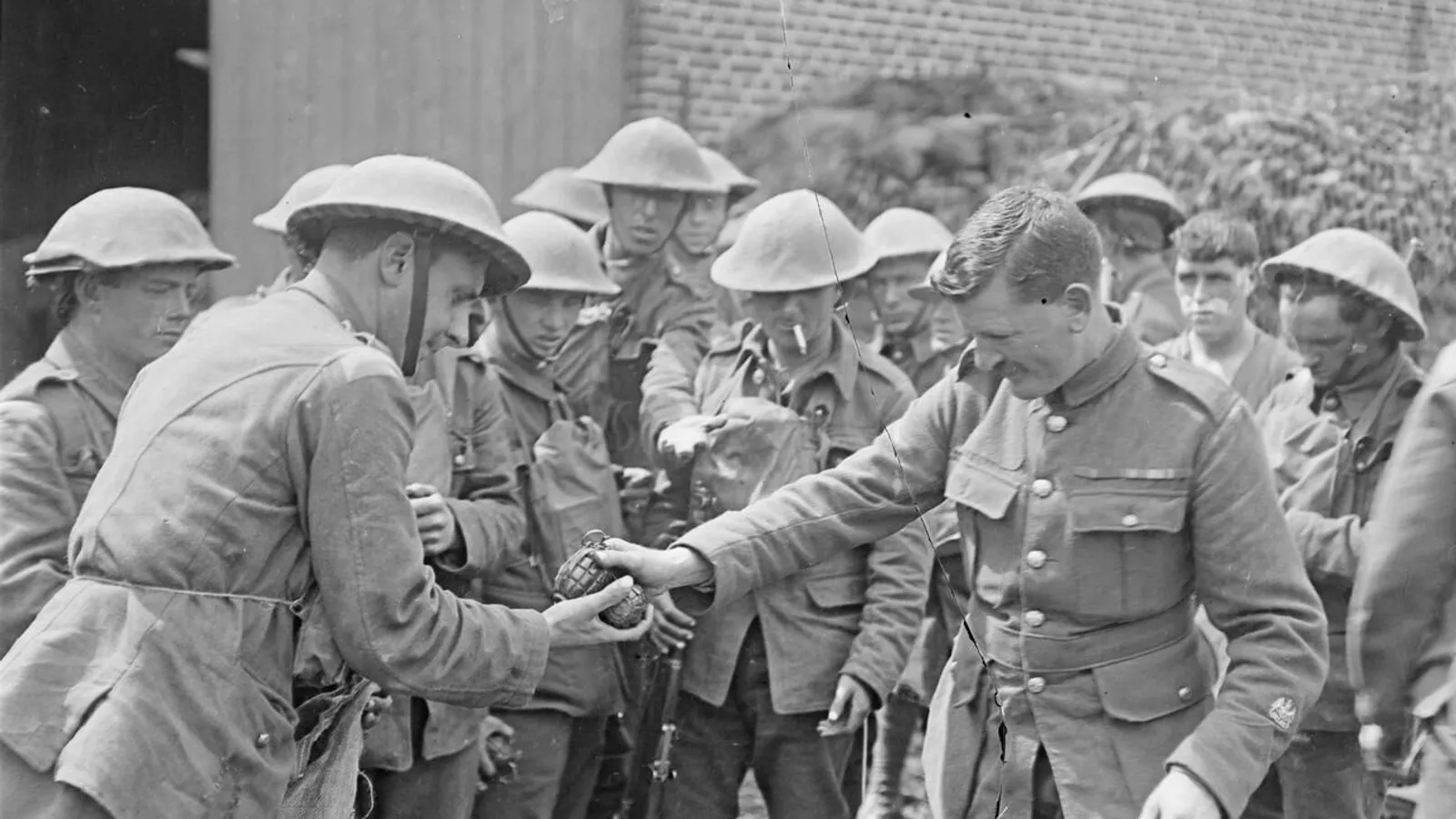

The Royal Scots — Scotland's Senior Infantry Regiment
Contents
The Royal Scots were the 1st Regiment of Foot, conventionally the oldest and most senior infantry regiment of the line in the British Army, raised under a royal warrant of 1633 and amalgamated in 2006. This card tests three things: how far the "unbroken service since 1633" claim holds, what "oldest regiment" really means, and whether the nickname "Pontius Pilate's Bodyguard" is history or regimental humour.
TL;DR
- established The Royal Scots trace their lineage to a royal warrant of 1633, when Sir John Hepburn raised a regiment of Scots for French service. traditional The "unbroken service since 1633" framing rests on the legal continuity of that warrant rather than an uninterrupted domestic corporate life.
- established Ranked the 1st Regiment of Foot after the Army was numbered in 1751, the Royal Scots were conventionally regarded as the oldest and most senior line infantry regiment of the British Army. This is seniority by precedence, distinct from the Coldstream Guards' separate claim to be the oldest regiment in continuous service.
- traditional The nickname "Pontius Pilate's Bodyguard" is a jocular regimental tradition, not history: it grew from a mock seniority dispute with the French Régiment de Picardie and is first attested in print only in 1851.
- established A Lowland regiment, not a kilted Highland one, the Royal Scots wore tartan trews (Hunting Stewart) rather than the kilt, recruited in Edinburgh and the Lothians, and marched to "Dumbarton's Drums", reputedly the oldest regimental march in the British Army.
- established The Royal Scots raised thirty-five battalions in the First World War, more than any other Scottish regiment, suffered the Quintinshill rail disaster of 1915 (Britain's worst rail accident), fought through the Second World War from Dunkirk to Hong Kong, Kohima and Normandy, and in 2006 became the founding component of the 1st Battalion, Royal Regiment of Scotland (covered in full on Card #23).
Key Facts
- Period/dates covered
- 1633 (royal warrant) – 2006 (amalgamation); legacy continuing to the present
- Key institution
- The Royal Scots (The Royal Regiment); the 1st Regiment of Foot; regimental museum at Edinburgh Castle
- Notable feature
- Conventionally the oldest and most senior infantry regiment of the line in the British Army; a Lowland (trewed, not kilted) regiment
- Nickname
- "Pontius Pilate's Bodyguard"
- March
- "Dumbarton's Drums" (quick); "The Garb of Old Gaul" (slow)
- Current status/legacy
- Lineage carried into the Royal Regiment of Scotland in 2006 as the Royal Scots Borderers (1 SCOTS); that battalion was re-roled as 1st Battalion, The Ranger Regiment in 2021. Regimental museum, association and pipe band continue.
Scottish Impact Index (SI Score)
- Military Impact
- 8/10
- Enduring Significance
- 10/10
- Strategic Importance
- 8/10
- Military Distinctiveness
- 8/10
- Military Legacy
- 10/10
- Recognition
- 8/10
52/60
Ranked =16th of 43 in Defence
A Note on Claims and Evidence
Each major claim carries one of three labels. established means supported by primary records, official bodies or several independent reliable sources. shared means the core fact is sound but sources disagree on details, dates or interpretation. traditional means widely repeated but not traceable to a primary or independent source.
- Established (documented): The 1633 royal warrant to Sir John Hepburn; decades of Continental (French) service under the names Hepburn's, Douglas's and Dumbarton's; permanent placement on the English establishment by 1678 and the title "Royal Regiment of Foot" in 1684; ranking as 1st Foot from 1751; service in the Nine Years' War, War of the Spanish Succession, Napoleonic Wars (3rd Battalion at Quatre Bras and Waterloo), Crimea, the Boer War, and both World Wars; the Quintinshill disaster (1915); the 2006 amalgamation.
- Shared/Traditional: The framing of "373 years of unbroken service." The regiment's legal continuity as a crown unit from 1633 is real, but its early existence was operationally messy — a pre-1633 nucleus dating to 1625, roughly 45 years mostly in foreign service under changing colonels' names, repeated shuttling between the English and French establishments (1661–1678), a mass desertion of over 700 men in 1667, and an obstructed, depleted repatriation in 1678. "Traces its lineage to 1633" is accurate; "continuous unbroken corporate existence" is a conventional regimental convention that glosses these complications. (This is the same caveat introduced on Card #1.)
- Traditional (legend): The nickname "Pontius Pilate's Bodyguard" and the implied claim of extreme antiquity. This is regimental humour, first recorded in print in 1851 — see the Caveats section.
Timeline
John Hepburn is serving as a colonel of Scots in Swedish service under Gustavus Adolphus.
Hepburn's regiment, with Lumsden's and Mackay's, forms the Swedish army's "Green Brigade".
After quarrelling with Gustavus Adolphus, Hepburn leaves Swedish service.
Hepburn receives a royal warrant from Charles I to raise ~1,200 Scots for French service; the traditional founding date. (Sources give the commission as January and the warrant as March/April 1633.)
Hepburn made Maréchal de camp after the siege of La Mothe in Lorraine.
Hepburn's 6,000-strong command crosses the Rhine and soon relieves Heidelberg.
Hepburn made a Marshal of France; Scots from Bernhard of Saxe-Weimar's army, including veterans of the Green Brigade, join his regiment.
Hepburn killed at the siege of Saverne.
His younger brother and successor as colonel, James Hepburn, killed at the siege of Damvilliers; command passes to Lord James Douglas, and the corps later becomes the Régiment de Douglas.
Recalled and returned repeatedly between the English/Scottish and French establishments; becomes Dumbarton's Regiment (1675); finally placed permanently on the English establishment in 1678.
First battle honour, defending Tangier.
Titled "His Majesty's Royal Regiment of Foot" by Charles II.
Fights at Sedgemoor against Monmouth's rebellion; a 2nd Battalion raised (1686).
Nine Years' War: Steenkerque, Landen, Namur.
War of the Spanish Succession: Blenheim, Ramillies, Oudenarde, Malplaquet under Marlborough.
2nd Battalion at Culloden.
Numbered the 1st (Royal) Regiment of Foot.
Seven Years' War: Louisburg, Guadeloupe, Havana.
3rd Battalion in the Peninsular War (Corunna, Salamanca, Vitoria, Nive).
Adopts the "Royal Scots" title.
3rd Battalion at Quatre Bras and Waterloo.
Crimean War: Alma, Inkerman, Sevastopol.
Becomes The Royal Scots (Lothian Regiment).
Boer War.
First World War; thirty-five battalions raised; Quintinshill disaster (22 May 1915).
Retitled The Royal Scots (The Royal Regiment).
Second World War: Dunkirk, Hong Kong, Kohima/Burma, Italy, Normandy/Germany.
Two regular battalions merged into one.
Amalgamated with the King's Own Scottish Borderers to form the Royal Scots Borderers, 1st Battalion, Royal Regiment of Scotland (1 SCOTS) — see Card #23.
1 SCOTS re-roled as 1st Battalion, The Ranger Regiment.
Details
Origins under Sir John Hepburn and the 1633 warrant
established The Royal Scots grew directly out of Scotland's long tradition of soldiers-for-hire on the Continent — the milieu of the "Auld Alliance"-descended Scots mercenary service explored in Card #1. Sir John Hepburn (c. 1598–1636), a professional soldier from Athelstaneford in East Lothian, commanded a regiment of Scots in Swedish service from about 1625; from 1630–31 it formed part of Gustavus Adolphus's celebrated "Green Brigade" during the Thirty Years' War. After quarrelling with the Swedish king, Hepburn left Swedish service in 1632 and returned to Scotland.
established The historians Steve Murdoch and Alexia Grosjean, in Alexander Leslie and the Scottish Generals of the Thirty Years' War (2014), fill in this Swedish phase. Hepburn's lifelong friend Robert Monro recalled that they had been comrades "first at Colledge, next in our travels in France, at Paris and Poictiers" in 1615. In Pomerania in 1630 Hepburn governed Rügenwalde at the head of an army group of some 8,000 men, about a quarter of them Scots, and the Green Brigade was built round his regiment with those of James Lumsden and Donald Mackay. He led its storming parties at Frankfurt an der Oder in 1631, where he was shot above the knee, went on to take Landsberg and Werben, and in March 1632 led a mixed brigade in the assault on Donauwörth. The break came in 1632, when Hepburn sided with the Marquis of Hamilton in a quarrel with Gustavus Adolphus, and the king either questioned his Catholicism or his competence, or both. Hepburn gave up his command and served as a volunteer, taking command one last time at the Alte Veste in August 1632, and left the army with Hamilton in October.
shared In 1633 Hepburn received a royal warrant from Charles I to raise a regiment of around 1,200 Scots for service with the French crown. (Sources place his commission at 26 January 1633 and the warrant itself at March/April; the regiment's own history uses 28 March.) The nucleus came from his former Swedish regiment, and in France the corps rapidly absorbed the remnants of other Scottish mercenary units, swelling to some 8,000 men by 1635.
established Murdoch and Grosjean show that the French phase was built on Hepburn's personal standing: Louis XIII and Cardinal Richelieu admired him, and he had travelled home in 1633 with the Swedish embassy of Johan Oxenstierna. His first officers included his younger brother James, George Livingstone, Captain James Maxwell (brother of the Earl of Nithsdale) and Thomas Lindsay. After the siege of La Mothe in 1634 he was made Maréchal de camp, and that July Richelieu noted his request for twenty new companies to bring the regiment up to 3,000. He crossed the Rhine with 6,000 men on 19 December 1635, relieved Heidelberg, and in spring 1636 Louis XIII made him a Marshal of France. At that point Scots from Bernhard of Saxe-Weimar's army, including elements of the old Green Brigade, were offered service under him, and this is how the Régiment d'Hepburn absorbed many veterans of the Swedish army. shared The "8,000 men by 1635" figure should be handled with care: Murdoch and Grosjean give 3,000 as the regiment's target in 1634 and 6,000 for Hepburn's wider command, which reports after the battle of Nördlingen put at 10,000. The larger figures describe the Scottish and other troops under his command, not the regiment alone.
established It fought for Louis XIII and Louis XIV, and it is crucial that, because it had been raised by royal warrant, it remained legally part of the crown's forces even while serving abroad — it could be recalled to Britain at will.
established Hepburn was killed at the siege of Saverne in Alsace in July 1636. Command passed to his younger brother James Hepburn, killed at the siege of Damvilliers on 16 October 1637, and then to Lord James Douglas, after whom the unit, which kept the Hepburn name for some years, became the Régiment de Douglas (the name in use from 1642, according to the St Andrews SSNE database). Murdoch and Grosjean note that by 1638 it was the only full Scottish regiment left in French service. It later became Dumbarton's Regiment when George Douglas was created Earl of Dumbarton. This succession of colonels' names is a reminder that, in the 17th century, the regiment was a proprietary "colonel's regiment," changing title with its commander rather than bearing a fixed institutional name.
The "Pontius Pilate's Bodyguard" legend, examined honestly
traditional The Royal Scots' best-known nickname is "Pontius Pilate's Bodyguard." The story runs that, during the regiment's Continental service, a dispute over precedence — the coveted right of the line — broke out with the French Régiment de Picardie. The French claimed seniority on the grounds that they had descended from the Roman soldiers who guarded Christ's tomb; a Scots officer retorted that had the Scots been on guard, the body would never have gone missing. The Picardy regiment thereupon dubbed Hepburn's corps "Pontius Pilate's Guard," and the Royal Scots wore the joke with pride ever after.
established This is a wonderful regimental tradition — but it is tradition, not documented history, and the site's standards require saying so plainly. The nickname is a jocular sobriquet, and there is no known 17th-century contemporary record of it. The authoritative Dictionaries of the Scots Language (Scottish National Dictionary) is careful to call it "a jocular nickname… said to have been given c.1635," and its earliest citation is James Grant's Memoirs and Adventures of Sir John Hepburn (1851, p. 236) — over two centuries after the supposed event — followed by Sir Herbert Maxwell's The Lowland Scots Regiments (1918). In short, the nickname is attested only retrospectively, in the Victorian period, and is best understood as regimental folklore expressing (and gently mocking) the regiment's pride in its seniority — not as evidence that the Royal Scots are of literally ancient origin. It deserves to be enjoyed and explained, but flagged clearly as legend.
Establishment as a British regiment and seniority status
established The regiment served in France from 1633 until it was finally, permanently placed on the English establishment in 1678, after the Treaties of Nijmegen (its earlier recalls of 1661 and the 1660s having been temporary). Historians note that this repatriation was deliberately obstructed by the French, who were reluctant to lose veteran troops, so that the body of men actually reaching England was much depleted. In 1680 the regiment won its first battle honour defending the English colony of Tangier, and on its return to England in 1684 Charles II conferred the title "His Majesty's Royal Regiment of Foot."
established When the British Army's regiments were formally numbered by royal warrant in 1751, the Royal Scots were ranked the 1st (Royal) Regiment of Foot — the senior regiment of the infantry of the line. This is the solid basis for the regiment's status as "the oldest and most senior" line infantry regiment. It is worth being precise: this is seniority by precedence among the line regiments. The Coldstream Guards (raised 1650) make a separate and well-founded claim to be the oldest regiment in continuous service, and the Foot Guards as a body take precedence ahead of the line regiments on parade. So the honest formulation is that the Royal Scots were the senior/oldest regiment of the line infantry, "First of Foot" — a distinct claim from "oldest regiment in the Army full stop."
Major European and imperial campaigns
established The regiment took part in most of the campaigns the British Army fought. In the Nine Years' War (1689–97) its two battalions fought at Steenkerque, Landen and Namur. Under Marlborough during the War of the Spanish Succession (1702–13) both battalions served in all four of his great victories — Blenheim, Ramillies, Oudenarde and Malplaquet. The 1st Battalion fought at Fontenoy in the War of the Austrian Succession, while the 2nd Battalion helped defeat the Jacobite rising of 1745–46, serving at Culloden. During the Seven Years' War the 2nd Battalion campaigned in North America and the Caribbean (Louisburg, Guadeloupe, Havana).
established The 19th century was overwhelmingly one of imperial and colonial soldiering, and it should be presented as such rather than romanticised. The 2nd Battalion was in India from 1806 to 1826, fighting in the Third Maratha War and the First Burmese War; the 3rd Battalion fought through the Peninsular War (Corunna, Salamanca, Vitoria, the Nive) before Waterloo. Under Queen Victoria the regiment garrisoned the Empire, put down the Canadian rebellion of 1837–38, fought in the Crimean War (Alma, Inkerman, Sevastopol), took the Taku Forts in China during the Second Opium War, and served through the Boer War (1899–1902). These were the campaigns of imperial expansion and control, and the "battle honours" they generated record colonial warfare as much as glory.
established Waterloo (brief — see Card #26): It was the regiment's 3rd Battalion that fought in the Waterloo campaign, at Quatre Bras (16 June 1815) and Waterloo (18 June 1815), as part of Pack's brigade — not the whole regiment, and this is worth stating precisely because not every Scottish regiment was present. At Quatre Bras the battalion suffered severely defending its Colours: four officers and the regimental sergeant-major fell carrying them, including the 15-year-old Ensign Kennedy. Combined Quatre Bras and Waterloo losses were 363 casualties out of a strength of 624 — nearly 60 per cent — per the regiment's own history. (The cavalry "Scots Greys" of the famous charge were an entirely separate regiment, not the Royal Scots.) Card #26 covers Waterloo in full.
First World War (1914–18)
shared The First World War saw the Royal Scots expand on a scale remarkable even by the standards of the time. From a peacetime strength of two regular and seven Territorial battalions, the regiment ultimately raised thirty-five battalions — more than any other Scottish regiment — of which eighteen saw active service (per the regiment's own history: "In all a total of thirty five RS battalions served in WW1, more than in any other Scottish Regiment, of which eighteen saw active service"). Over 100,000 men served; the regiment's records give 11,213 killed (over 10 per cent of those who served) and over 40,000 wounded — a total casualty list of over 50 per cent — and it won 79 Battle Honours (the regiment's earlier literature cites 71; the figure varies by source and should be handled with care) and six Victoria Crosses. Its battalions fought on the Western Front, at Gallipoli, and in Egypt and Palestine.
established Two episodes stand out. McCrae's Battalion — the 16th (Service) Battalion, raised in Edinburgh when Sir George McCrae recruited 1,350 men in just 13 days in late November 1914 — was one of the first "sporting" or "footballers'" battalions, famously including players and supporters of Heart of Midlothian and many other clubs. On the first day of the Somme (1 July 1916) it advanced further than almost any other unit towards Contalmaison, at a cost of some 12 officers and over 570 men in three days; a memorial cairn at Contalmaison, unveiled in 2004, commemorates it.
shared The Quintinshill rail disaster of 22 May 1915 remains the worst rail accident in British history and is inseparable from the regiment's story. A troop train carrying half (498 all ranks) of the 1/7th (Leith) Battalion, bound for Gallipoli via Liverpool, collided with a stationary local train near Gretna, and a northbound express then ploughed into the wreckage, which caught fire. Because the battalion roll was destroyed in the blaze, the exact toll is uncertain, but the regiment records that 216 all ranks of the 7th Royal Scots and 12 others died; the official overall toll, including passengers and railwaymen, was 227 (National Records of Scotland gives 230). The regiment counts only 62 men unhurt; the roll call is also given as 58 men and seven officers. The dead were buried in a mass grave at Rosebank Cemetery, Leith, on 24 May 1915, beneath a granite cross dedicated in 1916; later memorials stand near Gretna (1995) and at Blacksyke Bridge (2010). The signalmen, James Tinsley and George Meakin, were convicted of culpable homicide at the High Court in Edinburgh in September 1915.
Second World War (1939–45)
established In the Second World War the regiment served across multiple theatres. The 1st Battalion was effectively destroyed fighting rearguard actions at Dunkirk in 1940 and was reformed; it later deployed to India and Burma, fighting at Kohima in 1944. The 2nd Battalion, stationed in Hong Kong, was overwhelmed in the Japanese assault of December 1941 — its A Company holding the Shing Mun Redoubt on the Gin Drinkers' Line — and every survivor became a prisoner of war; the 12th Battalion was redesignated 2nd Battalion in January 1942 to replace it. The regiment's Far East losses (1st and 2nd Battalions, 1941–45) totalled 1,203 casualties, of whom 496 were killed or died as prisoners of war and a further 707 were wounded or recorded missing. Elsewhere, the 7th/9th Battalion served in France in 1940 and returned to the Continent in 1944; the reformed 2nd Battalion fought in Italy from 1944; and the 8th Battalion landed in Normandy in 1944 and fought into Germany, ending the war near Hamburg.
Regimental traditions and Lowland identity
established Crucially — and in clear distinction from the kilted Highland regiments covered on Cards #3–4 (the Black Watch) — the Royal Scots were a Lowland regiment. Historically the Lowland regiments wore standard British military uniform, and it was only from 1881 that they adopted tartan trews (tartan trousers) rather than the kilt. The Royal Scots' regimental tartan was Hunting Stewart, worn by all ranks except the pipers, who from 1933 were granted the honour of wearing the sovereign's personal Royal Stewart tartan by King George V to mark the regiment's tercentenary.
established The one kilted exception was the Territorial 9th (Highland) Battalion — the "Dandy Ninth" — formed largely of Edinburgh professional men of Highland background who paid for their own Highland dress and refused to march to war in Lowland trews. The regiment's quick march was "Dumbarton's Drums," reputedly the oldest regimental march in the British Army, named for the Earl of Dumbarton; its slow march was "The Garb of Old Gaul"; and its motto was the national motto of Scotland, Nemo me impune lacessit ("No one provokes me with impunity"). Its recruiting heartland was Edinburgh, the Lothians and Peeblesshire — it was the county regiment for Midlothian, East Lothian and West Lothian from 1881 — and it also drew heavily on Leith, Musselburgh and the central belt. The regimental museum is at Edinburgh Castle, and HRH The Princess Royal became Colonel-in-Chief in 1983.
The 2006 amalgamation (brief — see Card #23)
established Following the 2004 defence review, the Scottish Division's historic regiments were brought together into the single Royal Regiment of Scotland on 28 March 2006. The Royal Scots initially became the Royal Scots Battalion; then, on 1 August 2006, it amalgamated with the King's Own Scottish Borderers to form The Royal Scots Borderers, 1st Battalion, The Royal Regiment of Scotland (1 SCOTS) — the direct successor to the Royal Scots' lineage. The regiment's Territorial element became A (Royal Scots Borderers) Company of 6 SCOTS. In a further change, 1 SCOTS was re-roled and redesignated 1st Battalion, The Ranger Regiment on 1 December 2021. The full story of the 2006 formation is told on Card #23 (Royal Regiment of Scotland).
Did You Know?
- "First of Foot, Right of the Line." As the 1st Regiment of Foot, the Royal Scots claimed the traditional place of honour on the right of the line — the very precedence dispute that generated the Pontius Pilate joke.
- The oldest march in the Army. "Dumbarton's Drums" is reckoned the oldest tune used for a march-past in the British Army, and when in 1881 all infantry regiments were ordered to submit their march tunes for approval, the Royal Scots simply did not comply.
- A diarist's ear. Samuel Pepys recorded hearing the regiment's drums in the streets of Rochester in 1667, calling the "Scotch march" beaten before the soldiers "very odde."
- Born of the Mutiny Act. When the regiment mutinied in 1689 after the Glorious Revolution, Parliament responded by passing the first Mutiny Act — a foundational moment in the legal control of the British Army.
- The "Dandy Ninth." The 9th (Highland) Battalion was the only kilted battalion of this Lowland regiment, its members famously paying for their own Highland dress.
- A footballers' battalion. McCrae's 16th Battalion drew in players and fans of Heart of Midlothian and dozens of other clubs; four members of the Hearts side that led the league in 1914 were dead within two years.
- Britain's worst rail disaster is a Royal Scots story. The Quintinshill crash of 1915 killed more than 200 men of the 1/7th (Leith) Battalion before they ever reached the front.
- Royal tartan for the pipers. King George V granted the regiment's pipers the sovereign's own Royal Stewart tartan in 1933, to mark 300 years since Hepburn's warrant.
FAQ
1When were the Royal Scots founded?
Conventionally in 1633, when Sir John Hepburn received a royal warrant from Charles I to raise a regiment of Scots for French service. Its nucleus dated back to about 1625 in Swedish service. The 1633 warrant is a genuine, documented origin, though the popular phrase "373 years of unbroken service" is a regimental convention resting on the warrant's legal continuity rather than an uninterrupted home existence.
2Who was Sir John Hepburn?
An East Lothian soldier who commanded Scots in the Swedish army, led the Green Brigade under Gustavus Adolphus, and then entered French service in 1633, rising to Marshal of France in 1636 shortly before he was killed at Saverne. Steve Murdoch and Alexia Grosjean count him among the elite of the Scottish generals of the Thirty Years' War.
3Were the Royal Scots really the oldest regiment in the British Army?
They were conventionally regarded as the oldest and most senior infantry regiment of the line, ranked 1st Foot from 1751. This is well founded. However, the Coldstream Guards separately claim to be the oldest regiment in continuous service, and the Foot Guards take parade precedence ahead of the line. So "oldest line infantry regiment" is precise; "oldest regiment in the Army" needs that qualification.
4Why were they called "Pontius Pilate's Bodyguard"?
The nickname comes from a jocular seniority dispute with the French Régiment de Picardie, who claimed descent from the guards at Christ's tomb; a Scots officer quipped that had the Scots been guarding it, the body would not have gone missing. It is regimental humour and folklore, first recorded in print in 1851 — enjoyable and culturally significant, but not historical evidence of ancient origin.
5Were the Royal Scots a Highland (kilted) regiment?
No. They were a Lowland regiment and did not wear the kilt. From 1881 they wore tartan trews in the Hunting Stewart tartan. Only the Territorial 9th (Highland) "Dandy Ninth" Battalion wore the kilt. This is a key distinction from the kilted Highland regiments such as the Black Watch (Cards #3–4).
6Did the Royal Scots fight at Waterloo?
Yes, but specifically their 3rd Battalion, at Quatre Bras and Waterloo in 1815, as part of Pack's brigade — not the whole regiment. It suffered heavy losses defending its Colours. The cavalry "Scots Greys" of the famous charge were a completely separate regiment. Card #26 covers Waterloo in detail.
7How many battalions did the Royal Scots raise in the First World War?
Thirty-five battalions in total — more than any other Scottish regiment — of which eighteen saw active service. Over 100,000 men served in the regiment during the war.
8What was the Quintinshill disaster?
On 22 May 1915 a troop train carrying half (498 all ranks) of the 1/7th (Leith) Battalion to Gallipoli collided near Gretna with a local train, and an express then struck the wreckage, which burned. Around 216 Royal Scots died (227 in total including others). It remains the worst rail disaster in British history. Because the battalion roll burned, exact figures vary.
9What happened to the 2nd Battalion in the Second World War?
It was defending Hong Kong when the Japanese attacked in December 1941. After fierce fighting on the Gin Drinkers' Line and at Golden Hill, the colony fell on 25 December and the surviving men of the 2nd Battalion became prisoners of war, enduring years of harsh captivity.
10What was McCrae's Battalion?
The 16th (Service) Battalion, raised in Edinburgh by Sir George McCrae in 1914 and famous as an early "footballers'" battalion, including many Heart of Midlothian players and supporters. It suffered devastating losses on the first day of the Somme in 1916 and is commemorated by a memorial cairn at Contalmaison.
11What was the regiment's motto and march?
The motto was Nemo me impune lacessit ("No one provokes me with impunity"), the national motto of Scotland. The quick march was "Dumbarton's Drums," reputedly the oldest regimental march in the British Army, and the slow march was "The Garb of Old Gaul."
12Where did the Royal Scots recruit?
Chiefly Edinburgh, the Lothians (Midlothian, East Lothian, West Lothian) and Peeblesshire, for which it was the county regiment from 1881, with strong recruiting also in Leith, Musselburgh and across the central belt.
13What happened to the Royal Scots in 2006?
They amalgamated with the King's Own Scottish Borderers to form the Royal Scots Borderers, 1st Battalion, Royal Regiment of Scotland (1 SCOTS) — the founding senior battalion of the new regiment. In 2021 that battalion was re-roled as 1st Battalion, The Ranger Regiment. Card #23 covers the 2006 formation in full.
Sources and Further Reading
Primary/Institutional
- National Army Museum, "The Royal Scots" (nam.ac.uk) — regimental overview, campaigns and dress.
- The Royal Scots (The Royal Regiment) official regimental website and museum, Edinburgh Castle (theroyalscots.co.uk) — heritage pages, First and Second World War battalion histories, Quintinshill and McCrae's Battalion accounts.
- National Records of Scotland, "Quintinshill disaster, 22 May 1915" (nrscotland.gov.uk).
- Imperial War Museums / Lives of the First World War — Quintinshill and Royal Scots records.
- Dictionaries of the Scots Language / Scottish National Dictionary — entry "Pontius Pilate's Bodyguard."
Scholarly/Critical
- John Childs, works on the Restoration and later Stuart armies (e.g. The Army of Charles II) — for the regiment's 17th-century establishment transfers and the 1667 desertions.
- Steve Murdoch and Alexia Grosjean, Alexander Leslie and the Scottish Generals of the Thirty Years' War, 1618–1648 (Pickering & Chatto, 2014) — Hepburn's Swedish and French careers.
- Steve Murdoch (ed.), Scotland and the Thirty Years' War, 1618–1648 (Brill, 2001) — context for Scots mercenary service.
- Scotland, Scandinavia and Northern European Biographical Database (SSNE), University of St Andrews, entry "Hepburn, James [SSNE 2657]" — James Hepburn's succession and death at Damvilliers, 1637.
- Jack Alexander, McCrae's Battalion: The Story of the 16th Royal Scots — history of the footballers' battalion.
- Augustus Muir, The First of Foot (1961) — official regimental history of the Second World War.
Further reading
- James Grant, Memoirs and Adventures of Sir John Hepburn (1851) — earliest print source for the Pontius Pilate nickname (of antiquarian, not evidential, value).
- Sir Herbert Maxwell, The Lowland Scots Regiments (1918).
- Scottish National War Memorial, Edinburgh Castle (snwm.org).
Caveats: Myths and Disputed Claims
- Myth: "Pontius Pilate's Bodyguard" shows the regiment's ancient origin. The nickname is regimental folklore, not documented history. It is first attested in print only in 1851 (James Grant), and the Scottish National Dictionary itself says it was "said to have been given c.1635". There is no known 17th-century record. It is a colourful tradition expressing the regiment's pride in its seniority, not evidence of a literally ancient (still less Roman) origin.
- Disputed: "unbroken service since 1633". The 1633 warrant is genuine and the regiment's legal continuity as a crown unit is real. But the phrase glosses a messy reality: a pre-1633 nucleus from 1625; roughly 45 years mostly in French service under a succession of colonels' names (Hepburn's, Douglas's, Dumbarton's); repeated transfers between the English and French establishments between 1661 and 1678; a mass desertion of over 700 of 1,500 men in 1667; and a deliberately obstructed, depleted repatriation in 1678. The regiment "traces its lineage to 1633"; it did not have an uninterrupted domestic corporate life. The same caveat applies on Card #1.
- Disputed: "oldest regiment in the British Army". The Royal Scots were the oldest and most senior regiment of the line infantry (1st Foot). The Coldstream Guards claim to be the oldest regiment in continuous service, and the Foot Guards outrank the line on parade.
- Myth: the Royal Scots were the Scots Greys. The Royal Scots (infantry) are often confused with the Royal Scots Greys (cavalry, of the famous Waterloo charge). They are entirely separate regiments.
- Disputed: casualty and battalion figures. First World War dead are usually given as 11,213; battle-honour totals for the war are cited as 71 or 79; and the Quintinshill death toll is given as roughly 216 (Royal Scots) to 227 (overall) because the battalion roll was destroyed in the fire.
Finished reading? Try the Fact Machine: three reels, one surprising Scottish connection →
Card 005 · Defence