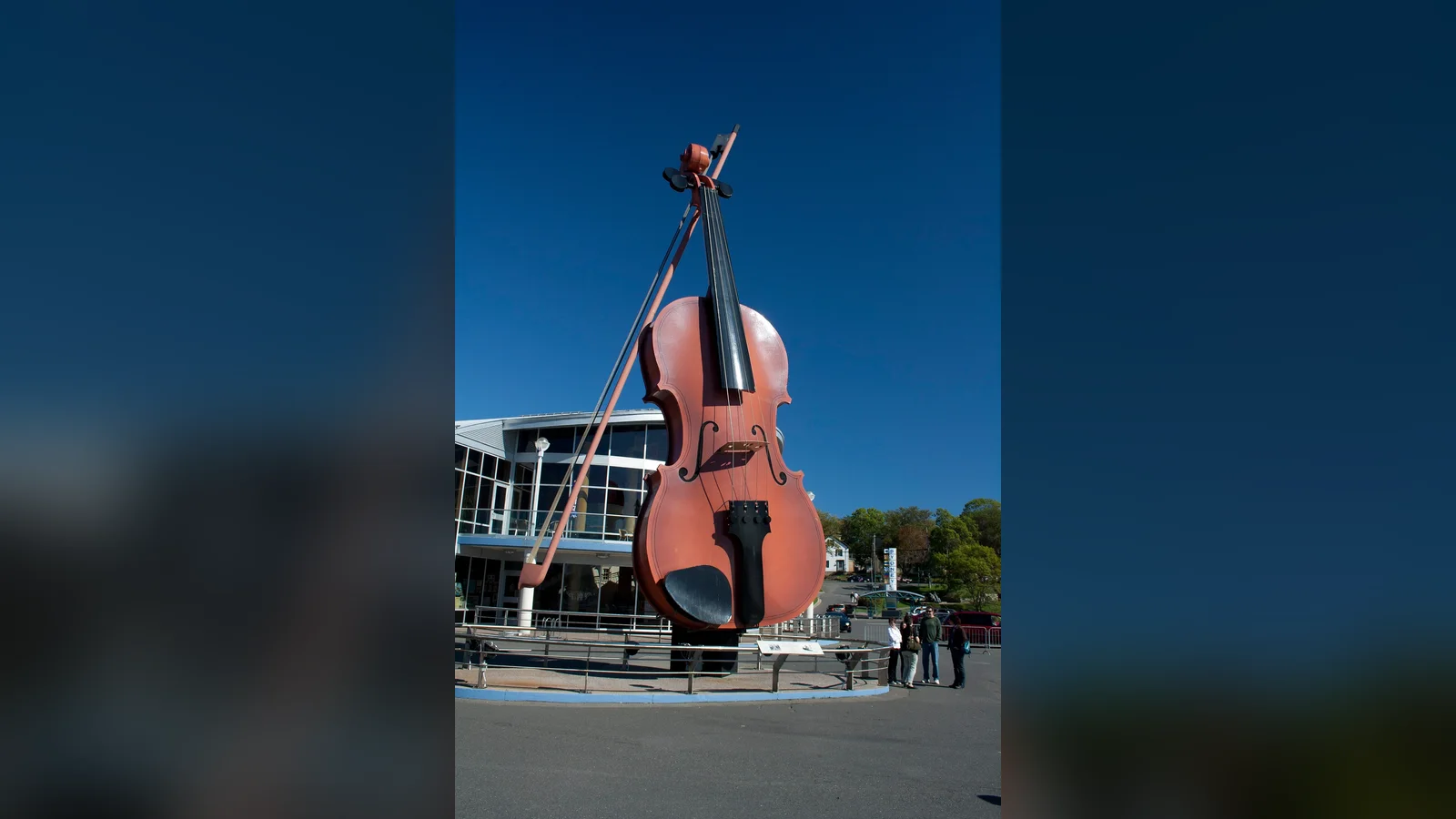

The Cape Breton Fiddle: The Music That Came Home
Contents
Highland emigrants took their strathspeys, reels and step dances to Cape Breton Island in Nova Scotia. There the music kept growing, with piano accompaniment, New England square sets and jigs, while in the Highlands the old style of fiddling and step dancing faded. In 1971 a CBC documentary warned that the Cape Breton fiddler was vanishing; instead a revival followed. From the 1980s Scottish musicians brought Cape Breton fiddlers and dancers to teach in Skye and South Uist, and the emigrants' music came back across the Atlantic.
TL;DR
- established Cape Breton fiddle music kept the fiddle, the pipes, strathspeys, reels and step dancing of the Highland emigrants, and added piano accompaniment, New England square dances and jigs.
- established In the Highlands, the anthropologist Jonathan Dembling writes, evangelicalism treated music and dance as sinful, accordion country dancing took over, and step dancing almost disappeared from memory.
- established The CBC documentary The Vanishing Cape Breton Fiddler (1971) prompted the founding of the Cape Breton Fiddlers' Association and a revival that, within twenty years, made the warning look unbelievable.
- established In the 1980s the fiddler Alasdair Fraser and the piper Hamish Moore brought Cape Breton teachers to Scotland. Fraser invited Buddy MacMaster and the step dancer Harvey Beaton to Sabhal Mòr Ostaig on Skye; Moore set up the Ceòlas summer school in South Uist.
- shared Many musicians hold that Cape Breton players keep a Gaelic rhythm, "you play it as you would sing it". Others in Scotland, including some Gaelic speakers, do not hear it at all.
Key Facts
- Place
- Cape Breton Island, Nova Scotia; and Skye and South Uist in Scotland
- Settlement
- Highland Gaels, in large numbers from about 1770 to 1850
- Turning point
- CBC documentary The Vanishing Cape Breton Fiddler, 1971
- Revival body
- Cape Breton Fiddlers' Association
- Return to Scotland
- 1980s: Alasdair Fraser (Sabhal Mòr Ostaig, Skye) and Hamish Moore (Ceòlas, South Uist)
- Names
- Buddy MacMaster, Harvey Beaton, Natalie MacMaster, Ashley MacIsaac
- Related card
- Diaspora 32, Gaelic Nova Scotia and Cape Breton
- Main source
- Jonathan Dembling, "You Play It as You Would Sing It", in Celeste Ray (ed.), Transatlantic Scots (University of Alabama Press, 2005)
Scottish Impact Index (SI Score)
- Global Influence
- 6/10
- Enduring Connection
- 8/10
- Material Contribution
- 6/10
- Scottish Diaspora Distinctiveness
- 8/10
- Diaspora Legacy
- 8/10
- Recognition
- 5/10
41/60
Ranked =60th of 93 in Diaspora
A Note on Claims and Evidence
Each major claim carries one of three labels. established means supported by primary records, official bodies or several independent reliable sources. shared means the core fact is sound but sources disagree on details, dates or interpretation. traditional means widely repeated but not traceable to a primary or independent source.
The account rests mainly on one anthropological chapter, with George Emmerson's 1972 dance history for an earlier view. Dembling did fieldwork in Scotland in 2003, interviewing musicians, dancers and Gaelic speakers, and he draws on earlier work by Michael Kennedy, John Gibson and others. His interest is less in the music's history than in how Scots in Scotland have adopted it and argued over it.
The claim that Cape Breton fiddling preserves the eighteenth-century Highland style is widely made, and Dembling treats it with care: the music has changed a great deal since the settlers arrived, and what Scottish enthusiasts take from it is a selection.
Timeline
Large numbers of Highland Gaels settle in Cape Breton and eastern Nova Scotia.
In the Highlands, evangelicalism discourages music and dance; accordion-led country dancing spreads; step dancing nearly disappears.
In Cape Breton, piano accompaniment, New England square sets and jigs join the fiddle repertoire.
The CBC broadcasts The Vanishing Cape Breton Fiddler. The Cape Breton Fiddlers' Association is formed and a revival begins.
Alasdair Fraser and Hamish Moore discover Cape Breton fiddlers such as Buddy MacMaster and bring Cape Breton teachers to Skye and South Uist.
Within twenty years of the documentary, the revival is so strong that newcomers cannot believe the music was ever endangered.
Dembling's fieldwork in Scotland.
Details
Two paths from one tradition
established The Gaels who settled Cape Breton brought the fiddle and the pipes, strathspeys and reels, and step dancing. Dembling stresses that the music did not stand still. Piano accompaniment became almost universal, square dances came in from New England, and jigs became popular. But the Gaels fitted these changes to their own style: they step-danced through the square sets, and piano players echoed the ornaments of fiddle and feet.
established In the Highlands the tradition took a different road. Nineteenth-century evangelicalism often cast music and dance as sinful. Accordion-driven country dancing became the main social dance. Gaelic piping survived at the edges, and step dancing was almost forgotten. At the same time, Highland dance and pipe music were formalised for military and competition use, with rhythms that could be measured and judged.
An earlier view: George Emmerson, 1972
shared The dance historian George S. Emmerson, writing thirty years before Dembling in A Social History of Scottish Dance (1972), came at the question from the dance floor. He noticed that the Cape Breton four- and eight-handed reels were stepped, in a hornpipe manner more associated with Ireland than with Scotland, and that hardly a trace of what is now called Highland dancing survived among the Cape Breton Gaels. Some had concluded that the stepping was Irish, or a legacy of the French. Emmerson rejected that: Gaels who had kept their language, music and poetry so tenaciously would hardly have lost only their dancing. He thought it more likely that they had kept the dance style of the West Highlands, the Hebrides and Sutherland in the early nineteenth century, and that stepping had once been part of Scottish social dancing too; he found it in North Argyll in 1800 and in Lowland barn dances later in the century. He identified the Cape Breton "four-handed" reel, Ruidhleadh Cheathrar or Ruidhleadh Beag, with the old circular Scotch Reel.
shared On the music he was more cautious. He heard Cape Breton fiddling as a mix of Scottish, Irish and French music, mostly of a common-time hornpipe character, with a way of playing "identifiably different" from the native Scottish style and closer in some respects to Irish fiddlers. He set it alongside other Scottish settlements in Canada that kept their own fiddle styles: the Glengarry settlement in Ontario, the Ottawa Valley and Red River. His reading and Dembling's differ less than they seem: both see a tradition that changed in Canada while its Scottish parent changed more.
The documentary that failed
established By the later twentieth century, tartan tourism and mass culture had pushed the old music to the edge even in Cape Breton. In 1971 the Canadian Broadcasting Corporation made The Vanishing Cape Breton Fiddler, which predicted the style's end. The response proved it wrong. The Cape Breton Fiddlers' Association was formed, concerts and dances sprang up, older fiddlers came forward and young people took lessons. Within twenty years, Dembling writes, visitors hearing the music for the first time could hardly believe it had been in danger. Step dancing and piano playing revived with it.
The return to Scotland
shared Many Scots who first heard Cape Breton fiddling doubted it was Scottish at all and took it for Irish or French. In Scotland, where Victorian forms were assumed to be the authentic ones, the emigrants' music sounded foreign.
established That changed in the 1980s, when the Scottish fiddler Alasdair Fraser and the piper Hamish Moore heard players such as Buddy MacMaster and found in them a liveliness they felt Scottish music had lost. Fraser invited MacMaster and the step dancer Harvey Beaton to teach at his summer school at Sabhal Mòr Ostaig, the Gaelic college on Skye. Moore founded Ceòlas, a summer school in South Uist with many Cape Breton tutors. Dembling calls both schools very successful, and says they led many Scots to take up Cape Breton music and dance.
established Ceòlas was not one man's project. Moore was joined by a local committee, by Proiseact nan Ealain (the Gaelic Arts Project) and by Allan MacDonald, a Gaelic-speaking piper from the West Highlands. Control later passed to a board made up entirely of Uist people.
"You play it as you would sing it"
shared The case for Cape Breton's Gaelic character rests on a phrase Dembling heard again and again: "you play it as you would sing it." Older players learned a tune by "jigging" it, singing the Gaelic words, and would not play it until they could sing it, so the rhythms of the language shaped the music. Research in Cape Breton supports the link for the older players.
shared Not everyone hears it. Some Hebridean and Highland fiddlers told Dembling that Cape Breton style did not sound Gaelic to them; one called it "Scottish music with a French accent". Others heard the Gaelic flavour at once. A piper who visited Cape Breton in the late 1960s said the fiddlers there played tunes as his father used to sing them. Musicians from Shetland and the north-east, with strong traditions of their own, were often sceptical of calling Cape Breton style more Scottish than what Scots play now.
What Scotland chose to take
shared Dembling notes that Scots did not adopt the whole Cape Breton tradition. They favoured Scottish tunes over ones composed in Cape Breton, strathspeys and reels over jigs, and step dancing over square sets, and Cape Breton piano style barely caught on. In his reading, the eighteenth-century Highlands were being treated as a golden age before the Clearances and Victorian tartanry, with Cape Breton as its last remnant. The accordion was excluded from Ceòlas, which upset some local players who saw it as part of island culture too.
Did You Know?
- A 1971 documentary predicted the end of the Cape Breton fiddle and helped start its revival.
- Cape Breton fiddlers have taught on Skye and South Uist, bringing an emigrant style back to the Hebrides.
- Older Gaelic-speaking fiddlers would not play a tune until they could sing its words.
- Step dancing almost disappeared in Scotland but survived in Cape Breton.
- Cape Breton piano accompaniment, one of the island's own creations, barely caught on in Scotland.
- In 1972 the dance historian George Emmerson argued that Cape Breton step dancing was not Irish but a survival of the West Highland dancing of the early nineteenth century.
FAQ
1Is Cape Breton fiddling the old Highland style, unchanged?
Not unchanged. It kept the core of the Highland tradition but added piano, square sets and jigs, and it has its own innovations.
2What was The Vanishing Cape Breton Fiddler?
A 1971 CBC documentary predicting the style's end. It prompted a revival instead.
3How did Cape Breton music come back to Scotland?
Through musicians such as Alasdair Fraser and Hamish Moore, who from the 1980s brought Cape Breton fiddlers and dancers to teach on Skye and in South Uist.
4Does Cape Breton fiddling sound Gaelic?
Many musicians say it does, because players learned tunes from Gaelic words. Some Gaelic speakers in Scotland disagree.
5Who are well-known Cape Breton fiddlers?
Buddy MacMaster, Natalie MacMaster and Ashley MacIsaac are among the names Dembling gives.
Sources and Further Reading
Scholarly/Critical
-
Jonathan Dembling, "You Play It as You Would Sing It: Cape Breton, Scottishness, and the Means of Cultural Production", in Celeste Ray (ed.), Transatlantic Scots (University of Alabama Press, 2005). Main source.
-
George S. Emmerson, A Social History of Scottish Dance: Ane Celestial Recreatioun (McGill-Queen's University Press, Montreal and London, 1972), pp. 158–160, 175–177.
Further reading (not consulted directly)
- Michael Kennedy, Gaelic Nova Scotia: An Economic, Cultural, and Social Impact Study (Nova Scotia Museum, 2002).
- John Gibson, Traditional Gaelic Bagpiping, 1745–1945 (McGill-Queen's University Press, 1998).
- Peter Murphy, Buddy MacMaster: The Master of the Cape Breton Fiddle (1991).
Caveats: Myths and Disputed Claims
- Myth: Cape Breton music is an untouched survival. It has changed a great deal; what Scots took from it is a selection.
- Disputed: the Gaelic link. Supported by research on older players and by many Gaelic speakers; rejected by some others.
- Disputed: authenticity. Dembling shows that "authentic" can mean old, Gaelic, or simply what Scots do now, and each view has its supporters.
Finished reading? Try the Fact Machine: three reels, one surprising Scottish connection →
Card 074 · Diaspora