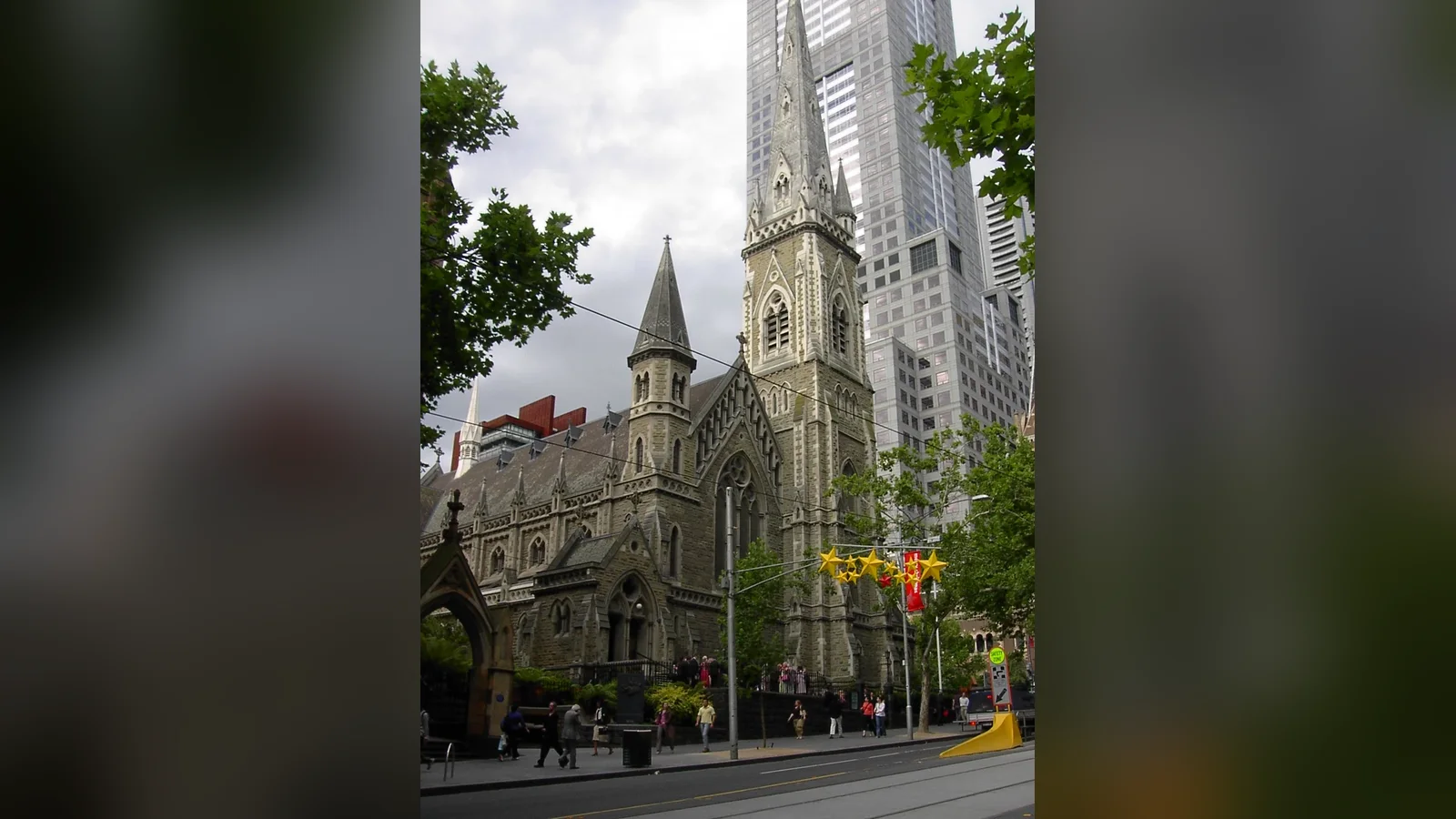

Presbyterian Victoria: Scots' Church, the Disruption and the Union of 1859
Contents
Melbourne was barely two years old when its Scots gathered to call a minister. By 1841 they were building a church on the Eastern Hill, Scots' Church, whose minister was among the best paid in Australia. Then the quarrels of Scotland arrived. The Disruption of 1843, which split the Church of Scotland in two, split the colony's Presbyterians too, and for a decade Victoria had three rival Presbyterian churches, one for each faction at home. The gold rush flooded them with new people. In 1859 they united as the Presbyterian Church of Victoria, which went on to found Scotch College and Ormond College.
TL;DR
- established The Rev. James Forbes, licensed in Aberdeenshire and ordained by the Presbytery of Glasgow in 1837, reached Melbourne in January 1838. His congregation called him that June and laid the foundation of Scots' Church in Collins Street on 22 January 1841.
- established Victoria's Presbyterians reproduced the divisions of Scotland. After the Disruption of 1843, Forbes left the established church and founded the Free Church of Port Phillip in 1846–47. A third body, the United Presbyterians, held to the "voluntary principle" of no state aid.
- established The gold rush from 1851 transformed the colony. The three bodies negotiated for years over state money, property and doctrine, and on 7 April 1859 most of them united as the Presbyterian Church of Victoria.
- established The Free Church's Melbourne Academy, on the Eastern Hill, became Scotch College. In the 1880s the church built Ormond College at the University of Melbourne, named after Francis Ormond, who offered £10,000 if the church matched it.
- shared Gaelic-speaking Highlanders were served by special ministers from 1842, but Hamilton found that their children were growing up in English and that Gaelic would not survive as a spoken language in the colony.
Key Facts
- First pastor
- Rev. James Forbes, Melbourne, 1838 (died 12 August 1851)
- Pioneer
- Rev. James Clow, a retired Bombay chaplain, the first ordained minister to hold regular services in Melbourne
- Scots' Church
- Collins Street at Russell Street; foundation stone 22 January 1841; first building cost about £2,500
- Divisions
- Church of Scotland (Synod of Australia); Free Church (from 1846–47); United Presbyterian (voluntary)
- Union
- Presbyterian Church of Victoria, 7 April 1859
- Colleges
- Scotch College (from the Free Church's Melbourne Academy); Ormond College, University of Melbourne
- Gaelic ministry
- Rev. Peter Gunn, from 1842
- Related cards
- Diaspora 55, Scots in Australia; Diaspora 71, Presbyterian Colleges in America
- Main source
- Robert Hamilton, A Jubilee History of the Presbyterian Church of Victoria (M. L. Hutchinson, Melbourne, 1888)
Scottish Impact Index (SI Score)
- Global Influence
- 6/10
- Enduring Connection
- 7/10
- Material Contribution
- 6/10
- Scottish Diaspora Distinctiveness
- 7/10
- Diaspora Legacy
- 7/10
- Recognition
- 5/10
38/60
Ranked =76th of 93 in Diaspora
A Note on Claims and Evidence
Each major claim carries one of three labels. established means supported by primary records, official bodies or several independent reliable sources. shared means the core fact is sound but sources disagree on details, dates or interpretation. traditional means widely repeated but not traceable to a primary or independent source.
Hamilton was a minister of the church he describes, writing for its jubilee, and he says he let "the records, as far as possible, speak for themselves". He drew on the minutes of presbyteries, synods and the General Assembly, and the book is full of dates, names and calls. It is also a celebration, and it describes the colony's Aboriginal people in the dismissive language of its time.
The book is long and detailed on church politics. Only its main outline is used here.
Timeline
The Rev. John Dunmore Lang begins Presbyterian work in New South Wales.
The Rev. James Clow, retired from Bombay, holds the first regular Presbyterian services in Melbourne.
James Forbes ordained by the Presbytery of Glasgow for Australia.
Forbes reaches Melbourne.
The congregation calls Forbes; on 1 August it adopts a constitution and appoints five trustees.
A day school opens; within six months it has eighty pupils.
Foundation stone of the Collins Street church laid.
Presbytery of Melbourne formed. The Rev. Peter Gunn arrives to minister to Gaelic-speakers.
The Disruption divides the Church of Scotland.
Forbes leaves the established church and founds the Free Church in Port Phillip.
Victoria becomes a separate colony; gold is discovered; Forbes dies on 12 August.
Victoria's new constitution provides £50,000 a year for public worship.
Union forms the Presbyterian Church of Victoria.
Further unions bring in most of the remaining groups.
David Mitchell builds Scots Church, Melbourne (Prentis).
Ormond College opens at the University of Melbourne (Prentis).
Jubilee of the church; Hamilton's history published.
Details
The first congregation
established The first Presbyterian services in Melbourne were held by the Rev. James Clow, who had spent fifteen years as a minister in Bombay and came to the new settlement intending to retire. Hamilton calls him the first ordained minister of any denomination to hold regular services in the district. The Presbyterians first shared a building with the Church of England, until the Anglican bishop claimed it for his church alone, and then put up a wooden building of their own in Collins Street.
established Their first settled minister was James Forbes, licensed in Aberdeenshire and ordained by the Presbytery of Glasgow in June 1837 to go to Australia. He reached Melbourne in January 1838. On 22 June the heads of families called him as their pastor, and on 1 August they appointed five trustees: James Clow, Skene Craig, Peter Snodgrass, William Ryrie and Thomas Napier. A day school opened in November 1838 and had eighty pupils within six months.
established The government granted two acres at the corner of Collins and Russell Streets on the Eastern Hill. The foundation stone of the church was laid on 22 January 1841, and by the end of the year, with the whole province's population over 11,000, the unfinished building was in use. It had cost about £2,500. The congregation could claim the highest government supplement to a stipend, £200 a year, and Hamilton thought Forbes's income perhaps the largest of any minister in Australia.
Scotland's quarrels in Australia
established Until 1846 all the pioneer Presbyterian ministers in Australia held communion with the established Church of Scotland. The Disruption of 1843, when a third of the Church of Scotland's ministers walked out to form the Free Church, reached the colonies as "startling news". In 1846, after the synod and the Presbytery of Melbourne decided to stay with the established church, Forbes separated from his colleagues and founded the Free Church of Port Phillip. At about the same time a third Scottish body, the United Presbyterian Church, which refused all state support, appeared in the colony. For more than a decade Victoria had three Presbyterian churches, each answering to a different church in Scotland.
shared Forbes, worn out by pioneering, died on 12 August 1851. Hamilton presents him as the founder of Presbyterianism in Melbourne and of its Free Church.
Gold and union
established The gold discoveries of 1851 brought a flood of people and money. The churches struggled to find ministers: appeals to Scotland went largely unanswered, as the home churches were absorbed in their own needs, and many of the ministers who did come were from the Synod of Ulster. Victoria's new constitution of 1855 set aside £50,000 a year for public worship, and the Free Church agreed to accept state grants of land.
established Negotiations for union began in the early 1850s and dragged on over property, state money and the terms of belief. On 7 April 1859 the Synod of Victoria, most of the Free Church and the United Presbyterians united as the Presbyterian Church of Victoria, celebrated with services in Scots' Church. Minorities stayed out; further unions in 1867 and 1870 brought in most of them.
Highlanders
shared In 1842 the Rev. Peter Gunn, ordained by the Presbytery of Caithness, arrived to minister to Gaelic-speakers. He found the Highlanders too scattered to form a congregation in Melbourne, and served them where he could. Later efforts met the same problem: no community was large enough to support a minister preaching wholly in Gaelic, and Hamilton concluded that, with the children growing up in English, Gaelic would not last as a spoken language once the older generation had gone.
Schools and colleges
established The Free Church's only institution for higher learning in the 1850s was the Melbourne Academy on the Eastern Hill, which, Hamilton writes, "merged afterwards in the Scotch College". The united church later supported a theological hall, a ladies' college and a residential college at the University of Melbourne. When subscriptions for the university college had reached £6,000, the pastoralist Francis Ormond offered to raise his gift to £10,000 if the church raised another £10,000, and the General Assembly named it Ormond College.
What Prentis adds
established Malcolm Prentis's The Scots in Australia (2008) counts James Forbes among the ministers who pioneered Scottish education in Australia, with J. D. Lang and John McGarvie in New South Wales, John Lillie in Van Diemen's Land, Ralph Drummond in South Australia and Thomas Mowbray in Queensland. He dates Ormond College, the Presbyterian residential college at the University of Melbourne, to 1881. Its benefactor, Francis Ormond, also provided most of the money for Melbourne's Working Men's College and Geelong's Gordon Technical College, both founded in 1887. Prentis records that the contractor David Mitchell (1829–1916) built Scots Church in 1873–74, during Melbourne's boom, who also built Presbyterian Ladies' College (1874) and the Exhibition Building (1880).
Did You Know?
- Melbourne's first Presbyterian services were held by a minister retired from Bombay.
- The first Presbyterian and Anglican congregations shared a building until the bishop claimed it.
- For more than ten years Victoria had three rival Presbyterian churches, each matching a faction in Scotland.
- Scotch College grew out of the Free Church's Melbourne Academy.
- Ormond College is named after a donor who offered £10,000 if the church matched it.
FAQ
1When did Presbyterianism begin in Melbourne?
In 1837–38, with services by the Rev. James Clow and the arrival of the Rev. James Forbes as minister.
2What is Scots' Church?
The first Presbyterian church in Melbourne, in Collins Street, begun in 1841.
3Why were there several Presbyterian churches?
Because Scotland's Disruption of 1843 and its other divisions were copied in the colony.
4When did they unite?
On 7 April 1859, as the Presbyterian Church of Victoria.
5What colleges did it found?
Scotch College grew from its Melbourne Academy, and it founded Ormond College at the University of Melbourne.
Sources and Further Reading
Scholarly/Critical
-
Robert Hamilton, A Jubilee History of the Presbyterian Church of Victoria (M. L. Hutchinson, Melbourne, 1888). Free scan at the Internet Archive. Main source.
-
Malcolm D. Prentis, The Scots in Australia (UNSW Press, Sydney, 2008), for the pioneers, Ormond College and the 1870s church.
Further reading (not consulted directly)
- Robert Sutherland, The History of the Presbyterian Church of Victoria (James Nisbet, London, 1877).
Caveats: Myths and Disputed Claims
- Not one church. Victoria's Presbyterians were divided from 1846 to 1859, and minorities stayed out of the 1859 union.
- Scotch College's founding date. Hamilton gives its origin in the Free Church's Melbourne Academy but no founding year; the school's own date should be checked before print.
- Partisan source. Hamilton was a minister of the united church writing for its jubilee.
Finished reading? Try the Fact Machine: three reels, one surprising Scottish connection →
Card 084 · Diaspora