
Scots in the Dutch Republic: Soldiers, Sailors, Students and Exiles
Contents
For two hundred years the Dutch Republic was Scotland's window on the modern world. Scottish soldiers fought for it from the start of its revolt against Spain; Scottish sailors manned its merchant ships and served the Dutch East India Company; Scottish merchants clustered at Veere and Rotterdam, where the Scots Kirk had around 1,000 communicants by 1700; and more than a thousand Scottish students went to Dutch universities in fifty years, bringing home the law and medicine that helped make the Scottish Enlightenment. Covenanters and their enemies took refuge there in turn.
TL;DR
- established Thousands of Scots joined the Dutch revolt against Spain after 1568. Their numbers settled at a notional 3,000 men in three regiments, known as the Scots Brigade, which Murdoch and Grosjean call a "nursery of arms" for Scottish professional soldiers.
- established Veere, in Zeeland, was the Scottish staple port of the Dutch Republic, through which Scottish trade was supposed to pass. A Scottish conservator lived there until 1799.
- established Rotterdam had a Scottish Kirk from 1642, with around 1,000 communicants by 1700. Communions were held in spring and autumn because so many members were sailors away at sea. The Dutch merchant marine was said to employ as many as 1,500 Scots in 1672.
- established Between 1680 and 1730 just over 1,000 Scottish students went to Dutch universities. Andrew Mackillop argues that this shaped the early Scottish Enlightenment and the rise of Edinburgh as a centre of medicine.
- established The Republic was a refuge for Scots exiles. In 1640 a Scots merchant at Veere shipped arms to the Covenanters; in 1663 the Covenanting minister John Livingston fled to Holland, and his son Robert went on to found a leading New York family.
Key Facts
- Period
- 1568 (Dutch Revolt) to 1799 (end of the Veere staple)
- Places
- Veere (the staple port); Rotterdam; Leiden and the other universities; garrisons such as Willemstad and Groningen
- Soldiers
- The Scots Brigade, a notional 3,000 men in three regiments
- Church
- Scots Kirk, Rotterdam, founded 1642; around 1,000 communicants in 1700
- Sailors
- As many as 1,500 Scots in the Dutch marine in 1672 (reported)
- Students
- Just over 1,000 Scots at Dutch universities, 1680–1730
- Main sources
- Andrew Mackillop in Global Migrations (2016), ch. 2; T. M. Devine, To the Ends of the Earth (2011); Bueltmann, Hinson and Morton, The Scottish Diaspora (2013); Steve Murdoch and Alexia Grosjean, Alexander Leslie and the Scottish Generals of the Thirty Years' War (2014)
Scottish Impact Index (SI Score)
- Global Influence
- 6/10
- Enduring Connection
- 6/10
- Material Contribution
- 7/10
- Scottish Diaspora Distinctiveness
- 8/10
- Diaspora Legacy
- 7/10
- Recognition
- 4/10
38/60
Ranked =76th of 93 in Diaspora
A Note on Claims and Evidence
Each major claim carries one of three labels. established means supported by primary records, official bodies or several independent reliable sources. shared means the core fact is sound but sources disagree on details, dates or interpretation. traditional means widely repeated but not traceable to a primary or independent source.
The Scots in the Netherlands are well studied by specialists, notably Douglas Catterall's Community Without Borders (2002), which was not consulted directly. The sources used here are surveys that summarise that work. Their figures are given with their origins: the 1,500 sailors of 1672 are "according to some reports", in Devine's words, and the Scots Brigade's 3,000 was a notional establishment, not a headcount.
Timeline
The Dutch revolt against Spain begins. Thousands of Scots enlist on the Protestant side.
Some 400–500 Scottish troops return from Flanders, giving James VI a pool of experienced soldiers.
James VI asserts his right to recall troops from the Scots Brigade.
Rotterdam has a stock exchange; a chamber of insurance follows in 1604 and a bank by 1635.
With the Twelve Years' Truce, the Scots Brigade is reduced to two regiments.
During the Bishops' Wars, eleven of thirteen ships sent by Thomas Cunningham of Veere reach Scotland with supplies for the Covenanters.
A Scottish Kirk is established in Rotterdam.
The Covenanting minister John Livingston takes refuge in Holland.
The Dutch marine is reported to employ as many as 1,500 Scots.
Robert Livingston, John's son, settles in New York.
Just over 1,000 Scottish students attend Dutch universities.
The Rotterdam Scots Kirk has around 1,000 communicants.
The last Scottish conservator leaves Veere.
Details
The Scots Brigade
established The Dutch revolt against Spain, which began in 1568, drew thousands of Scots to fight for their fellow Calvinists. Murdoch and Grosjean describe Dutch service as a "nursery of arms": its sieges and garrisons taught Scots military skills they could not learn at home, and engineers such as Francis de Traytorrens made their names on fortresses like Willemstad. The Scots in Dutch pay settled at a notional 3,000 men in three regiments, the Scots Brigade.
shared The brigade served Scottish as well as Dutch purposes. The regency governments and then James VI used foreign service to train men who could be recalled in an emergency; in 1594 James asserted his right to do exactly that. The English Privy Council noted that the Scots were stronger in arms than before because of their service in the Low Countries. In the Thirty Years' War the Dutch Scots were "borrowed" for other fronts: The Scottish Diaspora records 1,000 of them fighting in Bohemia alongside 1,500 newly recruited Scots.
Veere and the staple
established Scottish trade with the Netherlands ran through a staple port, a town given the exclusive right to handle Scottish goods. The Dutch Republic designated Veere, in Zeeland, as its Scottish staple. All Scottish trade was supposed to pass through it, and a Scottish conservator lived there to oversee it until 1799. The town kept a small Scottish community, and Global Migrations notes that some modern re-enactors at Veere still play the part of its early modern Scottish wool merchants. Veere has its own planned card.
established Veere's merchants could be political actors. In 1640, during the Bishops' Wars, the Covenanters' agent William Colville sought arms and allies in the Republic. Murdoch and Grosjean find that most of the Scots-Dutch community rallied to the Covenant, and that eleven of thirteen ships sent by Thomas Cunningham of Veere got through to Scotland.
Rotterdam
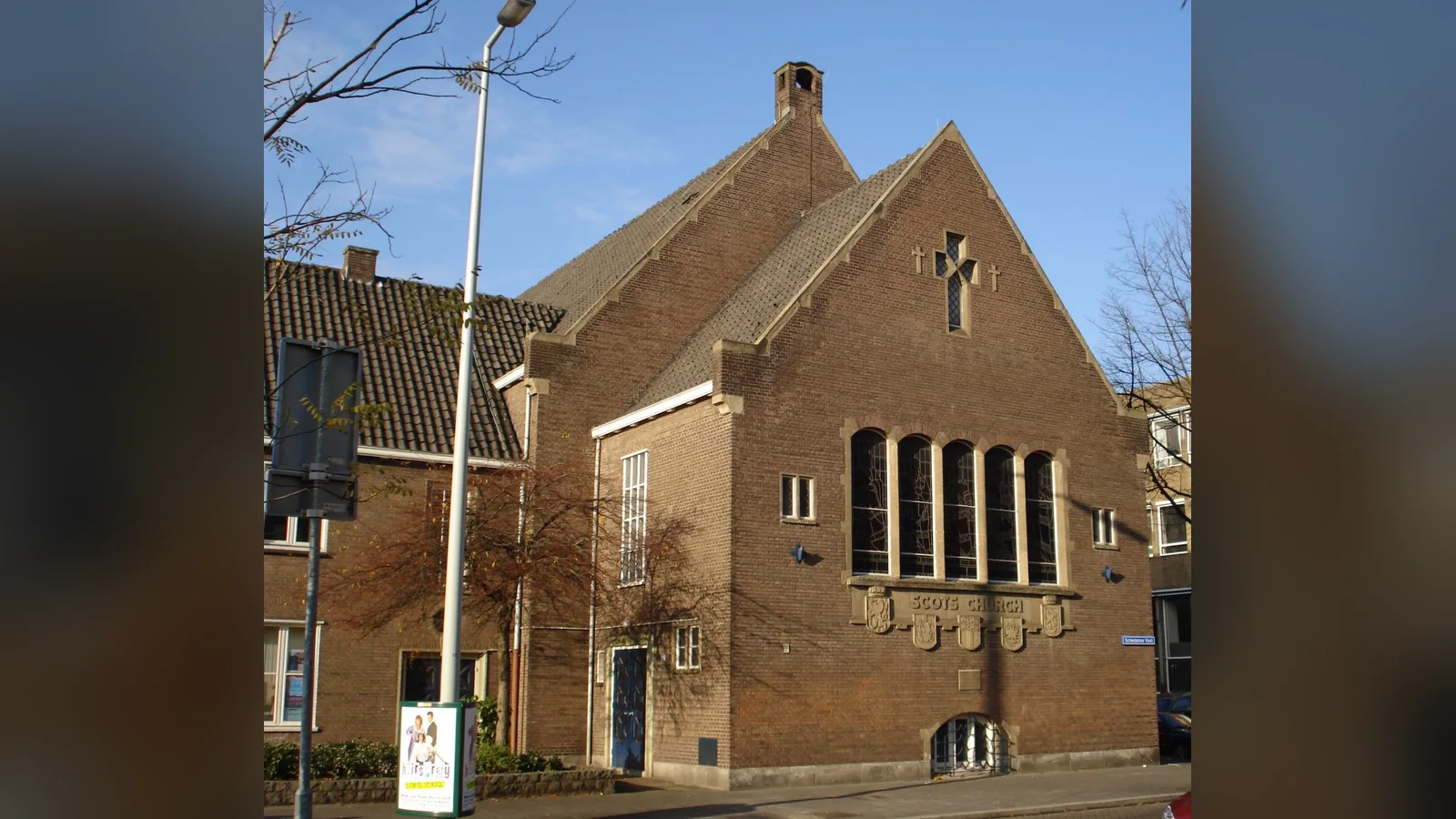
established The larger community was at Rotterdam, where a Scottish Kirk was established in 1642. By 1700, Devine writes, it had around 1,000 communicants. Many were seafarers: communions were held in spring and autumn because so many members served in Dutch merchant ships, in Arctic waters in summer and in the Mediterranean in winter. Rotterdam's navy, the Dutch East India Company and its merchant houses all needed experienced sailors, and some reports put the number of Scots in the Dutch marine at 1,500 in 1672. Some Scots rose to high naval and administrative posts, and others served the East India Company in Asia.
shared Devine argues that the Dutch connection prepared Scots for empire. Rotterdam had a stock exchange in 1598, a chamber of insurance in 1604 and a bank by 1635, and the sons of Scottish merchants were sent to Dutch commercial academies to learn accounts. The techniques Scots learned trading in Europe, family networks, credit and cheap goods in bulk, were carried to the Atlantic.
Students
established Between 1680 and 1730 just over 1,000 Scottish students went to the great Dutch universities, above all Leiden. Mackillop calls this a strategy for building human capital: it gave Scottish lawyers, ministers and doctors the latest thinking from one of Europe's most advanced societies. He argues that the early Scottish Enlightenment owed part of its character and timing to it, and that by helping to make Edinburgh the leading medical school of the British world by the 1750s, the Dutch connection shaped Scottish medicine across the empire for a century after the original links had faded.
Exiles
established The Republic was also a refuge. The Covenanting minister John Livingston fled there in 1663. His son Robert became a leading merchant in Rotterdam, then moved to Scotland, Boston and, by 1674, New York, where his Dutch, Scots and English were all useful. In 1678 he married Alida Schuyler, linking himself to three of the most powerful Dutch families in New York. He became a successful transatlantic trader, and the family he founded rose to eminence in American politics in the revolutionary era.
What it left
shared The Scots in the Netherlands were rarely permanent settlers. Soldiers, sailors, merchants and students came and went, and the community faded in the eighteenth century as Scottish trade turned to England and the Atlantic. Mackillop's point is that the migration left its mark at home: in Scottish law, medicine and commerce, and in the skills Scots took into the British Empire.
Did You Know?
- Communions at the Scots Kirk in Rotterdam were timed for when the sailors were home.
- Veere kept a Scottish conservator until 1799.
- More than a thousand Scottish students went to Dutch universities between 1680 and 1730.
- A Veere merchant ran supplies to the Covenanters in 1640; eleven of his thirteen ships got through.
- The founder of New York's Livingston family was the son of a Covenanting minister who fled to Holland.
- Scots learned book-keeping at Dutch commercial academies.
FAQ
1Why did Scots go to the Netherlands?
To fight for the Dutch against Spain, to trade, to serve at sea, to study at the universities, and in times of persecution to take refuge.
2What was the Scots Brigade?
The Scottish regiments in Dutch service, settling at a notional 3,000 men in three regiments. Diaspora 11 covers them in more detail.
3What was the Scottish staple?
A Dutch port, Veere, through which Scottish trade with the Netherlands was supposed to pass, with a resident Scottish conservator until 1799.
4Was there a Scottish church in Rotterdam?
Yes, from 1642. By 1700 it had around 1,000 communicants, many of them sailors.
5Which university did Scots attend?
Above all Leiden. Just over 1,000 Scots studied at Dutch universities between 1680 and 1730.
6How did this affect Scotland?
Historians argue that Dutch-trained lawyers and doctors helped shape the Scottish Enlightenment and Edinburgh's medical school.
7Did Scots stay in the Netherlands?
Some did, but most came and went. The community faded in the eighteenth century.
Sources and Further Reading
Scholarly/Critical
- Andrew Mackillop, "'As hewers of wood, and drawers of water': Scotland as an emigrant nation, c. 1600 to c. 1800", in Angela McCarthy and John M. MacKenzie (eds), Global Migrations: The Scottish Diaspora since 1600 (Edinburgh University Press, 2016), ch. 2.
- T. M. Devine, To the Ends of the Earth: Scotland's Global Diaspora, 1750–2010 (Allen Lane, 2011).
- Tanja Bueltmann, Andrew Hinson and Graeme Morton, The Scottish Diaspora (Edinburgh University Press, 2013), ch. 1.
- Steve Murdoch and Alexia Grosjean, Alexander Leslie and the Scottish Generals of the Thirty Years' War, 1618–1648 (Pickering & Chatto, 2014).
Further reading (not consulted directly)
- Douglas Catterall, Community Without Borders: Scots Migrants and the Changing Face of Power in the Dutch Republic, c. 1600–1700 (Brill, 2002).
- Peter Blom, Scots Girn about Grits, Gruel and Greens: Four Centuries of Scots Life in Veere (Stichting Veere-Schotland, 2003).
Caveats: Myths and Disputed Claims
- Disputed: the size of the Scots Brigade. The 3,000 was a notional establishment; actual numbers rose and fell with the wars.
- Disputed: 1,500 Scottish sailors in 1672. Devine gives the figure as reported, not counted.
- Myth: the Scots in Holland were settlers. Most were soldiers, sailors, merchants and students who came and went.
Finished reading? Try the Fact Machine: three reels, one surprising Scottish connection →
Card 072 · Diaspora