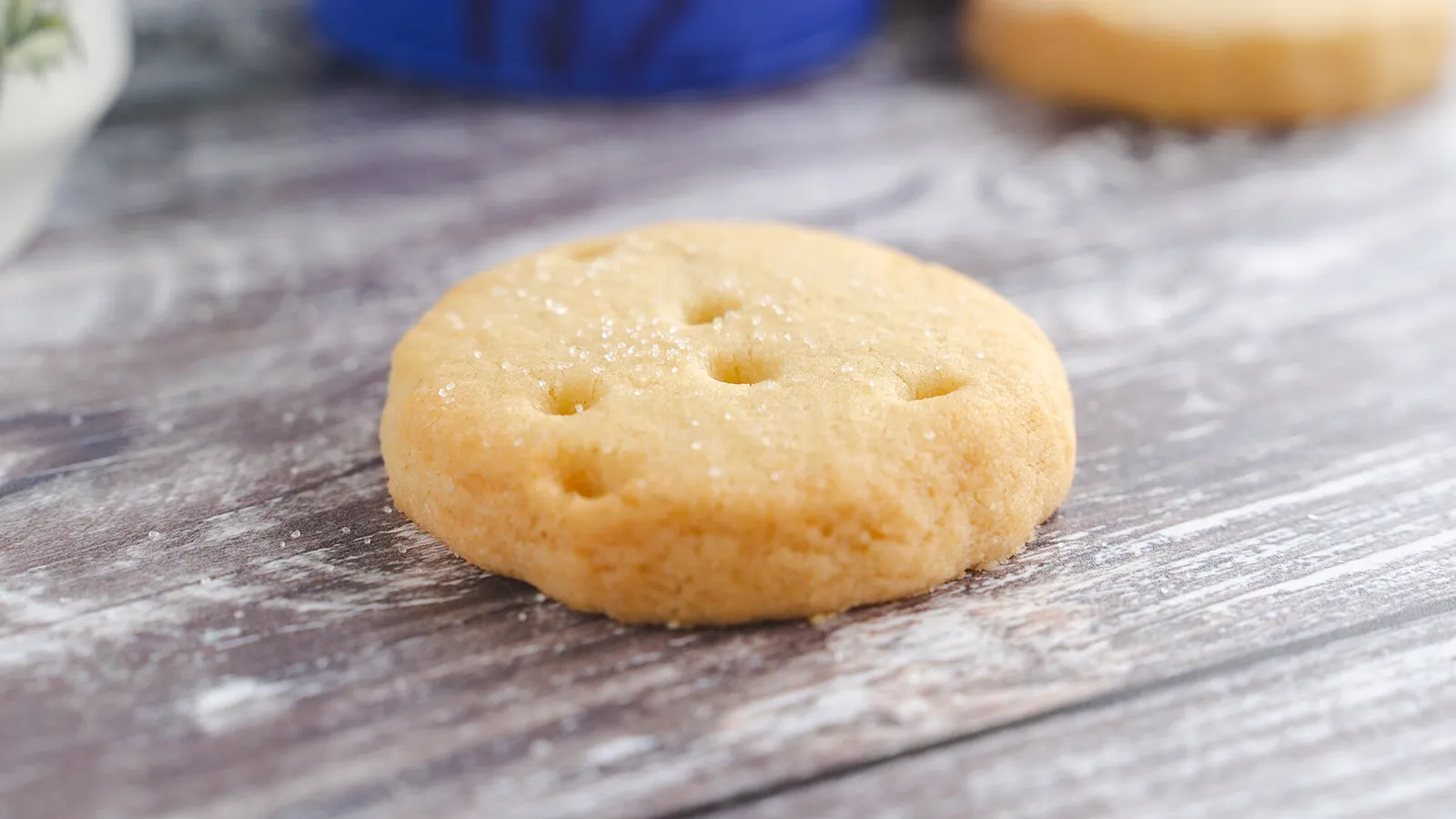

Shortbread: Scotland's Butter Biscuit
Contents
Shortbread is a rich biscuit of flour, butter and sugar, baked so that it crumbles: "short" in the old sense of fat breaking up the dough. It is one of Scotland's best-known foods and one of its most-bought souvenirs. Its Scottish history is better documented than most people realise, going back to the 1590s. The story most often told about it, that Mary, Queen of Scots introduced it from France, is not. This card tests what the records show.
TL;DR
- established "Short-bread" is recorded in Scotland from 1597, when Ayr ruled that it must contain at least half a pound of butter to a peck of flour.
- established The first printed shortbread recipe is Scottish, in Mrs McLintock's Receipts for Cookery and Pastry-Work, published in Glasgow in 1736, the oldest cookery book printed in Scotland.
- shared Shortbread grew out of "biscuit bread", dried and twice-baked bread dough, a practice found across Britain and Europe, not only in Scotland.
- traditional The story that Mary, Queen of Scots brought "petticoat tails" shortbread from France has no documentary support. The food historian Emma Kay says she can find no legitimate link.
- established Shortbread comes in three classic shapes: a large round scored into wedges (petticoat tails), individual rounds, and thick fingers.
- shared The Oxford Companion to Food (3rd edn, 2014) traces shortbread instead to the rich, flat "short cakes" of 16th-century pastry-cooks, and gives the classic proportions as one part sugar, two of butter and three of flour.
- shared A third explanation of "petticoat tails", from the English writer Dorothy Hartley (1954), derives it from medieval "petty cotes tallis", small pastry cases cut into tallies. It is as unproven as the French one.
- traditional The derivation of "petticoat tails" from French petites gatelles (little cakes) was already debated in a note in Meg Dods's Cook and Housewife's Manual (first published 1826) and was later listed by the folklorist F. Marian McNeill among her Franco-Scottish kitchen words. It is a romantic etymology, not a proven one, and none of these early sources mentions Mary, Queen of Scots.
Key Facts
- Ingredients
- Flour, butter, sugar (classically in a 3:2:1 ratio by weight)
- "Short" means
- Crumbly: the butter stops the dough forming a tough structure
- Earliest Scottish record
- 1597, Ayr burgh regulation
- Older Scots spelling
- Schort breid
- First printed recipe
- Mrs McLintock's Receipts, Glasgow, 1736
- Three shapes
- Petticoat tails, rounds, fingers
- Regional variant
- Ayrshire shortbread, with egg yolk and cream
- Other variants (Oxford Companion to Food)
- Pitcaithly bannock (peel and almonds); Queen Victoria's Balmoral recipe (a little salt); English relatives: Shrewsbury cakes, Goosnargh cakes, Dorset shortbread
- Softening flour
- Some Scottish recipes add rice flour
- Best-known maker
- Walkers, founded 1898 by Joseph Walker, later based in Aberlour
A Note on Claims and Evidence
Each major claim carries one of three labels. established means supported by primary records, official bodies or several independent reliable sources. shared means the core fact is sound but sources disagree on details, dates or interpretation. traditional means widely repeated but not traceable to a primary or independent source.
The record from 1597 onwards is strong: the Dictionary of the Older Scottish Tongue quotes burgh records through the 17th century. The weak points are the stories told about earlier origins. Claims that shortbread dates from the 12th century refer to rusks and twice-baked bread in general, not to any dated record of shortbread. The link with Mary, Queen of Scots is a story, not a record.
Alan Davidson's The Oxford Companion to Food (3rd edn, ed. Tom Jaine, 2014) is a respected reference, and its entries on shortbread, shortcake and biscuit (the last by Laura Mason) add useful context on origins and variants. Its shortbread entry is unsigned, and on Mary, Queen of Scots it contains a plain error of date, noted below; its etymologies are reported as theories.
Timeline
Across Britain and Europe, leftover bread dough is dried in a low oven into twice-baked "biscuit bread".
Rich, flat "short cakes" of pastry appear in English cookery; a recipe book of 1594 has "To make short Cakes" (Oxford Companion to Food).
Ayr rules that shortbread must contain at least half a pound of butter to the peck, and fixes its price at 16 pence.
Dumbarton's accounts repeat the half-pound-of-butter rule.
Peebles records "four schort breid" bought with a box of sweets.
Hawick records "a pint of wine with a short bread".
Lady Grisell Baillie's directions to her housekeeper set "best" shortbread at 3 lb butter to 8 lb flour (as quoted by Annette Hope).
Mrs McLintock's Receipts for Cookery and Pastry-Work, the oldest cookery book printed in Scotland, includes a shortbread recipe made with yeast.
Scott's The Bride of Lammermoor lists "petticoat-tails" among old-fashioned festive baking.
Meg Dods's Cook and Housewife's Manual is first published, with a petticoat-tails recipe; a note in the Manual records the dispute over the name.
Carr's of Carlisle makes four kinds of biscuit by machine, one of them shortbread fingers (Collingham).
Most recipes have dropped yeast and use only butter, flour and sugar.
McVitie's shortbread and oatcakes win a gold medal and a certificate of excellence at the Calcutta Exhibition (Grace's Guide).
Joseph Walker, aged 21, takes over a bakery at Torphins, Aberdeenshire, with a £50 loan.
Crawford's introduces assorted shortbread in round tins, made thinner at its Liverpool factory for English buyers (Carol Foreman).
Walker moves the business to Aberlour on Speyside.
Walkers decides to concentrate on shortbread.
Walkers moves to a purpose-built factory at Aberlour.
McNeill's The Scots Kitchen records shortbread as the indispensable Hogmanay fare for first-footers and gives Ayrshire, Pitcaithly and Shetland variants.
Details
Where shortbread came from
shared Shortbread is usually traced to medieval "biscuit bread": leftover bread dough dried slowly into a hard rusk. "Biscuit" itself means "twice cooked". Over time butter replaced yeast, and because fat stops the dough developing a chewy structure, the result was crumbly, or short. Food historians stress that this practice was common across Britain and Europe; England had its own short cakes. Scotland's genuine claim is to the refined butter biscuit and to the long record of it, not to the idea.
shared The Oxford Companion to Food (3rd edn, 2014) offers a different ancestry. Its entry on shortbread places the biscuit's origin in the "short cakes" made in the 16th century. Laura Mason's entry on biscuits describes these as flat, once-baked products of rich shortcrust pastry with eggs, sometimes leavened with a little yeast but kept thin, and pricked or "docked" to stop the yeast raising them unevenly. A recipe book of 1594 already had "To make short Cakes", and Shakespeare named a character Alice Shortcake in The Merry Wives of Windsor. On this view shortbread is a pastry that became a biscuit, not a bread that became one. The two accounts can be reconciled: Mrs McLintock's yeasted shortbread of 1736 looks like the short cake tradition, and the docked centre of a shortbread round survives from it. The Companion's entry on shortcake, quoting John Ayto, adds that "shortcake" and "shortbread" have never been properly distinguished in Britain.
established Mason groups modern shortbread with digestive biscuits as biscuits made from a short pastry mixture, and with other enriched short cakes of the 18th and 19th centuries such as Derbyshire wakes cakes, Lancashire's Goosnargh cakes and Shrewsbury cakes flavoured with cinnamon. Rich butter doughs of the same kind are also specialities of central and northern Europe. In Britain, the Companion concludes, shortbread is regarded as a particular Scottish speciality, although similar biscuits are made elsewhere.
traditional The folklorist F. Marian McNeill, in The Scots Kitchen (1929), points to Edinburgh's "caik-baxteris" (cake-bakers), who in 1503 were ordered to make eight-ounce cakes for a penny and were convicted the same year of selling them underweight. She thought it "almost certain" that shortbread came from these town bakers. That is her inference; the records she cites do not name shortbread.
traditional Many accounts, including makers' own histories, date shortbread to the 12th century. No 12th-century document describes shortbread. The date refers to the general age of twice-baked bread.
The Scottish record
established The Dictionary of the Older Scottish Tongue, the standard dictionary of Scots before 1700, defines schort breid as food made from flour, butter and sugar mixed so that it bakes to a short, biscuit-like texture. Its earliest quotation is from Ayr in 1597, where the burgh ruled that shortbread must contain at least half a pound of butter to the peck of flour and be sold at 16 pence. The same rule appears in Dumbarton's accounts in 1617–18. Peebles bought "four schort breid" in 1635–36; Irvine records "aill and schorte bread" in 1648; and in Hawick in 1690 it was served with a pint of wine. It was a food for occasions, made expensive by its butter.
established A great household's proportions survive from the early eighteenth century. The food historian Annette Hope, in A Caledonian Feast (1987), quotes Lady Grisell Baillie's directions to her housekeeper: "For best shortbread 8 lb flour 3 lb butter", while "second shortbread" had only 2 lb of butter to the 8 lb of flour. That is far less butter than the modern classic of two parts butter to three of flour. Lady Grisell's note names no sugar.
shared Hope reads this as evidence that the shortbread of the time was a plain mixture of flour and butter, with "very little sugar, if any", and that sugar and flavourings such as peel and nuts came later. The Dictionary of the Older Scottish Tongue defines schort breid as made with sugar, and a housekeeper's list may simply have left out a minor ingredient, so the question is open. Hope connects the sweeter shortbread to the later eighteenth century, when sugar landed on the Clyde fell sharply in price and the new houses of farmers and tradesmen had coal ranges with proper ovens. In her phrase, the scones, shortbreads and gingerbreads that followed became "the pride of every Scots kitchen".
shared Hope also makes a broader claim that does not fit the shortbread record. She argues that the biscuits and little cakes often said to have come to Scotland from France in the sixteenth century did not appear in France itself until almost the seventeenth, and that "the first mention of anything similar in Scotland occurs in the 1700s". The burgh records quoted above show "short-bread" in Ayr in 1597 and in several towns in the seventeenth century, so on shortbread her date is too late. Her point against the French story stands: the Scottish record points to burgh bakers, not to Mary, Queen of Scots' French court.
established The first printed recipe appeared in 1736, in Mrs McLintock's Receipts for Cookery and Pastry-Work, published in Glasgow. It is the oldest cookery book printed in Scotland, and a copy is held by the University of Glasgow Library. Mrs McLintock's shortbread still used yeast. By around 1850 most recipes used only butter, flour and sugar.
established The Oxford Companion to Food notes that Mrs McLintock's book, though the first Scottish cookbook, was short, practical and sober, and unknown to bibliographers and food writers until the bibliographer Virginia Maclean brought it to light in the 1970s. That is why older histories of Scottish cookery do not mention its shortbread.
Mary, Queen of Scots and "petticoat tails"
traditional The most popular story is that Mary, Queen of Scots, raised at the French court, brought a refined shortbread called "petticoat tails", sometimes flavoured with caraway, to Scotland in the 1560s. It is repeated by makers, tourist sites and recipe books. But there is no record of it. In A History of British Baking (2020), the food historian Emma Kay writes that she cannot find any legitimate or authentic links between Mary and shortbread.
shared The name "petticoat tails" has two explanations, and both were in print in the nineteenth century. In Meg Dods's Cook and Housewife's Manual (first published 1826), a note from the fictional Cleikum Club reports that an English traveller familiar with France had told them the name was a corruption of the French petites gatelles, "little cakes". The club replied that "it may be so", but thought the name came from the shape, "exactly that of the bell-hoop petticoats of our ancient Court ladies". The Meg Dods recipe explains why: a large round is rolled thin, a small circle is cut from its centre with a saucer and left whole, and the outer ring is cut into eight pieces, laid round the centre like the panels of a hooped skirt.
traditional The French derivation is the romantic one. The American writer Kate Douglas Wiggin played with it in Penelope's Experiences in Scotland (1890s), suggesting petits gastels, and McNeill lists "petticoat tails" against petites gatelles in her appendix of Franco-Scottish domestic terms, as quoted in The Scots Kitchen. Neither offers evidence beyond the resemblance of the sounds, and none of the nineteenth-century sources links the name to Mary, Queen of Scots; that connection appears to be later embroidery.
shared The Oxford Companion to Food (3rd edn, 2014) records a third theory, from the English food writer Dorothy Hartley's Food in England (1954). Hartley claimed that these biscuits "date at least from the twelfth century" and were called "petty cotes tallis": little pastry cases ("cotes", as in sheep-cotes) cut into tallies, or measured pieces. When the filling was dropped they became plain biscuits, and the centre was cut out to stop the points breaking. Hartley gave no source, and her explanation is no better evidenced than the French one. It may, however, be one origin of the persistent claim that shortbread dates from the 12th century.
established The same Companion entry repeats the petites gatelles theory with an obvious error: it says Mary, Queen of Scots brought the cakes to Scotland "in 1650". Mary returned from France in 1561 and was executed in 1587. The slip shows how loosely the story has been handled even in reference works. The Companion itself sides with McNeill's quotation from the Cleikum Club that the name comes from the shape.
Shapes and styles
established Shortbread is made in three classic shapes. Petticoat tails are a large round, scored into wedges while still hot. Rounds are individual biscuits. Fingers are cut from a thick oblong slab. Regional variants include Ayrshire shortbread, made richer with egg yolk and a little cream.
established McNeill records more variants. Her standard Scots shortbread uses a little rice flour with the wheat flour, is pressed by hand or in a carved wooden mould rather than rolled, and is pinched round the edge and pricked. For festive cakes she gives white "sweetie almonds", caraway comfits ("sweetie carvies") and strips of candied peel. Pitcaithly bannock adds chopped almonds and citron peel. In Shetland, the bride's bonn was a large round of shortbread with caraways, fired on the girdle where there was no oven. Meg Dods's petticoat tails, made with butter melted in milk, could include caraway, though McNeill notes they were usually made without.
established The Oxford Companion to Food describes the original Scottish shortbread as "simply a thick layer of rich, sweetened shortcrust pastry", without extra flavourings, relying on the quality of its ingredients. Its classic proportions are one part sugar to two of butter and three of flour, often with soft cake flour, softened further in some Scottish recipes with rice flour. It lists the Pitcaithly bannock with peel and almonds, Ayrshire shortbread with egg yolk and cream, and Queen Victoria's Balmoral recipe, seasoned with a little salt. South of the border it notes Dorset shortbread made with demerara sugar and Goosnargh cakes, from a Lancashire village, flavoured with ground coriander and caraway. Its entry on gingerbread adds an Edinburgh relation: a thin, crisp gingerbread with treacle and brown sugar known in the 19th century as parliament cake, or "parlies", which it says resembles shortbread and was supposedly eaten by members of the Scottish Parliament.
traditional Annette Hope adds the Edinburgh setting of the parlies story. They were said to be bought from booths and taverns around Parliament Square, and at Mrs Flockhart's small tavern in the Potterrow a plate of them stood in the window each day beside bottles of brandy, rum and whisky, for a stream of elderly lawyers and bankers who called in at noon. Meg Dods's Cook and Housewife's Manual (1826) claimed to give Mrs Flockhart's own recipe, a thin, crisp ginger biscuit of flour, brown sugar, butter and treacle rolled to "a sixth of an inch or less". The tavern scene is an anecdote, and the parliamentary origin of the name is tradition.
traditional The pinched edge and pricked centre of a round are sometimes said to represent the sun's rays, linking shortbread to old midwinter cakes. The idea is McNeill's: she calls the round Hogmanay shortbread "the lineal descendant of the ancient Yule-bannock", an oatcake notched to symbolise the sun, which she believed white-flour shortbread gradually replaced at Yule and at weddings. That is folklore, not a documented origin.
established The Companion's entry on Hogmanay supports the older half of McNeill's picture. The gift that prudent householders kept ready for callers at New Year used to be oatcakes, and the "noor cake" baked for the day is simply a contraction of "New Year's cake", according to Gillian Edwards (1970). Children going round the bakers to collect them wore aprons with large pockets. Catherine Brown adds that the Church banned the observance of Christmas in 1649, so Hogmanay took over the festive baking of Christmas, Yule and Twelfth Night, which is why shortbread in Scotland belongs to New Year.
established McNeill, writing in 1929, says shortbread was "invariably provided" for first-footers at New Year, and describes the great quantities posted each Yule to Scots overseas, many iced with sprigs of heather and mottoes such as "A gude New Year to Ane an' A'".
shared Shortbread is also linked with weddings, where it was broken over a bride's head in parts of Scotland. McNeill records that the older infar-cake, broken over the bride at her new threshold, was originally a rich oatcake, and that shortbread later took its place before the iced fruit cake displaced both. In Shetland, according to Jessie Saxby as quoted by McNeill, unmarried guests each broke a piece from a notched cake with a sweet at its centre; whoever touched the sweet would stay single.
shared Shortbread also had a place at funerals. The food historian Lizzie Collingham, in The Biscuit (2020), records that sponge-finger biscuits were served to mourners in Britain until the Second World War, and that small rounds of shortbread, often stamped with a heart for the soul of the dead, were sometimes served instead. Her sources for this are studies of northern English custom by Peter Brears, so the practice should not be presented as specifically Scottish.
Shortbread in the biscuit factories
established Shortbread was part of the industrial biscuit trade from the start. Collingham records that in 1844 J. D. Carr's factory in Carlisle, one of the first to make biscuits by machine, produced just four kinds: captain's biscuits, Pic-Nics, alphabet biscuits and shortbread fingers. In the Victorian period a grocer's tin of Carr's Rich Desserts included soft lemon-flavoured shortbreads among the iced and sugared biscuits. Shortbread was delicate on the line: at Jacob's Dublin factory in the 1920s and 1930s, boys rolled out the dough for fragile biscuits such as shortbread, while men ran the mixers and ovens.
established The Scottish factories made shortbread a staple line. Grace's Guide records that McVitie's shortbread and oatcakes won a gold medal at the Calcutta Exhibition in 1883–84. A company history of Macfarlane Lang of Glasgow, published for the Glasgow Trades House, lists shortbread among its later products. Leith's William Crawford & Sons made shortbread from its early years, and the industrial-history site Let's Look Again records that by 1962 it was the firm's best-known product, with Tartan shortbread still a leading Crawford's line at Liverpool in 1977.
shared Carol Foreman, in Made in Scotland (2nd edn, 2010), a popular history drawn from company material, explains how Crawford's sold shortbread south of the border. Thick Scottish shortbread did not appeal in England, so the firm made a thinner version at Liverpool, and its "assorted" shortbread in round tins, introduced in 1910–11, was a great success; one salesman became known as the "Shortbread King". This is the company's account. Crawford's called itself the "Oldest of Biscuit Manufacturers" on the strength of an 1813 start, but the Leith bakery it grew from passed to William Crawford only in 1856.
established Rich shortbread doughs also underlie several English biscuits. Collingham notes that Shrewsbury cakes, rout cakes and Easter biscuits were all based on a rich shortbread, flavoured variously with sherry, flower waters, spices, currants or citrus peel, and that in Grasmere the local gingerbread became a buttery ginger shortbread. That supports the Oxford Companion's point that the type is not uniquely Scottish, even if Scotland made it its own.
established Collingham closes her history with shortbread as a matter of etiquette: each host, she writes, has a sense of when shortbread is the right thing to serve. It has kept the air of an occasion that the Ayr butter rule of 1597 implied.
Shortbread today
established Shortbread is now a major Scottish export and souvenir. Walkers, the best-known maker, began when Joseph Walker, aged 21, took over a village bakery at Torphins in Aberdeenshire in 1898 with a £50 loan. According to the company, he sold that bakery and moved the family to Aberlour on Speyside in 1921. His grandchildren began exporting in the 1970s, and the company is still family-run.
established Shortbread was already a symbol abroad. Annette Hope found in the 1980s that for Canadians of Scottish descent, shortbread, black bun, scones and gingerbread were a way of asserting family roots, and that one of the most popular souvenirs for American tourists to take home from British Columbia was shortbread in tartan tins, exported to Canada from Scotland.
shared Foreman's account of Walkers, based on company material, adds detail and one conflict. She dates the move to Aberlour to 1909, where the company now says 1921. In her version Joseph's sons Joseph and James joined after the First World War; tins appeared by the Second World War; and in the mid-1950s the firm decided to concentrate on shortbread, because its ingredient cost was high relative to the labour it needed. A purpose-built factory opened at the edge of Aberlour in 1975, and by 2010, she says, exports took 45 per cent of output. The Flora MacDonald and Bonnie Prince Charlie painting on the tins had been used since the 1960s, and in 1998 the firm bought the original at Sotheby's. Foreman also repeats the petticoat-tails story of Mary, Queen of Scots' French chef and the sun-ray reading of the notched edge, without evidence, which shows how firmly both legends are attached to the modern trade. Paterson's, founded in Rutherglen in 1895 and now owned by Burton's Biscuits, describes itself as Britain's leading shortbread brand by sales; that is a company claim.
Did You Know?
- Ayr regulated the amount of butter in shortbread in 1597.
- In 1597 a shortbread in Ayr was priced at 16 pence.
- The oldest cookery book printed in Scotland, from 1736, has a shortbread recipe that uses yeast.
- "Short" means crumbly: the butter keeps the dough from becoming tough.
- The word "biscuit" means "twice cooked".
- Shortbread was traditionally broken over a bride's head at some Scottish weddings.
- Walkers began with a £50 loan in 1898.
- No record links Mary, Queen of Scots to shortbread.
- Even The Oxford Companion to Food got the Mary story wrong, dating her arrival with the cakes to 1650, 63 years after her death.
- Queen Victoria's Balmoral shortbread was seasoned with a little salt.
- Shortbread fingers were one of only four biscuits made by machine at Carr's of Carlisle in 1844.
- McVitie's shortbread won a gold medal at the Calcutta Exhibition in 1883–84.
- Walkers began not in Aberlour but in Torphins, Aberdeenshire; the move to Speyside came in 1921.
- Crawford's made its shortbread thinner at Liverpool because thick Scottish shortbread did not sell in England.
- Walkers bought the original of the Flora MacDonald painting on its tins at Sotheby's in 1998, after using the image for decades.
- Lady Grisell Baillie's "best shortbread" used 3 lb of butter to 8 lb of flour; her "second shortbread" only 2 lb.
FAQ
1Is shortbread Scottish?
Yes, in its refined form, with records from 1597. Its ancestor, twice-baked bread, was common across Europe.
2When was shortbread first recorded?
In Ayr in 1597, in a rule about how much butter it must contain.
3What is the first shortbread recipe?
The recipe in Mrs McLintock's Receipts for Cookery and Pastry-Work, Glasgow, 1736.
4Why is it called "short"?
Because the butter makes it crumble. "Short" here means crumbly.
5Did Mary, Queen of Scots invent petticoat tails?
There is no evidence of it. The story is legend.
6Where does the name "petticoat tails" come from?
Probably from the shape: in the old recipe the outer ring of a round is cut into pieces that resemble the panels of a hooped petticoat. The French petites gatelles derivation, debated in Meg Dods's Manual and listed by McNeill, is romantic and unproven.
7Why is shortbread eaten at Hogmanay?
By McNeill's account it was the standard offering to first-footers. Her claim that it descends from the sun-notched Yule bannock is folklore, but she is a good witness that it had replaced oatcakes as the festive bake by her time.
8What are the three shapes of shortbread?
Petticoat tails, rounds and fingers.
9What is Ayrshire shortbread?
A richer version made with egg yolk and cream.
10Did early shortbread use yeast?
Yes. The 1736 recipe did. By about 1850 most recipes used only butter, flour and sugar.
11Does shortbread date from the 12th century?
No record shows that. The claim refers to twice-baked bread in general.
12Was early shortbread as rich as today's?
Probably not. Lady Grisell Baillie's household directions of the early eighteenth century give 3 lb of butter to 8 lb of flour for her best shortbread, against roughly 2 parts butter to 3 of flour in modern recipes, and name no sugar.
13When is shortbread traditionally eaten?
At Hogmanay and New Year, and at weddings.
14What are the classic proportions?
One part sugar, two of butter and three of flour by weight, sometimes with rice flour in place of part of the flour.
15When did factories start making shortbread?
From the beginning of machine biscuit-making. Carr's of Carlisle made shortbread fingers in 1844, and McVitie's, Macfarlane Lang and Crawford's all made it in Scotland.
16Where did Walkers start?
In Torphins, Aberdeenshire, in 1898. Joseph Walker moved the business to Aberlour in 1921.
17When did Walkers start specialising in shortbread?
In the mid-1950s, according to Carol Foreman. Before that it was a general bakery.
18How did shortbread reach English shops?
Partly through Scottish biscuit firms. Crawford's made a thinner shortbread at Liverpool and sold assorted shortbread in round tins from 1910–11.
19Is shortbread a pastry or a biscuit?
Both, in a sense. The Oxford Companion to Food traces it to 16th-century "short cakes" of rich pastry, and describes Scottish shortbread as a thick layer of sweetened shortcrust.
Sources and Further Reading
Primary/Institutional
- Dictionaries of the Scots Language, Dictionary of the Older Scottish Tongue, "Schort breid" (dsl.ac.uk)
- Walkers Shortbread, "History & Heritage" (walkersshortbread.com)
- Walkers Shortbread, "Celebrating Our Founder, Joseph Walker": https://www.walkersshortbread.com/blog/celebrating-joseph-walker/
- Macfarlane Lang & Co Ltd 1817 to 1925 (company history, Trades House of Glasgow library): https://www.tradeshouselibrary.org/uploads/4/7/7/2/47723681/macfarlane_lang_and_co_ltd_1817_to_1925.pdf
Scholarly/Critical
- Annette Hope, A Caledonian Feast (Mainstream, 1987)
- Emma Kay, A History of British Baking: From Blood Bread to Bake-Off (Pen & Sword, 2020), pp. 113–114, as quoted in Wikipedia, "Shortbread"
- Lizzie Collingham, The Biscuit: The History of a Very British Indulgence (Bodley Head, 2020)
Specialist
- F. Marian McNeill, The Scots Kitchen: Its Traditions and Lore with Old-Time Recipes (Blackie, 1929; 2nd edn 1963), including its quotations from Meg Dods, The Cook and Housewife's Manual (1826)
- Alan Davidson, The Oxford Companion to Food, 3rd edn, ed. Tom Jaine (Oxford University Press, 2014): entries "shortbread", "shortcake", "biscuit" (Laura Mason), "gingerbread", "Hogmanay", "Scotland"
- Dorothy Hartley, Food in England (Macdonald, 1954), as quoted in the Companion
- Grace's Guide, "McVitie and Price": https://www.gracesguide.co.uk/McVitie_and_Price
- Let's Look Again, "Baking history: William Crawford & Sons": https://letslookagain.com/?p=9213
- Scottish Grocer, "Cause for celebration" (Paterson's), 1 April 2020: https://scottishgrocer.co.uk/2020/04/01/cause-for-celebration/
- Burton's Biscuits, "Our history": https://burtonsbiscuits.com/our-story/our-history/
General
- Carol Foreman, 'Made in Scotland': Household Names that Began in Scotland (Birlinn, 2nd edn, 2010)
- Edinburgh Evening News, "Is this Scotland's oldest recipe book?" (edinburghnews.scotsman.com)
- Wikipedia, "Shortbread" (en.wikipedia.org)
Caveats: Myths and Disputed Claims
- Myth: Mary, Queen of Scots invented or introduced shortbread or petticoat tails. No record supports it.
- Disputed: "petticoat tails" comes from French petites gatelles. It was reported second-hand in Meg Dods's Manual and repeated by McNeill, without evidence.
- Inference, not record: the Edinburgh cake-bakers of 1503 made shortbread. This is McNeill's inference.
- Myth: shortbread dates to the 12th century.
- Myth: the idea of a butter biscuit was uniquely Scottish. Twice-baked bread was common across Europe.
- Undocumented: the pinched edge represents the sun's rays. This is not a documented origin.
- Unproven: "petticoat tails" comes from medieval "petty cotes tallis". This is Dorothy Hartley's theory, without a source.
- Disputed: when Walkers moved to Aberlour. The company says 1921; Carol Foreman says 1909.
- Myth: Crawford's was making biscuits under that name from 1813. The Leith bakery dates from 1813, but William Crawford bought it in 1856.
- Disputed: early shortbread contained little or no sugar. Lady Grisell Baillie's directions name only flour and butter, but the old dictionary definition includes sugar.
- Myth: parliament cakes were named by members of the Scottish Parliament. It is an Edinburgh tradition without a record.
Finished reading? Try the Fact Machine: three reels, one surprising Scottish connection →
Card 003 · Food & Drink