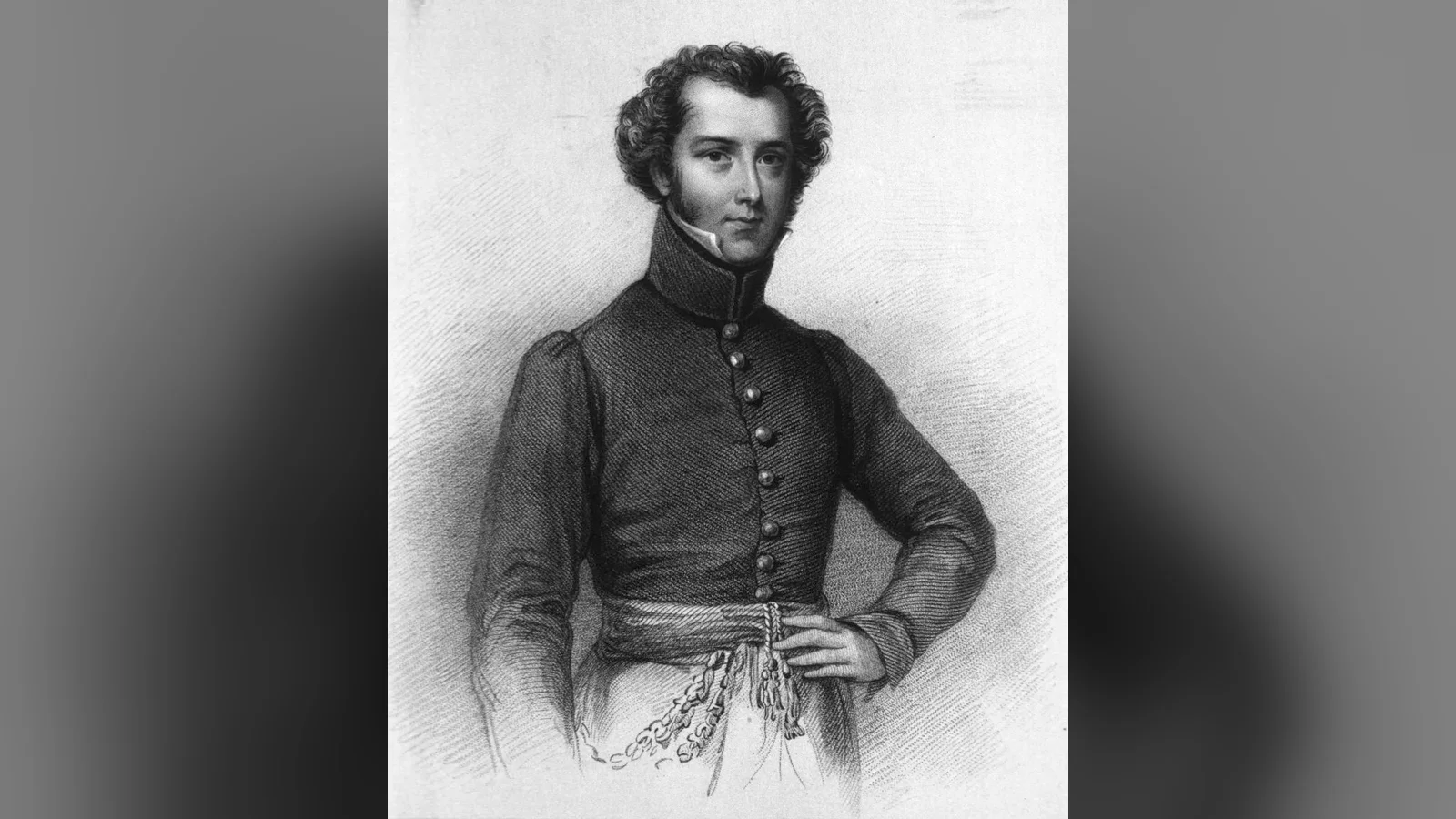

Alexander Gordon Laing (1793–1826): The Edinburgh Officer Who Looked for the Source of the Niger
Contents
In April 1822 Alexander Gordon Laing, a lieutenant in the 2nd West India Regiment, left Sierra Leone on a mission from the Governor, Sir Charles MacCarthy, to open trade with the Solima people of Falaba, more than two hundred miles inland. He walked up the Rokel River through the Temne and Kuranko countries, was received at Falaba by the Solima king, measured the source of the Rokel and, from a hilltop, was shown the place where the Niger rises. Because the spring was only about 1,600 feet above the sea, he concluded that the Niger could not be high enough to reach the Mediterranean by way of the Nile. His Travels were printed in 1825 while he was already on his way to Timbuktu, the journey on which he would be killed.
TL;DR
- established Sent by Sir Charles MacCarthy, Laing left Sierra Leone by boat up the Rokel on 16 April 1822, with goods to trade and orders to promote commerce and ask about the slave trade.
- established He travelled through the Temne and Kuranko countries, was detained by local headmen, and reached Falaba, capital of the Solima king Assana Yeera, in June 1822.
- established Ill with fever for weeks, he recovered and in September measured the source of the Rokel at 1,470 feet. From a hill he was shown the source of the Niger, which the local people called the Tembie, about 25 miles off, near Mount Loma.
- established Judging the source too low for the river to reach the Mediterranean through the Nile, he placed it at about 9° 25' N, 9° 45' W. Local custom stopped him reaching the spring itself.
- established Back in Sierra Leone by the end of 1822, he was sent to fight the Asante on the Gold Coast. He wrote the Travels in camp and in Scotland, and left London for Tripoli and Timbuktu on 5 February 1825, before the book was through the press.
Key Facts
- Born
- 1793, Edinburgh (general knowledge; not in the source)
- Rank in 1822
- Lieutenant, 2nd West India Regiment
- Mission
- Sierra Leone to Falaba and back, April to late 1822
- Sent by
- Brigadier-General Sir Charles MacCarthy, Governor of Western Africa
- Falaba
- Capital of the Solima; king Assana Yeera
- Measurements
- Rokel source 1,470 ft; Niger source estimated at about 1,600 ft, near Mount Loma
- Later service
- Commanded African auxiliaries against the Asante, 1823–24
- Left for Timbuktu
- 5 February 1825
- Died
- 1826, near Timbuktu (general knowledge; after the source)
- Related
- Great Scots 79, Mungo Park; Great Scots story, Hugh Clapperton
- Main source
- Major Alexander Gordon Laing, Travels in the Timannee, Kooranko, and Soolima Countries, in Western Africa (John Murray, London, 1825)
A Note on Claims and Evidence
Each major claim carries one of three labels. established means supported by primary records, official bodies or several independent reliable sources. shared means the core fact is sound but sources disagree on details, dates or interpretation. traditional means widely repeated but not traceable to a primary or independent source.
The Travels are Laing's own journal of 1822, written up during the Asante war and in Scotland, and seen through the press by his friend Captain Sabine after Laing had left for Tripoli. The book says Laing saw it in print only as far as page 144. It is an officer's account of a trade mission, frank about the "villany" of the headmen who held him up and confident about the benefits of British trade.
The book ends in 1822. Laing's birth, his marriage at Tripoli and his journey to Timbuktu are general knowledge and should be checked before print. The 1825 spellings are kept in quotations: Timannee for Temne, Kooranko for Kuranko, Soolima for Solima, Rokelle for Rokel.
Timeline
Born in Edinburgh (general knowledge).
Sir Charles MacCarthy returns to Sierra Leone and finds the Mandingo trade cut off by war.
Laing's instructions for a first embassy to the Kambia and the Mandingo country.
Leaves Sierra Leone up the Rokel for Falaba.
Crosses the Kuranko country to Kamato.
Reaches Falaba.
Recovering from fever, asks the king's leave to go east to the Niger.
Measures the source of the Rokel; is shown the source of the Niger.
On the way back to the coast.
War with the Asante; ordered to the Gold Coast.
Commands a native force on the Fante–Asante frontier.
MacCarthy killed; Laing sent home with despatches.
Leaves London for Tripoli, to travel with the caravan to Timbuktu.
The Travels published.
Killed after leaving Timbuktu (general knowledge).
Details
MacCarthy's mission
established When Sir Charles MacCarthy came back to Sierra Leone in November 1821, he found a war between Amara, the Almamy of the Mandingo, and a lesser chief, Sannassee, cutting off trade with the interior. He sent Laing first to the Kambia and the Mandingo camp. Laing's written instructions, dated 7 January 1822, told him to report on trade, to urge the chiefs to grow white rice, cotton and coffee for export, and to learn their views on ending the slave trade. On that journey he heard of the Solima, whose king had sent an army of more than ten thousand under his brother, Yaradee, to help Amara.
established MacCarthy then sent him to Falaba, the Solima capital, more than two hundred miles east of Freetown. Laing chose to follow the Rokel, which he hoped would become the main trade route inland. He left Sierra Leone by boat on 16 April 1822, with goods, carriers from the Wolof country and a boy, Mahomed, from Ségou.
Through the Temne and Kuranko countries
established The journey was slow. At Ma-Boom headmen held him up for days, and Laing devotes chapters to Temne and Kuranko customs, farming, spinning and weaving. He was welcomed at the Kuranko town of Kamato and went on by Komia, Semba and Konkodoogore. When the party reached Falaba, praise-singers greeted him, and one told the king to thank God for "the white man" who had made him greater than any king before him.
The source of the Niger
established After weeks of fever at Falaba, Laing asked the king's leave in July to go east to the "large river". He wanted to measure the height of the Niger's source, to test the theory that it might flow all the way to the Mediterranean through the Nile. In early September he measured the source of the Rokel at 1,470 feet above the sea. The next morning, from a hilltop, he was shown Mount Loma about twenty-five miles away and the point from which the Niger issues, at about the height on which he stood, some 1,600 feet.
established He could not reach the spring, which local tradition held was dangerous to approach. He fixed its position at about 9° 25' N and 9° 45' W, and recorded that the river was called the Tembie at its source, ran north to Kankan, and further on became the Ba, the Joliba and the river of Ségou, Djenné and Timbuktu.
The Asante war and Timbuktu
established On his return to Sierra Leone Laing was ordered at once to the Gold Coast, where war had broken out with the Asante. Through 1823 he organised and commanded a large African auxiliary force on the Fante–Asante frontier. After MacCarthy was killed early in 1824, the new commander sent Laing to London with despatches. He went to Scotland to recover his health and worked on the Travels there.
shared In London he was given the chance to go to Timbuktu with the caravan from Tripoli, a journey he had long wanted. He left London on 5 February 1825, leaving Sabine to see the book through the press. He reached Timbuktu in 1826, the first European known to have done so, and was killed soon after leaving it. (General knowledge; check before print.)
Did You Know?
- Laing's orders told him to persuade the chiefs to grow white rice for the West Indies market.
- He measured heights with a barometer, recording the readings in his footnotes.
- He was shown the source of the Niger from a hilltop but was never allowed to reach it.
- He left for Timbuktu before his first book was through the press.
- The Solima praise-singers credited him with making their king greater than his father.
FAQ
1Who was Alexander Gordon Laing?
A Scottish army officer who explored the interior of Sierra Leone in 1822 and was the first European known to reach Timbuktu, in 1826.
2Did he find the source of the Niger?
He was shown it from a hilltop, about twenty-five miles away near Mount Loma, and estimated its height and position, but was not allowed to reach it.
3What was Falaba?
The capital of the Solima kingdom, in what is now northern Sierra Leone.
4What happened to him?
After reaching Timbuktu in 1826 he was killed in the desert. The story is outside this book.
Sources and Further Reading
Primary
- Major Alexander Gordon Laing, Travels in the Timannee, Kooranko, and Soolima Countries, in Western Africa (John Murray, London, 1825). Free from Google Books and the Internet Archive. The source for this story.
Further reading (not consulted directly)
- E. W. Bovill (ed.), Missions to the Niger, vol. 1 (Hakluyt Society, 1964), with Laing's letters from the Timbuktu journey.
- Frank Kryza, The Race for Timbuktu (Ecco, 2006).
Caveats: Myths and Disputed Claims
- "Discovered the source of the Niger". He saw the source from a distance and estimated its position; he did not reach it.
- Timbuktu. His arrival there and his death are told from later evidence, not from this book.
- A partisan source. Laing writes as an agent of British trade and of MacCarthy's policy.
Finished reading? Try the Fact Machine: three reels, one surprising Scottish connection →
A Great Scots story