Anne Redpath (1895–1965)
Contents
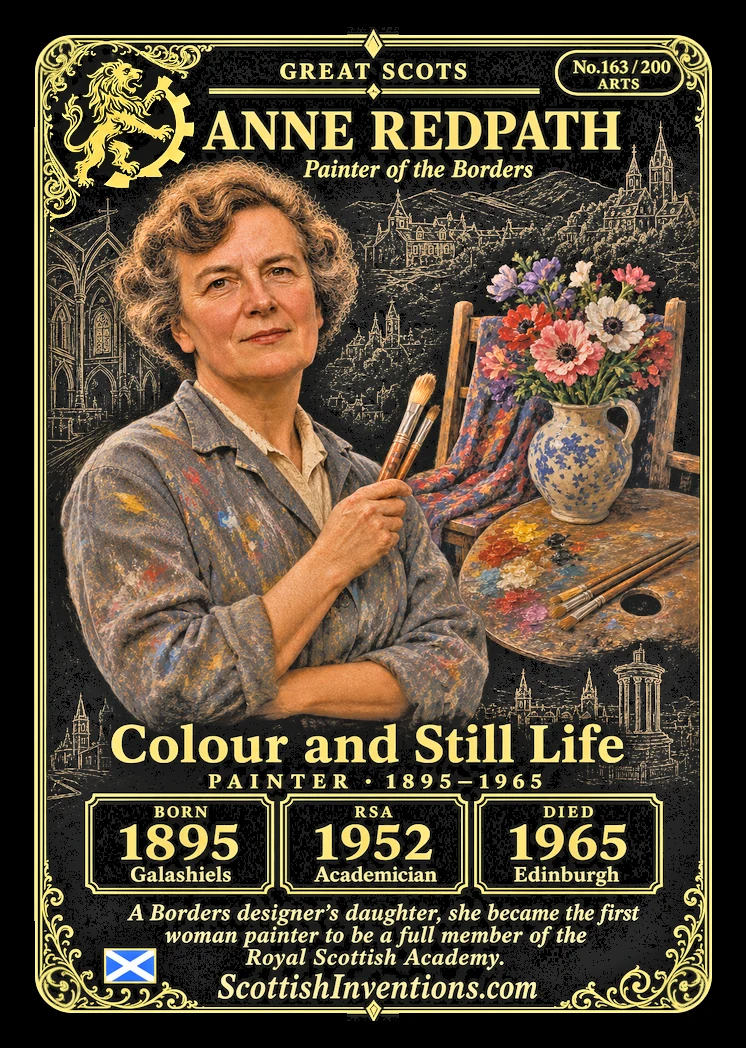
Anne Redpath was a Borders weaver's-designer's daughter who became one of the most admired Scottish painters of the twentieth century. Her bold still lifes and blazing scenes of Spain, Portugal and the Canaries made her a central figure in post-war Scottish art.
TL;DR
- established Born in Galashiels in 1895 and raised in Hawick, she trained at Edinburgh College of Art and won a travelling scholarship to France and Italy in 1919.
- established After her marriage she lived in France for fourteen years and largely stopped painting while raising three sons; she relaunched her career after returning to Hawick in 1934.
- established She was elected an associate of the Royal Scottish Academy in 1947 and a full academician in 1952, and was the first woman painter to become a full RSA academician.
- established Her still lifes, such as The Indian Rug (1940s, Scottish National Gallery of Modern Art), and her later travel paintings are known for flattened patterns, strong colour and energetic brushwork.
- traditional She liked to compare her use of a single spot of colour to the way her father, a tweed designer, worked a single bright thread into a cloth.
Key Facts
- Born
- 29 March 1895, Galashiels
- Died
- 7 January 1965, Edinburgh (aged 69)
- Parents
- Thomas Brown Redpath, textile designer; Agnes Milne
- Trained
- Edinburgh College of Art; Moray House teacher training
- Married
- James Beattie Michie, architect, in 1920
- Children
- Alastair (1921), Lindsay (1924), David (1928)
- Honours
- ARSA 1947, RSA 1952, OBE 1955, ARA 1960
- Known for
- Still lifes, Spanish and Portuguese landscapes, church interiors
A Note on Claims and Evidence
Each major claim carries one of three labels. established means supported by primary records, official bodies or several independent reliable sources. shared means the core fact is sound but sources disagree on details, dates or interpretation. traditional means widely repeated but not traceable to a primary or independent source.
The main facts of her life are well documented in exhibition catalogues and in The New Biographical Dictionary of Scottish Women. Her own remarks about her father's tweeds come from interviews and are repeated in many catalogues; they are labelled traditional here because the exact wording varies. The claim that she was the first woman painter elected a full RSA academician is established; the sculptor Phyllis Bone had been the first woman academician of any kind, in 1944.
Timeline
Born in Galashiels on 29 March.
Family moves to Hawick.
Leaves Hawick High School, encouraged by her art master John Gray, and enrols at Edinburgh College of Art.
Qualifies as a primary teacher at Moray House, a condition her parents set for art school.
Wins a travelling scholarship; visits Bruges, Paris, Florence and Siena.
Marries James Michie; they move to St Omer in northern France.
Returns to Hawick after her husband's employer goes bankrupt; resumes her career.
President of the Scottish Society of Women Artists.
First solo exhibition, in Edinburgh; elected ARSA.
Moves to Edinburgh, later settling at 7 London Street.
Painting trips to Spain, Brittany, Corsica, the Canary Islands and Portugal.
Elected a full member of the Royal Scottish Academy.
Appointed OBE.
Elected an associate of the Royal Academy in London.
Dies in Edinburgh on 7 January.
Details
A Borders upbringing
established Anne Redpath was born in Galashiels, the daughter of Thomas Brown Redpath, a designer of tweed, and Agnes Milne. The family moved to Hawick in 1901. At Hawick High School the art master, John Gray, encouraged her talent. Her parents agreed to let her study at Edinburgh College of Art on condition that she also trained as a teacher at Moray House, and she qualified in 1917. traditional She later said that her father's work shaped her eye: just as he would set one bright thread into a sober tweed, she would put one spot of red or blue into a painting.
Training and Italy
established At art college she won her diploma in 1918, then a bursary, a year of postgraduate study and, in 1919, a travelling scholarship. She went through Belgium to Paris and on to Florence and Siena, where she discovered Italian painting of the fifteenth century. The flat, decorative surfaces of early Sienese painting stayed with her.
Fourteen years in France
established In 1920 she married James Beattie Michie, an architect working for the Imperial War Graves Commission, and they settled at St Omer in northern France, later moving south. Their three sons were born there. She continued to paint and exhibit locally, but most of her energy went into the family. Her biographers note the long pause in her career, something rarely asked of male artists of her generation.
Starting again
established The family returned to Hawick in 1934 after her husband's employer went bankrupt. He moved to London to look for work, and the couple drifted apart. Redpath took up painting again, concentrating on landscapes and still life, and resumed showing at the Royal Scottish Academy in 1935. She was president of the Scottish Society of Women Artists from 1944 to 1947, and held her first solo exhibition in 1947 in Edinburgh. In the late 1940s she belonged to the Hanover Street Group, an informal circle of artists who met to share ideas.
Still life and colour
established Her still lifes gather objects collected over a lifetime: jugs, rugs, chairs, flowers, fruit. They tilt the tabletop up towards the viewer so it reads almost as a flat pattern. The Indian Rug, in the Scottish National Gallery of Modern Art, is a famous example, with a pair of red slippers set against a richly patterned rug. shared Writers have linked her style to Bonnard and Matisse, to Islamic miniatures and to the patterned cloth of her Borders childhood.
The travelling years
established After two trips to Skye in the 1940s, Redpath travelled widely in the 1950s: Spain in 1951, Brittany in 1953, Corsica in 1954, the Canary Islands in 1959 and Portugal in 1961. Harsh light, poor villages, whitewashed walls and, above all, the gold altarpieces of Portuguese churches changed her work. Her early pale palette gave way to strong colours, heavy paint and rapid brushwork. Her late church interiors glow with encrusted gold and red.
A central figure
established From the 1950s her Edinburgh home at 7 London Street, now marked with a plaque, was a meeting place for artists. She was elected ARSA in 1947 and a full academician in 1952, the first woman painter to be so honoured. She had five solo shows at the Scottish Gallery between 1950 and 1963, and won recognition in England with an OBE in 1955 and election as an associate of the Royal Academy in 1960. Her son David Michie also became a well-known painter.
Did You Know?
- She had to qualify as a primary teacher before her parents would let her study art.
- Her father designed tweeds in the Borders textile trade.
- She hardly painted for fourteen years while raising her sons in France.
- She was the first woman painter elected a full member of the Royal Scottish Academy.
- A plaque marks her home at 7 London Street, Edinburgh.
- Portuguese gold altarpieces inspired some of her most famous late paintings.
- Her son David Michie became a painter and art teacher.
FAQ
1Who was Anne Redpath?
A Scottish painter (1895–1965) known for richly coloured still lifes, landscapes and church interiors.
2Where was she born?
In Galashiels, in the Scottish Borders; she grew up in Hawick.
3What is her most famous painting?
The Indian Rug (1940s), in the Scottish National Gallery of Modern Art, is among the best known.
4Why did she stop painting for a while?
She lived in France from 1920 to 1934, and most of her time went into raising her three sons.
5Was she the first woman in the Royal Scottish Academy?
She was the first woman painter to become a full academician, in 1952. The sculptor Phyllis Bone was the first woman academician, in 1944.
6Which artists influenced her?
Writers often mention early Italian painting, Bonnard and Matisse.
7Where did she travel to paint?
Skye, Spain, Brittany, Corsica, the Canary Islands and Portugal, among other places.
8Did her father influence her?
She often said his work as a tweed designer shaped her sense of colour.
9Where can I see her work?
In the National Galleries of Scotland, the Royal Scottish Academy and many public collections.
10Was she part of a group?
In the late 1940s she belonged to the Hanover Street Group in Edinburgh.
Sources and Further Reading
Primary/Institutional
- National Galleries of Scotland: collection records for Anne Redpath, including The Indian Rug.
- Royal Scottish Academy collections and exhibition records.
Scholarly/Critical
- Elizabeth Ewan, Rose Pipes et al. (eds), The New Biographical Dictionary of Scottish Women (Edinburgh University Press, 2018), entry "Redpath, Anne".
- Patrick Bourne, Anne Redpath 1895–1965 (1989).
- Philip Long, Anne Redpath 1895–1965 (exhibition catalogue, National Galleries of Scotland, 1996).
- George Bruce, Anne Redpath (1974).
- Duncan Macmillan, Scottish Art 1460–2000 (2000).
Caveats: Myths and Disputed Claims
- Myth: she was the first woman in the RSA. She was the first woman painter to become a full academician; Phyllis Bone, a sculptor, came first.
- Caution: the tweed quotation. Her remark about her father's tweeds is widely repeated, but the wording varies between sources.
- Caution: dating. Many of her works are undated or dated only by decade.
Finished reading? Try the Fact Machine: three reels, one surprising Scottish connection →
Card 163 · Great Scots