Benny Lynch (1913–1946): The Gorbals Flyweight Who Conquered the World
Contents
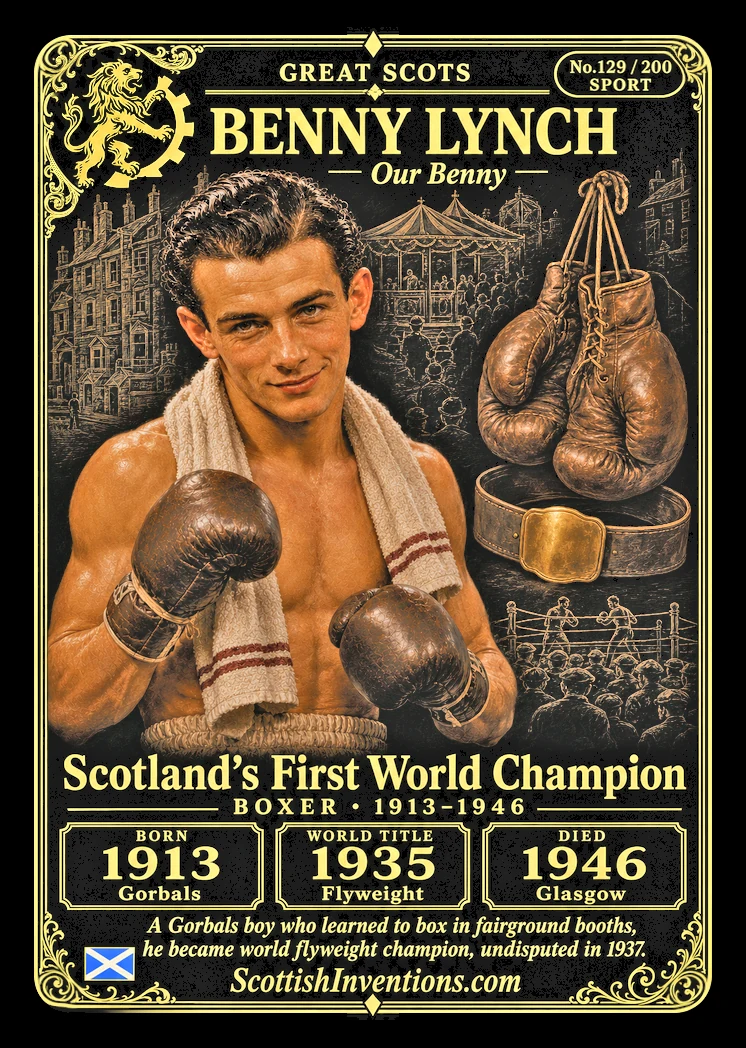
Benny Lynch was the Gorbals boy who became world flyweight champion. "Our Benny" learned to fight on the street corners of Florence Street and in the fairground booths, won the world title in Manchester in 1935, made himself undisputed champion in 1937 and drew 40,000 people to Shawfield Park to watch him beat Peter Kane. A year later he lost the title on the scales, and drink finished his career at 25 and his life at 33. This account draws on John Burrowes's biography Benny: The Life and Times of a Fighting Legend (1982), written with the help of his widow, his manager's son and many of the boxers he fought.
TL;DR
- established Born in a single-room house at 17 Florence Street in the Gorbals on 2 April 1913, the son of a railway surfaceman whose family came from Inishowen in Donegal, he learned to box in the travelling booths of the west of Scotland.
- established Managed by the former boxer and bookmaker Sammy Wilson, he won the Scottish flyweight title in 1934, and on 9 September 1935 in Manchester he beat Jackie Brown for the British, European and world titles.
- established In January 1937 he outpointed Small Montana, the American-recognised champion, at Wembley to become undisputed world flyweight champion, and in October he knocked out Peter Kane before 40,000 at Shawfield Park, Glasgow.
- established In June 1938 he weighed in six and a half pounds over the limit for a defence against Jackie Jurich and forfeited the title, although he won the fight. His last fight was in October 1938.
- established Ruined by alcoholism, he died in Glasgow on 6 August 1946, aged 33.
- shared He is usually called Scotland's first world boxing champion, though the National Records of Scotland give that honour to Johnny Hill of Edinburgh. He is widely ranked among the greatest flyweights of all time.
Key Facts
- Born
- 2 April 1913, 17 Florence Street, Gorbals, Glasgow
- Died
- 6 August 1946, Southern General Hospital, Glasgow (aged 33)
- Parents
- John Lynch, railway surfaceman; Lizzie Hunter
- Family roots
- Carnamoyle, Inishowen, County Donegal
- Nickname
- "Our Benny"
- Weight
- Flyweight (8 stone)
- Height
- 5 ft 4 in
- Managers
- Sammy Wilson; later George Dingley
- World title
- Won 9 September 1935; undisputed from 19 January 1937; forfeited 29 June 1938
- Married
- Anne McGuckian, 8 March 1935; two sons
- Honours
- International Boxing Hall of Fame (1998); Scottish Sports Hall of Fame
- Buried
- St Kentigern's Cemetery, Lambhill, Glasgow
A Note on Claims and Evidence
Each major claim carries one of three labels. established means supported by primary records, official bodies or several independent reliable sources. shared means the core fact is sound but sources disagree on details, dates or interpretation. traditional means widely repeated but not traceable to a primary or independent source.
His birth, marriage and death are recorded in the statutory registers held by the National Records of Scotland. Burrowes interviewed his widow, the son of his first manager and many of the boxers of the 1930s, and he says plainly that he changed a few names and that dialogue not recounted to him is reconstructed from the facts. His scenes are therefore used here for events, not for exact words. Fight records differ between sources because many early booth and small-hall bouts went unrecorded: Burrowes counts 104 listed fights, other records 119. Stories of his generosity and of the hangers-on who exploited him come from family and friends and are labelled traditional.
Timeline
Born in Florence Street on 2 April.
His mother leaves the family; he and his brother James are brought up partly by relatives and neighbours.
His brother James dies of meningitis; Benny decides to box for money.
Begins boxing professionally under Sammy Wilson.
Beats Jim Campbell for the Scottish flyweight title.
Marries Anne McGuckian at Gretna.
Draws with the world champion Jackie Brown in a non-title fight in Glasgow.
Marries Anne again, in church, at St Margaret's, Kinning Park.
Beats Brown in Manchester for the British, European and world titles.
Outpoints Small Montana at Wembley to become undisputed world champion.
Knocks out Peter Kane in the 13th round at Shawfield Park, Glasgow.
Draws with Kane at Anfield, Liverpool.
Fails to make the weight against Jackie Jurich at Love Street, Paisley; forfeits the title but wins the fight.
Last fight, a knockout defeat by Aurel Toma in London.
The British Boxing Board of Control withholds his licence.
Dies in Glasgow on 6 August.
Bill Bryden's play Benny Lynch staged.
Inducted into the International Boxing Hall of Fame.
Details
Florence Street
established Benjamin John Lynch was born on 2 April 1913 in a single-room house at 17 Florence Street, in the Gorbals, then Britain's most congested slum. His grandfather, James Lynch, had left a cottage called The Rocks of Meenamault, in the townland of Carnamoyle in Inishowen, Donegal, to find work in Scotland. His father, John Lynch, was a railway surfaceman and a part-time soldier in the Highland Light Infantry, and his mother was Lizzie Hunter. shared Burrowes describes closes shared by sixteen families, the Sanitary Department's metal "tickets" on the doors limiting how many could sleep there, and streets so full of children that the whole quarter-mile of Florence Street seemed to move.
established His mother left the family when he was small, and he and his elder brother James were brought up for a time by an aunt and uncle and then by "Maw" Kelter, a neighbour with fourteen children of her own. James, an apprentice boilermaker at Babcock and Wilcox in Renfrew and a boxer too, died of meningitis after a fall at work. traditional It was Benny's first experience of death, and afterwards he told his friends they could keep amateur boxing: if he was going to fight, it would be for money.
The booths and the fifty-bob men
established Professional boxing was the big sport of interwar Glasgow, with hundreds of fighters and halls such as the Adelphi at the foot of Florence Street. shared Burrowes's preface explains the economics: ten rounds could earn a man fifty shillings, an average week's wage. In summer the booths at the fairs paid a steady wage for taking on all comers, and some fighters boxed in two booths at the same fair under two names. established Lynch went round the "gaffs" with his friend Andy Smith, joining the booth run by the former Empire middleweight champion Len Johnson at Sunderland. The booth language of "flatties" for the crowd and "gee fights" for staged bouts was part of his education.
Sammy Wilson
established His first manager, Sammy Wilson, was as Gorbals as the iron works. A former riveter and booth boxer who had become a bookmaker in Florence Street, he took Lynch on as a teenager and steered him through the small halls, fighting sometimes once a week for small print on the bill. established By 1934 he was good enough to spar with the Scottish flyweight champion, Jim Campbell, and that year he beat Campbell for the title. shared Wilson planned every step. Before the non-title fight with the world champion Jackie Brown in Glasgow on 4 March 1935 he told Lynch to hold back and settle for a draw, so that Brown would think he could beat him and agree to a title fight. It ended in a draw.
Anne
established Anne McGuckian was the eldest of seven children of a Kinning Park docker, a machinist in a rubber-coat factory. In February 1935 she and Lynch eloped to Gretna and married over the anvil, and her furious parents sent them home to their separate families until they were married properly. They married again on 8 March 1935 at St Margaret's Roman Catholic Church, Kinning Park, four days after the Brown fight. They had two sons, John and Bobby.
Manchester, 1935
established On 9 September 1935 Lynch met Brown for the British, European and world flyweight titles at Belle Vue, Manchester. Some five hundred Scots travelled south with him, more than had ever followed a fighter to an English promotion. Pipers led him to the ring, where an old friend from the booth days put a woollen tammy on his head. Brown went down eight times, and after four minutes and forty-two seconds, in the second round, he signalled that he could not go on. established The next day twenty thousand people packed the concourse of Glasgow Central Station to welcome him home, and mounted police took hours to clear the streets. shared Burrowes notes that Glasgow Corporation offered no civic reception; the Daily Record hastily organised a dinner instead.
Undisputed
established In the 1930s boxing's world titles were split. American authorities recognised the Filipino fighter Small Montana as champion. After Lynch split from Sammy Wilson, George Dingley became his manager. Lynch went to a training camp at Taplow, in Buckinghamshire, more than ten stone three weeks before the fight, and still made the weight. On 19 January 1937 he outpointed Montana over fifteen rounds at Wembley to become undisputed world flyweight champion. shared Burrowes dates his serious drinking from this period: life became a seesaw between hard training and hard drinking, with weight lost by starvation and purges.
Shawfield
established On 13 October 1937 he defended his titles against the young English challenger Peter Kane at Shawfield Park, Glasgow. The ground was packed with 40,000 people, and thousands more could not get in. Lynch knocked Kane out in the thirteenth round. shared Tommy Farr called it the best fight at any weight he had ever seen, and the former champion Elky Clark rated it the greatest flyweight match in boxing history. established Belfast's Jim Warnock was the one fighter he never solved, beating him twice, including over fifteen rounds in June 1937.
Losing on the scales
established By 1938 Lynch was drinking heavily and struggling to make the 8-stone limit. After a draw with Kane at Anfield in March, fought at bantamweight, he was due to defend his world title against the Californian Jackie Jurich at Love Street, Paisley, the St Mirren ground, on 29 June 1938. He weighed in at 8 stone 6 pounds 8 ounces, six and a half pounds over, and the Board told him he was no longer champion. He also forfeited his £500 deposit, which went to Jurich. The fight went ahead as a non-title match before 14,000 people, half the crowd he would once have drawn, and Lynch knocked Jurich out in the twelfth round. shared Burrowes argues that others shared the blame: managers who grew richer as he grew poorer, a trainer who fixed the scales in practice, and promoters who kept putting him in the ring.
established The Boxing Board ordered him not to fight below bantamweight. He lost on points to Kayo Morgan in September 1938, a fight for which the promoter could not pay him, and six days later, on 3 October 1938, he was knocked out by the Romanian Aurel Toma in London. It was the only time he was knocked out, and his last official fight. He was 25. On 26 August 1939 the Board withheld his licence because he could not pass its fitness test.
The last years
established In July 1939 he toured the north of Scotland giving exhibition bouts, hoping for a comeback. Treatment at a clinic for alcoholics in Chislehurst, Kent, failed. His old schoolmate and fellow boxer Johnny McGrory persuaded him to try the Cistercian monastery of Mount Melleray in County Waterford, where other drinkers had found help. He stayed for some time, but on the drive north from the monastery he was drinking again in the first town. His marriage broke down, and he went back to live with his mother.
established On the evening of 6 August 1946 he was taken to the Southern General Hospital in Glasgow with pneumonia, and he died there a few hours later, aged 33. Large crowds attended his funeral, and he is buried at St Kentigern's Cemetery, Lambhill. established Anne remarried and moved to Bramalea, Ontario; their elder son, John, died in his early thirties.
Legend
established Lynch has become one of Glasgow's great folk heroes. His story was told on stage in Bill Bryden's play Benny Lynch (1974) and Peter Arnott's The Boxer Benny Lynch (1984), which The Edinburgh History of Scottish Literature describes as offering a less macho view of the world than Bryden's. established In 1938 he was paid £3 to endorse Barr's Iron Brew as a restorative for athletes. shared Boxing historians regularly rank him among the five greatest flyweights ever, and Burrowes ends with the verdict that he should be remembered as a great fighter in the ring, not as a loser in life.
Did You Know?
- His family came from Inishowen in Donegal.
- His brother James's death from meningitis made him decide to box for money.
- He married his wife twice: over the anvil at Gretna, and three weeks later in church.
- His manager told him to hold back against the world champion so as to get a title fight.
- Jackie Brown went down eight times in under five minutes.
- Twenty thousand people met his train at Glasgow Central.
- He lost his title on the scales, not in the ring, by six and a half pounds.
- He was paid £3 to endorse Iron Brew in 1938.
FAQ
1Who was Benny Lynch?
A Glasgow boxer (1913–1946) who became world flyweight champion in 1935.
2When did he win the world title?
On 9 September 1935, beating Jackie Brown in Manchester.
3Was he undisputed champion?
Yes, from January 1937, after beating Small Montana at Wembley.
4Was he Scotland's first world champion?
He is usually described that way, but the National Records of Scotland give the honour to Johnny Hill of Edinburgh, who held a version of the flyweight title in 1928–29.
5How did he lose his title?
He weighed in six and a half pounds over the flyweight limit for a defence in June 1938.
6How did he die?
Of pneumonia, brought on by malnutrition and alcoholism, in August 1946.
7Where was he from?
Florence Street in the Gorbals, Glasgow.
8Is he in the Hall of Fame?
Yes, the International Boxing Hall of Fame (1998) and the Scottish Sports Hall of Fame.
9How many fights did he have?
Burrowes lists 104; other records give 119. Many early fights went unrecorded.
10Where is he buried?
At St Kentigern's Cemetery, Lambhill, Glasgow.
Sources and Further Reading
Primary/Institutional
- National Records of Scotland, "Benny Lynch (1913–1946)", Hall of Fame: birth (1913), marriage (1935) and death (1946) entries.
- Scottish Sports Hall of Fame, inductee entry.
Scholarly/Critical
- John Burrowes, Benny: The Life and Times of a Fighting Legend (Mainstream, 1982; Fontana, 1984).
- The Edinburgh History of Scottish Literature, vol. 3: Modern Transformations: New Identities (from 1918) (2007), chapters on drama, for the Bryden and Arnott plays.
- Carol Foreman, Made in Scotland: Household Names That Began in Scotland, chapter on Barr's Iron Brew.
Caveats: Myths and Disputed Claims
- Disputed: Scotland's first world champion. Lynch's gravestone and most accounts say so, but the National Records of Scotland accept Johnny Hill of Edinburgh (1905–1929), who held a version of the world flyweight title before his early death.
- Caution: fight totals. His record varies between 104 (Burrowes) and 119 listed fights.
- Caution: dates. Burrowes gives his death as 8 August 1946, and some sources give 12 April for his birth; the statutory records give 2 April 1913 and 6 August 1946.
- Disputed: the Toma fight. Burrowes's record has him knocked out in the fifth round; other records give the third.
- Disputed: the Manchester crowd. Burrowes says about five hundred Scots travelled south; later accounts often say thousands.
- Traditional: hangers-on. Accounts of how others exploited his money are anecdotal.
Finished reading? Try the Fact Machine: three reels, one surprising Scottish connection →
Card 129 · Great Scots