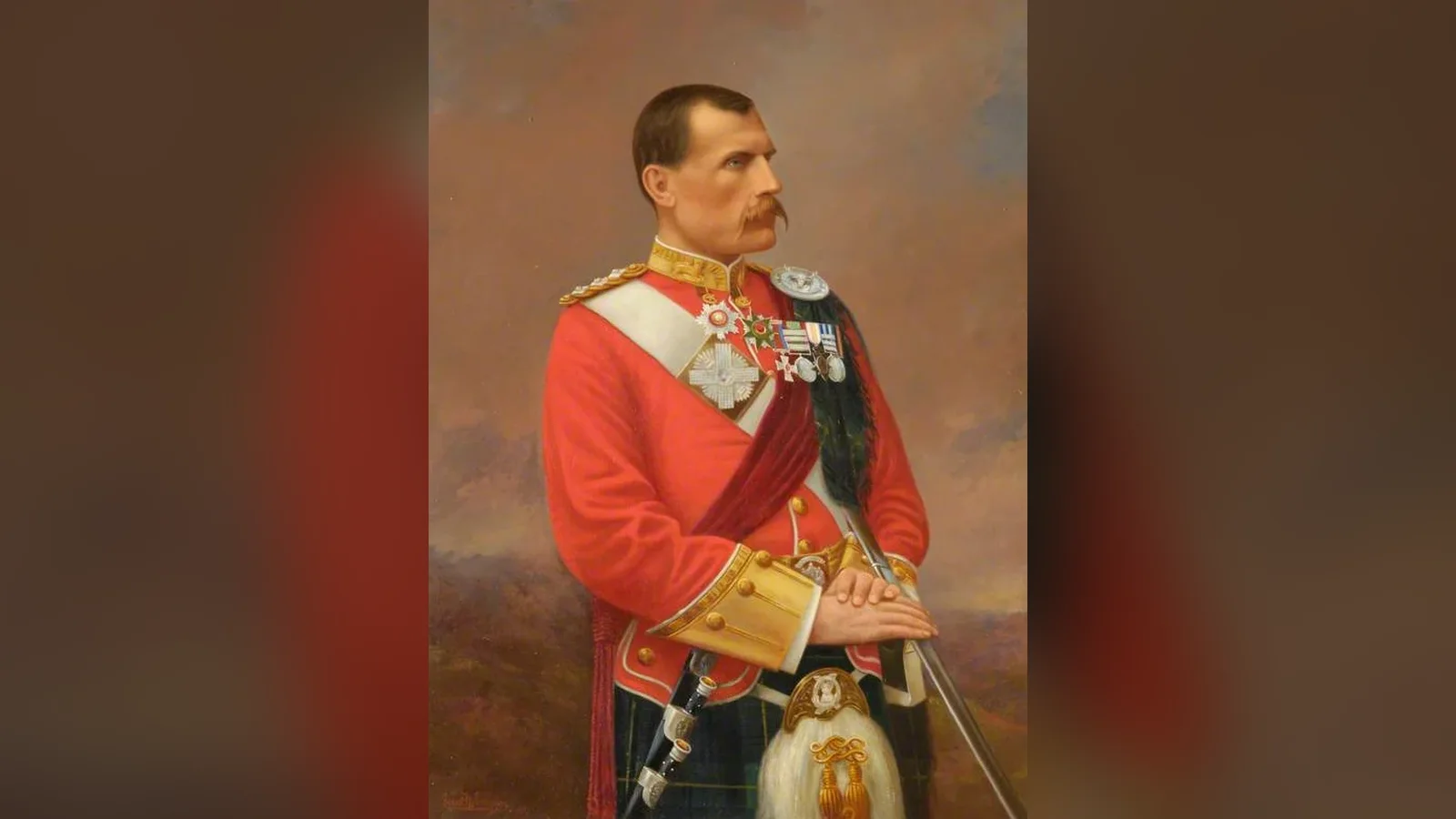

Sir Hector MacDonald (1853–1903): "Fighting Mac", the Crofter's Son Who Became a General
Contents
Hector MacDonald was a crofter's son from the Black Isle who enlisted as a private in 1870 and rose to major-general. He was commissioned from the ranks in Afghanistan, fought with the Gordon Highlanders at Majuba, and at Omdurman in 1898 his Sudanese brigade turned to meet the last great charge of the Khalifa's army. Scotland made him a national hero. In 1903, facing accusations in Ceylon, he shot himself in a Paris hotel, and he was buried at dawn in Edinburgh. A later rumour claimed he had faked his death and become the German Field Marshal von Mackensen. This account follows Trevor Royle's biography Death Before Dishonour: The True Story of Fighting Mac (1982).
TL;DR
- established Born 4 March 1853 at Rootfield, Mulbuie, on the Black Isle; he later gave his birth as 1852 so he could enlist in 1870.
- established A draper's apprentice in Dingwall and Inverness, he joined the 92nd (Gordon) Highlanders and was commissioned by General Roberts during the Afghan war of 1879–80.
- established At Majuba in 1881 he fought until his ammunition ran out and was taken prisoner; the Boers returned his sword.
- established At Omdurman on 2 September 1898 he commanded the 1st Sudanese Brigade, which bore the Khalifa's final attack.
- established He led the Highland Brigade in South Africa after Magersfontein and was wounded at Paardeberg.
- established Facing charges in Ceylon, he killed himself in the Hotel Regina, Paris, on 25 March 1903.
- shared Royle shows the Mackensen story to be a myth.
Key Facts
- Born
- 4 March 1853, Rootfield, Mulbuie, Black Isle
- Died
- 25 March 1903, Hotel Regina, Paris
- Buried
- Dean Cemetery, Edinburgh, 30 March 1903
- Enlisted
- 1870, as a private
- Regiment
- 92nd (Gordon) Highlanders
- Commissioned
- From the ranks, Afghanistan, 1880
- Married
- Christina Duncan, by private declaration, Edinburgh, 1884
- Son
- Hector Duncan MacDonald, born 1887
- Famous action
- Omdurman, 2 September 1898
- Rank
- Major-General; KCB, DSO
- Nickname
- "Fighting Mac"
A Note on Claims and Evidence
Each major claim carries one of three labels. established means supported by primary records, official bodies or several independent reliable sources. shared means the core fact is sound but sources disagree on details, dates or interpretation. traditional means widely repeated but not traceable to a primary or independent source.
Royle wrote with access to MacDonald's papers kept by his family at Rootfield and to the scrapbook of Miss Munro of Foulis Castle. MacDonald's army career is well documented; his private life is not. His marriage was kept secret for nearly twenty years, and the Ceylon charges were never tested in court. The stories that grew around him, from the bare-fisted fight at Majuba to the Mackensen legend, are labelled traditional where Royle cannot confirm them.
Timeline
Born at Rootfield, Mulbuie.
Apprenticed to drapers in Dingwall, then at the Royal Clan and Tartan Warehouse in Inverness; joins the Inverness Highland Rifle Volunteers.
Enlists in the army.
Afghan war; distinguishes himself at Charasiab.
Commissioned from colour-sergeant by Roberts.
Captured at Majuba.
Marries Christina Duncan by private declaration in Murrayfield.
Son Hector born.
Serves with the Egyptian Army.
Omdurman.
Given the freedom of Dingwall.
Takes command of the Highland Brigade in South Africa.
Wounded at Paardeberg.
Lands in Ceylon as commander of the troops.
Dies in Paris.
Buried at dawn in the Dean Cemetery.
Details
The crofter's son
established MacDonald was born on 4 March 1853 at Rootfield, a croft his father William rented from the Allangrange estate in the parish of Ferintosh and Urquhart, on the Black Isle. He was the seventh son. Journalists later liked to say that Mulbuie meant "isle of Mars"; Royle dismisses this. established He was apprenticed to a draper in Dingwall, grew bored with selling serge, and was sent to the Royal Clan and Tartan Warehouse in Inverness, which shared its Gothic building with the YMCA. There he joined the Inverness Highland Rifle Volunteers. In 1870 he enlisted, breaking his indenture. To avoid waiting a year he told the recruiting sergeant he was older than he was, and his birth date was later often given as 13 April 1852.
From the ranks
established He served with the 92nd (Gordon) Highlanders in India and rose to colour-sergeant. In the Afghan war of 1879–80 he distinguished himself in the fighting at Charasiab, south of Kabul, and General Frederick Roberts gave him a commission in the regiment, an unusual promotion in the Victorian army. shared Royle argues that Roberts knew what he was doing: the Gordons were a regiment where a promoted ranker could be accepted.
Majuba
established On 27 February 1881, in the First Boer War, the Gordons were among the troops driven off Majuba Hill. MacDonald held a spur until only he and a lance-corporal were left, threw rocks when the ammunition ran out, and was persuaded to surrender. His sword, a gift from his fellow soldiers, was taken from him. traditional The Boer general Piet Joubert is said to have returned it, remarking that a brave man and his sword should not be parted, and MacDonald was said to have fought with his bare fists before he was taken.
A secret marriage
established In Edinburgh in 1883 he met Christina Duncan, a schoolmaster's daughter of fifteen. The Gordons discouraged marriage below the rank of captain, and in spring 1884 the couple married in the old Scots way, by private declaration, at her family's home in Murrayfield. Their son Hector was born in 1887. They lived apart, and the marriage was kept quiet until after his death.
Omdurman
established He spent the next decade with the Egyptian Army, training Sudanese troops. At Omdurman on 2 September 1898, Kitchener's army was advancing on the city when the Khalifa's reserve attacked its exposed flank. MacDonald's 1st Sudanese Brigade was alone in its path. He wheeled his battalions to face the new attack under fire and held it until help arrived. shared The war correspondents, and many soldiers, called him the true hero of the battle.
Scotia's darling
established He came home a national celebrity. In May 1899 London Scots gave him a Highland dinner at the Hotel Cecil, and on 11 May Dingwall gave him the freedom of the burgh, with five thousand people in the streets. shared Many in Scotland felt the honours were thin for so much service, and that a crofter's son was being kept in his place.
South Africa
established After the disaster at Magersfontein in December 1899, he was sent to take over the shattered Highland Brigade. He led it at Paardeberg in February 1900, where he was wounded. shared Royle finds in his letters afterwards a new sense of grievance and suspicion.
Ceylon and Paris
established He landed in Ceylon on 25 March 1902 to command the troops. Early in 1903 allegations were made about his conduct with schoolboys, and he returned to London. Lord Roberts, now commander-in-chief, told him he could not stay in the army while such charges went unanswered, and a court martial was ordered in Ceylon. shared Royle stresses that the exact charges are unknown: the Colonial Office papers say little, and the Judge-Advocate's records for Ceylon for 1903 are missing. On his way back MacDonald stopped at the Hotel Regina in Paris. On the morning of 25 March 1903 he saw the charges reported on the front page of the European edition of the New York Herald, went to his room and shot himself. established His wife arranged a private burial at dawn on 30 March in the Dean Cemetery, Edinburgh. The secrecy angered many Scots, who felt their hero had been hidden away.
The Mackensen myth
shared For decades a story circulated that MacDonald had faked his death and become August von Mackensen, the German cavalry general who rose to field marshal in the First World War and died in 1945. Edgar Lustgarten revived it in the Sunday Express in 1962. Royle traces it and dismisses it as a myth people wanted to believe: Mackensen was a much-photographed figure, and no surgeon could have turned Fighting Mac's face into his.
Memory
established His schoolfellows put up a round tower to him at Mulbuie, beside the road south to Inverness, and a larger memorial tower stands above Dingwall. Royle points out the odd parallels with another Black Isle man, Hugh Miller: both rose from humble beginnings, both died by their own hand, and both were buried in Edinburgh.
Did You Know?
- He lied about his age to join the army a year early.
- He began working life in a tartan warehouse in Inverness.
- He was commissioned from the ranks by General Roberts.
- His sword was returned to him by the Boers after Majuba, by tradition.
- His marriage was a secret Scots marriage by declaration.
- He was buried at six in the morning.
- A myth claimed he became a German field marshal.
FAQ
1Who was Fighting Mac?
Sir Hector MacDonald, a crofter's son from the Black Isle who rose from private to major-general.
2What did he do at Omdurman?
He turned his Sudanese brigade to meet the Khalifa's final attack and held it.
3How did he die?
He shot himself in a Paris hotel on 25 March 1903 after charges against him were made public.
4Was he really von Mackensen?
No. The story is a myth.
5Where is he buried?
In the Dean Cemetery, Edinburgh.
Sources and Further Reading
Biography
- Trevor Royle, Death Before Dishonour: The True Story of Fighting Mac (Mainstream, 1982; St Martin's Press, 1982).
- John Montgomery, Toll for the Brave: The Tragedy of Major-General Sir Hector Macdonald (1963), as cited by Royle.
Caveats: Myths and Disputed Claims
- Myth: he became Field Marshal von Mackensen. Disproved.
- Myth: Mulbuie means "isle of Mars". A journalists' invention.
- Traditional: fighting with his fists at Majuba; Joubert returning his sword. Long told; not fully documented.
- Disputed: the Ceylon charges. Never tried; MacDonald protested his innocence.
Finished reading? Try the Fact Machine: three reels, one surprising Scottish connection →
A Great Scots story