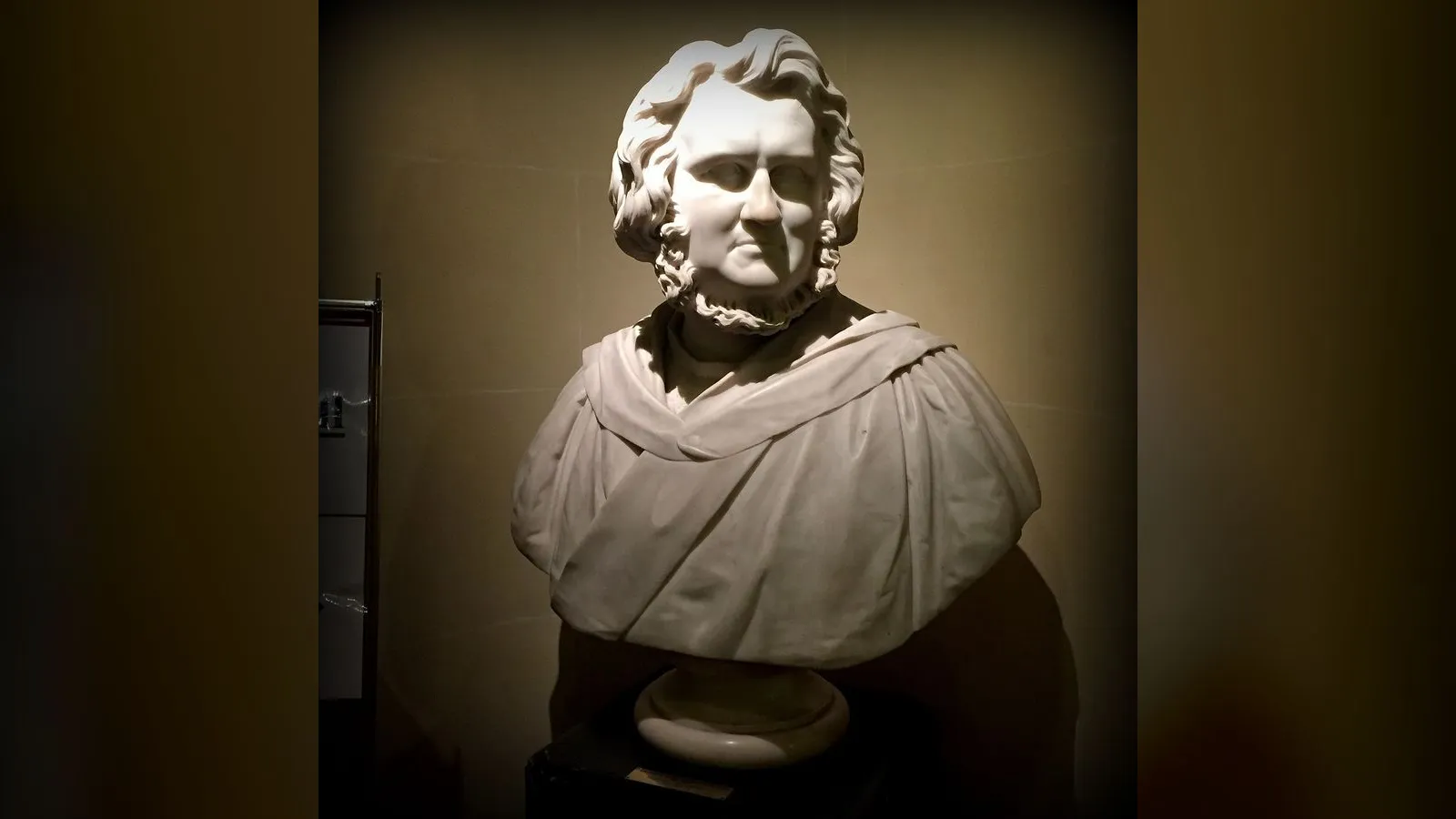

Sir James Young Simpson (1811–1870): Scotland's Pioneer of Chloroform Anaesthesia
Contents
Sir James Young Simpson, a Bathgate baker's son who became Edinburgh's Professor of Midwifery at 28, made chloroform and pain-free childbirth standard practice. This card tests what he actually did first, how much of the famous dinner-table story and the "religious revolt" is true, how far Queen Victoria's chloroform belongs to him rather than John Snow, and whether chloroform was the right choice at all.
TL;DR
- established Simpson did not invent anaesthesia, but on 4 November 1847 he was the first physician to demonstrate chloroform's anaesthetic effect on humans, and the relentless champion who made it, and pain-free childbirth, standard practice.
- established His advocacy triumphed over medical, moral and religious objections and was sealed by Queen Victoria's use of "that blessed Chloroform" in 1853 and 1857, administered by Dr John Snow, not Simpson.
- shared He was made a baronet in 1866, described variously as the first doctor knighted for services to medicine and the first doctor in Scotland so honoured.
- established In hindsight Simpson backed the more dangerous drug: chloroform causes fatal cardiac arrhythmias and liver toxicity and was abandoned in the 20th century in favour of ether and safer agents.
- shared The "dinner-table" and "religious revolt" stories are partly mythologised; historians still dispute how real the religious opposition was.
Key Facts
- Born
- 7 June 1811, Bathgate, Linlithgowshire (now West Lothian)
- Parents
- David Simpson, village baker, and Mary Jarvie (also given as Jervais); youngest of eight children, seventh son
- Education
- University of Edinburgh from 1825 (aged 14); LRCSEd 1830; MD 1832; studied under surgeon Robert Liston
- Chair
- Professor of Midwifery, Edinburgh, 1840 (aged 28), succeeding James Hamilton
- First obstetric ether
- 19 January 1847, the first such use in Britain
- Chloroform
- Self-tested 4 November 1847 at 52 Queen Street, Edinburgh; first used in childbirth 8 November 1847
- Inventions
- Simpson's forceps; the "Air Tractor" vacuum extractor; acupressure; iron-wire sutures
- Honours
- Physician to the Queen in Scotland (1847); President RCPE (1850); baronet (3 February 1866); DCL Oxford (1866); Freedom of Edinburgh (1869)
- Motto
- Victo Dolore, "pain conquered"
- Died
- 6 May 1870, 52 Queen Street, Edinburgh, aged 58; buried Warriston Cemetery
Scottish Impact Index (SI Score)
- Global Influence
- 8/10
- Enduring Relevance
- 9/10
- Material Contribution
- 6/10
- Exceptional Achievement
- 8/10
- Lasting Legacy
- 8/10
- Recognition
- 5/10
44/60
Ranked =25th of 200 in Great Scots
A Note on Claims and Evidence
Each major claim carries one of three labels. established means supported by primary records, official bodies or several independent reliable sources. shared means the core fact is sound but sources disagree on details, dates or interpretation. traditional means widely repeated but not traceable to a primary or independent source.
Simpson's life, offices and the 1847 chloroform trial are well documented, including in his own words. The weak points are the embellishments of the dinner-table story, the scale of religious opposition (a genuine dispute among historians), the Glover priority question, the dating of the Air Tractor, and some honours claims.
Timeline
Humphry Davy notes the effects of nitrous oxide.
Simpson born in Bathgate; baptised "James Simpson" on 30 June 1811.
Enters the University of Edinburgh, aged 14, as an arts student.
Begins the study of medicine.
Licentiate of the Royal College of Surgeons of Edinburgh.
Chloroform synthesised independently by Samuel Guthrie, Eugène Soubeiran and Justus von Liebig.
Graduates MD.
Jean-Baptiste Dumas names chloroform.
Senior President of the Royal Medical Society.
Devises the "Air Tractor", the earliest known vacuum extractor (often dated 1848–49, when he presented it).
Professor of Midwifery at Edinburgh, aged 28.
Robert Mortimer Glover describes chloroform's anaesthetic effect in animals; Crawford Long uses ether in Georgia in March (unpublished until 1849).
Simpson opens a Dispensary for Women and Children.
William Morton demonstrates ether at Massachusetts General Hospital.
William Scott uses ether in surgery in Dumfries; Robert Liston amputates under ether in London on 21 December.
Simpson uses ether in an obstetric case, the first in Britain.
Simpson, Keith and Duncan inhale chloroform at 52 Queen Street.
First birth under chloroform (Wilhelmina Carstairs).
Simpson reads his findings to the Medico-Chirurgical Society of Edinburgh.
Publishes his "Answer to the Religious Objections".
Hannah Greener dies under chloroform, the first anaesthetic death.
President of the Royal College of Physicians of Edinburgh.
John Snow gives Queen Victoria chloroform at the birth of Prince Leopold.
Snow attends again for Princess Beatrice.
Simpson introduces acupressure.
Created a baronet; DCL Oxford the same year.
Publishes Archaic Sculpturings.
"Hospitalism" published; Freedom of Edinburgh.
Dies at 52 Queen Street, aged 58.
William Brodie's bronze statue erected in West Princes Street Gardens.
Details
Biography and rise
established James Simpson was born on 7 June 1811 in Bathgate, then in Linlithgowshire (now West Lothian), where his father David kept the village bakery. He was the eighth and youngest child, and the seventh son, of David Simpson and Mary Jarvie. According to the Dictionary of National Biography, the family came of "shrewd yeoman-farmer stock," and his mother was of Huguenot descent. After his mother died when he was nine, his father and brothers stinted themselves to fund his education.
established He entered Edinburgh University at 14 in 1825, won the Stuart Bursary, and began medical study in 1827, qualifying as a Licentiate of the Royal College of Surgeons of Edinburgh in 1830 and graduating MD in 1832. He studied under the surgeon Robert Liston. His thesis on inflammation so impressed Professor John Thomson that Simpson became his assistant. He was made Senior President of the Royal Medical Society in 1835. In 1840, at 28, he won the chair of midwifery, succeeding James Hamilton, in a contested election in which establishment figures resented the baker's son and senior faculty regarded him as a "young upstart."
traditional The middle name "Young" was not given at birth: he was baptised "James Simpson" on 30 June 1811, and its adoption is unexplained. One theory is that "Young Simpson" began as an affectionate or mocking reference to his youth.
The discovery of chloroform, November 1847
established News of Morton's October 1846 ether demonstration in Boston reached Britain quickly. Simpson used ether in an obstetric case on 19 January 1847 — the first use of ether in midwifery in Britain — but disliked its irritating smell, bulk, lung irritation and flammability in candlelit rooms. He and his assistants Dr George Skene Keith and Dr James Matthews Duncan spent evenings inhaling candidate chemicals at 52 Queen Street. The Liverpool chemist David Waldie, a Linlithgowshire man who knew Simpson from student days, suggested chloroform; Simpson obtained a sample from the Edinburgh pharmacy of Duncan, Flockhart & Co. (William Flockhart).
established On the evening of 4 November 1847 the three men inhaled it, became "bright-eyed, very happy and very loquacious," then collapsed, waking on the floor. Simpson recalled: "We all ended under the mahogany in a trice." On waking he was convinced he had his agent. He used it in childbirth on 8 November 1847, delivering the daughter of Jane Carstairs, Wilhelmina, and read his findings to the Medico-Chirurgical Society of Edinburgh on 10 November, publishing "Account of a New Anaesthetic Agent, as a Substitute for Sulphuric Ether in Surgery and Midwifery" within days (Edinburgh: Sutherland and Knox). Demand outstripped supply within weeks.
established Chloroform itself was not new: it was synthesised independently in 1831 by Samuel Guthrie (USA), Eugène Soubeiran (France) and Justus von Liebig (Germany), and named by Jean-Baptiste Dumas around 1834. Robert Mortimer Glover had described chloroform's anaesthetic effect in animals in an 1842 Edinburgh thesis that won the Harveian Society Gold Medal, but feared its toxicity and did not try it on humans. Simpson's genuine claim is to the first demonstration on humans and to popularisation, not to discovery of the molecule or even of its anaesthetic property in the laboratory.
Ether, mesmerism and a Dumfries claim
shared Chloroform did not arrive in an empty field. Humphry Davy had noted the effects of nitrous oxide in 1799/1800, and Crawford Long had used ether in Georgia in March 1842, though he did not publish until 1849. The first successful public demonstration of ether was in Boston on 16 October 1846, and Robert Liston amputated a leg under ether in London on 21 December. Dumfries has a rival claim to Britain's first surgical use of ether, by the surgeon William Scott in December 1846, and the local paper reported in March 1847 that ether had been given to "a vicious horse" so that it could be shod. Mesmerism was also being promoted as a way to spare patients pain. The historian Helen Dingwall points out that Simpson, an obstetrician, was looking for relief in childbirth rather than a general surgical anaesthetic, and that wider use followed from that narrower aim.
Religious and moral controversy
established Opposition came on medical, moral and religious grounds. The religious objection invoked Genesis 3:16, that women should bring forth children "in sorrow." Simpson, a devout (if heterodox) Free Church adherent and a capable Hebrew scholar, replied in a December 1847 pamphlet, "Answer to the Religious Objections Advanced Against the Employment of Anaesthetic Agents in Midwifery and Surgery" (Edinburgh: Sutherland and Knox, 1847). His most celebrated argument held that God himself performed the first operation under anaesthesia, citing Genesis 2:21 — the "deep sleep" (Hebrew tardemah) cast upon Adam before the removal of his rib — which he called evidence "of our Creator himself using means to save poor human nature from the unnecessary endurance of physical pain." He also argued that the Hebrew translated "sorrow" meant "labour/toil" rather than physical pain, and that the curse was not immutable. Thousands of copies were printed.
shared How real was the religious opposition? This is genuinely contested among historians. A.D. Farr (Annals of Science, 1983) argued it was essentially a myth — "an artifact of historiography based upon a contemporary defence prepared against an attack which never materialized" — finding genuine opposition on medical and moral, not religious, grounds. Russell (Proceedings of the History of Anaesthesia Society, 2000) called it "an established myth of recent medical history," a view nuanced by Adams and Maltby (2001), who noted opposition may have been "heard rather than read." But A.G. McKenzie (International Journal of Obstetric Anaesthesia, 2016), examining the Edinburgh Royal Maternity Hospital casebook, found a statistically significant rise (P<0.01) in obstetric anaesthesia use after Simpson's pamphlet, concluding the data "support the existence of opposition... and the success of Simpson's pamphlet in overcoming it" — though the near-simultaneous arrival of chloroform may also explain part of the increase.
Queen Victoria and John Snow
established The decisive turn in public acceptance came when Queen Victoria accepted chloroform, administered by Dr John Snow (not Simpson) on a handkerchief in fifteen-minim doses over a 53-minute inhalation, at the birth of Prince Leopold on 7 April 1853; Snow attended again for Princess Beatrice in 1857. In her journal entry of 22 April 1853 (Royal Collection Trust), Victoria wrote that "Dr Snow administered 'that blessed Chloroform' & the effect was soothing, quieting & delightful beyond measure."
established The Lancet attacked the practice: in an 1853 editorial (Vol. I, p. 453) its editor Thomas Wakley wrote that "in no case could it be justifiable to administer chloroform in perfectly ordinary labour," adding that the profession "could not imagine that any one had incurred the awful responsibility of advising the administration of chloroform to her Majesty during a perfectly natural labour." Yet royal sanction — sometimes called "anaesthesia à la Reine" — made obstetric anaesthesia respectable. Simpson's role here was indirect and foundational; the clinical credit for the royal births belongs to Snow, who was also the more careful and scientific administrator, developed dose-regulating inhalers, and famously identified the Broad Street pump in London's cholera outbreak.
Other inventions and contributions
established Simpson designed the long obstetric forceps still known as "Simpson's forceps," with elongated, fenestrated, tapered blades suited to a moulded fetal head; modifications (Simpson-Braun, Luikart-Simpson, DeLee) remain in obstetric use. shared In 1838 (often dated 1848–49 for his presentation) he devised the "Air Tractor," the earliest known vacuum extractor — an idea that lay dormant until Tage Malmström's ventouse in the 1950s.
established He introduced iron-wire sutures and, in 1858/1864, "acupressure" for arresting surgical haemorrhage. He coined "hospitalism," using statistics published in his 1869 "Hospitalism" (Edinburgh Medical Journal, June 1869) to show that of 2,089 amputations in big urban hospitals 855 died (40.9%), against 226 of 2,098 in country practice (10.8%), warning that "the man laid on the operating table in one of our hospitals is exposed to more chances of death than the English soldier on the field of Waterloo." He campaigned against hospital cross-infection and opened a Dispensary for Women and Children (1844).
established His wide interests embraced the history of leprosy and syphilis in Scotland, Roman-Britain medicine, prehistoric "cup-and-ring" rock art (Archaic Sculpturings, 1867), and fetal pathology and hermaphroditism. He was an early advocate of midwives in hospitals and a fierce critic of homeopathy.
Chloroform's dangers
established The first anaesthetic death — 15-year-old Hannah Greener of Winlaton, near Newcastle — occurred under chloroform on 28 January 1848, barely months after its introduction; her parish burial record reads "Died from the effects of Chloroform" (Knight & Bacon, Anesthesiology, 2002). Chloroform sensitises the heart, causing fatal arrhythmias ("sudden sniffer's death"), and its metabolite phosgene causes liver and kidney damage. Glover's findings on chloroform's dangers were confirmed by Robert Halliday Gunning in May 1848 and largely ignored at the time.
established Killian's 1934 statistical review found fatal complications under ether ran between 1 in 14,000 and 1 in 28,000 administrations, against between 1 in 3,000 and 1 in 6,000 for chloroform — roughly a five-to-tenfold higher death rate. Simpson defended chloroform, blaming improper administration, and downplayed the risk; ether, which he rejected for its unpleasantness, was actually safer, and chloroform was abandoned in the 20th century. Simpson's championing of obstetric pain relief was a humane triumph, but his specific preference for chloroform over ether was, medically, the inferior long-run choice.
Death, funeral and legacy
established Simpson was Physician to the Queen in Scotland from 1847 and President of the Royal College of Physicians of Edinburgh in 1850. He was created a baronet on 3 February 1866, received a DCL from Oxford the same year, and the Freedom of Edinburgh in 1869. shared The baronetcy is described as making him the first doctor in Scotland so honoured, and sometimes as the first person knighted for services to medicine.
established After suffering from angina pectoris, Simpson died at 52 Queen Street on 6 May 1870, aged 58. His wife Jessie (Grindlay) survived him by only a few weeks; five of their nine children predeceased him. The family declined a Westminster Abbey grave; he was buried in Warriston Cemetery, Edinburgh, where his is the most eminent grave. His funeral was among the largest in Edinburgh's history: a Scottish holiday was declared, with banks and the stock markets closing, over 1,700 colleagues and public figures in the procession itself, and over 100,000 citizens lining the route.
established He is commemorated by a seated bronze statue (1877, by William Brodie) in West Princes Street Gardens; a memorial bust in Westminster Abbey's St Andrew's Chapel inscribed "To whose genius and benevolence the world owes the blessings derived from the use of chloroform for the relief of suffering"; the Simpson Memorial Maternity Pavilion (and the earlier 1879 Edinburgh Royal Maternity and Simpson Memorial Hospital), now succeeded by the Simpson Centre for Reproductive Health at the Royal Infirmary of Edinburgh; plaques at 52 Queen Street, St Giles' Cathedral and the University; and Simpson Loan in the Quartermile development. His coat of arms bears the motto "Victo Dolore" — "pain conquered."
Places to visit
established Surgeons' Hall Museums, Edinburgh (Royal College of Surgeons of Edinburgh), holds Simpson material and exhibitions on midwifery and anaesthesia history, and is the best single museum stop. In Edinburgh there are also the statue in West Princes Street Gardens (free, viewable from Princes Street), his grave in Warriston Cemetery, marked by a tall obelisk, and the plaque at 52 Queen Street; in London, the bust in Westminster Abbey. Bathgate, his birthplace, has local heritage resources (Bathgate Old Times / Linlithgow Heritage Trust) for the Simpson and David Waldie connections.
Did You Know?
- Dumfries claims Britain's first surgical use of ether, in December 1846, and in March 1847 the local paper reported that "a vicious horse" had been shod under ether.
- Simpson's own laconic account of the famous night was simply, "We all ended under the mahogany in a trice."
- Some retellings say Keith and Duncan urged checking the test rabbits the next morning, and found them dead, yet the men experimented on themselves anyway. It is a colourful, late-added detail.
- The first baby delivered under chloroform was not named "Anaesthesia." She was Wilhelmina Carstairs (baptised Christmas 1847); "Anaesthesia" was merely Simpson's affectionate nickname, debunked by her son in a 1948 letter to The Scotsman.
- Simpson's niece, Miss Agnes Petrie, reportedly tried chloroform and fell asleep singing "I am an angel!"
- A noted free-thinker, Simpson once seated a Southern US slave-owner next to a freed slave at his table.
- He was a Freemason, initiated in a lodge in Bathgate while waiting, because he was too young, for his licence to practise.
- His motto, Victo Dolore, means "pain conquered".
- Ambrose Parry's historical-novel series (The Way of All Flesh, 2018–) dramatises Simpson's household; it is entertaining but fiction.
FAQ
1Did Simpson invent anaesthesia?
No. Nitrous oxide (Davy, 1799/1800) and ether (Long 1842; Morton 1846) came first. Simpson was the first to demonstrate chloroform on humans, in November 1847, and the great populariser of obstetric anaesthesia.
2Did Simpson discover chloroform?
No. It was synthesised in 1831 by Guthrie, Soubeiran and Liebig, and Glover had shown its anaesthetic effect in animals in 1842.
3What happened on 4 November 1847?
At 52 Queen Street, Simpson, George Skene Keith and James Matthews Duncan inhaled chloroform after dinner, became euphoric, and collapsed, waking on the floor.
4Who suggested chloroform to Simpson?
The Liverpool chemist David Waldie, a Linlithgowshire man who knew Simpson from student days. The sample came from Duncan, Flockhart & Co. in Edinburgh.
5Who was the first baby born under chloroform?
Wilhelmina Carstairs, delivered on 8 November 1847. The story that she was named "Anaesthesia" is a myth.
6Did the Church oppose chloroform?
Historians disagree. Farr (1983) and Russell (2000) called the religious opposition largely a myth; McKenzie (2016) found casebook evidence that some opposition was real and that Simpson's pamphlet helped overcome it.
7Did Simpson give Queen Victoria chloroform?
No. Dr John Snow administered it at the births of Prince Leopold (1853) and Princess Beatrice (1857).
8Was chloroform safe?
No. It causes fatal heart arrhythmias and liver and kidney damage. Killian's 1934 review found it roughly five to ten times deadlier than ether, and it was abandoned in the 20th century.
9What are Simpson's forceps?
Long obstetric forceps with elongated, fenestrated, tapered blades, still used in modified forms today.
10What did Simpson mean by "hospitalism"?
The higher death rate in large hospitals. His 1869 figures showed 40.9% of amputees died in big urban hospitals against 10.8% in country practice.
11Where is Simpson buried?
In Warriston Cemetery, Edinburgh. His family declined a grave in Westminster Abbey, which has a memorial bust instead.
12Why "Young"?
No one knows. He was baptised "James Simpson"; one theory is that "Young Simpson" began as a reference to his youth.
Sources and Further Reading
Primary/Institutional
- James Young Simpson, "Account of a New Anaesthetic Agent, as a Substitute for Sulphuric Ether in Surgery and Midwifery" (Edinburgh: Sutherland and Knox, 1847)
- James Young Simpson, "Answer to the Religious Objections Advanced Against the Employment of Anaesthetic Agents in Midwifery and Surgery" (Edinburgh: Sutherland and Knox, 1847)
- James Young Simpson, "Hospitalism", Edinburgh Medical Journal, June 1869
- The Lancet, editorial, 1853, Vol. I, p. 453
- Royal Collection Trust, Queen Victoria's journal, 22 April 1853
- Royal College of Physicians of Edinburgh, heritage pages
- Royal College of Surgeons of Edinburgh / Surgeons' Hall Museums
- University of Edinburgh, "Our History"
- Science Museum Group
- Old Operating Theatre Museum
- Westminster Abbey
Scholarly/Critical
- A.D. Farr, Annals of Science (1983)
- Russell, Proceedings of the History of Anaesthesia Society (2000); Adams and Maltby (2001)
- A.G. McKenzie, International Journal of Obstetric Anaesthesia (2016)
- Defalque & Wright, Anaesthesia (2004), on the Glover priority question
- Knight & Bacon, Anesthesiology (2002), on Hannah Greener; and the Anesthesiology paper on the "Baby Anaesthesia" myth
- Helen M. Dingwall, A History of Scottish Medicine: Themes and Influences (Edinburgh University Press, 2003), chapter 8, on anaesthesia, mesmerism and the Dumfries ether claim
- PubMed (indexed papers on the 1847 discovery)
Specialist
- Embryo Project Encyclopedia (Arizona State University)
- Linda Hall Library
- O&G Magazine
- whonamedit.com
- Sophia Rare Books (on the 1847 pamphlet)
- Creation.com (on the religious objections)
- Bathgate Old Times / Linlithgow Heritage Trust
General
- Encyclopaedia Britannica
- Dictionary of National Biography (Wikisource)
- Smithsonian
- Encyclopedia.com
- The Scotsman / Surgeons' Hall
- Wikipedia
Further reading
- Ambrose Parry, The Way of All Flesh (2018–), historical fiction
Caveats: Myths and Disputed Claims
- Myth: Simpson invented anaesthesia. Nitrous oxide (Davy, 1799/1800) and ether (Long 1842; Morton 1846) preceded him, and even chloroform's anaesthetic effect was first shown in animals by Glover (1842). Simpson was the first to demonstrate chloroform on humans (November 1847) and the great populariser of obstetric anaesthesia. Calling him the "discoverer of anaesthesia", or even of chloroform, oversimplifies.
- Disputed: the dinner-table story. The core (self-experimentation, collapse, waking on the floor) is well attested in Simpson's own words and contemporary accounts, but florid details (standing on his head, exact dialogue, the dead rabbits) come from later, dramatised retellings. Some eyewitnesses suggested Simpson already suspected chloroform's potency and was partly performing.
- Disputed: Glover's priority. Simpson was one of the examiners of Glover's 1842 thesis yet claimed never to have read it and to have reached his conclusions independently; Defalque and Wright (2004) find this "curious", since Simpson published in the same journal Glover used.
- Disputed: the "religious revolt" against chloroform. Farr (1983) and Russell (2000) argued the scale of clerical opposition is a historiographical myth; McKenzie (2016) found casebook evidence that some opposition was real and that Simpson's pamphlet helped overcome it. It is a genuine scholarly dispute, not a settled "Church against science" tale.
- Myth: Simpson gave Queen Victoria chloroform. John Snow did, in 1853 and 1857.
- Myth: chloroform was the better anaesthetic. It was the more dangerous choice: the first anaesthetic death (Hannah Greener, 1848) came under chloroform, and Killian's 1934 review found it roughly five to ten times deadlier than ether.
- Myth: the first chloroform baby was named "Anaesthesia". She was Wilhelmina Carstairs; "Anaesthesia" was Simpson's nickname for her.
- Disputed: "first doctor knighted for services to medicine". The 1866 honour was a baronetcy, and sources variously call him the first doctor so honoured and the first in Scotland.
Finished reading? Try the Fact Machine: three reels, one surprising Scottish connection →
Card 052 · Great Scots