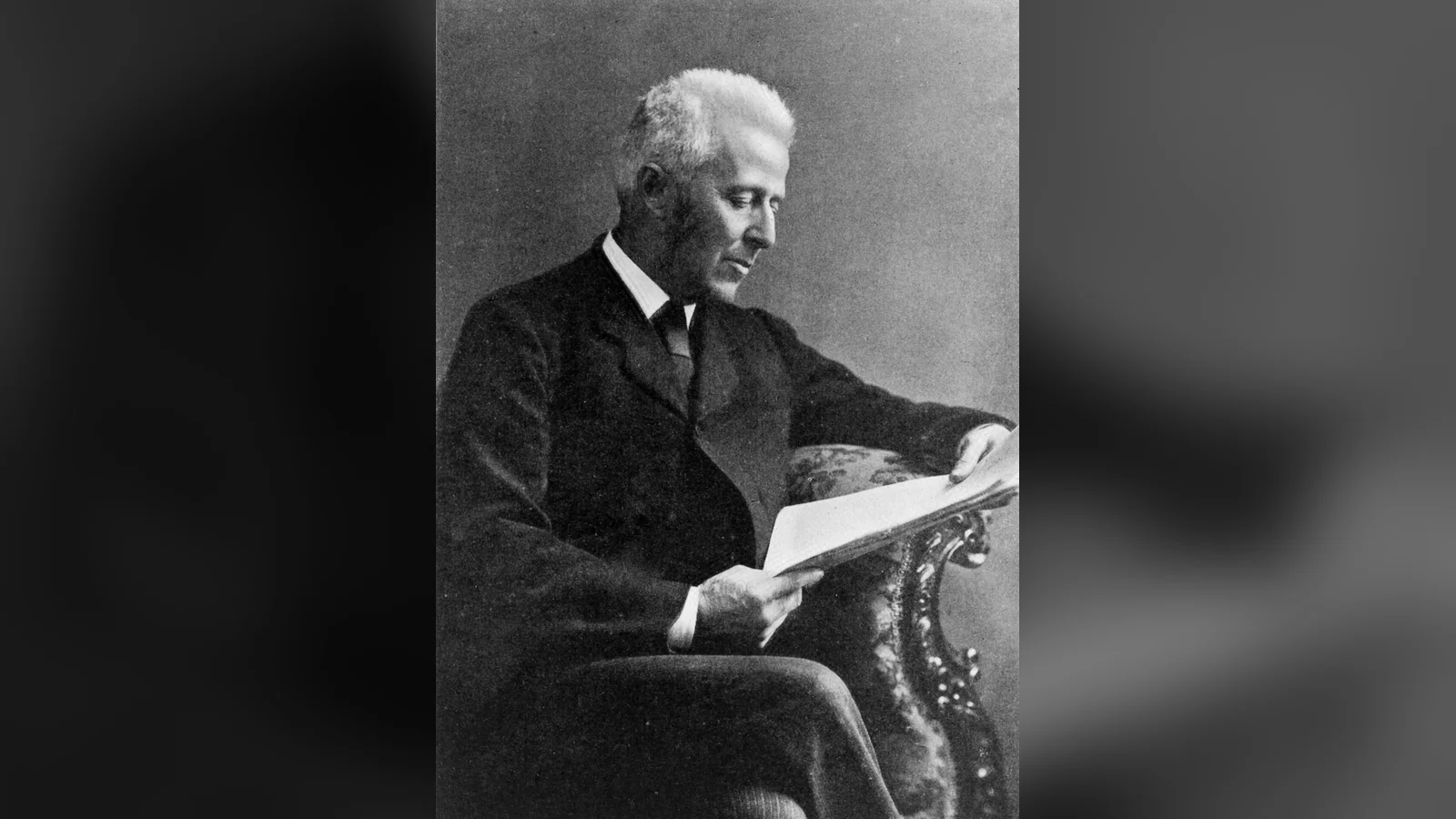

Dr Joseph Bell (1837–1911): The Surgeon Behind Sherlock Holmes
Contents
Joseph Bell was an Edinburgh surgeon who could tell a stranger's trade and recent travels from his hands, his walk and his accent, and liked to do it in front of a class. One of the students who watched was Arthur Conan Doyle, who served as his outpatient clerk in 1878 and nine years later gave the method to a fictional detective. Bell is remembered almost wholly for that. This short article sets out what Conan Doyle's biographer Andrew Lycett records about him, including the points at which the legend runs ahead of the evidence.
TL;DR
- established Bell came from a family of Edinburgh surgeons, had been house surgeon to Professor James Syme, and edited the Edinburgh Medical Journal.
- established In 1878 he chose Conan Doyle as his outpatient clerk at the Royal Infirmary of Edinburgh.
- established In 1892 Conan Doyle confirmed to Bell in writing that Holmes was modelled on him, and dedicated The Adventures of Sherlock Holmes to "my old teacher Joseph Bell MD".
- shared Bell was not the only model. Lycett argues that Holmes also owes a good deal to Henry Littlejohn, Edinburgh's Medical Officer of Health and a forensic expert, and to Robert Christison, neither of whom Conan Doyle credited.
- shared Bell's deductions were not infallible. Lycett shows that his best-known example rests on a doubtful medical assumption, and Bell's own grandson saw little of the famous gift at home.
Key Facts
- Born
- 2 December 1837, Edinburgh
- Died
- 4 October 1911, Edinburgh
- Profession
- Surgeon, Royal Infirmary of Edinburgh; teacher of surgery
- Training
- House surgeon to Professor James Syme
- Other work
- Editor, Edinburgh Medical Journal; ophthalmology at the Edinburgh Eye Infirmary
- Home
- Mauricewood, near Penicuik
- Conan Doyle's clerkship
- 1878
- Dedication
- The Adventures of Sherlock Holmes (1892)
- Main sources
- Andrew Lycett, The Man Who Created Sherlock Holmes (2007); Ely Liebow, Dr. Joe Bell (1982)
A Note on Claims and Evidence
Each major claim carries one of three labels. established means supported by primary records, official bodies or several independent reliable sources. shared means the core fact is sound but sources disagree on details, dates or interpretation. traditional means widely repeated but not traceable to a primary or independent source.
Everything here comes from a biography of Conan Doyle. Lycett sees Bell through his pupil's life, and gives no account of Bell's surgical career, family or publications beyond what touches that story. The standard life of Bell, Ely Liebow's Dr. Joe Bell (1982), was added on 17 November 2026 and is the source for the section on his own life and for his dates.
The two famous anecdotes below come from different places. The Highland soldier is from Conan Doyle's autobiography, written decades later. The bitter drug is from a magazine article about Bell. Neither is a contemporary record of a particular day.
Timeline
Born in Edinburgh, the great-grandson of the surgeon Benjamin Bell (1749–1806).
Appointed Syme's assistant at the Royal Infirmary, after serving as his house surgeon.
Marries Edith Erskine Murray.
Publishes his Manual of Operations of Surgery, which runs to many editions.
Becomes editor of the Edinburgh Medical Journal, a post he holds until 1896.
Edith dies of puerperal peritonitis.
Conan Doyle, a first-year student, notices Bell on holiday at Brodick on Arran, where he went each year to shoot grouse.
Becomes Senior Surgeon to the Infirmary. He picks Conan Doyle as his outpatient clerk.
Bell clashes in the Edinburgh Medical Journal with Bryan Waller, the Doyle family's lodger, over a new surgical knife.
Conan Doyle, casting about for a new kind of detective, recalls Bell's method.
Conan Doyle tells The Bookman that Holmes embodies one of his old Edinburgh teachers. Bell writes to ask whether he is meant.
Conan Doyle's letters to Bell.
Harry How names Bell in the Strand Magazine and prints his letter on method. The Adventures appear with the dedication.
His only son, Benjamin, an officer in the Seaforth Highlanders, dies of peritonitis after appendicitis.
Resigns from the Royal Hospital for Sick Children.
Bell publicly supports Conan Doyle's parliamentary candidacy in Edinburgh Central.
Baden-Powell's Aids to Scouting commends the powers of observation of both Holmes and Bell.
Bell dies in Edinburgh.
Details
His own life
established Ely Liebow's Dr. Joe Bell (1982), the only full biography, fills in what a life of Conan Doyle leaves out. Bell was born on 2 December 1837 into a dynasty of Edinburgh surgeons: his great-grandfather Benjamin Bell (1749–1806) was among the doctors who made Edinburgh a world centre of medicine, and his father, also Benjamin (1810–1883), was an Edinburgh surgeon. After graduating he became house surgeon and then, in January 1865, assistant to James Syme at the Royal Infirmary. In the same year he married Edith Erskine Murray. His Manual of Operations of Surgery followed in 1866 and went through edition after edition. He edited the Edinburgh Medical Journal from 1873 to 1896, became Senior Surgeon to the Infirmary in 1878, and served the Royal Hospital for Sick Children until 1896.
established Liebow also shows a side of Bell absent from the Holmes story: at about the time Florence Nightingale's training school opened in London, he began teaching nurses at the Infirmary himself, and he taught the women medical students of Sophia Jex-Blake's generation, by one nurse's account treating them exactly as he treated the men. His private life was marked by loss. Edith died of puerperal peritonitis on 9 November 1874, leaving him with three small children. Their only son, Benjamin, commissioned into the Seaforth Highlanders in 1889, died of peritonitis after appendicitis in June 1893, and colleagues said Bell aged visibly afterwards. He died on 4 October 1911, after two heart attacks.
The observer
established Lycett describes Bell as wiry, with a jerky walk and a high voice, and suggests that being an odd figure himself had sharpened his eye for the oddities of others. He had studied under Henry Littlejohn and served as house surgeon to Syme. Beyond surgery his interests ran to ophthalmology, to the place of women in medicine, on which he corresponded with Florence Nightingale, and to medical journalism.
traditional Conan Doyle's autobiography gives the classic performance. Bell looked at a patient and announced that he was a recently discharged non-commissioned officer of a Highland regiment who had served in Barbados. He then explained: the man was respectful and yet kept his hat on, as soldiers do; he had an air of command; he was plainly Scottish; and his complaint was elephantiasis, a West Indian disease.
shared Lycett points out the flaw. Elephantiasis was nicknamed "Barbados leg", but it was commoner elsewhere, above all in Africa, where a Scottish regiment was just as likely to have been posted. The chain of reasoning sounds conclusive and is not. The same could be said of a good many of Holmes's.
traditional A second story shows the showman. Bell passed round a jar of a foul and bitter drug, saying he would ask nothing of the class that he would not do himself, and dipped a finger and tasted it. When every student had grimaced through the same test, he told them they had failed to observe: he had put one finger in the jar and a different one in his mouth.
The clerk
established In 1878 Bell singled out Conan Doyle to be his outpatient clerk. The clerk saw patients first and presented them. Conan Doyle, raised in Edinburgh by Irish parents and schooled in Lancashire, had to learn the patients' Scots: he did not know that a "bealin" in the "oxter" was an abscess in the armpit. The post also took him on Bell's extra rounds at the Eye Infirmary.
shared Why Bell chose him is unknown. Lycett thinks it had less to do with promise than with connections, since teachers and students had little contact. Bell belonged to Syme's circle, and so did a close friend of the Doyle family, Dr John Brown.
Holmes
established When Conan Doyle set out to write a detective story in 1886, his problem was to add something to what Poe and Gaboriau had done. His answer was to imagine how Bell would have worked had he been a detective, and to make detection a science. Bell had taught that all successful diagnosis rested on "the precise and intelligent recognition and appreciation of minor differences". Holmes's first words to Watson, telling him he has been in Afghanistan, are the Bell method on the page.
established Conan Doyle did not name him at first. In May 1892 he told an interviewer that Holmes was the literary embodiment of one of his old professors. Bell saw it and wrote to ask whether he was the man. Conan Doyle said yes. Bell then offered a case of his own, involving a criminal who used bacteria, as material. Conan Doyle was wary of bringing the laboratory too far into stories for general readers, but asked for more, and for any hints "of a Sherlock Holmesy nature". When the Strand named Bell later that year, Conan Doyle wrote to sympathise that his old teacher would now receive letters from cranks, and described some of his own.
shared Lycett suggests that "The Dying Detective", published after Bell's death and turning on a deliberately transmitted infection, may have been a late use of that suggestion.
Not the only model
shared Lycett's most pointed observation concerns who was left out. Henry Littlejohn was Edinburgh's first Medical Officer of Health and its leading forensic witness, a man who brought photographs and fingerprints into court. His evidence had helped to convict Conan Doyle's own former schoolmaster, Eugène Chantrelle, of murder in 1878. Conan Doyle never acknowledged him, and Lycett calls the omission strange. A note in the biography says plainly that Holmes has traits of both Bell and Littlejohn.
shared The same note quotes Bell's grandson, who wrote that the family saw few signs of the famous power. His one memory of it was his grandfather noticing clean shoes and concluding, correctly, that the boy had cycled up a hill.
Afterwards
established Bell remained on good terms with his pupil. He was among the prominent citizens who backed Conan Doyle when he stood for Edinburgh Central in 1900 and lost. He died in Edinburgh on 4 October 1911, as Conan Doyle was beginning The Lost World, whose Professor Challenger was drawn from two more of their Edinburgh teachers. A fellow student who went to the funeral met Littlejohn there, very old and still cheerful.
Did You Know?
- Bell found out he was Sherlock Holmes by reading a magazine interview, and wrote to ask.
- He offered Conan Doyle plots, one of them about a poisoner who used germs.
- The founder of the Scouts recommended both Holmes and Bell as models of observation.
- Conan Doyle had to learn Scots words for parts of the body to work as Bell's clerk.
- Bell's grandson remembered only one piece of detection, and it concerned mud on a pair of shoes.
FAQ
1Was Joseph Bell the real Sherlock Holmes?
He was the acknowledged model for Holmes's method of deduction from small details. Conan Doyle said so in 1892. Other Edinburgh figures, and Conan Doyle himself, also went into the character.
2How did Conan Doyle know him?
As a medical student at Edinburgh. Bell made him his outpatient clerk at the Royal Infirmary in 1878.
3What was Bell's method?
Close observation of a patient's appearance, manner and speech before any question was asked, followed by an explanation of the inference.
4Was he always right?
No. His best-known deduction relied on a link between a disease and a place that does not hold.
5Did Bell like being identified with Holmes?
He confirmed it readily to a journalist and supplied Conan Doyle with ideas. Lycett records nothing to suggest he resented it.
6When did he die?
In early October 1911, in Edinburgh.
Sources and Further Reading
Scholarly/Critical
- Andrew Lycett, The Man Who Created Sherlock Holmes: The Life and Times of Sir Arthur Conan Doyle (Free Press, 2007). The main source, including its notes on the Bell letters of 4 May and 7 July 1892 (Royal College of Surgeons of Edinburgh).
General
- Ely M. Liebow, Dr. Joe Bell: Model for Sherlock Holmes (Bowling Green University Popular Press, 1982; reissued by the University of Wisconsin Press, 2007). The standard life; used for his career, family and dates.
Caveats: Myths and Disputed Claims
- Myth: Bell was Holmes. He supplied the method. The character is a composite.
- Myth: Bell's deductions never failed. They were demonstrations for students, chosen to succeed, and at least one does not survive scrutiny.
- Disputed: how much Holmes owes to Littlejohn. Lycett presses the case. Conan Doyle never made it.
Finished reading? Try the Fact Machine: three reels, one surprising Scottish connection →
A Great Scots story