Margaret Tait (1918–1999)
Contents
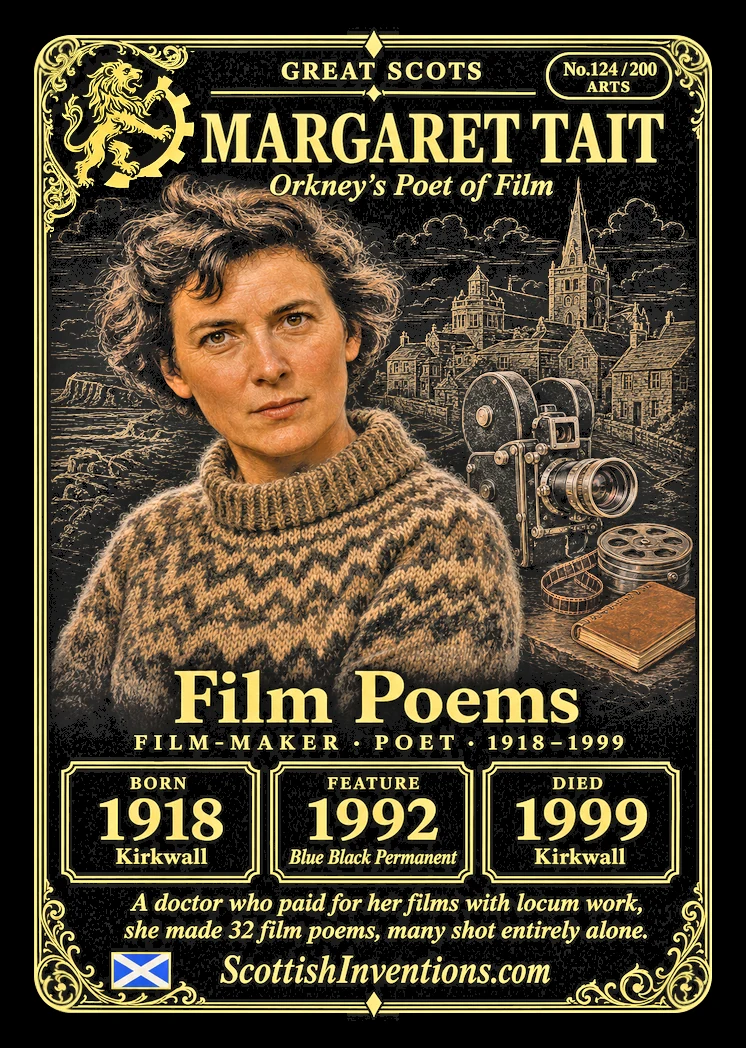
Margaret Tait was an Orkney doctor who gave up medicine to make films, and over nearly fifty years made thirty-two of them almost entirely on her own. She called herself a "film poet". Long overlooked, she is now recognised as one of the most original voices in European experimental cinema.
TL;DR
- established Born in Kirkwall, Orkney, in 1918, she qualified in medicine at Edinburgh in 1941 and served in the Royal Army Medical Corps from 1943 to 1946.
- established She studied film in Rome from 1950 to 1952 and, unable to find a place in the British film industry, made 32 films between 1951 and 1998, all but three paid for herself.
- established She usually worked as a one-woman crew: camera, sound, editing and often her own voice reading poetry.
- established Her only feature film, Blue Black Permanent (1992), was made when she was 74, from a script begun in the 1940s.
- established She also published poetry and stories, and her films are now widely shown and studied; an award for Scottish artists working with moving image bears her name.
Key Facts
- Born
- 11 November 1918, Kirkwall, Orkney
- Died
- 16 April 1999, Kirkwall (aged 80)
- Parents
- Charles Tait, agricultural merchant; Mary Isbister
- Education
- University of Edinburgh (medicine, 1941); film school in Rome (1950–52)
- War service
- Royal Army Medical Corps, 1943–46
- Partner
- Alex Pirie, married 1968
- Films
- 32, 1951–98
- Feature
- Blue Black Permanent (1992)
A Note on Claims and Evidence
Each major claim carries one of three labels. established means supported by primary records, official bodies or several independent reliable sources. shared means the core fact is sound but sources disagree on details, dates or interpretation. traditional means widely repeated but not traceable to a primary or independent source.
Tait's life and work are documented in the Tait Papers at Orkney Archives and in her films, preserved by the National Library of Scotland Moving Image Archive. Dates for some films vary between sources by a year or two, because she often worked on a film over a long period; The New Biographical Dictionary of Scottish Women is followed where they differ.
Timeline
Born in Kirkwall on 11 November.
Graduates in medicine from the University of Edinburgh.
Serves in the Royal Army Medical Corps.
Studies at the Centro Sperimentale di Cinematografia in Rome.
Begins making films with her own small company, Ancona Films.
Works from a studio in Rose Street, Edinburgh, and films the street in Rose Street (1956).
A Portrait of Ga, a short film about her mother.
Publishes three books of poetry and stories.
Where I Am Is Here, filmed in Edinburgh.
Hugh MacDiarmid – A Portrait, filming the poet.
Marries Alex Pirie.
Land Makar, about an Orkney crofter.
Directs her first feature, Blue Black Permanent.
Makes her last film, Garden Pieces.
Dies in Kirkwall on 16 April.
Details
Doctor first
established Margaret Tait was born in Kirkwall, the daughter of an agricultural merchant. She studied medicine at the University of Edinburgh, graduating in 1941, and served as a doctor in the Royal Army Medical Corps from 1943 to 1946. Medicine gave her a living for years to come: the locum work she took on paid for most of her films.
Rome
established In the late 1940s she developed a passion for cinema, and from 1950 to 1952 she studied at the Centro Sperimentale di Cinematografia in Rome, the Italian national film school, during the years of Italian neorealism. With fellow students she set up Ancona Films. established Returning to Scotland, she found no place in the British film industry, where women directors were very rare.
A one-woman crew
established Between 1951 and 1998 she made 32 films, and only three were funded by anyone but herself. She usually shot, recorded and edited alone on 16mm film, sometimes helped by her partner Alex Pirie, whom she married in 1968 and who is credited as producer on Where I Am Is Here (1964). For many years she worked from a studio at 91 Rose Street in Edinburgh and later from Orkney.
The film poet
established Tait called herself a film poet, not a documentary maker. shared Her films look closely at ordinary things: a street, a garden, a hen, her mother sitting in the sun, the light on a burn. Some seem to record a vanishing past, like Land Makar (1981), about an Orkney crofter, but her aim was to make visual poems out of image and sound rather than to document. She painted directly on to film in pieces such as Calypso (1956) and Painted Eightsome, and her portrait of the poet Hugh MacDiarmid shows him at home and walking in Edinburgh.
A Portrait of Ga
established One of her most loved films, A Portrait of Ga (1955), is a few minutes long and shows her mother in Orkney: eating a sweet, smoking, looking out to sea. It has become a touchstone for artists working with personal film.
Blue Black Permanent
established In 1992, aged 74, she directed her first and only feature film, Blue Black Permanent, based on a script she had begun in the 1940s. Filmed in Edinburgh and Orkney, it follows three generations of women and the mystery of a mother's drowning. The Edinburgh International Film Festival catalogue later called it beautiful, ingenious and very sad.
Writer and painter
established Tait also published poetry and stories, including Origins and Elements (1959), Subjects and Sequences (1960) and The Hen and the Bees (1960). A collection of her writings, edited by Sarah Neely, appeared in 2012. She painted as well.
Recognition
established Late in life her work began to be rediscovered. Critics in the 1990s called her Britain's oldest living experimentalist, and retrospectives followed after her death. The Margaret Tait Award, run by LUX Scotland and the Glasgow Film Festival, supports Scottish artists working with moving image. Her centenary in 2018 was marked by screenings and exhibitions across Scotland.
Blue Black Permanent
shared Petrie (2000) records that Blue Black Permanent was one of four Scottish debut features commissioned by the BFI Production Board in the late 1980s and early 1990s, along with Play Me Something, Silent Scream and Venus Peter. It starred Celia Imrie as Barbara and Gerda Stevenson as her mother, Greta, whose drowning, accident or suicide, haunts her daughter. Petrie admires the poetic Orkney and Edinburgh shorts of the 1950s and 1960s, but judges that Tait was out of her depth with feature-film conventions, apart from the closing montage. That is one critic's view.
Did You Know?
- She was a qualified doctor and served in the army in the Second World War.
- She paid for almost all her films with locum medical work.
- She studied film in Rome in the early 1950s.
- She often worked completely alone.
- Her only feature film was made when she was 74.
- A Portrait of Ga is about her mother.
- She filmed the poet Hugh MacDiarmid.
FAQ
1Who was Margaret Tait?
An Orkney-born doctor, poet and filmmaker (1918–1999), known for short experimental films.
2What did she mean by "film poet"?
That she made films as poems built from image and sound, not as documentaries.
3How many films did she make?
Thirty-two, between 1951 and 1998.
4How did she fund them?
Mostly herself, by working as a locum doctor.
5What was her only feature film?
Blue Black Permanent (1992).
6Where did she train as a filmmaker?
At the Centro Sperimentale di Cinematografia in Rome.
7Where can I see her films?
Many are held by the National Library of Scotland Moving Image Archive, and some are distributed by LUX.
8Did she write?
Yes, she published poetry and stories from the late 1950s.
9What is the Margaret Tait Award?
An award for artists in Scotland working with moving image, named after her.
10Was she married?
Yes, to Alex Pirie, in 1968, after many years together.
Sources and Further Reading
Primary/Institutional
- Orkney Library and Archive: the Tait Papers.
- National Library of Scotland, Moving Image Archive: Margaret Tait films.
- Margaret Tait, Origins and Elements (1959); Subjects and Sequences (1960); The Hen and the Bees (1960).
Scholarly/Critical
- Duncan Petrie, Screening Scotland (BFI Publishing, 2000). ISBN 0-85170-785-8.
- Elizabeth Ewan, Rose Pipes et al. (eds), The New Biographical Dictionary of Scottish Women (Edinburgh University Press, 2018), entry "Tait, Margaret".
- Peter Todd and Benjamin Cook (eds), Subjects and Sequences: A Margaret Tait Reader (2004).
- Sarah Neely (ed.), Margaret Tait: Poems, Stories and Writings (2012).
- Sarah Neely, Between Categories: The Films of Margaret Tait (2016).
Caveats: Myths and Disputed Claims
- Disputed: the year of Blue Black Permanent. 1992 in the article's earlier sources; Petrie (2000) dates it 1993.
- Caution: film dates. Some of her films carry different dates in different catalogues.
- Caution: "documentary". She rejected the label herself, though her films are often shelved as documentaries.
Finished reading? Try the Fact Machine: three reels, one surprising Scottish connection →
Card 124 · Great Scots