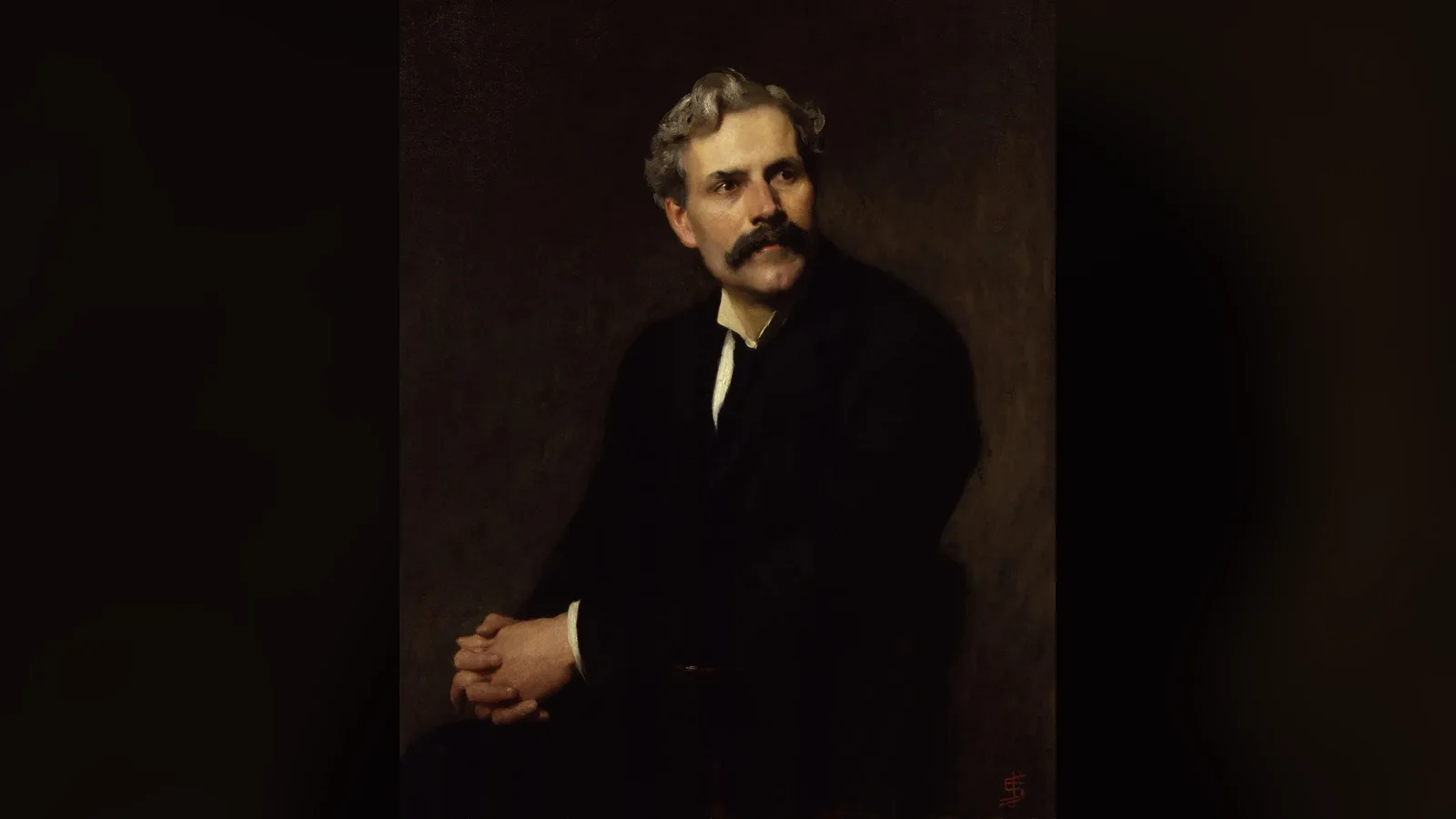

Ramsay MacDonald (1866–1937): From a Lossiemouth But-and-Ben to Downing Street
Contents
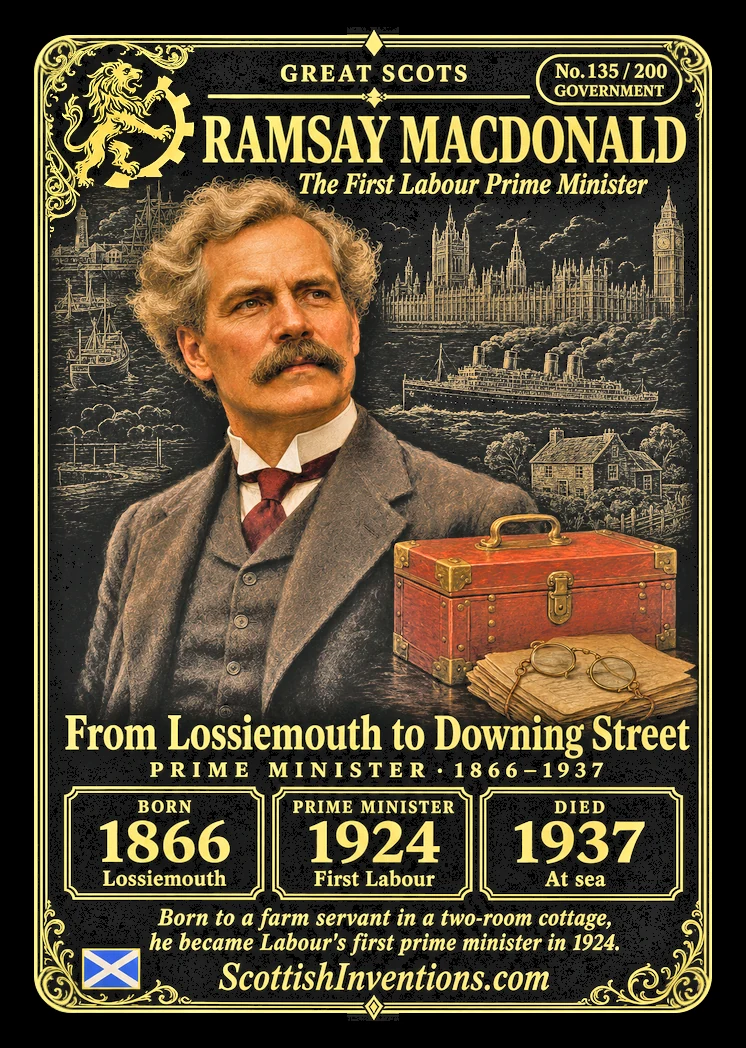
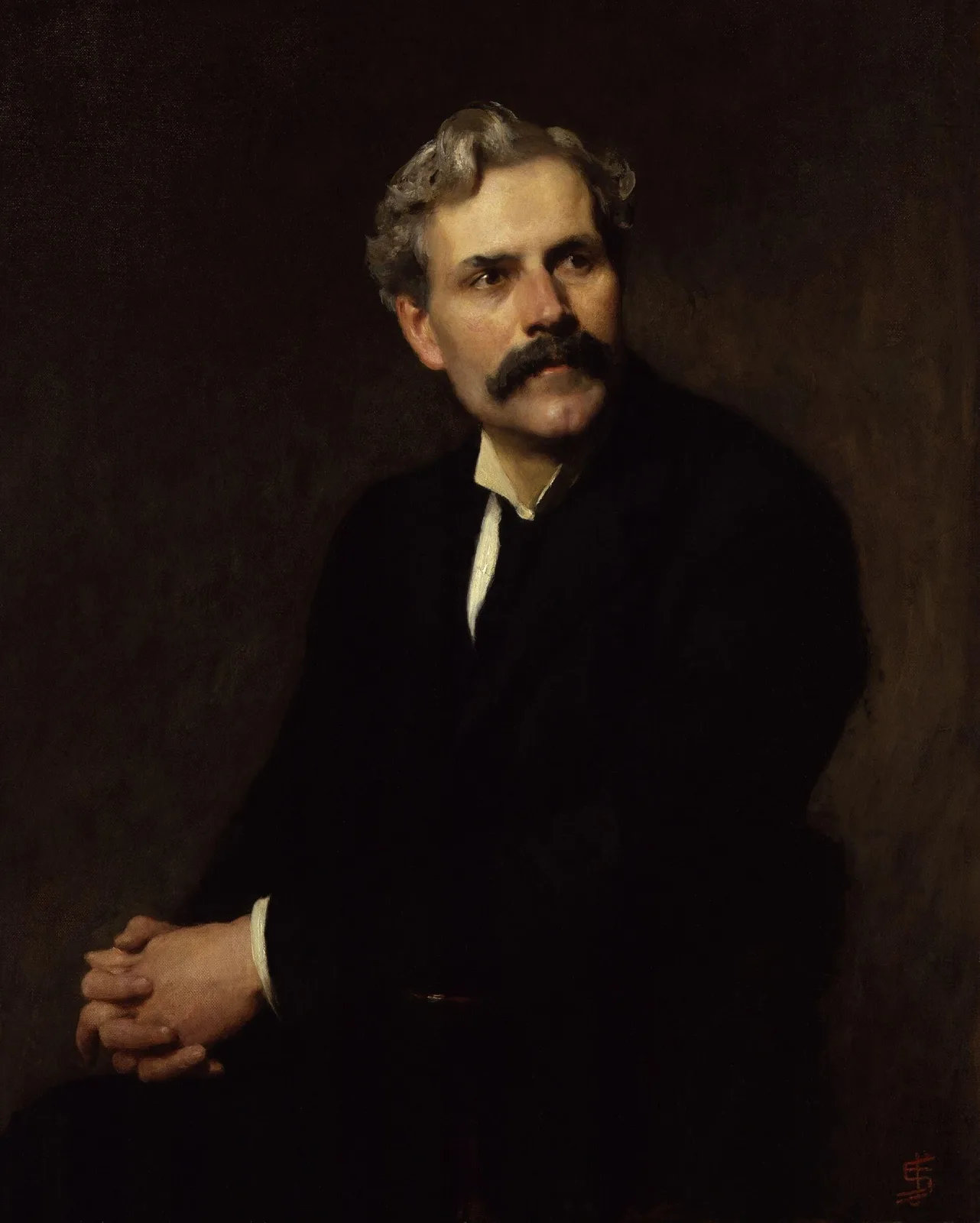
James Ramsay MacDonald rose from a two-room cottage in Lossiemouth to become Britain's first Labour prime minister. He was the illegitimate son of a farm servant, taught by an exceptional village dominie, and he left Moray at eighteen with a new suit and twenty-seven shillings. He did more than anyone to build the Labour Party, led it into government twice, and then split it in 1931 by forming a National Government with the Conservatives and Liberals. He never stopped going home: he spent his summers in Lossiemouth, sat for the Scottish Universities in his last Parliament, refused both a peerage and the Order of the Thistle, and is buried at Spynie beside his wife. His was one of the most argued-over careers in British politics. The main source here is David Marquand's biography Ramsay MacDonald (1977), written from MacDonald's own papers.
TL;DR
- established Born illegitimate in Lossiemouth, Moray, on 12 October 1866, the son of Anne Ramsay and a ploughman, John Macdonald, he was brought up by his mother and grandmother and educated at Drainie parish school, where he became a pupil-teacher.
- established He left for Bristol in 1885 and then London, where he was a clerk, a political secretary and a journalist, and in 1888 honorary secretary of the London committee of the Scottish Home Rule Association.
- established He was the first secretary of the Labour Representation Committee in 1900, the body that became the Labour Party, and negotiated the electoral pact with the Liberals that won it 29 seats in 1906.
- established He opposed the First World War and was vilified for it, even being voted out of the Moray Golf Club in 1916. He became the first Labour prime minister in January 1924 and was prime minister again from 1929.
- established In August 1931, during a financial crisis, he formed a National Government with Conservatives and Liberals; Labour expelled him and was crushed at that year's election. He stayed prime minister until 1935.
- shared Long remembered by Labour as a traitor, he is now seen by many historians, Marquand foremost, as the master builder of the party, a gifted and flawed leader caught in an impossible crisis.
Key Facts
- Born
- 12 October 1866, Lossiemouth, Moray
- Died
- 9 November 1937, at sea aboard the liner Reina del Pacifico (aged 71)
- Registered as
- James McDonald Ramsay
- Parents
- Anne Ramsay, farm servant and seamstress; John Macdonald, ploughman (unmarried)
- Married
- Margaret Gladstone (1870–1911), in November 1896; six children
- Party
- Independent Labour Party, Labour; National Labour from 1931
- Prime Minister
- January–November 1924; June 1929–June 1935
- Seats
- Leicester (1906–18); Aberavon (1922–29); Seaham (1929–35); Combined Scottish Universities (1936–37)
- Lossiemouth home
- The Hillocks
- Buried
- Spynie churchyard, near Elgin
A Note on Claims and Evidence
Each major claim carries one of three labels. established means supported by primary records, official bodies or several independent reliable sources. shared means the core fact is sound but sources disagree on details, dates or interpretation. traditional means widely repeated but not traceable to a primary or independent source.
Marquand wrote from the 1,600 files of MacDonald's papers, including his diary, which he then deposited in the Public Record Office, and from interviews with people who had known him. His book is still the standard life and has been republished several times, most recently with a new introduction in 1997. MacDonald himself wrote a good deal about his Lossiemouth childhood, but Marquand warns that his rich prose often veils as much as it reveals, so memories that rest only on MacDonald's later essays are treated with some caution. What is contested about MacDonald is judgement, not fact: whether his decision in 1931 was statesmanship or betrayal. The events are established; the verdicts are shared.
Timeline
Born in Lossiemouth on 12 October.
Pupil at Drainie parish school under the dominie James Macdonald.
Pupil-teacher at Drainie; founds the Lossiemouth Field Club and becomes secretary of the Mutual Improvement Society.
Leaves Drainie for a post at a church guild in Bristol.
In London: unemployed, then an envelope-addresser and invoice clerk.
Private secretary to the Radical politician Thomas Lough; honorary secretary of the London committee of the Scottish Home Rule Association (6 March).
Joins the Independent Labour Party; adopted for Southampton the following year.
Marries Margaret Gladstone.
Becomes secretary of the new Labour Representation Committee.
Negotiates the electoral pact with the Liberal chief whip, Herbert Gladstone.
Elected MP for Leicester; 29 LRC candidates win; the LRC becomes the Labour Party.
Chairman of the Labour MPs; his wife Margaret dies on 8 September.
Resigns the chairmanship over his opposition to the First World War.
John Bull publishes his birth certificate.
Voted out of the Moray Golf Club.
Heavily defeated at Leicester West.
Loses the Woolwich East by-election.
Returned for Aberavon and elected Labour leader.
First Labour prime minister.
Government falls over the Campbell case; Labour loses the election that follows.
Elected for Seaham; prime minister again, with Labour the largest party; visits President Hoover in the United States.
Forms the National Government; expelled from Labour; wins a landslide in October.
Hands the premiership to Stanley Baldwin; becomes Lord President; loses Seaham to Manny Shinwell in November.
Returned for the Combined Scottish Universities.
Leaves office.
Dies at sea; buried at Spynie on 27 November.
Details
A child of Anne Ramsay
established MacDonald was born on 12 October 1866 in a but-and-ben, a two-room cottage, in Lossiemouth. His birth certificate described him as "James McDonald Ramsay, child of Anne Ramsay"; the father's name was left blank. The minute-book of the Alves Free Kirk session records that on 14 December 1866 Anne Ramsay and John Macdonald, then a foreman at Sweethillock, appeared together and acknowledged the child. They had been fellow servants at the farm of Claydale. The session admonished them and restored them to church privileges, and John Macdonald then fades from the record.
traditional Two stories explain why they did not marry. In one, Anne quarrelled with him shortly before the wedding and refused to be bullied. In the other, her mother forbade the match because no ploughman was good enough for an Allan. established That mother, Isabella Ramsay, was born an Allan, of a family of small farmers whose gravestones in Spynie churchyard went back more than a century. She had separated from her husband, an Elgin baker, and brought up four children in Lossiemouth by working as a seamstress. Anne, too, earned her living mainly as a dressmaker; within living memory, Marquand was told, half the women of Lossiemouth wore her bonnets. She was a confirmed rebel. When Ladysmith was relieved in the Boer War in 1900, she pulled down her blinds and hung black crepe on her door, and was burned in effigy on the town's celebration bonfire.
shared Illegitimacy rates in Moray were the highest in Scotland, and the stigma was probably less there than in middle-class England. Marquand nevertheless traces some of MacDonald's prickliness, suspicion and reserve to a fatherless childhood, and some of his drive and self-reliance to the undivided attention of his mother and grandmother.
The dominie of Drainie
established He went first to the Free Kirk school in Lossiemouth, where he was thrashed by a teacher who had earlier taught J. M. Barrie. When that master drowned, he was sent to the parish school at Drainie, four miles across the fields. Its dominie, James Macdonald, ran a one-teacher school of about seventy pupils, whose inspectors complained about the humming and the dust but could not fault the results. MacDonald later wrote that the dominie taught "without putting any goal except knowledge" before his pupils. A diary he kept for a fortnight at thirteen, in April 1880, records Bible readings, a new cricket club and the news that Gladstone had won Midlothian.
established In the summer of 1881, aged nearly fifteen, he left school and went to work on a farm, but within months he was taken back as pupil-teacher. shared Marquand calls it one of the most decisive turning points of his life: it saved him from the fields and gave him a better education than any Labour leader of his generation. He walked to and from Drainie with Latin, Greek or Euclid open in his hands.
established He read Burns, Dickens and Shakespeare, borrowed from a consumptive watchmaker who had come home to Lossiemouth to die, and acquired Hugh Miller's My Schools and Schoolmasters. Jonathan Rose's study of working-class reading notes that he also enjoyed Samuel Smiles's lives of working-class naturalists. For some years science was his ruling passion. He founded the Lossiemouth Field Club, and his surviving papers include a 44-page geological description of the Coulard Hill. He became secretary of the Mutual Improvement Society and wrote speeches attacking the game laws and calling for the land to be nationalised; he had probably read Henry George. The Reform Act of 1884 had just enfranchised the farm labourers of Moray, and in 1886 an "Advanced Radical" took the seat of Elgin and Nairn.
Bristol and London
established On 1 May 1885 he left Drainie for a post as assistant to a Bristol clergyman, Mordaunt Crofton, who was starting a boys' and young men's guild. He left home, it is said, in a suit given by the local draper and with twenty-seven shillings in his pocket. Bristol was one of the few English provincial cities with an active socialist organisation, and his political education went a stage further there. In 1886 he moved to London, where he tramped the streets in search of work, living on oatmeal sent from home, before finding jobs addressing envelopes for the National Cyclists' Union at ten shillings a week and then as an invoice clerk. He studied science at the Birkbeck Institute in the evenings.
established Early in 1888 he became private secretary to Thomas Lough, a tea merchant and Radical, at £75 a year. The post gave him an entry to the National Liberal Club, the Radical press and London politics. On 6 March 1888 he moved that a meeting of London Scots form itself into the London General Committee of the Scottish Home Rule Association, and he was chosen its honorary secretary. The committee sent a message of support to Keir Hardie at the Mid-Lanark by-election that April, which Hardie fought on Scottish home rule and Labour independence. shared Marquand describes the London branch as almost languid, raising little more than £10 in 1888. MacDonald drifted away from it after 1890, although in 1892 there were rumours that he would stand as a home rule candidate in Aberdeen.
established He joined the Fabian Society in the late 1880s, was elected to its executive in 1894, and the same year threw in his lot with the Independent Labour Party. He stood as ILP candidate for Southampton in 1895. He made his living as a journalist and lecturer.
Margaret Gladstone
established In 1896 he married Margaret Gladstone, the daughter of John Hall Gladstone, a chemist, Fellow of the Royal Society and one of the founders of the YMCA. The Gladstones came of Border stock, and one of Margaret's uncles on her mother's side was William Thomson, Lord Kelvin. The wedding took place in November, and the couple set up home at 3 Lincoln's Inn Fields, which became an office of the young Labour movement. Margaret's private income of about £460 a year freed MacDonald for politics. They had six children.
established Margaret worked tirelessly on committees, inquiries and the Women's Labour League. In July 1911 she fell ill with blood poisoning, and on 8 September 1911 she died. Her ashes were buried in Spynie churchyard. shared Marquand writes that part of MacDonald died with her. One of the children remembered him calling them all to the room where he was working, at the very hour of her death, on the first anniversary, in a state of terrible grief.
Building the Labour Party
established In February 1900 a conference of 129 delegates at the Memorial Hall in Farringdon Street set up the Labour Representation Committee to get working men into Parliament, and MacDonald became its secretary. shared Marquand calls him, if not the chief architect of the "Labour Alliance", then at least its master builder: he created its organisation and wrote much of its thinking. established In 1903 he negotiated a secret agreement with the Liberal chief whip, Herbert Gladstone, under which the Liberals stood aside in a number of seats. At the 1906 election 29 LRC candidates were elected, only five of whom had faced a Liberal, MacDonald among them at Leicester. The LRC renamed itself the Labour Party. He became chairman of the parliamentary party in 1911.
Public enemy
established In August 1914 MacDonald opposed Britain's entry into the war and resigned the chairmanship. In November he helped launch the Union of Democratic Control, which campaigned against secret diplomacy. The press turned on him. In September 1915 Horatio Bottomley's John Bull published a facsimile of his birth certificate. MacDonald saw the placards at Aberdeen station and spent the journey to Edinburgh, he wrote, in "the most terrible mental pain"; he said he had never before known that he had been registered under the name of Ramsay.
established Then the Moray Golf Club, of which he had been one of the earliest members and where he played with his sons, moved against him. A first attempt failed in 1915. In September 1916 a special meeting in the burgh court house in Elgin, with nearly a hundred members present, voted by 73 to 24 that his conduct had endangered the club and that he had forfeited his membership. shared His friends agreed that this hurt him more than anything else in the war.
established At the 1918 election he lost Leicester West by a majority twice the size of his own vote, and in 1921 he lost a by-election at Woolwich East to a Conservative who had won the Victoria Cross. established Yet his stand against the war won him lasting respect on the left. In November 1922 he was returned for Aberavon, and on 21 November the Labour MPs, among them the new Clydesiders, elected him leader over J. R. Clynes.
First Labour prime minister
established After the 1923 election left no party with a majority, Baldwin's government was defeated, and on 22 January 1924 MacDonald became the first Labour prime minister, also serving as his own foreign secretary. His minority government passed the Wheatley Housing Act, and at the London conference that summer it helped settle the dispute over German reparations on the basis of the Dawes plan. established It also brought him his first scandal. His old friend Alexander Grant, a fellow Moray man from Forres whose father had worked on the Highland Railway with MacDonald's uncle and who was now the owner of McVitie & Price, lent him a Daimler and £40,000 in securities, £30,000 of it in McVitie & Price preference shares, to supplement his salary. Grant was made a baronet in the next honours list, for his gift of the Advocates' Library to Scotland. When the Daily Mail revealed the shares in September, MacDonald's confused explanation did him great harm. shared Marquand calls the affair an act of remarkable folly, but finds no sign that either man saw any connection between the loan and the baronetcy.
established The government fell in October 1924 over the Campbell case, the withdrawn prosecution of a Communist editor, and lost the election that followed, which was overshadowed by the forged "Zinoviev letter".
The second Labour government
established Labour returned as the largest party in 1929, with 287 seats, and MacDonald, now MP for Seaham, again became prime minister. In October 1929 he visited the United States, where New York gave him a ticker-tape parade and the freedom of the city and he stayed with President Hoover at his camp on the Rapidan. The visit prepared the London Naval Treaty of 1930. shared Marquand judges the Anglo-American understanding behind it a real achievement. The Wall Street Crash and the Depression then overwhelmed the government's domestic plans, and unemployment rose remorselessly.
1931
established In the summer of 1931, facing a run on the pound and demands for cuts in spending, including unemployment benefit, the Cabinet split. On 24 August MacDonald formed a National Government with Conservatives and Liberals. Labour expelled him. The pay cuts that followed provoked the Invergordon mutiny on 15 September, which led to heavier withdrawals of gold, and Britain left the gold standard. At the October 1931 election the National Government won a landslide and Labour was reduced to 52 seats. shared Marquand finds no evidence that MacDonald planned the split; he acted, under great strain, in what he believed to be the national interest, and his reasons and their rights and wrongs remain profoundly controversial.
established He stayed prime minister until 1935, increasingly dominated by the Conservatives and in failing health, his eyesight and memory deteriorating.
Last years
established In June 1935 he handed over to Stanley Baldwin and became Lord President of the Council. When he went to tell George V, the King offered him the Thistle, which MacDonald declined because it would have made him "Sir"; the King knew he would not take a peerage. established In November 1935 he lost Seaham to Manny Shinwell. At a by-election for the Combined Scottish Universities in early 1936 he was returned with 16,393 votes against 9,034 for the Scottish Nationalist and 3,597 for Labour, and took his seat on 5 February. His son Malcolm won Ross and Cromarty a week later. He left office in May 1937, having declined a peerage for the third time, and spent the summer at Lossiemouth.
established On 5 November 1937 he and his daughter Sheila sailed from Liverpool on the liner Reina del Pacifico for a holiday in South America. On the evening of 9 November he died of heart failure at sea. His body was brought home from Bermuda on the cruiser HMS Apollo. After a funeral service in Westminster Abbey on 26 November he was cremated at Golders Green, and his ashes were taken overnight to Lossiemouth. On 27 November, after a service at the Hillocks at which the Glasgow Orpheus Choir sang and a piper of the Highland Light Infantry played "The Flowers of the Forest", they were buried in Margaret's grave at Spynie, overlooking the Moray Firth.
Reputation
shared For decades Labour remembered him as the man who betrayed the party in 1931. In 1950 its golden jubilee pamphlet mentioned him only as having attended the founding conference. Later historians, led by Marquand, have offered a more balanced view: an outstanding organiser, writer and speaker who did more than anyone to make Labour a party of government, and who gave Attlee, Morrison, Cripps and Dalton their first ministerial posts, but who was aloof, vain and suspicious, and who in 1931 chose what he saw as national duty over party. Harold Wilson's warm tribute at the centenary of his birth in 1966 marked the start of Labour's reconciliation with him. shared His early part in the Scottish home rule movement is also better remembered now.
Did You Know?
- His birth certificate named him James McDonald Ramsay.
- His mother hung black crepe on her door when Ladysmith was relieved, and was burned in effigy for it.
- He was taught at Drainie by a dominie who believed in knowledge for its own sake.
- He began his political life as secretary of the London committee of the Scottish Home Rule Association in 1888.
- His wife Margaret was a niece of Lord Kelvin.
- The Moray Golf Club voted him out in 1916 for opposing the war.
- He refused the Order of the Thistle and a peerage three times.
- His last seat was the Combined Scottish Universities.
- He died at sea, on 9 November 1937, and is buried at Spynie.
From the archive
Original documents and images from the period.
FAQ
1Who was Ramsay MacDonald?
The first Labour prime minister of the United Kingdom, born in Lossiemouth in 1866.
2When was he prime minister?
January to November 1924, and from June 1929 to June 1935.
3Why is he controversial?
In 1931 he formed a National Government with the Conservatives and Liberals, and Labour expelled him.
4Was he really illegitimate?
Yes. His mother, Anne Ramsay, never married, and the Kirk session records name the father as John Macdonald, a ploughman.
5Where did he go to school?
At the Free Kirk school in Lossiemouth and then the parish school of Drainie, where he became a pupil-teacher.
6Did he support Scottish home rule?
Yes. He was honorary secretary of the Scottish Home Rule Association's London committee from 1888.
7Did he oppose the First World War?
Yes, and he resigned as Labour leader in 1914 because of it.
8Why was he thrown out of a golf club?
In 1916 members of the Moray Golf Club voted 73 to 24 to remove him because of his opposition to the war.
9What was the Zinoviev letter?
A forged letter, published before the 1924 election, suggesting Soviet influence on Labour.
10How did he die?
Of heart failure aboard a liner bound for South America on 9 November 1937.
11Where is he buried?
At Spynie churchyard near Elgin, in the same grave as his wife Margaret.
Sources and Further Reading
Primary/Institutional
- The National Archives, Kew: Ramsay MacDonald papers (PRO 30/69).
- J. Ramsay MacDonald, Wanderings and Excursions (1925) and At Home and Abroad (1936).
- Jane Cox (ed.), A Singular Marriage: A Labour Love Story in Letters and Diaries (1988).
Scholarly/Critical
- David Marquand, Ramsay MacDonald (Jonathan Cape, 1977; Richard Cohen Books, 1997).
- Mary Agnes Hamilton, J. Ramsay MacDonald (1929).
- T. M. Devine and Jenny Wormald (eds), The Oxford Handbook of Modern Scottish History (2012), chapters on the Union and on Labour.
- Edward J. Cowan and Richard J. Finlay (eds), Scottish History: The Power of the Past (2002), chapter on women and the Scottish radical tradition.
- Jonathan Rose, The Intellectual Life of the British Working Classes (2001).
Caveats: Myths and Disputed Claims
- Myth: he planned the 1931 split in advance. Marquand finds no evidence of a plot; the Cabinet broke up under the pressure of the crisis.
- Disputed: betrayal or duty. This remains a matter of judgement.
- Disputed: why his parents did not marry. Two family stories survive; neither can be proved.
- Corrected: the Scottish Home Rule Association. The association was founded in Edinburgh in 1886; MacDonald became secretary of its London committee in 1888, not 1886, as some accounts say.
- Caution: the name. He was registered as James McDonald Ramsay but always used James Ramsay MacDonald; he said he had not known of the registration until John Bull printed it in 1915.
- Caution: the Grant loan. It was a loan of £40,000 in securities, not a gift of shares, and it was not linked to Grant's baronetcy, though it looked that way.
Finished reading? Try the Fact Machine: three reels, one surprising Scottish connection →
Card 135 · Great Scots