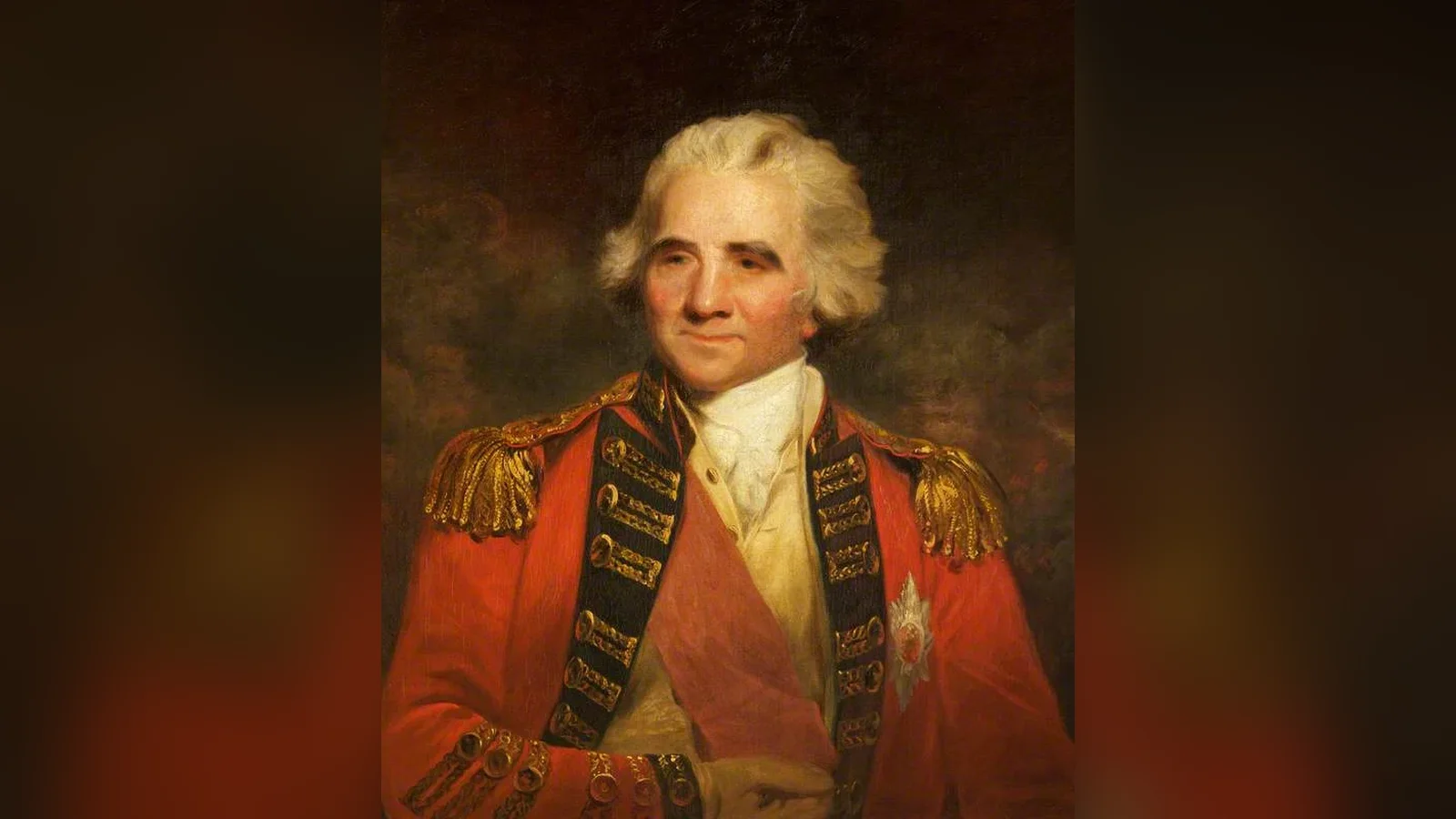

Sir Ralph Abercromby (1734–1801): The Clackmannanshire Laird Who Beat Napoleon's Army in Egypt
Contents
Sir Ralph Abercromby was a quiet, short-sighted Lowland laird from Tullibody who rebuilt the reputation of the British Army. After forty years in which it had known little but failure, he trained a scratch force of ill-provided battalions, landed it on a defended beach in Aboukir Bay in March 1801, and defeated the veterans of Bonaparte's Army of the Orient at Mandara and Alexandria. He was mortally wounded in the second battle and died a week later, aged 66. His victory ended the French conquest of Egypt and became the pattern for Wellington's army in the Peninsula. Nelson and Abercromby are named together on Cleopatra's Needle in London. This account draws on Piers Mackesy's British Victory in Egypt, 1801: The End of Napoleon's Conquest (1995).
TL;DR
- established Abercromby was the third generation of the Abercrombys of Tullibody, Clackmannanshire, educated at Rugby, Edinburgh University and Leipzig, and a soldier from the Seven Years War onwards.
- established A liberal who sympathised with the Americans in 1775, he resigned the Irish command in 1798 after condemning the army's indiscipline, and led the expedition to Holland in 1799.
- established His kinsman Henry Dundas, the War Secretary, pushed the invasion of Egypt through Pitt's Cabinet in October 1800 and left Abercromby complete discretion in carrying it out.
- established After weeks of training and landing rehearsals in Marmaris Bay, his army stormed ashore at Aboukir on 8 March 1801, won at Mandara on 13 March and beat Menou's attack at Alexandria on 21 March.
- established Hit in the thigh on 21 March, he stayed on the field until the battle was over and died on HMS Foudroyant on 28 March 1801. He was buried in Fort St Elmo, Malta.
- shared Mackesy argues that the army he trained, Moore's officers above all, became the model for the victorious British army of the Peninsular War.
Key Facts
- Born
- 1734, of the Abercrombys of Tullibody, Clackmannanshire
- Died
- 28 March 1801, aboard HMS Foudroyant in Aboukir Bay (aged 66)
- Education
- Rugby School; University of Edinburgh; Leipzig
- Family
- Mother a Dundas; "Scotch cousin" of Henry Dundas
- Commands
- West Indies; Ireland (1797–98); Holland (1799); Egypt (1800–01)
- Victories
- Aboukir landing (8 March 1801); Mandara (13 March); Alexandria (21 March)
- Buried
- Castle of St Elmo, Valletta, Malta
- Memorials
- St Paul's Cathedral (Flaxman); Cleopatra's Needle, London
- Honour
- His widow made Baroness Abercromby of Aboukir
A Note on Claims and Evidence
Each major claim carries one of three labels. established means supported by primary records, official bodies or several independent reliable sources. shared means the core fact is sound but sources disagree on details, dates or interpretation. traditional means widely repeated but not traceable to a primary or independent source.
Mackesy, an Oxford historian of Britain's wars against Revolutionary France, built his account from the papers of Abercromby, Moore, Hutchinson, Dundas, Lord Elgin and dozens of officers and soldiers, set against the French generals' published reports. He writes openly to restore Abercromby's reputation, and some of his judgements are labelled shared for that reason. Where he finds the evidence contradictory, as over the French standard captured at Alexandria, the dispute is given here.
Timeline
Born, the heir of the Abercrombys of Tullibody.
Studies law at Edinburgh and Leipzig, then joins the army; serves in the Seven Years War in Germany.
Sympathising with the Americans, stays with his regiment in Ireland rather than serve against them.
Half-pay colonel in Scotland; briefly MP for Clackmannanshire.
Serves in Flanders and Holland.
Commands in the West Indies.
Commander-in-chief in Ireland; resigns after his General Order on discipline is overruled.
Commands the landing in Holland.
After the fiasco at Cadiz, receives orders to invade Egypt.
Trains and rehearses his army in Marmaris Bay, on the Turkish coast.
Assault landing in Aboukir Bay.
Battle of Mandara.
Battle of Alexandria; wounded in the thigh.
Dies aboard HMS Foudroyant.
Buried in the Castle of St Elmo, Malta.
Cairo surrenders to his successor, John Hely-Hutchinson.
The British enter Alexandria.
Details
A liberal laird
established Abercromby came of a long line of Banff and Aberdeenshire lairds, but he was the third generation of the Abercrombys of Tullibody in Clackmannanshire, a cultivated family who had helped support the painter David Allan in Rome. His mother was a Dundas, and his eldest son married a daughter of Henry Dundas, the War Secretary. He was educated for the law at Rugby, Edinburgh University and Leipzig, where he fell under the military spell of Frederick the Great, and switched to the army to serve in the Seven Years War in Germany.
established His politics were liberal. When the Americans rebelled in 1775 he privately sympathised with them and admired Washington, and he avoided American service by staying with his regiment in Ireland. In the long peace he lived in Scotland as a half-pay colonel, managing the estate for his aged father and keeping a house in Edinburgh. After the French Revolution he joined an Edinburgh society for spreading useful knowledge among the people, and he was heard to say that a youth who was not a republican at twenty would be a corrupt man at forty. shared Mackesy suggests that he went to war against France to protect the Low Countries, a limited aim, but never shared the Foreign Secretary Lord Grenville's crusade to overthrow the Revolution.
Flanders, the Caribbean and Ireland
established He volunteered for active service in 1793 and saw the British Army at its worst: defeat in Flanders, the winter retreat through Holland, and in the West Indies the destruction of whole regiments by yellow fever. In Ireland in 1797 he found his forces scattered in small packets to protect the gentry, whom he despised as the real cause of the country's troubles. He issued a General Order telling the army that its indiscipline made it formidable to everyone but the enemy, and forbade troops to fire on rioters without a magistrate's authority. The Irish lobby had the order rescinded, the Home Secretary rebuked him, and he resigned. shared Mackesy sees the excesses of the 1798 rebellion as the result.
established In 1799 he led the landing in Holland, where his protégé John Moore was badly wounded at Egmond aan Zee. The campaign ended in withdrawal, and Grenville never forgave him for not pressing on after the landing.
"In your hands I feel the interests of the country safe"
established By the autumn of 1800 the army's reputation had reached its lowest point. Abercromby's force of 22,000 men had been sent to destroy the Spanish fleet at Cadiz, only for the naval commander, Lord Keith, to bungle the boat plan and sail away. Meanwhile Bonaparte's Army of the Orient still held Egypt, the land-bridge to India. Henry Dundas, who had spent years reorganising the government of British India, fought for six weeks to persuade the Cabinet that Abercromby's army must strike at Egypt. On 3 October 1800, with Pitt's help, he carried the decision by a bare majority, against Grenville, Windham and the evident disapproval of George III. Next day he wrote privately to his "Scotch cousin", giving him complete discretion. shared "In your hands," the letter ended, "I feel the interests of the country safe."
Forging the blade
established Abercromby, approaching his 67th year, inherited a mixed bag of battalions: the Guards, the young 79th Camerons and 92nd Gordons, militiamen, Irish recruits and foreign regiments. He weeded out bad officers, inspected every regiment himself, and at Marmaris Bay on the Turkish coast spent weeks rehearsing a landing by boat until each man knew his place in the line. shared Mackesy describes him as a strict but humane disciplinarian: obedience, he wrote, must be taught with "prudence and sense", and the new volunteers "must be led by degrees". John Moore, the Glasgow physician's son who commanded the Reserve, and the Adjutant-General John Hope were among the Scots around him whom the English sneered at as a mafia of Scotch staff officers.
Aboukir and Mandara
established On 8 March 1801 the first wave of boats rowed for the beach in Aboukir Bay under heavy fire. Three boats were sunk by round shot, but the infantry formed on the sand and drove the French from the dunes. Abercromby's staff had arranged for his boat not to push off until the beach was won; he called for it anyway and was ashore before the fighting ended. established On 13 March, at Mandara, the 90th Perthshire Volunteers, raised by Thomas Graham, and the 92nd Gordons led the advance and broke the charge of the new French cavalry, losing both their commanding officers. They alone carry the battle honour "Mandora".
Alexandria, 21 March 1801
established Before dawn on 21 March the French commander, General Menou, attacked the British line drawn up on the ridge east of Alexandria. The heaviest fighting fell on Moore's Reserve around a redoubt and the Roman ruins on the coast. The 42nd Royal Highlanders cut off a battalion of the 21st light demi-brigade inside the ruins, and Abercromby, riding up without his staff, called on them to "remember your forefathers". As the 42nd pursued too far into the smoke, French dragoons caught them with gaps in their line. Abercromby, near-sighted, was surrounded and thrown from his horse; a dragoon's sabre passed between his arm and his body, and a corporal of the 42nd shot the man, leaving his sword in the old general's hand. established Unnoticed, he had also been hit in the thigh by a musket ball. He walked to the redoubt on the ridge and watched until the French withdrew at about nine o'clock, refusing to take a surgeon away from the badly wounded and insisting he had only been hit by a spent ball.
established The army lost 1,436 killed and wounded, the 42nd alone 313. Riding past their tents next morning, Lord Dalhousie saw most of the Highlanders, officers and men, "crying like children".
Death and burial
established He was carried aboard Lord Keith's flagship, HMS Foudroyant. The surgeons could not find the ball, which had lodged in the thigh-bone near the hip, where it could never have been extracted. On 28 March his son Robert saw that he was dying, and at about eleven that night he died quietly. His body was taken to Malta, where at his son's request he was buried on 29 April in a sepulchre cut into the rock of a bastion of Fort St Elmo, between two cannon, with muffled drums and minute guns from the fortress and the fleet.
Finishing the task
established His successor, John Hely-Hutchinson, an eccentric Irishman, advanced up the Nile, took Cairo, which surrendered on 27 June, and besieged Alexandria, which the British entered on 2 September 1801. An army from India under Sir David Baird crossed the desert from Kosseir on the Red Sea. The French were shipped home and the threat to India ended. established The barony Abercromby had refused because he could not afford it was given to his widow, as Baroness Abercromby of Aboukir, with a pension. The regiments of the expedition were awarded the Sphinx superscribed "Egypt" for their colours, which Mackesy calls the first general battle honour in the British Army.
Legacy
established The House of Commons voted him a monument in St Paul's Cathedral, by John Flaxman. The Highland Society of London linked his name with the three Highland regiments that fought under him in Egypt, the 42nd, 79th and 92nd, and still drinks to "the Immortal Memory of Sir Ralph Abercromby and all Scotsmen who have fallen in defence of their country" at the meeting nearest 21 March. shared Seven years later, at Vimeiro, Brigadier Anstruther called on his men to make that day "another glorious 21st". Mackesy argues that Abercromby's training and Moore's methods produced the officers and light infantry of Wellington's Peninsular army, so that his legacy outlived his fame.
Did You Know?
- Nelson and Abercromby are named together on Cleopatra's Needle.
- He studied law at Edinburgh and Leipzig before becoming a soldier.
- He privately sympathised with the American rebels.
- His kinsman Henry Dundas sent him to Egypt against the wishes of George III.
- A corporal of the 42nd shot the dragoon who unhorsed him at Alexandria.
- He fought the rest of the battle with a musket ball lodged near his hip.
- He is buried in the rock of Fort St Elmo, Malta.
- His widow was made Baroness Abercromby of Aboukir.
FAQ
1Who was Sir Ralph Abercromby?
A Scottish general from Tullibody, Clackmannanshire, who defeated the French in Egypt in 1801.
2Why did Britain invade Egypt?
To drive out the army Bonaparte had left there, which threatened the route to India.
3How did he die?
He was hit by a musket ball at the Battle of Alexandria on 21 March 1801 and died a week later.
4Where is he buried?
In Fort St Elmo, Valletta, Malta.
5Which Scottish regiments fought under him?
The 42nd (Black Watch), 79th (Cameron Highlanders), 92nd (Gordon Highlanders), 90th Perthshire Volunteers and the Royal Scots, among others.
6Was he related to Henry Dundas?
Yes. His mother was a Dundas, and his eldest son married one of Henry Dundas's daughters.
Sources and Further Reading
Books
- Piers Mackesy, British Victory in Egypt, 1801: The End of Napoleon's Conquest (Routledge, 1995).
- Piers Mackesy, Statesmen at War: The Strategy of Overthrow, 1798–99 (1974), on the Holland expedition.
Caveats: Myths and Disputed Claims
- Disputed: the French standard at Alexandria. The 42nd took the standard of the 21st light demi-brigade, but lost it when French cavalry rode over the sergeant carrying it. Private Antoine Lutz of the Minorca Regiment brought it in and was given the credit; the 42nd believed he had simply picked it up. A regimental inquiry confirmed the loss but not the recovery.
- Disputed: who repulsed the French column in the rear. The 42nd claimed it; an officer of the 28th credited the 58th.
- Shared: his reputation. Mackesy openly sets out to restore it; his judgement of Abercromby as a great soldier is a historian's argument.
Finished reading? Try the Fact Machine: three reels, one surprising Scottish connection →
A Great Scots story