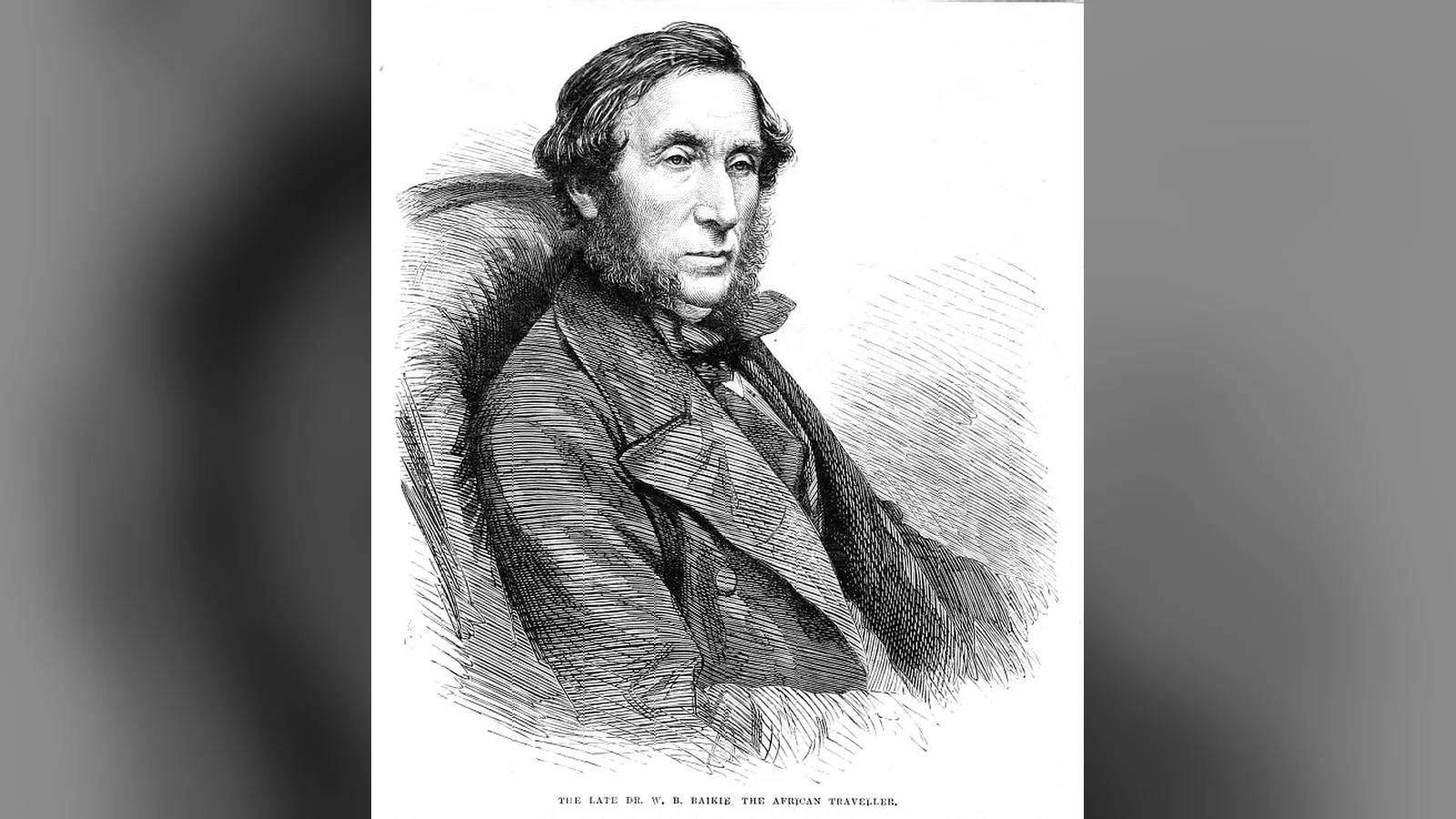

William Balfour Baikie (1825–1864): The Orkney Doctor Who Took Quinine up the Niger
Contents
Earlier British expeditions up the Niger had been wrecked by fever: the government's three steamers of 1841 lost so many men that the river was thought a death sentence for Europeans. In 1854 a small iron steamer, the Pleiad, was sent up the Niger and its great eastern branch, the Benue, with as few white men as possible, in the rainy season, and with a new rule: every European was to take quinine as a preventive. When the expedition's leader died before it started, its 29-year-old surgeon and naturalist, William Balfour Baikie, a naval doctor from Kirkwall, took command. He took the Pleiad hundreds of miles up the Benue, farther than any European had gone, and brought all twelve Europeans home alive.
TL;DR
- established The Pleiad, an iron screw schooner built at Birkenhead for Macgregor Laird, was sent in 1854 to explore the Benue, which Heinrich Barth had crossed far upstream in 1851, and to help Barth and Vogel.
- established Baikie went as medical officer and naturalist. When the leader, the Consul Mr Beecroft, died at Fernando Po, Baikie took over the expedition.
- established The Pleiad left Fernando Po on 8 July 1854 with twelve Europeans and fifty-three Africans, including the Yoruba missionary Samuel Crowther.
- established Finding the ship's master obstructive, Baikie took full charge and pushed on up the Benue. On 29 September 1854 his boat party turned back at Dulti, he reckoned some fifty or sixty miles short of the Faro, where Barth had crossed.
- established Using "the free use of quinine", the expedition returned to Fernando Po in November with no European deaths. Baikie argued that, with proper precautions, Europeans could survive in the river.
Key Facts
- Born
- 1825, Kirkwall, Orkney (general knowledge; not in the source)
- Profession
- Naval surgeon (M.D.); wrote the Narrative at Haslar Hospital
- Expedition
- Pleiad, Niger and Benue rivers, July–November 1854
- Ship
- Iron screw schooner, 260 tons, 100 ft, built by John Laird, Birkenhead
- Party
- 12 Europeans and 53 Africans, including 33 Kru seamen
- Farthest point
- Dulti, on the Benue, 29 September 1854
- Result
- No European deaths; quinine used as a preventive
- Died
- 1864, Sierra Leone (general knowledge; after the source)
- Related
- Great Scots stories: Hugh Clapperton, Alexander Gordon Laing; Great Scots 79, Mungo Park
- Main source
- William Balfour Baikie, Narrative of an Exploring Voyage up the Rivers Kwóra and Bínue (commonly known as the Niger and Tsádda) in 1854 (John Murray, London, 1856)
A Note on Claims and Evidence
Each major claim carries one of three labels. established means supported by primary records, official bodies or several independent reliable sources. shared means the core fact is sound but sources disagree on details, dates or interpretation. traditional means widely repeated but not traceable to a primary or independent source.
Baikie wrote the Narrative at Haslar Hospital in 1855–56, partly to defend himself: he says the quarrels on board had by then "been made the subject of judicial proceedings", and his account of the ship's master, Mr Taylor, is that of one side. He was a careful observer who recorded languages, traditions and natural history, and he hoped the book would "excite a warmer feeling towards the ill-treated African", but he writes in the terms of his day, calling some of the people he met "savages".
The book ends in 1854. His birth in Orkney, his later expedition of 1857 and his death in 1864 are general knowledge, not from the source.
Timeline
Born in Kirkwall (general knowledge).
Laird and Oldfield's expedition reaches Dagbo on the Benue.
The government's Niger expedition is destroyed by fever.
Heinrich Barth crosses the upper Benue.
The Pleiad sails from Dublin.
Baikie sails from Plymouth by the mail packet.
Hears of Beecroft's death at Accra, on the way out.
The Pleiad leaves Clarence, Fernando Po.
Passes the Niger–Benue confluence; Baikie takes full command.
Turns back at Dulti.
Returns to Fernando Po; the Pleiad leaves for England on 29 November.
The Narrative is published.
Dies in Sierra Leone (general knowledge).
Details
The deadly river
established Baikie begins with the history of the Niger. Richard and John Lander had traced it to the sea; in 1833 Macgregor Laird and Mr Oldfield took steamers up it, and William Allen charted the Benue, then called the Tsadda, as far as Dagbo. The government's expedition of 1841, with three steamers, ended in "a fearful amount of sickness and loss of life", which confirmed the river's reputation. Then, in 1851, Heinrich Barth, crossing Africa from the north, crossed a great river in Adamawa that he guessed was the upper Benue. The Admiralty sent a ship to find out, and to help Barth and his colleague Vogel.
The Pleiad
established Laird had the Pleiad built at John Laird's yard at Birkenhead: an iron screw schooner of 260 tons, 100 feet long, drawing six or seven feet. The plan had three new features: as few white men as possible, entering the river with the rising waters of the rainy season, and quinine taken as a preventive. The Consul at Fernando Po, Mr Beecroft, was to lead, with Baikie as medical officer and naturalist. On the way out Baikie learned at Accra that Beecroft had died about ten days before. With Samuel Crowther, the Yoruba missionary, and a mixed crew including thirty-three Kru seamen, the Pleiad left Clarence on 8 July.
Taking command
established After thirty-six days in the river the Pleiad had still not reached Dagbo, the point Allen and Oldfield had reached twenty-one years earlier. Baikie blamed the master, Thomas Taylor, for "apathy and indecision" and for quarrels with his officers; Taylor believed they had reached the end of the navigable river. Baikie "assumed the entire responsibility and direction", made the chief mate, Harcus, sailing-master, and ordered steam for seven the next morning.
Up the Benue
established The Pleiad steamed far up the Benue, past the Igbira and Djuku (Jukun) countries, while Baikie mapped the river, named landmarks and recorded languages. Leaving the ship, he went on by boat. At Dulti, where the village stood in the floodwater, a crowd tried to seize the party and its instruments, and the boat escaped. On 29 September he turned back, reckoning he was fifty or sixty miles from the Faro, where Barth had crossed, and having added about thirty miles to the chart on the last leg alone. He was glad that "the first visit of Europeans to these wild regions" had not ended in bloodshed.
Quinine
established Baikie wrote that, apart from some cases of scurvy, there had been very little sickness, and that the only specific medical measure had been "the free use of quinine". He himself slept on deck, rose at midnight and three in the morning to take readings, and went ashore in swamps by day and night, yet kept his health in the river. "Under proper precautions," he concluded, "Europeans may not only live quietly, but even commit with impunity what, some years ago, would have been considered as terrible indiscretions." Crowther, writing to him at Fernando Po, gave thanks that the health of "all the Europeans" had been preserved.
Did You Know?
- The Pleiad drew only six or seven feet of water.
- Baikie took over the expedition because its leader died before it started.
- The ship carried twelve Europeans and fifty-three Africans.
- He got up at midnight and at three in the morning to read his instruments.
- No European on the expedition died.
FAQ
1Who was William Balfour Baikie?
An Orkney-born naval surgeon who led the 1854 Pleiad expedition up the Niger and Benue, and later worked for years on the Niger.
2Why does the 1854 expedition matter?
It went farther up the Benue than any European before it and lost no Europeans, largely thanks to quinine taken as a preventive.
3What were the Kwora and Binue?
Local names for the Niger and its eastern branch, the Benue.
4Who was Samuel Crowther?
A Yoruba missionary who sailed with the expedition; he later became the first African Anglican bishop (general knowledge).
Sources and Further Reading
Primary
- William Balfour Baikie, Narrative of an Exploring Voyage up the Rivers Kwóra and Bínue … in 1854 (John Murray, London, 1856). Free scan at the Internet Archive. The source for this story.
Further reading (not consulted directly)
- Samuel Crowther, Journal of an Expedition up the Niger and Tshadda Rivers (Church Missionary House, 1855).
- Philip D. Curtin, The Image of Africa (University of Wisconsin Press, 1964), on quinine and European mortality.
Caveats: Myths and Disputed Claims
- Quinine. Baikie shows that quinine worked on this voyage; he was not the first to suggest it, and the plan was laid down before he took command.
- The quarrel with Taylor. Told from Baikie's side; the dispute went to law.
- "First". Earlier expeditions had reached the lower Benue; Baikie's claim is to have gone farther, not to have been the first.
Finished reading? Try the Fact Machine: three reels, one surprising Scottish connection →
A Great Scots story