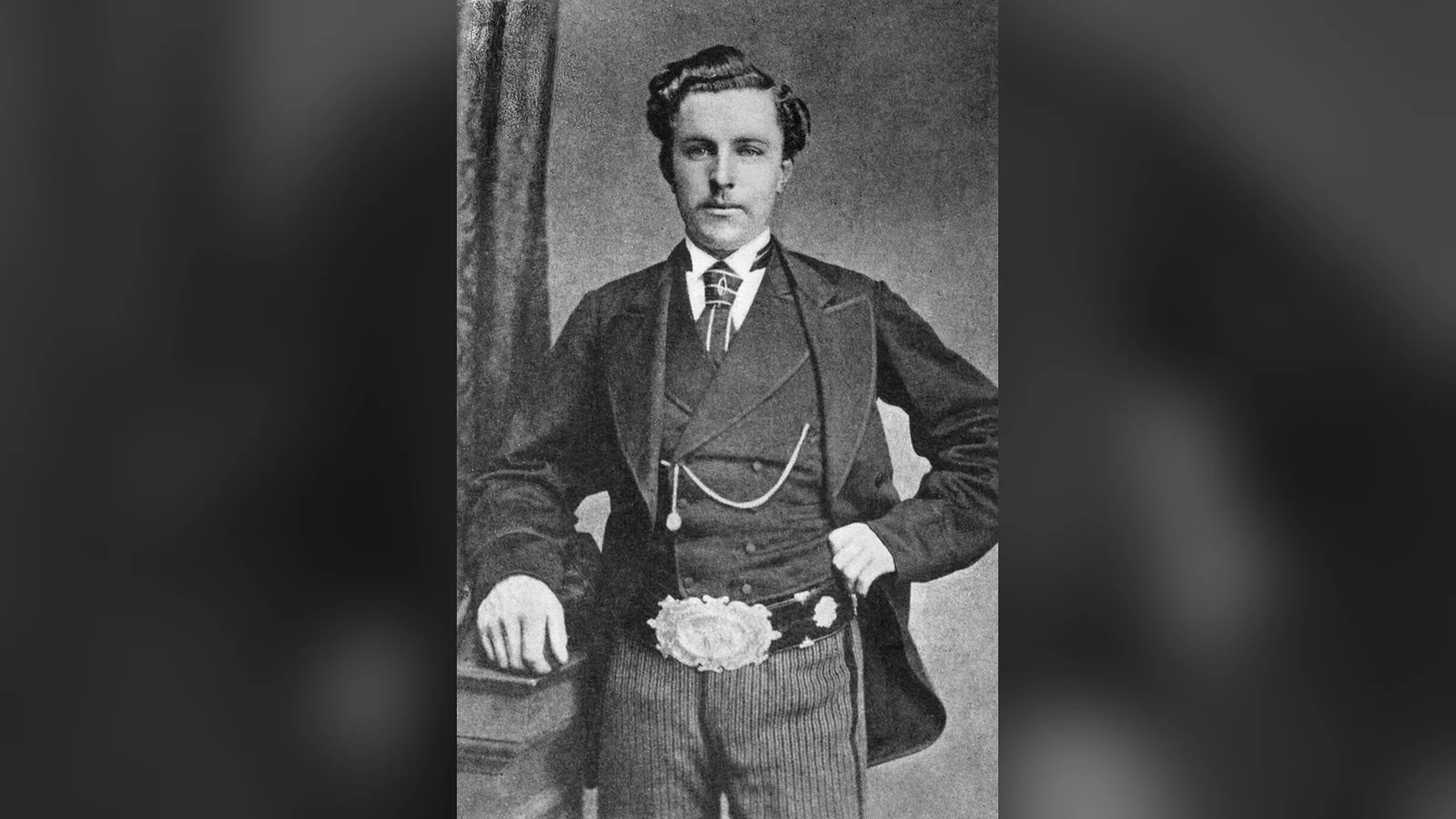

Young Tom Morris (1851–1875): Four Opens in a Row and Dead at Twenty-Four
Contents
Tommy Morris won the Open Championship at seventeen and then won the next three. No one has won four in a row since. He took the original trophy, the Challenge Belt, home for good, which is why golf's oldest championship is now played for a claret jug. He died in his father's house on Christmas morning 1875, aged twenty-four, three months after his wife and their baby. St Andrews said he died of a broken heart. The main source is Kevin Cook's Tommy's Honor (2007), the fullest modern account. What the record shows is kept apart from what the town came to believe.
TL;DR
- established Thomas Morris junior was born in St Andrews in the spring of 1851, the son of the golfer and greenkeeper Tom Morris, and grew up at Prestwick, where his father built the course on which the first Opens were played.
- established He won the Open in 1868, 1869, 1870 and 1872. No championship was held in 1871. He was seventeen at the first win and remains the youngest winner.
- established His third win, in 1870, gave him permanent possession of the Challenge Belt. His score of 149 over thirty-six holes at Prestwick was twelve strokes clear of the field.
- established In the 1869 Open he holed his tee shot at Prestwick's Station Hole, the first hole-in-one recorded in professional golf.
- established He married Margaret Drinnen at Whitburn on 25 November 1874. She died in childbirth in September 1875 with their stillborn son.
- traditional He is said to have died of a broken heart. The doctor called at the time gave the cause as internal bleeding, and a modern surgeon quoted by Cook attributes it to a pulmonary embolism.
Key Facts
- Born
- Spring 1851, St Andrews, Fife
- Died
- 25 December 1875, 6 Pilmour Links, St Andrews, aged 24
- Parents
- Tom Morris (1821–1908), greenkeeper and four-time Open champion, and Nancy Bayne
- Schooling
- Ayr Academy, until about the age of twelve
- Open Championships
- 1868, 1869, 1870, 1872, all at Prestwick
- Record score
- 149 for thirty-six holes, 1870
- Trophies
- The Challenge Belt, won outright in 1870; first winner under the three-club arrangement that led to the Claret Jug, 1872
- Married
- Margaret Drinnen, Whitburn parish church, 25 November 1874
- Buried
- St Andrews Cathedral churchyard; monument unveiled September 1878
- Main source
- Kevin Cook, Tommy's Honor (Gotham Books, 2007)
A Note on Claims and Evidence
Each major claim carries one of three labels. established means supported by primary records, official bodies or several independent reliable sources. shared means the core fact is sound but sources disagree on details, dates or interpretation. traditional means widely repeated but not traceable to a primary or independent source.
Scores, dates and prize money for the Opens and the big money matches were printed at the time in The Field and the Fife and Ayrshire newspapers, and Cook quotes them. They are secure.
Cook writes as a storyteller. He reconstructs scenes, thoughts and conversations that no record preserves. Those passages have not been used here. Where he gives a date, a score, a sum of money or a quotation from a named newspaper or memoir, he is followed.
What Tommy died of was not established by any examination that survives. The article gives the contemporary report and the modern opinion and treats the broken heart as the town's tradition.
Timeline
Born in St Andrews. He is given the name of an elder brother who had died in childhood. The family moves to Prestwick the same year.
Aged twelve or thirteen, beats a local prodigy, William Grieg, in a boys' match staged beside a professional tournament at Perth, for a prize of £5.
The Morrises return to St Andrews, where his father becomes keeper of the green.
Wins a tournament at Carnoustie against thirty professionals after a play-off with Willie Park and Bob Andrew. The first prize is £8.
Wins the Open at Prestwick, aged seventeen, with 154, beating the record by eight strokes. His father is second.
Wins again. In the first round he holes out from the tee at the Station Hole.
Wins a third time, with 149, and keeps the Belt.
No Open is held.
Prestwick agrees to share the championship with the Royal and Ancient and the Honourable Company. Tommy wins it days later, his fourth.
Marries Margaret Drinnen at Whitburn, West Lothian.
A telegram reaches his father during a match at North Berwick. Margaret dies after giving birth to a stillborn son.
Plays and wins a match over several days against Arthur Molesworth, the last rounds in snow.
Found dead in bed.
A monument paid for by sixty golf clubs is unveiled over his grave.
Details
Prestwick
established Tom Morris and his wife Nancy had already buried one son called Tom when their second was born in St Andrews in the spring of 1851. They gave him the same name. Within months the family moved to the Ayrshire coast, where the new Prestwick Golf Club had hired Morris to make a course out of dunes and rough grass. Members kept their clubs in the Morris cottage.
established Tommy was sent to Ayr Academy, where he sat beside the sons of Prestwick's gentlemen members. That was unusual for a professional's child. Caddies and club-makers were tradesmen, and most could expect no more than a parish school. He left at about twelve.
established In April 1864 his father took him to a professional tournament at Perth. He was too young to enter. The members of the Perth club arranged a match between him and a local boy, William Grieg, and collected a £5 prize, as much as the second-placed professional received. Tommy won easily. A newspaper wrote that he seemed "both born and bred to golf". Cook adds that his score would have won the main event.
The boy who beat the field
established The family went home to St Andrews at the end of 1864. In 1867, aged sixteen, Tommy entered a tournament at Carnoustie with a purse of £20, then the largest yet offered. Willie Park, the reigning Open champion, asked his father what he had brought the laddie for. Tommy tied for first with Park and Bob Andrew of Perth and beat them both in the play-off. A gambler offered his father good odds to back the boy. Tom Morris declined, on the ground that his son was "over-young".
established By 1868 father and son were playing as partners in money matches for stakes of ten to fifty pounds a day. That autumn Tommy won the Open at Prestwick. His three rounds of the twelve-hole course came to 154, eight strokes better than anyone had scored before. The local paper noted that he was the youngest man in the field. Cook says the next youngest was ten years older.
The Belt
established The prize was the Challenge Belt, red morocco leather with silver plates, given by the Prestwick club in 1860. The rules said that anyone who won it three years running could keep it.
established In the first round in 1869 Tommy came to the Station Hole, 166 yards across the dune called the Alps to a green behind a large bunker. His tee shot ran into the hole. It is the first hole-in-one recorded in professional play. He went round in 50 and won the championship again.
established In 1870 he began with a three at the first hole, which measured 578 yards and was the longest in tournament golf. He finished on 149. Davie Strath and Bob Kirk tied for second, twelve strokes back, and his father was thirteen behind. The amateur William Doleman worked out that 149 was two strokes above what he reckoned perfect play. The golf writer Bernard Darwin later calculated that over the three Belt years Tommy averaged nine strokes better than the runner-up.
established The Earl of Stair presented the Belt and it went back to St Andrews with him. Prestwick had no trophy and no plan, and no Open was held in 1871. On 11 September 1872 the club agreed to run the championship jointly with the Royal and Ancient Golf Club and the Honourable Company of Edinburgh Golfers, taking turns at Prestwick, St Andrews and Musselburgh. The first of the new series was played at Prestwick almost at once, for a purse of £20 with £8 to the winner. Tommy trailed Strath by five strokes with one round left and beat him by three. The silver claret jug that replaced the Belt had not yet been made; his name is the first on it.
The Rose Club
shared Cook presents Tommy as a professional who would not act like a servant. He and his friends formed the Rose Golf Club and in January 1872 held a ball in the town hall with the Belt hung on the platform, three months after the Royal and Ancient's own. Cook says the gentlemen who employed his father were offended and that Tom Morris spent weeks smoothing it over. The ball and the display of the Belt are reported in the St Andrews paper. The offence taken is Cook's reading.
Margaret Drinnen
established Margaret Drinnen came to St Andrews in 1872 to work as a maid in one of the large houses on The Scores. She was about thirty, some nine years older than Tommy, and the daughter of a pit worker at Whitburn in West Lothian. The banns were read in St Andrews on three Sundays in November 1874 and the wedding took place in her home parish on the 25th. Tommy's parents did not attend. His mother was bedridden. Cook takes his father's absence as a sign of disapproval.
established In September 1875 Tom and Tommy Morris were at North Berwick playing Willie and Mungo Park for £25 a side when a telegram came for the father, calling them home. He kept it in his pocket until the match was won. There was no train for hours. A member lent a yacht to take them across the Firth of Forth, and Old Tom told his son how serious it was only as they neared the harbour. Margaret was dead when they arrived. She was buried in the cathedral churchyard with her stillborn son in the same coffin.
The last match
established Tommy moved back into his father's house at 6 Pilmour Links. In the autumn Arthur Molesworth, an eighteen-year-old amateur from Westward Ho in Devon, challenged him to a match over several days, with Molesworth receiving strokes. The Field called the weather the worst the game had seen. On Saturday 4 December the links lay under snow and the balls were painted red so that they could be found. More than a thousand people watched. When heavy snow fell again the umpire ruled the course unfit, the Molesworths said a delay would inconvenience them, and Tommy agreed to go on. A friend recalled him saying that he continued only for the sake of those who had backed him. He won.
established Afterwards he was seen about the town looking ill and low. He spent two days in Edinburgh before Christmas, came back for the Watch Night service on Christmas Eve, had supper with friends and reached home at about eleven. In the morning he was found dead in bed, with a little blood at his mouth. The doctor said death had resulted from internal haemorrhage.
traditional The belief that he died of grief took hold at once and has never let go. His father did not accept it. Asked about it later, Tom Morris said that if a broken heart could kill a man, he would not be alive himself: within little more than a year he had buried his son, his daughter-in-law, two grandsons and his wife. David Malcolm, a St Andrews surgeon and golf historian quoted by Cook, puts the death down to a pulmonary embolism arising from an inherited weakness that might have killed him at any time.
established The funeral cost his father more than £100. In September 1878 a monument was unveiled in the south wall of the cathedral churchyard, paid for by sixty golf societies in Scotland and England. John Inglis, the Lord Justice General, performed the ceremony. It shows Tommy in tweeds and a Balmoral bonnet, addressing a ball.
Did You Know?
- The Open has a claret jug because a twenty-year-old won the original prize three times running and kept it.
- No Open was played in 1871 because there was nothing to play for.
- His winning score in a boys' match at Perth in 1864 would have won the men's tournament held the same week.
- The first recorded hole-in-one in professional golf was made during an Open, at a hole 166 yards long.
- His last match was played through snow with red balls.
- His father outlived him by thirty-two years and never believed the broken-heart story.
FAQ
1How many Opens did Young Tom Morris win?
Four: 1868, 1869, 1870 and 1872. All were at Prestwick.
2Why was there no Open in 1871?
He had won the Challenge Belt outright in 1870. The Prestwick club had no replacement trophy and had not yet agreed to share the event with other clubs.
3How old was he when he first won?
Seventeen. He is still the youngest winner of the Open.
4What happened to the Challenge Belt?
It became his property in 1870. Its later history is not covered here.
5Did he die of a broken heart?
That is the tradition. The doctor called on the morning he was found gave the cause as internal haemorrhage, and a modern medical opinion is pulmonary embolism.
6Who was his wife?
Margaret Drinnen, from Whitburn in West Lothian. They married in November 1874. She died in childbirth in September 1875.
7Did he ever play in partnership with his father?
Often. They were the best-known foursomes pair of the early 1870s and were playing together at North Berwick when news came of his wife's illness.
8Where is he buried?
In the grounds of St Andrews Cathedral, beneath a monument put up by public subscription in 1878.
Sources and Further Reading
Scholarly/Critical
- Kevin Cook, Tommy's Honor: The Story of Old Tom Morris and Young Tom Morris, Golf's Founding Father and Son (Gotham Books, 2007). The main source.
General
- W. W. Tulloch, The Life of Tom Morris (1908). The first biography of his father, quoted by Cook; not consulted directly.
Caveats: Myths and Disputed Claims
- Myth: He died of a broken heart. It is the town's story. The cause was physical, though which cause is uncertain.
- Myth: He won five Opens, or four in four years. He won four, in five years, with no contest in 1871.
- Disputed: whether his father withheld the news at North Berwick out of calculation. He kept the telegram until the match ended and softened the news on the crossing. Cook suggests he judged that minutes would make no difference. His motives are not recorded.
- Disputed: whether playing in the snow hastened his death. Friends thought so. Nothing proves it.
Finished reading? Try the Fact Machine: three reels, one surprising Scottish connection →
A Great Scots story