Hume on Miracles: How Much Evidence Would It Take?
Contents
In 1748 David Hume published an essay of about twenty pages that has been argued over ever since. "Of Miracles" asks a simple question: when someone tells us a miracle has happened, how far should we believe them? Hume's answer was that a wise person weighs the evidence, that the evidence for the laws of nature is about as strong as evidence gets, and that no human testimony is likely to outweigh it. The essay helped make Hume Scotland's most notorious sceptic and still shapes how scientists, lawyers and philosophers think about extraordinary claims. Some of the objections have never gone away.
TL;DR
- established "Of Miracles" is Section X of Hume's Philosophical Essays Concerning Human Understanding (1748), later retitled An Enquiry Concerning Human Understanding.
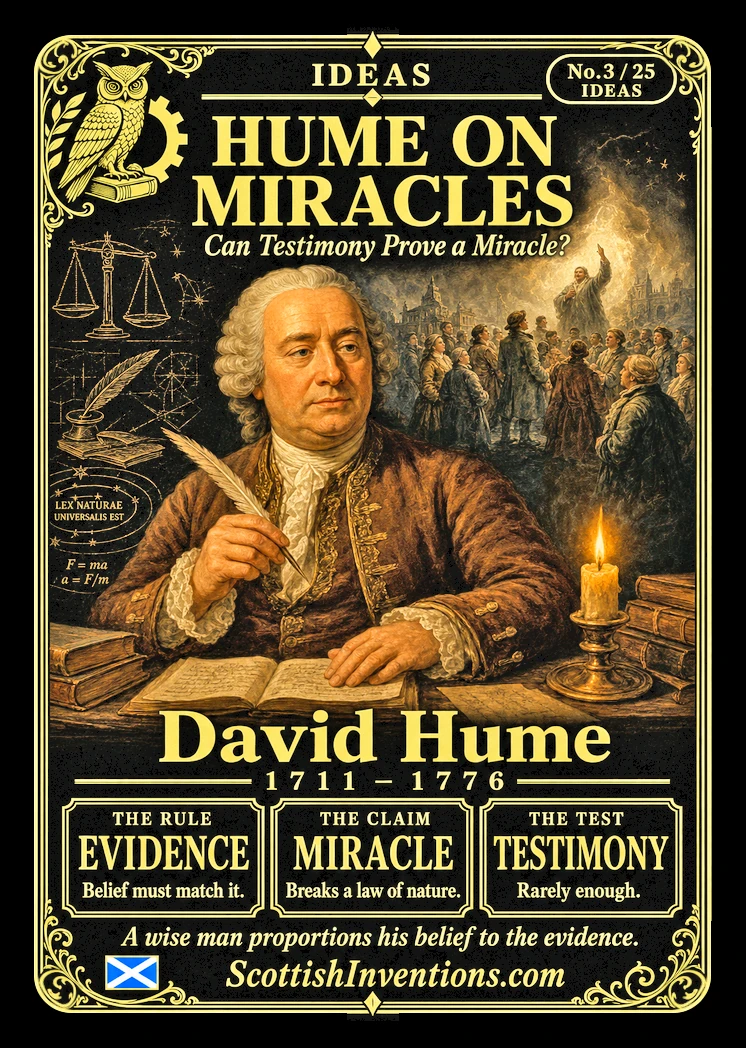
- established Its central principle is that "a wise man proportions his belief to the evidence". A miracle, which Hume defines as a violation of a law of nature, is contradicted by the uniform experience that established that law.
- established Hence his maxim: no testimony is enough to establish a miracle unless its falsehood would be more miraculous than the fact it reports.
- established In Part II he adds that testimony to miracles usually comes from credulous people, that humans love the marvellous, that miracle stories flourish among "ignorant and barbarous nations", and that rival religions' miracles cancel each other out.
- shared The essay was attacked at once, notably by George Campbell of Aberdeen (1762), and debate continues. Some modern philosophers, using probability theory, call it a landmark; others, such as John Earman, call it an "abject failure".
Key Facts
- Author
- David Hume (1711–1776)
- Published
- 1748, as Section X of Philosophical Essays Concerning Human Understanding
- Later title of the book
- An Enquiry Concerning Human Understanding (from 1758)
- Key principle
- "A wise man proportions his belief to the evidence"
- Definition of a miracle
- "A violation of the laws of nature"
- The maxim
- No testimony suffices unless its falsehood would be more miraculous than the fact
- Early critics
- George Campbell, A Dissertation on Miracles (1762); Richard Price
- Modern critique
- John Earman, Hume's Abject Failure (Oxford University Press, 2000)
- Modern echo
- "Extraordinary claims require extraordinary evidence" (popularised by Carl Sagan)
Scottish Impact Index (SI Score)
- Intellectual Influence
- 9/10
- Enduring Relevance
- 10/10
- Practical Consequences
- 6/10
- Originality of Thought
- 9/10
- Intellectual Legacy
- 9/10
- Recognition
- 8/10
51/60
Ranked #10 of 25 in Ideas
A Note on Claims and Evidence
Each major claim carries one of three labels. established means supported by primary records, official bodies or several independent reliable sources. shared means the core fact is sound but sources disagree on details, dates or interpretation. traditional means widely repeated but not traceable to a primary or independent source.
The text of the essay is not in doubt. What it means is: scholars disagree about whether Hume argued that miracles cannot happen, cannot be known to happen, or simply that it is never reasonable to believe reports of them. Interpretations are labelled Shared.
Timeline
Hume born in Edinburgh.
A Treatise of Human Nature; Hume reportedly holds back a discussion of miracles to avoid offence.
Hume's candidacy for the chair of moral philosophy at Edinburgh fails amid accusations of atheism.
Philosophical Essays Concerning Human Understanding, including "Of Miracles".
Hume fails to obtain a chair at Glasgow.
The book is retitled An Enquiry Concerning Human Understanding.
George Campbell publishes A Dissertation on Miracles in reply.
Richard Price publishes a reply and Thomas Bayes's essay on probability, which Price edited.
Hume dies in Edinburgh, calmly unbelieving, to the dismay of some visitors.
John Earman publishes Hume's Abject Failure.
Details
The argument
established Hume begins with a general rule for evidence: "A wise man ... proportions his belief to the evidence." Where experience has been uniform, we have what he calls a proof; where it has been mixed, only a probability. Testimony is a form of evidence, and we trust it because experience shows that witnesses usually tell the truth. But our trust is always balanced against what the testimony asserts.
established A miracle, Hume says, is "a violation of the laws of nature". The laws of nature are established by "a firm and unalterable experience": we have never seen the dead walk again. So any report of a miracle has against it the whole weight of experience that established the law it breaks. From this he draws his maxim: "no testimony is sufficient to establish a miracle, unless the testimony be of such a kind, that its falsehood would be more miraculous, than the fact, which it endeavours to establish."
Part II: the case against the witnesses
established In the second part of the essay Hume argues that, in practice, testimony to miracles never comes close to that standard. He gives four reasons: no miracle has ever been attested by enough educated, honest and independent witnesses; people love to wonder and to spread marvellous tales; miracle stories are found chiefly "among ignorant and barbarous nations"; and the miracles claimed by rival religions undermine one another, since each is offered as proof of a different faith.
shared Hume's argument is often read as aimed at the foundations of Christianity, since the resurrection was offered as proof of revealed religion. He closed with an ironic claim that Christianity is founded on faith, not reason, a remark many readers took as mockery.
Reception
established The essay made Hume notorious. He had already failed to win the chair of moral philosophy at Edinburgh in 1745 amid accusations of atheism, and he failed again at Glasgow in 1751. Replies poured out. The most respected came from the Aberdeen minister George Campbell, whose Dissertation on Miracles (1762) argued that our trust in testimony is natural and not simply derived from experience, and that well-attested testimony could outweigh experience. Hume and Campbell corresponded courteously.
shared The Welsh minister Richard Price, who edited and published Thomas Bayes's essay on probability in 1763, also used probabilistic reasoning against Hume, arguing that testimony could make even very improbable events credible. Some historians think Bayes's work was partly a response to Hume.
The modern debate
shared Philosophers still argue about what Hume proved. Some read him as saying miracles are impossible by definition, which would beg the question. Most now read him as making a claim about evidence: that it is never reasonable to believe a report of a miracle on testimony alone. Using modern probability theory, defenders argue his maxim is essentially correct; the philosopher John Earman, in Hume's Abject Failure (2000), argues that Hume's reasoning is confused and his conclusion unsupported.
established Hume's idea survives in everyday reasoning. Carl Sagan's slogan "extraordinary claims require extraordinary evidence", in law, science and journalism, is a direct descendant.
Did You Know?
- "Of Miracles" is only about twenty pages long.
- It first appeared in a book called Philosophical Essays, not the Enquiry.
- Hume twice failed to become a professor, partly because of his reputation for unbelief.
- His sharpest critic, George Campbell, corresponded with him politely.
- Thomas Bayes's famous theorem was published, by Richard Price, in the middle of the debate.
- Carl Sagan's "extraordinary claims require extraordinary evidence" echoes Hume.
FAQ
1What did Hume argue about miracles?
That a wise person proportions belief to evidence, and that testimony to a miracle can never outweigh the evidence for the law of nature it breaks.
2Did Hume say miracles are impossible?
Most scholars think he argued only that it is never reasonable to believe reports of them on testimony.
3Where was it published?
As Section X of his Philosophical Essays Concerning Human Understanding (1748), later the Enquiry.
4Who answered him?
George Campbell of Aberdeen and Richard Price, among many others.
5Is the argument still debated?
Yes. Some philosophers defend it with probability theory; others, like John Earman, reject it.
Sources and Further Reading
Primary/Institutional
- David Hume, An Enquiry Concerning Human Understanding, Section X, "Of Miracles" (1748)
- George Campbell, A Dissertation on Miracles (1762)
Scholarly/Critical
- John Earman, Hume's Abject Failure: The Argument Against Miracles (Oxford University Press, 2000)
- Robert J. Fogelin, A Defense of Hume on Miracles (Princeton University Press, 2003)
- James A. Harris, Hume: An Intellectual Biography (Cambridge University Press, 2015)
General
- Wikipedia, "Of Miracles" — https://en.wikipedia.org/wiki/Of_Miracles
Caveats: Myths and Disputed Claims
- Myth: Hume claimed that miracles are impossible. Most scholars now read him as making a claim about evidence: that it is never reasonable to believe a report of a miracle on testimony alone. Some readers disagree, and reading him as ruling miracles out by definition would beg the question.
- Myth: "Of Miracles" first appeared in the Enquiry. It appeared in 1748 as Section X of Philosophical Essays Concerning Human Understanding, which was retitled An Enquiry Concerning Human Understanding in 1758.
- Myth: Hume said "extraordinary claims require extraordinary evidence". That is Carl Sagan's slogan, a later descendant of Hume's maxim about proportioning belief to evidence.
- Disputed: Whether the argument works. Defenders use modern probability theory to argue his maxim is essentially correct. John Earman calls the essay an "abject failure", and George Campbell and Richard Price argued against it in the eighteenth century.
Finished reading? Try the Fact Machine: three reels, one surprising Scottish connection →
Card 003 · Ideas