The Claim of Right: Who Is Sovereign in Scotland?
Contents
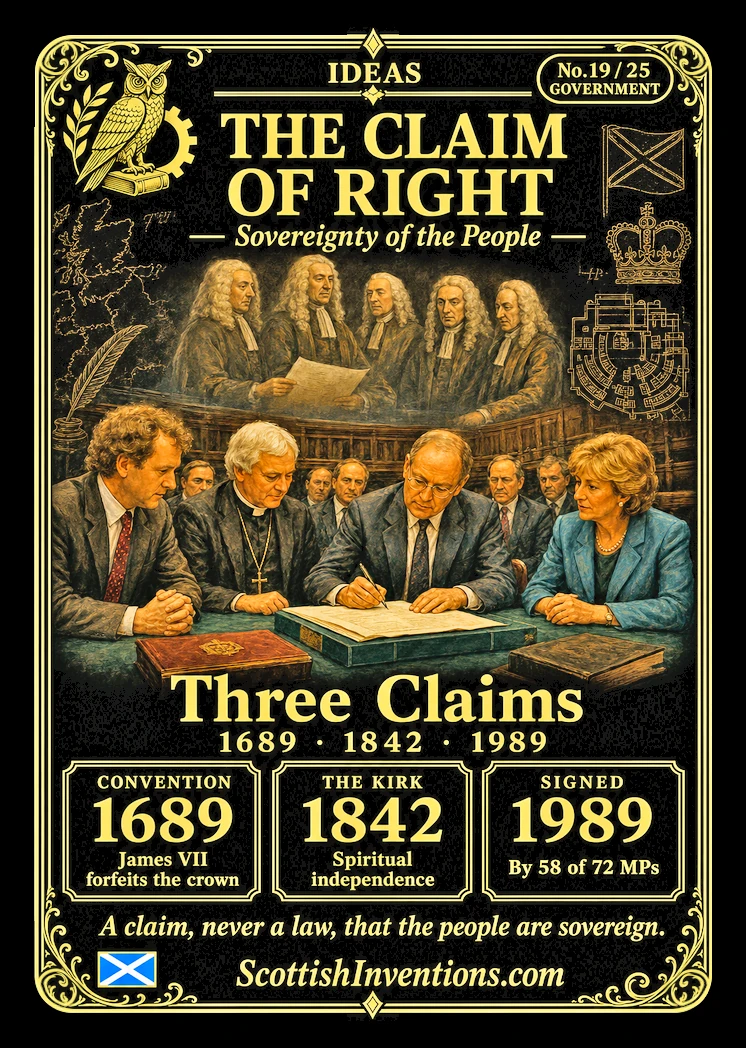
Three times in Scottish history, a document called a Claim of Right has asked who holds power in Scotland and on what terms. In 1689 the Scottish Convention of Estates declared that James VII had forfeited his throne by breaking the law. In 1842 the Church of Scotland claimed independence from the civil courts. And in 1988–89 a cross-party campaign declared "the sovereign right of the Scottish people to determine the form of Government best suited to their needs", a phrase that led to the Scottish Parliament and still frames the independence debate. The idea that sovereignty in Scotland rests with the people holds only partly in law.
TL;DR
- established The Claim of Right Act 1689 was passed by the Scottish Convention of Estates. It declared that James VII had forfeited the crown by his misgovernment and offered it to William and Mary on conditions, going further than the English Bill of Rights.
- established In 1842 the Church of Scotland's General Assembly adopted a Claim of Right asserting its spiritual independence from the civil courts; its rejection led to the Disruption of 1843.
- established A Claim of Right for Scotland (1988), from the Campaign for a Scottish Assembly, was signed on 30 March 1989 by 58 of Scotland's 72 MPs and many councils, churches and civic bodies. It acknowledged "the sovereign right of the Scottish people to determine the form of Government best suited to their needs".
- established It launched the Scottish Constitutional Convention, whose plans shaped the Scottish Parliament created in 1999. The Scottish Parliament endorsed its principle in 2012 and the House of Commons in July 2018.
- shared The 1989 Claim has never had legal force. UK constitutional law rests on the sovereignty of Parliament, and in 2022 the Supreme Court ruled that the Scottish Parliament could not legislate for an independence referendum without Westminster's consent.
Key Facts
- 1689 Claim of Right
- Act of the Convention of Estates, April 1689; James VII "forfaulted" the crown
- 1842 Claim of Right
- Church of Scotland General Assembly; spiritual independence of the Church
- 1988 report
- A Claim of Right for Scotland, Campaign for a Scottish Assembly
- 1989 signing
- 30 March 1989, General Assembly Hall, the Mound, Edinburgh
- Signatories
- 58 of 72 Scottish MPs, 7 of 8 MEPs, 59 of 65 councils, plus parties, churches and civic groups
- Key phrase
- "the sovereign right of the Scottish people to determine the form of Government best suited to their needs"
- Boycotted by
- The Conservatives and the SNP; Labour's Tam Dalyell declined to sign
- Outcome
- Scottish Constitutional Convention; Scottish Parliament, 1999
- Later endorsements
- Scottish Parliament, January 2012; House of Commons, July 2018
- Legal status
- None; a political declaration
Scottish Impact Index (SI Score)
- Intellectual Influence
- 7/10
- Enduring Relevance
- 9/10
- Practical Consequences
- 8/10
- Originality of Thought
- 7/10
- Intellectual Legacy
- 8/10
- Recognition
- 6/10
45/60
Ranked =19th of 25 in Ideas
A Note on Claims and Evidence
Each major claim carries one of three labels. established means supported by primary records, official bodies or several independent reliable sources. shared means the core fact is sound but sources disagree on details, dates or interpretation. traditional means widely repeated but not traceable to a primary or independent source.
The idea of Scottish popular sovereignty is often traced back further, to the Declaration of Arbroath (1320) and the political thought of George Buchanan. Those links are real but interpretive, and are labelled Shared. The legal effect of each Claim is a matter of record.
Timeline
The Declaration of Arbroath says the nobles would remove even Robert the Bruce if he betrayed the kingdom.
George Buchanan's De Jure Regni apud Scotos argues that kings rule by the people's consent.
James VII flees to France in the Revolution of 1688.
The Scottish Convention of Estates passes the Claim of Right and the Articles of Grievances, and offers the crown to William and Mary.
The Church of Scotland adopts its Claim of Right.
The Disruption.
A devolution referendum fails to meet a 40 per cent threshold.
A Claim of Right for Scotland published.
The Claim is signed at the General Assembly Hall; the Scottish Constitutional Convention begins.
The Convention publishes Scotland's Parliament, Scotland's Right.
Devolution referendum.
The Scottish Parliament opens.
The Scottish Parliament endorses the Claim's principle.
Independence referendum: 55 per cent vote No.
The House of Commons endorses the Claim's principles in a non-binding debate.
The UK Supreme Court rules that a referendum bill is outside Holyrood's powers.
Details
1689: a king who forfeited his crown
established After James VII fled to France in the Revolution of 1688, the Scots summoned a Convention of Estates in Edinburgh. In April 1689 it passed the Claim of Right, which listed James's breaches of law and declared that he had "forfaulted" (forfeited) his right to the crown. The Convention offered the throne to William and Mary on conditions, set out with the Articles of Grievances, which led to the abolition of bishops in the Church of Scotland.
shared The Scottish Claim went further than the English Bill of Rights, which said James had "abdicated". Saying a king had forfeited the crown implied that the Estates could judge and remove a monarch who broke the law. Historians see this as a distinctively Scottish, contractual idea of monarchy, with roots in George Buchanan's argument of 1579 and, some argue, in the Declaration of Arbroath.
1842: the Church claims its independence
established In May 1842, during the Ten Years' Conflict over patronage, the General Assembly of the Church of Scotland adopted its own Claim of Right, declaring that the civil courts had no authority over the Church's spiritual affairs. Parliament rejected it, and in 1843 more than a third of the Church's ministers left to form the Free Church.
1988–89: a claim for Scotland
established After the failed devolution referendum of 1979 and a decade of Conservative government with little support in Scotland, the Campaign for a Scottish Assembly commissioned a group of prominent Scots to report on how Scotland should be governed. Their report, A Claim of Right for Scotland, published in 1988, argued that Scotland's governance lacked consent and called for a constitutional convention.
established On 30 March 1989, at the General Assembly Hall on the Mound in Edinburgh, the Claim was signed by 58 of Scotland's 72 MPs, 7 of its 8 MEPs and 59 of its 65 local councils, along with political parties, churches, trade unions and civic organisations. Its opening words acknowledged "the sovereign right of the Scottish people to determine the form of Government best suited to their needs". The Conservatives refused to take part, the SNP withdrew from the process, and Labour's Tam Dalyell declined to sign.
established The signatories formed the Scottish Constitutional Convention, which drew up detailed plans for a Scottish Parliament. Those plans shaped the 1997 referendum and the Scotland Act 1998, and the Parliament opened in 1999.
Endorsements and limits
established In January 2012 the Scottish Parliament passed a motion acknowledging the sovereign right set out in the Claim. In July 2018 the House of Commons, in a non-binding debate, endorsed the principles of the Claim as agreed in 1989 and endorsed by Holyrood in 2012.
established The Claim has never had legal force. UK constitutional law rests on the doctrine of the sovereignty of the Westminster Parliament. In November 2022 the UK Supreme Court ruled unanimously that a bill for a second independence referendum would relate to reserved matters and was therefore outside the Scottish Parliament's powers.
shared The tension is the point of the idea. Supporters say popular sovereignty is a long Scottish constitutional tradition that Westminster has politically acknowledged; opponents say it is a political slogan without legal standing. Lord Cooper's remark in MacCormick v Lord Advocate (1953) that unlimited parliamentary sovereignty was "a distinctively English principle which has no counterpart in Scottish constitutional law" is often quoted on one side; the 2022 judgment on the other.
Did You Know?
- In 1689 the Scots said James VII had "forfaulted" the crown; the English said he had "abdicated".
- The 1842 Claim of Right led directly to the Disruption of the Church of Scotland.
- The 1989 Claim was signed in the same hall as the General Assembly of the Church of Scotland.
- 58 of Scotland's 72 MPs signed it.
- The House of Commons endorsed its principles in 2018 without giving them legal force.
FAQ
1What was the Claim of Right of 1689?
An Act of the Scottish Convention of Estates declaring that James VII had forfeited the crown and offering it to William and Mary on conditions.
2What did the 1989 Claim of Right say?
It acknowledged "the sovereign right of the Scottish people to determine the form of Government best suited to their needs".
3Did it lead to the Scottish Parliament?
Yes, through the Scottish Constitutional Convention.
4Is it legally binding?
No. It is a political declaration, and UK law rests on parliamentary sovereignty.
5Has Westminster recognised it?
The House of Commons endorsed its principles in a non-binding debate in July 2018.
Sources and Further Reading
Primary/Institutional
- Claim of Right Act 1689 (legislation.gov.uk, Acts of the Parliaments of Scotland)
- Scottish Government, "Scotland's right to decide" — https://www.gov.scot/publications/right-decide/pages/3/
- A Claim of Right for Scotland (Campaign for a Scottish Assembly, 1988)
Scholarly/Critical
- Owen Dudley Edwards (ed.), A Claim of Right for Scotland (Polygon, 1989)
- Lindsay Paterson, The Autonomy of Modern Scotland (Edinburgh University Press, 1994)
- Alasdair Raffe, "Scotland Restored and Reshaped: Politics and Religion, c.1660–1712", in T. M. Devine and Jenny Wormald (eds), The Oxford Handbook of Modern Scottish History (Oxford University Press, 2012) — further reading on the Claim of Right of 1689
- Iain McLean, "Challenging the Union", in T. M. Devine and Jenny Wormald (eds), The Oxford Handbook of Modern Scottish History (Oxford University Press, 2012) — further reading on the 1989 Claim of Right and the Constitutional Convention
General
- Wikipedia, "Claim of Right 1989" — https://en.wikipedia.org/wiki/Claim_of_Right_1989
Caveats: Myths and Disputed Claims
- Myth: The 1989 Claim of Right has legal force. It is a political declaration. UK constitutional law rests on the sovereignty of the Westminster Parliament, and in 2022 the Supreme Court ruled that Holyrood could not legislate for an independence referendum without Westminster's consent.
- Myth: The SNP signed the 1989 Claim. The Conservatives refused to take part and the SNP withdrew from the process. Labour's Tam Dalyell also declined to sign.
- Myth: The House of Commons accepted a legal right to independence in 2018. The July 2018 debate was non-binding, and it endorsed only the principles of the Claim as agreed in 1989.
- Disputed: A direct line from Arbroath (1320) to 1989. Links to the Declaration of Arbroath and to George Buchanan's argument of 1579 are real but interpretive. Supporters see a long Scottish tradition of popular sovereignty, while opponents call it a political slogan without legal standing.
Finished reading? Try the Fact Machine: three reels, one surprising Scottish connection →
Card 019 · Ideas