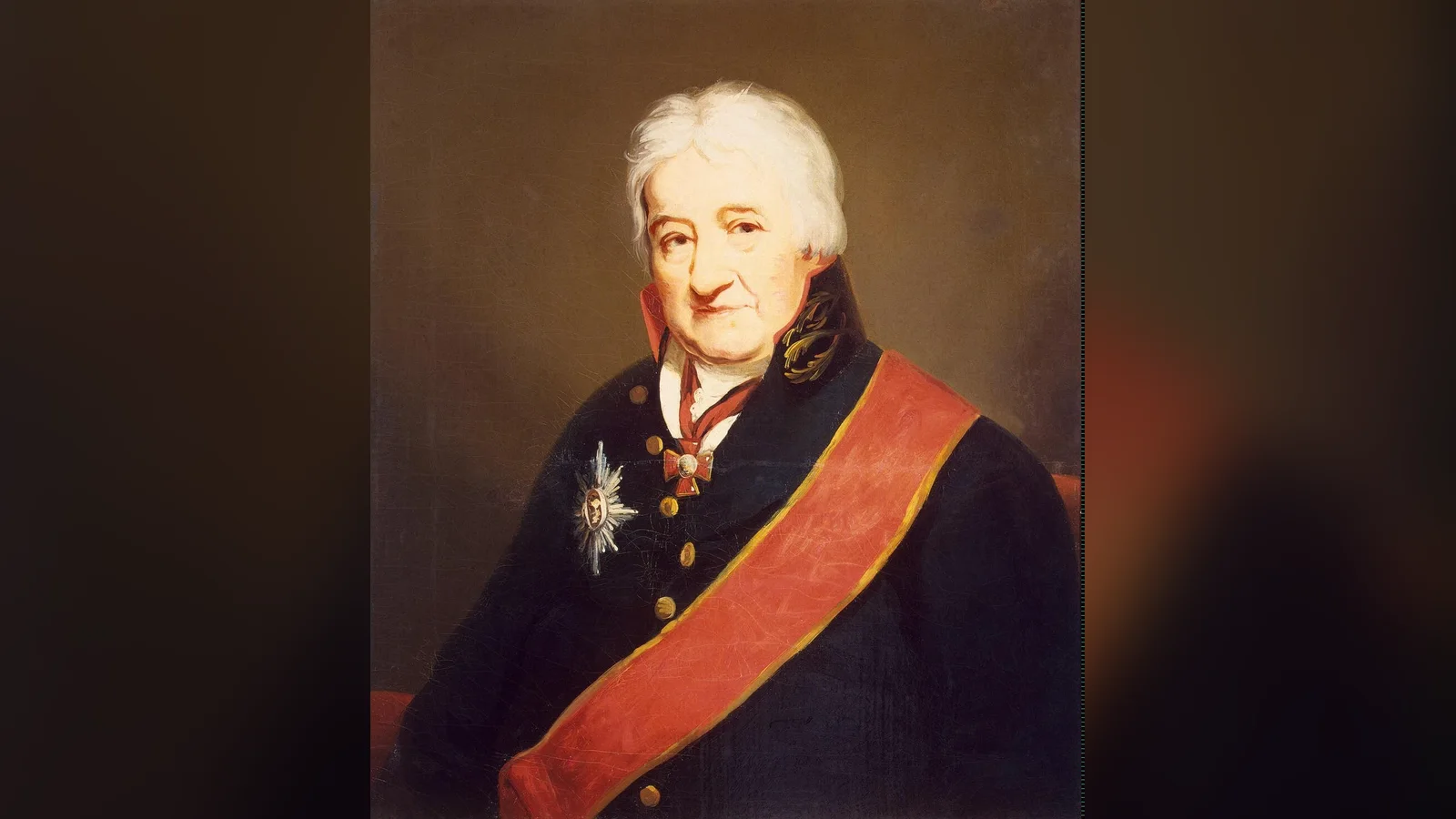

Charles Gascoigne (1738–1806): The Carron Manager Who Took Its Secrets to Russia
Contents
In 1786 the director of Scotland's greatest ironworks slipped away to Russia with eleven of his best men, to build the empress a cannon foundry on the Carron model. His former partners called it a crime. An English traveller who met him in 1800 called him a British outlaw. In Russia he was paid £2,500 a year, given 2,000 serfs and made a state councillor, and one of the works he founded became the most famous engineering plant in St Petersburg.
TL;DR
- established Gascoigne was director of the Carron Company near Falkirk and is credited with the short naval gun called the carronade.
- established In 1786 Admiral Samuel Greig, acting on Catherine the Great's orders, engaged him to set up a cannon foundry in Russia. He reached St Petersburg on 6 June.
- shared The Prime Minister, William Pitt, cleared him to go, but by Cross's account was told half the truth at most. Matthew Boulton and Gascoigne's former partner Samuel Garbett said the move broke the laws against exporting skilled men and machinery.
- established He rebuilt the Aleksandrovsk works at Petrozavodsk. The first gun passed proof on 22 April 1788.
- established He went on to found or reorganise works at Kronshtadt, Lugansk and Kolpino, and a foundry on the Peterhof road that later became the Putilov works.
- shared British contemporaries thought him a traitor. Russian historians have told the same events as a success for the state.
Key Facts
- Lived
- 1738–1806. Died July 1806.
- At Carron
- Director; produced, with John Smeaton, the plan for a steam engine to drain the docks at Kronshtadt (ordered 1774)
- Arrived in Russia
- 26 May/6 June 1786
- Associates
- Eleven, including James Baird, Charles Baird, Adam Armstrong and Josiah Roebuck
- Salary
- £2,500 a year, plus half of any saving on the agreed price of guns
- Russian honours
- Order of St Vladimir; Order of St Anna; 2,000 serfs (1797); actual state councillor (1798)
- Works
- Petrozavodsk and Konchezero (1786–89); Kronshtadt (1789); Lugansk (1795–99); Peterhof road foundry (1801); Izhora works at Kolpino (1803); Aleksandrovsk textile mill (1805)
- Main source
- Anthony Cross, By the Banks of the Neva (Cambridge University Press, 1997)
A Note on Claims and Evidence
Each major claim carries one of three labels. established means supported by primary records, official bodies or several independent reliable sources. shared means the core fact is sound but sources disagree on details, dates or interpretation. traditional means widely repeated but not traceable to a primary or independent source.
Cross does not say where Gascoigne was born, so he is not described here as a Scot. His importance to Scotland lies in Carron and in the Scottish workmen he took with him.
The account of his departure rests on Greig's letters to the Russian ambassador in London and on the complaints of Boulton and Garbett. Cross notes that a Russian scholar has written the episode up as a story of undercover agents and secret payments made to advance Russia's interests. The two national versions describe the same events with opposite sympathies.
The fullest evidence is a run of letters from Gascoigne to Greig between the autumn of 1786 and October 1788. After Greig's death the detail thins.
Timeline
Carron supplies a steam engine and fourteen workmen for the docks at Kronshtadt.
Greig negotiates Gascoigne's engagement. Gascoigne arrives in St Petersburg in June and leaves for Petrozavodsk in late August.
Greig visits the works and backs complete rebuilding.
The rebuilt No. 3 blast furnace goes into blast.
The first gun is proved and accepted.
The Konchezero foundry is finished. A small foundry opens at Kronshtadt.
His contract is renewed without limit of time.
The Lugansk foundry is established in southern Russia.
Receives 2,000 serfs at Paul I's coronation. Marries the teenage daughter of Dr Guthrie in November; they soon divorce.
President of the Board of the Olonets and Kronshtadt Works.
A dam bursts at Petrozavodsk.
Founds a state foundry on his own land on the Peterhof road.
Takes charge of rebuilding the Izhora works at Kolpino.
Dies.
Details
Leaving Carron
established Russia had bought guns and machinery from Carron for years, and Gascoigne had dealt with Russian orders as director. In 1786 Greig proposed something larger: that he come himself. Gascoigne attended his eldest daughter's wedding to Lord Haddington and then left the country. Cross uses the word "absconded".
shared Whether he broke the law depends on who is asked. He saw Pitt and was allowed to leave. Boulton and Garbett insisted that the real plan had been concealed and that it meant the illegal export of specialists and equipment. The British ambassador in St Petersburg was indignant, and the British community there cut both Gascoigne and Greig for a while. Years later Boulton, by then holding an approved Russian contract of his own, wrote that Gascoigne had a good income and lived in more splendour than he could ever have had at home.
Petrozavodsk
established His commission was to rebuild the state cannon works on Lake Onega and the older foundry at Konchezero, twenty-five miles away, so that they could turn out reliable guns "according to the Carron system". He arrived confident and was quickly sobered. His letters list the faults: a dam that leaked, badly made water wheels, local ore that was brittle when cold, no coal, a harsh climate and poor transport. He would have preferred to build nearer the sea.
established He was blunt about labour. Russian carpenters, he wrote, were the finest men with a hatchet he had ever seen, but they used no other tool, and a hatchet could not make a joint fit for machinery. His rule at Carron had been to hire the best workmen money could find for anything new, and he applied it. Men kept arriving from Scotland, some of them secretly.
established That created his most awkward problem. He still needed fire-bricks, axles and machine parts from Carron, and he knew what was said of him. He asked Greig to get the empress to order a hundred or so guns from Carron. Feeling in Scotland, he explained, was "outrageous" against him and the company, every eye was on them, and he could not get the hands and instruments he needed. A Russian order would quiet things.
established The works came together through 1787. A new blowing engine was finished in August, a fourth furnace started in September, and the first gun was accepted the following April. Many later guns failed the strict Russian proof. Even so the foundry became a principal supplier to the fleet and army, and it also made steam engines and ornamental castings.
A Scottish street on Lake Onega
established The men had come without their families. In 1787 one of them went home to fetch wives and children, and Gascoigne's youngest daughter came out with them. They built their own houses. A map of 1801 shows an "English Street" in Petrozavodsk. Cross reckons that about twenty-eight British specialists worked at the Olonets works in the 1790s. They seem to have formed their own masonic lodge.
Wealth and reputation
established His contract was renewed in 1789 and made open-ended in 1793. Under Paul I he rose fast, with a grant of serfs, orders of chivalry and high civil rank. He founded a foundry at Kronshtadt to recast old guns, surveyed the south for coal and built the Lugansk works near the Donets, and in 1801 set up a foundry on the Peterhof road on land of his own, for which he received government grants. That works later became the Putilov plant. In 1803 he took over the Admiralty's Izhora works at Kolpino, and within six months an admiral was writing that he had turned a ruin into a factory.
shared Cross does not flatter him. He made his fortune "by fair means and foul" and apparently borrowed freely from the works' account. The dam that burst at Petrozavodsk in 1800 may have failed because his rebuilding had blocked its relief channels, and the dam at Kolpino burst the year after he died.
established Charles Baird, who came out as his cannon-turning master, stayed in Russia and became a leading engineer and steamboat builder in St Petersburg.
Did You Know?
- Gascoigne asked the Russian empress to buy guns from the company he had just left, so that Scotland would stop watching him.
- He thought Russian workmen the best he had ever seen with a hatchet, and useless with anything else.
- One of the foundries he started became the Putilov works, later famous in the Russian revolutions.
- At sixty he married a teenager and was divorced on the ground of a disparity of age and disposition.
- Carron was still shipping him fire-bricks while its partners denounced him.
FAQ
1Who was Charles Gascoigne?
The director of the Carron ironworks, who entered Russian service in 1786 and reorganised the Russian state's cannon foundries.
2Was he Scottish?
The source used here does not give his birthplace. His career was made at Carron, near Falkirk.
3Did he invent the carronade?
Cross calls him its inventor and notes the alternative name "gasconade".
4Was it illegal for him to go?
His critics said so, under the laws restricting the emigration of skilled workers and the export of machinery. The government had let him leave.
5What did he achieve in Russia?
He rebuilt the Petrozavodsk works to cast guns by Carron methods and founded or reorganised four other major works.
6Who went with him?
Eleven men, among them James and Charles Baird, Adam Armstrong and Josiah Roebuck.
Sources and Further Reading
Scholarly/Critical
- Anthony Cross, By the Banks of the Neva: Chapters from the Lives and Careers of the British in Eighteenth-Century Russia (Cambridge University Press, 1997), chapters 5 and 6.
General
Caveats: Myths and Disputed Claims
- Disputed: traitor or pioneer. Both descriptions fit the facts. Which is chosen depends on whose interests are counted.
- Myth: the Wilsons came with him. Cross shows that Alexander Wilson, later head of two of his works, came to Russia separately and joined him only around 1800.
- Disputed: the quality of his guns. The works succeeded as a supplier, but many early guns failed proof.
Finished reading? Try the Fact Machine: three reels, one surprising Scottish connection →
A Industry story