
Links Golf
Contents
TL;DR
"Links" are the sandy, rolling coastal lands between the beach and farmland. They are where the Scottish game of golf grew up. Their firm, fast turf, dunes and wind shaped the game and gave rise to the word "links" for a golf course. Scotland's great links include the Old Course at St Andrews, Carnoustie, Muirfield, Royal Troon and Turnberry, which host the Open Championship. Musselburgh Links is often cited as the oldest playing golf course in the world.
Key Findings
- The word is old Scots. A "links" is sandy, undulating ground near the shore, poor for farming but perfect for golf.
- St Andrews set the standard. The Old Course established the 18-hole round in 1764, when its holes were reduced from 22 to 18.
- There are rival claims to be oldest. Musselburgh Links has documented golf from 1672 and is often called the oldest playing course, though golf was played at St Andrews and Leith earlier.
- Most Open venues are links. The Open Championship is always played on a links course, most often in Scotland.
- The links shaped the game. Wind, bunkers formed by sheltering sheep, and running shots along the ground all come from links golf.
Key Facts
- Definition
- Coastal sandy ground between beach and farmland
- Iconic courses
- St Andrews Old Course; Carnoustie; Muirfield; Royal Troon; Turnberry
- 18 holes
- St Andrews, 1764
- Oldest playing course claim
- Musselburgh (documented 1672)
- Open Championship
- Always played on links courses
Claim Status
established The definition, the St Andrews 18-hole standard and the Open venues.
shared "Oldest course" claims, which depend on the evidence and definitions used.
traditional That pot bunkers began as hollows where sheep sheltered. It is plausible and widely told, but hard to document.
Land Between
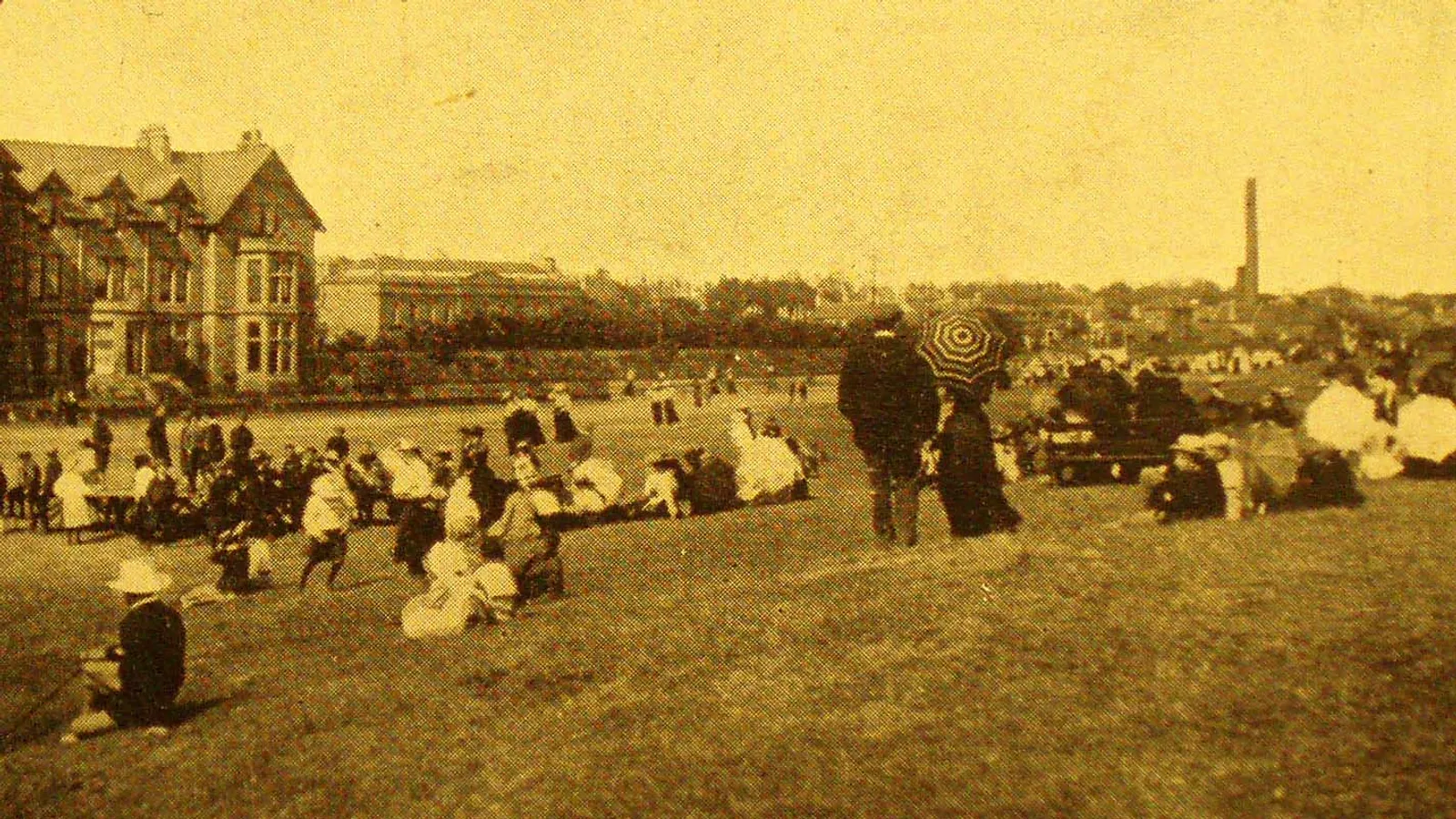
Links land, wind-blown sand stabilised by marram grass and fine turf, was common land in many Scottish burghs. Townsfolk used it for grazing, drying washing and games, including golf.
established Because the links were common ground, early golf on them was open to more than one class. The novelist Tobias Smollett described a "multitude of all ranks" on the links at Leith in the 18th century, and in 1810 the Musselburgh Golf Club recorded a prize for the best-scoring fishwife. The sports historian John Lowerson, in "Golf and the making of myths" in Grant Jarvie and Graham Walker (eds), Scottish Sport in the Making of the Nation (1994), warns against reading too much into this. Play by all classes on rough common land, he argues, was not the same as a universal following, and the game was confined for most of its history to a small part of the eastern Lowlands.
established The links were also contested. As clubs formed from the 18th century, some came to treat shared public links almost as private property. At Kilspindie, near Gullane, a landowner who leased links to the club for a shilling a year withdrew the lease in 1894 after members refused access to his tenants and workers. Lowerson singles out St Andrews and Dornoch as places that kept a reputation for open play under heavy pressure.
Making the Modern Game
Golf on the links demanded low, running shots and skill in the wind. Clubs such as the Honourable Company of Edinburgh Golfers (1744, Leith) and the Society of St Andrews Golfers (1754) wrote the early rules.
Links Today
Links golf draws golfers from around the world to Scotland, and its courses are recognised as part of the country's landscape heritage.
established Links tourism is older than it looks. From the 1880s railways opened up seaside courses to city golfers: North Berwick had a "golfing" express from Edinburgh, and resorts such as Dunbar, Elie and Dornoch promoted a "golfing season". The Golfer magazine reported in 1894 that Dornoch's rateable value had roughly doubled in a few years, largely because of golf. At Turnberry the Glasgow and South Western Railway built a large hotel over the links in the early 1900s and sold weekend packages of fares, meals and golf.
Timeline
Golf banned by Act of Parliament —
Golf documented at Musselburgh —
First rules (Leith) —
Society of St Andrews Golfers —
St Andrews adopts 18 holes —
First Open, Prestwick —
Did You Know?
- "Links" comes from the Old English hlinc, meaning rising ground or a ridge.
- The first Open Championship, in 1860, was played on the links at Prestwick.
- The Old Course is public land, and it is closed for golf on Sundays. The Sunday rest has two roots: Presbyterian Sabbath-keeping and Old Tom Morris's view that a course needs a day off. In 1939 more than half of Scotland's clubs still banned Sunday play.
- In the 1890s Edinburgh's municipal Braid Hills course was so busy that 200 to 300 golfers queued for up to three hours each morning to tee off.
Caveats: Myths and Disputed Claims
- Disputed: which is the oldest golf course. Musselburgh Links has documented golf from 1672 and is often called the oldest playing course, but golf was played at St Andrews and Leith earlier. The answer depends on the evidence and definitions used.
- Myth: golf was born on the links. The Scottish hole-based game developed there, but stick-and-ball games existed elsewhere earlier.
- Myth: links golf was open to everyone. Early play on common land was mixed, with Musselburgh fishwives winning a prize in 1810. But clubs increasingly treated the best links as their own, and John Lowerson argues the game's "democratic" reputation is overstated.
- Disputed: that pot bunkers began as hollows where sheep sheltered. The story is plausible and widely told, but hard to document.
FAQ
1What is a links course?
A golf course on sandy coastal land between the beach and farmland.
2What is the oldest golf course?
Musselburgh is often cited as the oldest still playing, but St Andrews and Leith have early claims too.
3Was links golf open to everyone?
On common links, people of all ranks played, including Musselburgh fishwives in 1810. But clubs increasingly controlled the best links, and historians such as John Lowerson argue the game's "democratic" reputation is overstated.
4Why is the Old Course closed on Sundays?
Partly Sabbath tradition and partly the old greenkeeping view, associated with Old Tom Morris, that the turf needs a rest.
Related
- Golf — The Scottish Game
- The 18-Hole Round
- The R&A
- St Andrews
Sources
- The R&A, history of golf. https://www.randa.org/
- St Andrews Links Trust, "History of the Old Course". https://www.standrews.com/
- Musselburgh Old Course Golf Club, history. https://www.musselburgholdcoursegolfclub.co.uk/
- John Lowerson, "Golf and the making of myths", in Grant Jarvie and Graham Walker (eds), Scottish Sport in the Making of the Nation: Ninety Minute Patriots? (Leicester University Press, 1994).
Finished reading? Try the Fact Machine: three reels, one surprising Scottish connection →
A Sport story