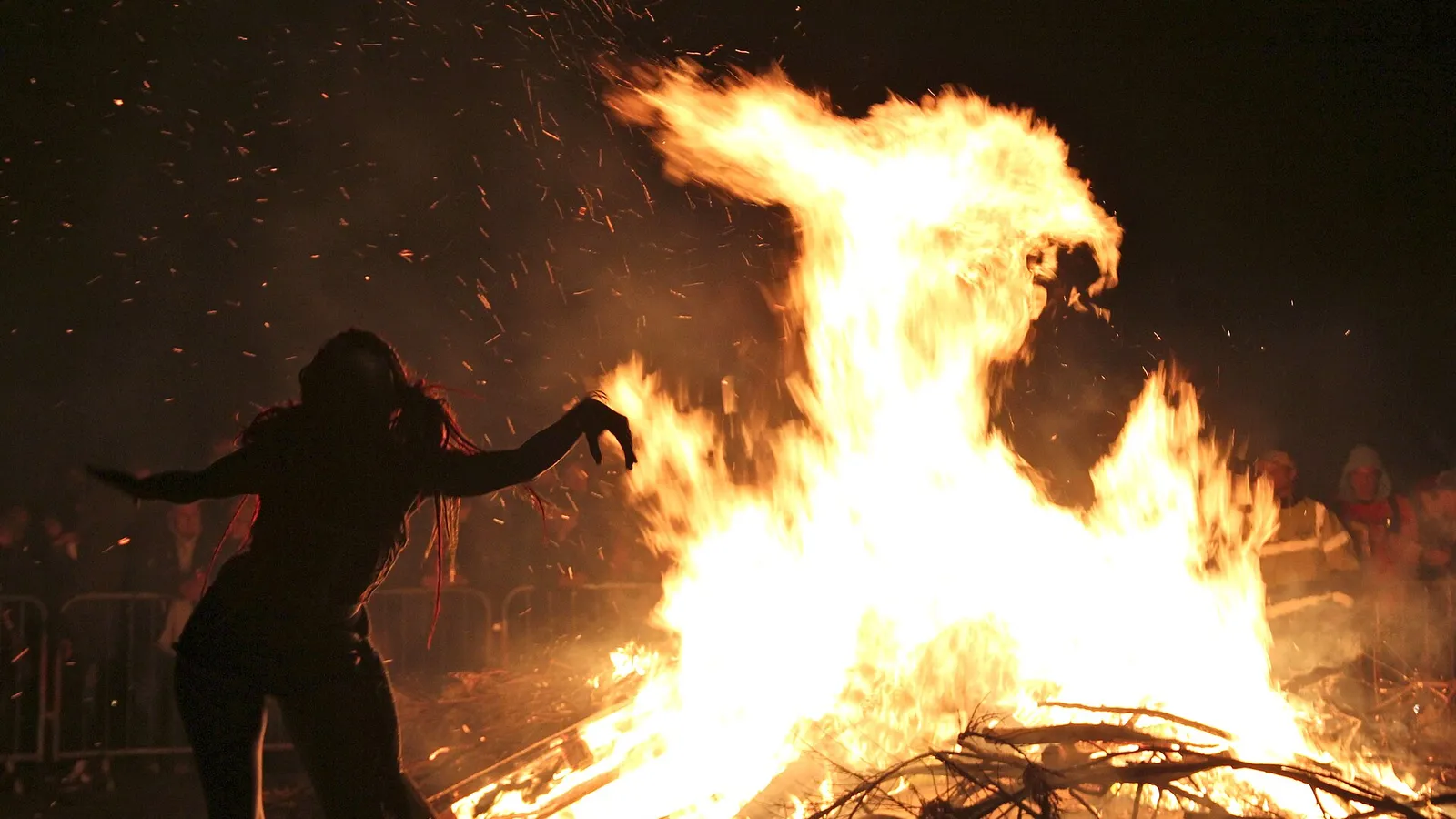

Beltane Fire Festival, Edinburgh: Ancient Roots, Modern Reinvention
Contents
Beltane, the Gaelic festival of 1 May, is genuinely ancient and well documented; the Beltane Fire Festival on Edinburgh's Calton Hill is a community arts event founded in 1988. This card tests the gap between them: what the old festival involved, when its fires died out, how the modern festival was created, and which of its "ancient" elements — the wicker man, the Green Man, an unbroken pagan tradition — are modern inventions.
TL;DR
- established The ancient Gaelic festival of Beltane is genuine and well documented: one of the four Gaelic quarter-day (cross-quarter) festivals, first recorded in the c.900 AD Irish glossary Sanas Cormaic (Cormac's Glossary).
- established The traditional folk fires died out across Scotland during the 19th century, so there is no unbroken living tradition to continue.
- established The Edinburgh Beltane Fire Festival on Calton Hill is a modern creation, founded on 30 April 1988 by artist Angus Farquhar of the industrial-music group Test Dept, with academic help from the University of Edinburgh's School of Scottish Studies — the same "invented/reinvented tradition" pattern this collection documented for Up Helly Aa.
- established The festival's own organisers state that "the organisers do not claim it to be anything other than a modern celebration of Beltane".
- traditional Its most mythic-seeming elements, the Green Man and the wicker-man "human sacrifice", are 20th-century inventions or ancient Roman propaganda rather than evidenced Celtic practice.
Key Facts
- Ancient festival
- Bealtaine/Beltane, ~1 May; one of four Gaelic festivals with Samhain (~1 Nov), Imbolc (~1 Feb) and Lughnasadh (~1 Aug)
- Meaning
- Start of summer and the pastoral cycle, when livestock went to summer pasture
- Earliest record
- Sanas Cormaic (Cormac's Glossary), c.900 AD
- Name
- Old Irish, generally read as "bright fire" or "lucky fire" (bil + teine)
- Folk customs
- Hilltop need-fires, driving cattle between fires, relighting hearths, Beltane bannocks, May dew
- Decline
- Fires died out in the 19th century (last at Helmsdale 1820; Shetland by the 1870s)
- Modern festival
- Founded 30 April 1988, Calton Hill, by Angus Farquhar of Test Dept
- Organiser
- Beltane Fire Society (registered Scottish charity SC040137)
- Audience
- Roughly 6,000–12,000; about 7,000 in 2025
- Characters
- May Queen, Green Man, Whites, Blues and Reds
A Note on Claims and Evidence
Each major claim carries one of three labels. established means supported by primary records, official bodies or several independent reliable sources. shared means the core fact is sound but sources disagree on details, dates or interpretation. traditional means widely repeated but not traceable to a primary or independent source.
The ancient festival, the 1988 founding and the Society's own statements are well documented. The weak points: some vivid "ancient" detail derives from Frazer's The Golden Bough, whose fertility-religion and human-sacrifice framings are now heavily qualified; Hutton's exact page numbers in Stations of the Sun (Ch. 22, approx. pp. 218–225) could not all be verified verbatim, though his broad conclusions are secure; attendance figures are approximate, and the founder-era numbers come from the Society's own account; the Society's founding year is given as both 1988 and 1993. Folklore blogs and tourism pages were set aside in favour of Encyclopaedia Britannica, National Museums Scotland, the Beltane Fire Society's own statements, the BBC, The Scotsman, The Edinburgh Reporter and academic works (Hutton; MacKillop's Dictionary of Celtic Mythology; McNeill's The Silver Bough). McNeill's food material comes from The Scots Kitchen (1929; 2nd edn 1963); she dates the same Pennant passage both 1769 and 1774 (probably the tour and a later edition).
Timeline
Cormac's Glossary records Beltane fires; Cormac mac Cuilennáin dies in 908.
Moray kirk sessions condemn Hogmanay torch-burning.
Thomas Pennant describes Highland Beltane rites.
John Ramsay of Ochtertyre records the Beltane bannock.
The Burghead clavie apparently brought to the new village.
Last Beltane fire at Helmsdale.
Fire rituals survive in Ireland; 1837 on the Isle of Man.
Fife fires die out.
Lerwick tar-barrelling, which becomes Up Helly Aa.
Allendale tar-barrels begin.
Shetland Beltane fires go unlit.
James Napier proposes a Baal derivation of "Beltane".
Campbeltown's Old New Year tar-barrels end.
Frazer claims "clear" traces of human sacrifice at Scottish Beltane fires.
Edinburgh's public Beltane beacons on Arthur's Seat cease; Carmina Gadelica published.
Ada Goodrich-Freer reports the Beltane bannock no longer made in Uist.
Lady Raglan coins the "Green Man".
Gerald Gardner's Witchcraft Today.
About 2,000 climb Arthur's Seat for May dew.
The Wicker Man released.
About 300 climb Arthur's Seat for May dew.
First modern Beltane on Calton Hill: five performers, 50–100 spectators.
Farquhar organises his last Beltane.
Beltane Fire Society formed (by its own detailed history).
First paid production manager.
First ticketed festival; about 12,000 attend.
Society incorporated (Company SC341753).
Premier Parks Events Levy dispute; about 7,000 attend.
Details
The genuine ancient festival
established Beltane is one of the best-attested Gaelic calendar festivals. Bealtaine/Beltane is one of the four Gaelic seasonal festivals — Samhain (~1 Nov), Imbolc (~1 Feb), Beltane (~1 May) and Lughnasadh (~1 Aug) — the cross-quarter days marking the midpoint between the spring equinox and summer solstice. It marked the start of summer and the pastoral cycle, when livestock were driven out to summer pasture. Encyclopaedia Britannica: "Beltane is a festival observed on May 1 in Ireland and Scotland… The first ever mention of Beltane was in a glossary attributed to Cormac, bishop of Cashel and king of Munster, who was killed in 908." National Museums Scotland confirms "Bealltainn (anglicised Beltane) has its roots in Gaelic culture and is one of four major festivals."
established The first written reference is in Sanas Cormaic (Cormac's Glossary), attributed to Cormac mac Cuilennáin, king-bishop of Munster (died 908), c.900 AD. The entry glosses "Belltaine" as "lucky fire"/"bil-tene," describing two fires the druids made "with great incantations," between which cattle were driven "against the diseases of each year." The festival also appears in medieval Irish literature such as Tochmarc Emire and the Lebor Gabála Érenn (Book of Invasions), which contains the story of the druid Mide lighting the first Beltane fire at Uisneach.
shared The name derives from Old Irish, generally read as "bright fire" or "lucky fire" (bil + teine). Some older writers (e.g. the Phoenician-Baal derivation in James Napier's 1879 folklore book) linked it to the god Baal; James Frazer explicitly rejected this: "the popular derivation of the first part from the Phoenician Baal is absurd."
established Historian Ronald Hutton — the standard academic authority on the British ritual year — treats Beltane as a genuinely old and comparatively well-attested fire festival, in explicit contrast to Samhain, "for which evidence of a major 'Celtic' fire festival is less apparent." On the ancient need-fires he writes that "to increase the potency of the holy flames, in Britain at least they were often kindled by the most primitive of all means, of friction between wood" (Stations of the Sun, 1996). Unlike some "ancient" festivals that are largely Victorian confections, ancient Beltane genuinely existed and was documented over a millennium ago.
Folk customs and their decline
established The documented customs are bonfires kindled on hilltops (often as "need-fires" made by friction), driving cattle between two fires for protection or purification, extinguishing and re-lighting household hearths, Beltane bannocks, and gathering May dew. Cormac's Glossary (c.900) describes two druidic fires with cattle driven between them, corroborated by 18th-century eyewitness accounts. Rich 18th-century Scottish accounts survive, notably Thomas Pennant's Tour in Scotland 1769 and John Ramsay of Ochtertyre, describing Highland Beltane rites in Perthshire and the Hebrides.
established Thomas Pennant (1769): "on the first of May, the herdsmen of every village hold their Bel-tien, a rural sacrifice. They cut a square trench on the ground… they make a fire of wood, on which they dress a large caudle of eggs, butter, oatmeal and milk." John Ramsay of Ochtertyre (1736–1814, friend of Walter Scott, patron of Burns) gave the fullest description of Highland Beltane, later quoted by Frazer.
established In the Beltane bannock game, an oatcake was divided among the company; whoever drew the charred piece became the mock "cailleach Beal-tine" in a symbolic (not real) mock-sacrifice game — documented on Mull, in Perthshire and the Hebrides. Pennant also describes each person taking an oatmeal cake with nine square knobs, breaking them off one by one and throwing them over the shoulder to the fire, as offerings to the protectors of the flocks or to their enemies: "this to thee, O Fox, spare thou my lambs".
established Washing the face in May-morning dew for beauty or luck, strongly associated with Edinburgh's Arthur's Seat, persisted into the 1960s–70s (a 1968 report counts ~2,000 climbers; by 1987 numbers had dwindled to ~300).
established Traditional Beltane fire customs declined through the 18th and 19th centuries. The Beltane Fire Society's own history states the last Beltane fire at Helmsdale was in 1820, the Fife fires died out mid-century, and the Shetland fires went unlit by the 1870s. Ronald Hutton's research records fire rituals surviving into the 1820s–1830s in Ireland and 1837 on the Isle of Man. By c.1900 Edinburgh's public Beltane beacons on Arthur's Seat had ceased. The related May-dew custom on Arthur's Seat outlasted the fires, persisting into the mid-20th century before fading.
Beltane food and the other quarter-day cakes (McNeill)
established The folklorist F. Marian McNeill, in The Scots Kitchen (1929), gathers the food side of these festivals. She quotes Pennant's two Beltane foods: the caudle of eggs, butter, oatmeal and milk cooked on the herdsmen's fire, part of which was spilled on the ground "by way of libation", and the oatmeal cake with nine raised knobs offered piece by piece to the guardians and the enemies of the flocks. She quotes John Ramsay of Ochtertyre for "a large cake baked with eggs and scalloped round the edge", which he calls an bonnach beal-tine, the Beltane bannock.
shared The word "caudle" is used in two ways in McNeill's sources. In Pennant it is a dish cooked in a pot on the fire. In the account McNeill takes from Sir James Frazer, the "Beltane caudle" is a thin batter of egg, milk, cream and a little oatmeal washed over an ordinary oatcake as it bakes. Both may be true of different places; neither should be treated as the single correct recipe.
established McNeill also records the decline. She quotes Ada Goodrich-Freer, writing in 1902, that the Beltane bannock was "no longer made in Uist", though the folklorist Father Allan McDonald of Eriskay remembered his grandmother making one about twenty-five years earlier. In Badenoch, she says, oatcakes marked with a cross on one side and a circle on the other were rolled down the hillside on Beltane morning "until recently". Her Badenoch evidence is cited from her own later work, The Silver Bough, and has not been checked here against an earlier source.
traditional McNeill calls the Beltane bannock "the last survivor" of four old Highland quarter cakes: bonnach Brìde for St Bride's Day (1 February), bonnach Bealltainn for Beltane, bonnach Lùnastail for Lammas (1 August) and bonnach Samhna for Hallowmas. The Beltane cake is well documented; the neat set of four rests largely on her own synthesis. So does a comparison she quotes from the Rev. Walter Gregor between the nine-knobbed Beltane cake and twelve-knobbed cakes offered by the ancient Athenians, which is Victorian comparative folklore, not evidence of descent.
established Other seasonal foods she records belong to the same farming year. At Lammas, shepherds in the south of Scotland were given "butter brughtins", oatcakes toasted, crumbled and stewed with butter, and Lammas fairs had their own sweets: "sweetie-foals", flat rounds of gingerbread scattered with coloured caraway comfits, at Kirkwall, and sugar hearts and "curly-andras" (coriander comfits) at St Andrews, still on sale there in 1938. At Michaelmas (29 September) the Hebrides baked the struan Mìcheil, St Michael's cake, from oats, barley and rye together, standing for the fruits of the field, and coated on both sides with three layers of a batter of cream, eggs and butter in the same way as the Beltane bannock. Smaller struans could be filled with cranberries, blaeberries, brambles, caraways or wild honey. McNeill takes the ritual of making it from Alexander Carmichael's Carmina Gadelica (1900).
The wicker-man and human-sacrifice myth
established The lurid image of Beltane human sacrifice in a giant "wicker man" derives from a single ancient thread — Julius Caesar's Gallic War (and Strabo/Diodorus), all ultimately traceable to the lost account of Posidonius — describing Gaulish, not British, druids. Modern scholarship (e.g. Peter Wells, The Barbarians Speak) holds "there is no evidence of the practices Caesar described… the stories of human sacrifice appear to derive from a single source, Posidonius, whose claims are unsupported." Frazer's 1890 claim that "traces of human sacrifice" at Scottish Beltane fires were "particularly clear and unequivocal" is now discounted. The wicker-man's grip on the popular imagination owes far more to the 1973 film The Wicker Man than to any evidenced ancient rite; the Beltane bannock "sacrifice" was a mock or divination game, not a real killing.
The modern Edinburgh festival
established Founding. The festival began on 30 April 1988 on Calton Hill. Angus Farquhar of Test Dept (later founder of arts organisation NVA) led it, with choreographer Lindsay John, dancers from the Laban centre, and Gaelic folklorist and ethnologist Margaret Bennett and other academics from Edinburgh University's School of Scottish Studies. The location was moved from Arthur's Seat (the historic Edinburgh Beltane site) to Calton Hill for accessibility and to "reclaim" a space then known for sex and drugs. Farquhar has described the impulse as arising after "years of fighting political battles during the Miners Strike and then… Murdoch at his Wapping Fortress," seeking "public ritual and not losing touch with our surroundings even in a city setting."
established Per the Society's history, "This first modern Beltane saw only five performers take to Calton Hill, watched by an audience of fifty to a hundred people," and "within five years this had grown to several hundred performers and three thousand audience members, during which time the Society came into place to support the continuation of the festival." Its choreography, iconography and performance were "moulded by the originators' research into historical accounts of Beltane and their own influences" (Test Dept's drumming, Trinidadian carnival, ritual dance). This is a newly created artistic event, not a continuation of unbroken folk practice.
established The organisers' own view. The Beltane Fire Society states plainly (per its official website and Wikipedia) that "the organisers do not claim it to be anything other than a modern celebration of Beltane, evolving with its participants," and that "the purpose of our festival is not to recreate ancient practices but to continue in the spirit of our ancient forebears." One BFS text calls the festival "but a flash in time in the wider and older history of Beltane, a mere couple of decades old."
shared Organisational development. In 1992 Farquhar organised his last Beltane. The Beltane Fire Society formed to continue it; its masthead says "formed in 1988" (Wikipedia specifies "for the second Beltane Fire Festival"), while its own detailed history says the Society formed in 1993. It is registered Scottish charity SC040137, Company Number SC341753 (registered/incorporated 2008). In 2001 it took on its first paid production manager (a part-time role in an otherwise volunteer body). In 2004 the festival became a ticketed event for the first time (previously free) and sold out with an audience of ~12,000. It is now produced in roughly two months by around 300 volunteer performers and collaborators; by 2006 the event had "over 300 voluntary collaborators and performers with the 11,500 available tickets selling out." Recent audiences vary between roughly 6,000 and 12,000; approximately 7,000 attended in 2025.
established Format and characters. The festival features the May Queen and the Green Man (his death and rebirth), a procession, groups called the Whites (the Queen's attendants), the Blues (elders, keepers of "Beltane lore") and the Reds (chaotic, carnal nature-spirits), plus drumming, fire performance, a need-fire and a bonfire. The core narrative was devised by the founders and has evolved yearly as new volunteers add elements. Test Dept's drumming, Trinidadian carnival and modern ritual-dance were direct influences.
established The Green Man himself is a modern construct: the term and figure were coined by Lady Raglan (Julia Somerset) in a 1939 Folklore article about medieval foliate church carvings; the idea that he is an "ancient fertility god" is a 20th-century invention, later absorbed into paganism. The festival's central male character is not an ancient Celtic deity.
Neopaganism and the "ancient religion" conflation
established The festival grew out of a countercultural, politically charged 1980s arts milieu (Farquhar came from anti-Thatcher, miners'-strike and Wapping activism). It draws on neopagan and Wiccan-adjacent seasonal symbolism, but modern Wicca and much of contemporary neopaganism are 20th-century new religious movements. Encyclopaedia Britannica: Wicca "emerged publicly in England during the 1950s," traced to Gerald Gardner, who published Witchcraft Today in 1954.
established Scholarly consensus (Ronald Hutton, The Triumph of the Moon, 1999) is that Wicca is not an unbroken survival of ancient paganism but a modern synthesis drawing on Romanticism, the Western occult revival and Margaret Murray's now-discredited "witch-cult" hypothesis. Hutton adopts a careful convention: "pagan" for the ancient religions and "Pagan" for the modern religions "which are partly inspired by their example," and describes his own conclusion that modern paganisms did not survive continuously but are "perfectly viable modern religions in their own right."
shared The Edinburgh festival sits in this modern Pagan and arts space: it uses seasonal pagan symbolism and attracts neopagan participants, but it is not — and does not claim to be — a continuation of ancient Celtic religion. National Geographic quotes a participant framing it as "part of Scots reclaiming our heritage," which is accurate as cultural reclamation but not ritual continuity.
Scotland's winter fire festivals
shared The historian Callum G. Brown, in Up-helly-aa (1998), surveys the winter fire customs often grouped with Beltane. Burghead's clavie seems to have been brought to the village after it was built in the early 19th century; Campbeltown's Old New Year tar-barrels ended in 1880; Lerwick's tar-barrelling ran from the early 1840s to 1878 before becoming Up Helly Aa; and Allendale's tar-barrels in Northumberland grew from a Methodist watchnight service around 1858. He argues these were customs of new fishing and textile towns, not pagan survivals, though bonfires and guizing are much older. Moray kirk sessions condemned Hogmanay torch-burning between the 1650s and 1730s. These are midwinter customs, not Beltane fires.
established The collection's Up Helly Aa piece (a Victorian festival that grew from Lerwick tar-barrelling in 1873–81 and took on Norse dress in stages between 1889 and 1921) and Hogmanay piece (fire and first-footing customs with contested antiquity) show the same pattern of modern reinvention on genuine but distant foundations. The contrast: ancient Beltane is better attested than "ancient" Up Helly Aa, yet the modern Edinburgh event (1988) is younger than modern Up Helly Aa (1870s–80s).
Controversies and challenges
established Ticketing and commercialisation. The shift from a free event to a ticketed one (2004) was driven by crowd capacity, safety and facility obligations, and council licensing. The Society stresses it "receive[s] no donations from any public funds" and is funded by membership, ticket sales and merchandise.
established The 2025 park levy dispute. The City of Edinburgh Council's Premier Parks Events Levy classified Beltane as having a "commercial element" (ticket price over £9, hot-drink traders). The Society called the levy a "targeted attack," and per The Edinburgh Reporter said "their costs will increase from £9,576.50 in 2024 to £18,476.50 in 2025. Of this the levy in 2025 of £8,874.00 makes up the largest part of the costs." The Society also said it "was not consulted on the ticket levy during the public spaces consultation process." The Scotsman reports the Council "rated Beltane a 50 per cent chargeable event due to being a charity with commercial status," with convener Cllr Val Walker stating the fee "is ring-fenced for site improvements in the area."
established Content. The festival includes nudity and "uninhibited behaviour"; the Society operates a "safer spaces" consent policy.
Did You Know?
- Cormac's Glossary of c.900 describes cattle being driven between two fires "against the diseases of each year".
- Need-fires were kindled by friction between pieces of wood.
- Pennant's herdsmen threw pieces of a knobbed oatcake over their shoulders: "this to thee, O Fox, spare thou my lambs".
- Whoever drew the charred piece of the Beltane bannock became the mock "cailleach Beal-tine".
- About 2,000 people climbed Arthur's Seat for the May dew in 1968.
- The first modern Beltane, in 1988, had five performers and an audience of 50 to 100.
- The Green Man was named in 1939, by Lady Raglan.
- The festival's organisers call it "a mere couple of decades old".
- The St Michael's cake of the Hebrides was baked from oats, barley and rye together.
- Kirkwall's Lammas fair sold "sweetie-foals", gingerbread scattered with coloured comfits.
FAQ
1Is Beltane a real ancient festival?
Yes. It is one of four Gaelic seasonal festivals, first recorded in Cormac's Glossary around 900 AD.
2What does "Beltane" mean?
It is generally read as "bright fire" or "lucky fire", from Old Irish bil and teine. The old link with the god Baal is rejected.
3What happened at traditional Beltane?
Hilltop fires were lit, cattle were driven between fires for protection, hearths were relit, Beltane bannocks were shared, and people washed in May dew.
4When did traditional Beltane fires die out?
During the 19th century: the last at Helmsdale in 1820, and Shetland's by the 1870s. Edinburgh's Arthur's Seat beacons had ceased by about 1900.
5When did the Edinburgh Beltane Fire Festival start?
On 30 April 1988, on Calton Hill, led by Angus Farquhar of Test Dept.
6Is the Edinburgh festival a continuation of ancient Beltane?
No, and its organisers say so: they call it "a modern celebration of Beltane".
7Did the Celts burn people in wicker men at Beltane?
There is no evidence. The story comes from Caesar and other classical writers about Gaulish druids, all probably from one source, Posidonius. The 1973 film did the rest.
8Is the Green Man an ancient Celtic god?
No. The name was coined in 1939 by Lady Raglan for medieval church carvings.
9Is Wicca an ancient religion?
No. It emerged publicly in England in the 1950s, traced to Gerald Gardner.
10Are Scotland's winter fire festivals pagan survivals?
Callum G. Brown argues that Burghead's clavie, Lerwick's tar-barrels and similar customs belong to 19th-century towns, though bonfires and guizing are older.
11How many people attend the Edinburgh festival?
Between about 6,000 and 12,000; about 7,000 in 2025.
12Why does the festival charge for tickets?
Since 2004, because of crowd capacity, safety and licensing. The Society says it receives no public funds.
Sources and Further Reading
Primary/Institutional
- Sanas Cormaic (Cormac's Glossary), c.900
- Thomas Pennant, A Tour in Scotland 1769
- John Ramsay of Ochtertyre, account of Highland Beltane
- Beltane Fire Society, official website and history
- National Museums Scotland
- City of Edinburgh Council, Premier Parks Events Levy
Scholarly/Critical
- Ronald Hutton, The Stations of the Sun (1996)
- Ronald Hutton, The Triumph of the Moon (1999)
- Callum G. Brown, Up-helly-aa: Custom, Culture and Community in Shetland (Manchester University Press, 1998)
- Peter Wells, The Barbarians Speak
- James MacKillop, Dictionary of Celtic Mythology
- Lady Raglan (Julia Somerset), "The Green Man", Folklore (1939)
Specialist
- F. Marian McNeill, The Scots Kitchen: Its Traditions and Lore with Old-Time Recipes (Blackie, 1929; 2nd edn 1963)
- F. Marian McNeill, The Silver Bough
- Alexander Carmichael, Carmina Gadelica (1900)
- James Frazer, The Golden Bough
- James Napier, folklore book (1879)
- Ada Goodrich-Freer (1902)
General
- Encyclopaedia Britannica, "Beltane" and "Wicca"
- BBC
- The Scotsman
- The Edinburgh Reporter
- National Geographic
- Wikipedia, "Beltane Fire Festival"
Further reading
- Gerald Gardner, Witchcraft Today (1954)
Caveats: Myths and Disputed Claims
- Myth: the Edinburgh Beltane Fire Festival is an unbroken continuation of ancient Celtic Beltane. It was created in 1988 after a gap of most of a century; its own organisers reject the claim.
- Myth: Celtic druids burned people in wicker men at Beltane. The story rests on classical accounts of Gaulish druids, probably all from Posidonius, and on the 1973 film; Frazer's "clear" traces of sacrifice at Scottish fires are now discounted.
- Myth: the Green Man is an ancient fertility god. The figure was named in 1939 and its "ancient god" reading is a 20th-century invention.
- Myth: "Beltane" comes from the god Baal. Frazer called the derivation "absurd".
- Myth: modern Paganism and Wicca are ancient religions. They are 20th-century movements.
- Disputed: the four Highland "quarter cakes". The Beltane bannock is well documented; McNeill's neat set of four, and the comparison with Athenian offerings, are her synthesis.
- Disputed: the Beltane caudle. Pennant's caudle is a pot dish; Frazer's is a batter washed over an oatcake.
- Disputed: when the Beltane Fire Society was founded. Sources give 1988 and 1993; the festival began in 1988, the Society coalesced in the early 1990s and registered as a charity and company in 2008.
- Myth: Scotland's winter fire festivals are pagan survivals. Callum Brown dates most of them to the 19th century.
Finished reading? Try the Fact Machine: three reels, one surprising Scottish connection →
Card 031 · Traditions