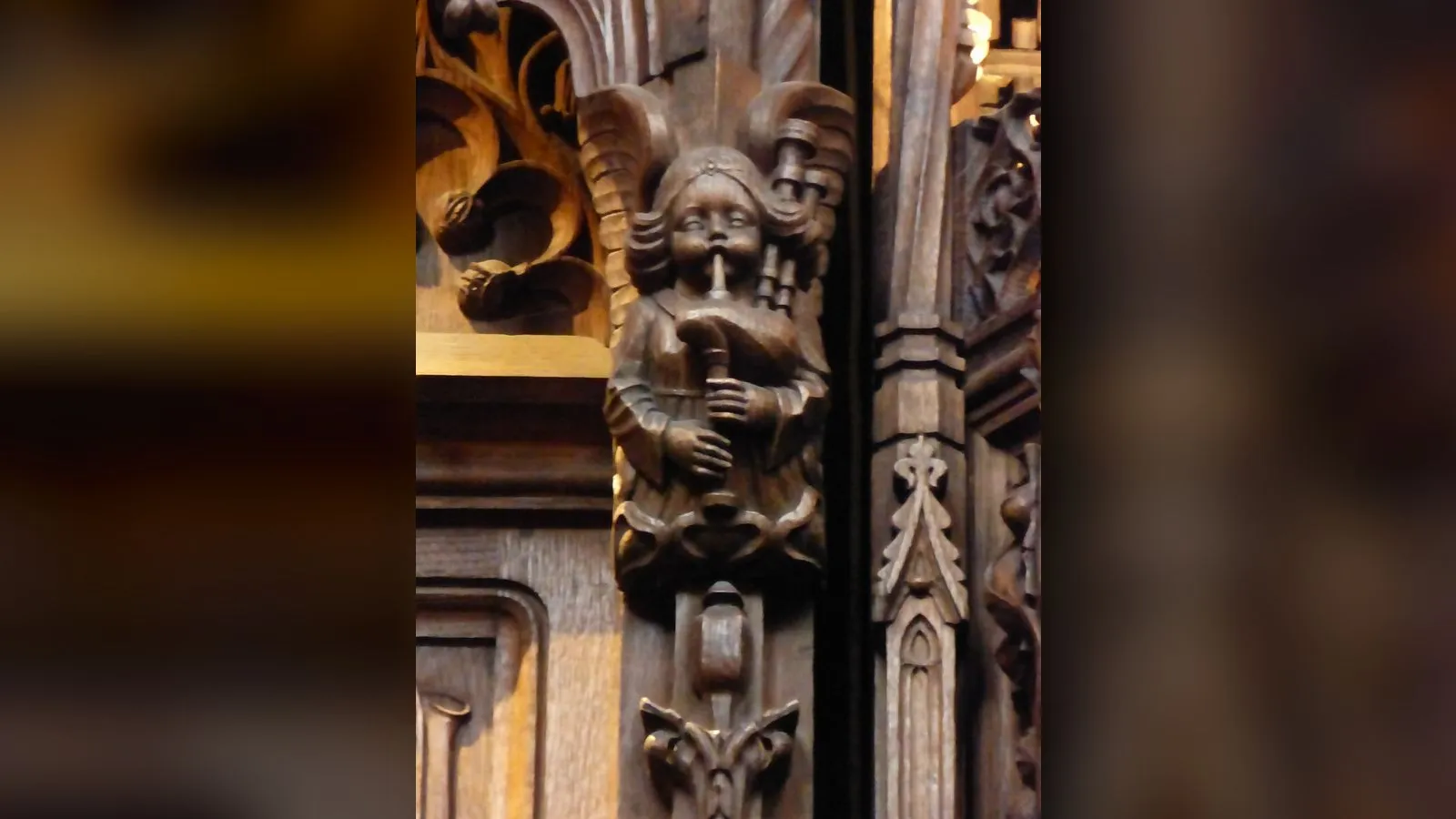

The Great Highland Bagpipe: Sorting Documented History from Patriotic Legend
Contents
Scotland did not invent the bagpipe. The instrument is ancient and near-universal, and Scotland's legitimate claim is to a distinctive regional variant, the Great Highland Bagpipe (a' phìob mhòr), and the musical culture built around it. This card tests the most-repeated "facts": that the pipes were played at Bannockburn, that they were banned in 1746, that a court declared them an "instrument of war", and what is really known of the MacCrimmons.
TL;DR
- established Scotland did not invent the bagpipe: the instrument is ancient and near-universal, with antecedents traceable to the Middle East and the classical Mediterranean world. Scotland's claim is to a distinctive variant, the Great Highland Bagpipe, not to the bagpipe as a category.
- established Bagpipes were never banned by the Act of Proscription 1746, and the famous "instrument of war" ruling was a rhetorical remark at piper James Reid's 1746 treason trial, not a statutory classification.
- traditional The MacCrimmon dynasty is real but heavily mythologised; its detailed genealogy, the tunes attributed to it and the Cremona-origin story are later invention.
- established The first solid evidence of bagpipes in Scotland comes around 1400, with carvings at Melrose (probably c.1358) and Rosslyn (c.1440s); the "Bannockburn 1314" pipes are legend.
- established Scotland built a world-class classical repertoire (pibroch, ceòl mòr), and the instrument spread worldwide through the British Army and Scottish emigration in the 18th–20th centuries; the War Office formalised Army pipers in 1854, and the RSPBA (1930) and World Pipe Band Championships institutionalised competition.
Key Facts
- Gaelic name
- A' phìob mhòr ("the great pipe")
- Form
- Mouth-blown; conical-bored chanter (nine notes, roughly Mixolydian); three drones (two tenor, one bass) in separate stocks
- Earliest Scottish depiction
- Pig-piper "gargoyle", Melrose Abbey, probably c.1358
- Other early carvings
- Two pipers, Rosslyn Chapel, c.1440–1450
- First "warpipes" reference
- 1396, Battle of the North Inch of Perth
- "Hieland pipes"
- Distinguished in a poem of 1598
- "Highland bagpipe"
- Term first documented 1748
- Art music
- Pìobaireachd (pibroch) or ceòl mòr; "pibroch" first attested 1719
- Army establishment
- War Office Letter, 28 January 1854: one Pipe Major and five Pipers per Highland regiment
- Pitch
- Concert A of 475–485 Hz (Peterson Strobe Tuners)
- Governing body
- Royal Scottish Pipe Band Association (1930; "Royal" from 1980)
Scottish Impact Index (SI Score)
- Cultural Reach
- 9/10
- Continuity of Tradition
- 10/10
- Social & Economic Importance
- 8/10
- Scottish Distinctiveness
- 10/10
- Cultural Legacy
- 10/10
- Recognition
- 10/10
57/60
Ranked =4th of 19 in Traditions
A Note on Claims and Evidence
Each major claim carries one of three labels. established means supported by primary records, official bodies or several independent reliable sources. shared means the core fact is sound but sources disagree on details, dates or interpretation. traditional means widely repeated but not traceable to a primary or independent source.
The strongest sources here are Hugh Cheape and National Museums Scotland, Encyclopaedia Britannica, the National Archives and Scottish History Society records for the Reid trial, and the Piobaireachd Society. Many popular piping and tourism websites repeat undated or embellished claims (Bannockburn pipes, the "ban", a 1409 surviving instrument) and are not relied on. Dates in this field are genuinely uncertain before the 18th century (drone additions, the Highland/Lowland divergence, the MacCrimmon genealogy), so ranges are given rather than false precision. The Reid quotation is contemporary in substance, but the exact Scots Magazine (1746) page has not been independently verified and reaches us via reliable secondary piping sources drawing on the archival trial record.
Timeline
Hittite carving at Eyuk, sometimes cited as a bagpipe (contested).
"Pipers of Thebes" said to play dog-skin pipes with bone chanters.
Suetonius records Nero as a player, or would-be player, of the tibia utricularis.
Oldest confirmed evidence of bagpipes anywhere, in English and Spanish sources.
Pig-piper carving at Melrose Abbey.
Chaucer's Miller plays the bagpipe in The Canterbury Tales.
"Warpipes" mentioned at the Battle of the North Inch of Perth.
Piper carvings at Rosslyn Chapel.
A second drone added.
Brian Mac Vicar, harper to the Earl of Argyll, witnesses a rental.
Battle of Balrinnes (Glenlivet).
A poem distinguishes "hieland pipes".
Glasgow kirk session forbids "playing on bagpipes" at wedding banquets.
Presbyteries of Haddington and Dunbar order piping at penny weddings to cease.
Cambusnethan session bans piping at bridals.
Third (bass) drone appears.
"Pibroch" first attested in Lowland Scots.
Piper James Reid captured at the surrender of Carlisle.
Act of Proscription; it does not mention bagpipes.
Reid tried at York.
Reid executed at York.
The term "Highland bagpipe" first documented.
Two pipers per grenadier company in Highland regiments, from at least this date.
Glasgow Gaelic Club founded.
Highland Society of London's first piping competition, at Falkirk.
The competition moves to Edinburgh, where it runs until 1844.
Glasgow Gaelic Club ball.
Iain Dubh MacCrimmon, last hereditary piper to MacLeod, dies; Donald MacDonald's pibroch collection is published.
MacLeod of Gesto publishes the Cremona origin story.
Angus MacKay's pibroch collection; the sword-dance music passes to the bagpipe.
War Office formally establishes pipers in eight Highland regiments.
Piobaireachd Society founded.
Cowal competition, the lineage of the World Pipe Band Championships.
Scottish Pipe Band Association launched.
The SPBA begins organising the World Championships.
51st Highland Division pipers play the battalions forward at El Alamein (23 October).
Bill Millin pipes on Sword Beach.
Argylls in Aden, generally cited as the last combat use.
"Royal" status conferred on the RSPBA.
A Hampstead Heath busker's "weapon of war" defence is rejected.
Details
1. The bagpipe is ancient and global — Scotland's claim is narrow and specific
established The bagpipe is one of the oldest instrument-families known, and it is emphatically not a Scottish invention. Encyclopaedia Britannica describes the bagpipe as a wind instrument of great antiquity found across Europe, North Africa and the Middle East, and notes that the Scottish Highland bagpipe is only one regional form among many. The reed-pipe ancestors of the bagpipe reach back to the ancient Near East, and classical writers describe bag-fed reed pipes: the Greek aulos and Latin tibia were reed instruments (routinely mistranslated as "flutes"), and the Roman biographer Suetonius (writing c. 120 CE) records that the emperor Nero was, or aspired to be, a player of the tibia utricularis — a bag-blown pipe.
shared The "pipers of Thebes" (c. 400 BCE, playing pipes of dog-skin with bone chanters) and the Hittite carving at Eyuk (c. 1000 BCE) are frequently cited as "the first bagpipe," but scholars note the Hittite carving is contested (some read it as a panpipe-and-drum), and the ancient references describe bag-fed reed pipes rather than the drone-bearing bagpipe proper. Modern organology holds that the bagpipe became a distinct class only once drones were added in the European Middle Ages. The "Nero fiddled while Rome burned / actually piped" line is a fun talking point but rests on a single ambiguous ancient anecdote; it is a curiosity, not established fact.
established The oldest confirmed evidence of bagpipes anywhere is 13th-century (English and Spanish sources, including an entry in the accounts of Edward I of England and the Spanish Cantigas de Santa María). Bagpipes then proliferated across late-medieval Europe — Chaucer's Miller plays one in The Canterbury Tales (c. 1387–1400) — with regional forms surviving today from the Spanish gaita and Breton veuze to the Bulgarian gaida and Hungarian duda.
established What Scotland can legitimately claim is well summarised by the leading modern authority, Dr Hugh Cheape (formerly of National Museums Scotland, which holds the definitive national bagpipe collection): "The evidence, as far as it goes, suggests that Scotland adopted a 'great pipe' from the European bagpipe tradition and made it, through the strength of the Gaelic language and its music, very much its own." In other words, the claim is to the Great Highland Bagpipe as a distinctive variant and to the sophisticated musical culture (above all pibroch) built on it — not to the bagpipe as such. Cheape explicitly warns against "a stereotype Great Highland Bagpipe assumed to have a continuous history from a distant past."
2. Earliest evidence in Scotland: around 1400, with carvings the firmest proof
established Bagpipes are "first attested in Scotland around 1400," and concrete evidence is thin before the 15th century. The firmest early evidence is material. Per Hugh Cheape and National Museums Scotland, the "pig piper as carved stone 'gargoyle' on Melrose Abbey" dates "probably to the rebuilding of the Cistercian monastery around 1358" and is "one of the earliest representations of the bagpipe in Scotland"; two carvings of pipers survive in Rosslyn Chapel dating to around 1440–1450. National Museums Scotland treats the Melrose carving as "the earliest evidence in Scotland for the bagpipe in a recognisable form." The pipes depicted are of the standard European medieval form (a conical chanter with a single drone), which supports the view that the instrument arrived in Scotland as part of the wider European tradition rather than originating there.
shared Documentary references are debated. A 12th-century line by Giraldus Cambrensis listing Scottish instruments as "cythara, tympano et choro" is sometimes read as mentioning a bagpipe (chorus), but the translation is not universally accepted. A firmer textual reference comes from 1396, when accounts of the Battle of the North Inch of Perth mention "warpipes." Evidence of a form peculiar to the Highlands is later still: a poem of 1598 (later printed in The Complaynt of Scotland) distinguishes "hieland pipes." The term "Highland bagpipe" itself is first documented in 1748 (per researcher Keith Sanger).
traditional Several romantic claims need flagging. The story that a surviving set of pipes was carried at Bannockburn (1314) is explicitly "debated" and unverified — one clan owns a remnant said to have been there, but the veracity is doubted. Claims of a bagpipe on St Martin's Cross at Iona (c. 750 CE) are a stretch. And the frequently repeated "oldest surviving bagpipe dates from 1409" claim should be treated with caution; the securely dated survivals are far later, and the oldest known Highland chanter is the 17th-century instrument associated with the blind composer Iain Dall MacKay, now at the National Piping Centre.
established Distinguishing the Great Highland Bagpipe from its cousins. The Highland pipe is mouth-blown, loud, with a conical-bored chanter (nine notes, roughly Mixolydian) and three drones (two tenor, one bass) in separate stocks. It is distinct from:
- Lowland/Border pipes — bellows-blown, quieter, drones in a common stock; a Scottish tradition that nearly died out in the 19th century and was later revived. Historian's caution: before the mid-17th century there is little basis to distinguish Highland from Lowland piping, and the divergence is defined as much by repertoire as by hardware.
- Irish uilleann pipes — bellows-blown, sweeter, with regulators for harmony, played sitting indoors.
- Scottish smallpipes / Northumbrian smallpipes — quiet, indoor, cylindrical-bore; the modern Scottish smallpipe is essentially a 1980s revival instrument.
shared The three-drone Highland form developed over time: the original pipe probably had a single drone, a second drone was added in the 16th century, and the third (bass) drone appeared in the early 18th century. The instrument "probably reached something like their distinctive modern form in the 18th century."
3. Pibroch (ceòl mòr) and the MacCrimmons: real tradition, embellished legend
established The Great Highland Bagpipe's art music is pìobaireachd (anglicised "pibroch"), also called ceòl mòr ("the great music") — extended theme-and-variation compositions (salutes, laments, gatherings) distinct from the "little music" (ceòl beag) of marches, reels and strathspeys. It was traditionally taught orally through a system of chanted vocables called canntaireachd. The word "pibroch" is first attested in Lowland Scots in 1719.
shared The MacCrimmons are the most celebrated of the hereditary piping families, serving as pipers to the MacLeod chiefs of Dunvegan and running a piping school at Boreraig on Skye. The reliably documented core:
- They were pipers to MacLeod of Dunvegan for roughly two to three centuries (commonly late 16th to early 19th century), with a school at Boreraig held rent-free as part of their office.
- The best-documented individuals are late: Iain Dubh (Black John, d. 1822), the last hereditary piper to MacLeod, and his brother Donald Ruadh (Red Donald). Their father and uncle piped for the Government side in the 1745–46 rising — a detail that complicates the romantic Jacobite framing.
- The known lineage of masters runs from Donald Mòr (c. 1570–1640) through Patrick Mòr (c. 1586–1670) to Patrick Òg (c. 1645–1730).
traditional What is not reliable: as the standard reference works bluntly state, "though much has been written about the MacCrimmon pipers … there is little reliable information on them," and the genealogy is "the subject of debate and speculation." The many pibroch tunes "attributed to the MacCrimmons by popular tradition" cannot actually be verified as their compositions. The romantic Cremona origin myth — that the family descended from an Italian named Giuseppe/Petrus Bruno from Cremona — was propounded by Captain Neil MacLeod of Gesto (published 1828) and is "not taken seriously today"; scholars derive the name from Old Norse via Gaelic Mac Ruimein. Much of the elaborated MacCrimmon story traces to Angus MacKay's influential 1838 collection; the journalist-author Alistair Campsie's The MacCrimmon Legend: The Madness of Angus MacKay argued that MacKay (Queen Victoria's first piper, later confined as insane) did more than anyone to build up the MacCrimmon myth. The MacCrimmons were a genuine and important hereditary piping family whose specific achievements were substantially romanticised in the 19th century.
shared The end of the Gaelic patronage system after 1746 sent pibroch into decline. Its survival owes much to the Highland Society of London, which launched competitions from 1781 (first at Falkirk), and later to the Piobaireachd Society (founded 1903), which collated and published authoritative tune settings — a standardisation that some modern scholars argue narrowed the tradition's earlier diversity.
4. The "instrument of war" myth and military adoption
established What is documented. James Reid, a piper in Lord Ogilvy's Regiment (the Forfarshire Regiment), was captured at the surrender of Carlisle on 30 December 1745 (not, as many popular sources say, at Culloden), imprisoned at Lancaster and York, tried at York on 2 October 1746 before a Commission of Oyer and Terminer headed by Lord Chief Baron Sir Thomas Parker, convicted of high treason, and executed at York on 15 November 1746 (hanged, drawn and quartered). These facts are confirmed by contemporary and archival records: his entry (no. 2800) in the Scottish History Society's The Prisoners of the '45 (1928) reads "Reid, James. Piper, Ogilvy's. 30.12.45 Carlisle; Lancaster Castle, York. Executed York 15/11/46," citing the trial record in the Baga de Secretis (Baga, lxix. 193) and State Papers (S.P.D., 79-26, 91-77), and the Caledonian Mercury (25 November 1746) independently reports the execution.
shared What the court actually said. A contemporary printed trial report records that, because Reid had carried no weapon, the jury recommended mercy, whereupon the court (Sir Thomas Parker's commission) ruled: "No regiment ever marched without musical instruments such as drums, trumpets and the like; and that a Highland regiment never marched without a piper; and therefore his bagpipe, in the eye of the law, was an instrument of war." So the phrase is genuinely contemporary (1746), not a modern fabrication — but the popular one-sentence version is a lightly modernised paraphrase of the fuller 18th-century wording, and the framing was popularised by W. H. Grattan Flood's The Story of the Bagpipe (1911).
established Why the popular telling is wrong. Reid was convicted of high treason for joining an armed rebellion, not because bagpipes were legally a weapon. The court's actual legal principle, recorded in the same report, was that "every person who joined any set of people engaged in an open rebellion, though they did not bear arms, [was] guilty of high treason"; the "instrument of war" line was a rhetorical rebuttal of his non-combatant defence, not a statutory classification or a binding precedent. As the National Piping Centre's librarian James Beaton notes, "the carrying of arms or 'instruments of war' was not relevant to the conviction," and even had the judge created case law "it would only have applied in England and Wales." Other captured pipers who pleaded they had been forced out were acquitted or released — confirming the outcome turned on individual culpability for treason.
traditional The further claim that bagpipes were thereafter officially inventoried among weapons "through WWI" is a traditional, popular embellishment, not established law. established A 1996 case in which a Hampstead Heath busker argued pipes were "a weapon of war, not a musical instrument," citing Reid, is real but trivial — the court rejected the argument and ruled bagpipes are musical instruments.
established The related proscription myth. Bagpipes were not banned by the Act of Proscription 1746 (the Dress Act and disarming legislation). The Act mentions weapons and Highland dress; it says nothing about bagpipes, and there is no record of any prosecution under it for owning or playing pipes. This directly parallels the Kilt article's findings: the same Act is routinely and wrongly credited with banning tartan, Gaelic, and family gatherings — none of which is true. The bagpipe-ban myth appears to stem from the 1822 letterpress of Donald MacDonald's pibroch collection.
established Genuine military role. The Great Highland Bagpipe became integral to the British Army's Highland regiments — precisely the context in which it survived and spread while other European bagpipe traditions declined. Highland regiments raised from the later 18th century carried pipers (two pipers per grenadier company from at least 1775), and the War Office formally recognised and funded pipers in 1854: the War Office Letter of 28 January 1854 (National Archives, Kew, WO3/115/387) notified regiments that "Her Majesty had granted an establishment of one Pipe Major and five Pipers," authorised for the eight then-existing Highland regiments (42nd, 71st, 72nd, 74th, 78th, 79th, 92nd and 93rd) — the institutional birth of the military pipe band.
shared Pipers famously led troops into battle into the 20th century (e.g. the 51st Highland Division at El Alamein in October 1942, and Bill Millin on Sword Beach on D-Day, 6 June 1944), a practice largely abandoned after WWI because of catastrophic piper casualties; the last combat use is generally cited as the Argyll and Sutherland Highlanders in the Aden Emergency in 1967.
5. Standardisation and global spread
established The instrument's construction was commercialised and gradually standardised from the 18th century. Contrary to the romantic idea of pipes whittled from local holly or boxwood, the record shows pipes were made by professional Lowland turners (e.g. Hugh Robertson of Edinburgh, active 1765–1821) using imported tropical hardwoods such as cocuswood. Real standardisation of construction, tuning and unison playing followed the rise of army and competition bands in the 19th and 20th centuries; today many band chanters are synthetic (Polypenco) for uniformity.
established Pipe pitch has drifted sharply upward. Per Peterson Strobe Tuners, "concert A pitch for Highland bagpipes is much higher than other instruments and varies between 475 and 485 Hz" — sharper than concert B♭4 (466.16 Hz); one veteran piper writing in Bagpipe News (June 2025) recorded "486 Hz for my low A … I remember playing as low as 466 Hz — but that was 50 years ago," illustrating how far pitch has climbed within living memory.
established Two forces spread the pipes worldwide: the British Empire (Scottish regiments garrisoned across the globe) and the Scottish (and Irish) diaspora of the 18th–19th centuries to North America, Australia and New Zealand. As National Piping Centre historian James Beaton summarises, the two key drivers were imperial military service and emigration — "wherever they went, the pipes reminded them of their roots."
established The competitive tradition is now highly institutionalised. Solo piping runs through the Highland Society of London's medals at the Argyllshire Gathering (Oban) and the Northern Meeting (Inverness). Pipe-band competition is governed by the Royal Scottish Pipe Band Association, "launched in October 1930 with William Sloan as the first President" as the Scottish Pipe Band Association; per Piping Press, "'Royal' status was subsequently conferred on the Association by HM The Queen 50 years later in 1980." The World Pipe Band Championships — whose lineage runs back to Cowal in 1906 but which the SPBA/RSPBA has organised since 1947 — is held every August in Glasgow and draws bands from around the world, confirming that the Great Highland Bagpipe has become a genuinely global instrument played by many non-Scots.
established "National instrument" is cultural, not legal: Scotland has no statutory national instrument. The phrase reflects the pipe's iconic status, itself substantially a product of the 19th-century Victorian Highland revival covered in the Kilt article.
6. Pipes for the dance
established The working piper. The dance historian George S. Emmerson, in A Social History of Scottish Dance (1972), shows how much of a piper's ordinary work was playing for dancing. The "Elegy of Habbie Simson, Piper of Kilbarchan", by Robert Sempill of Beltrees (1595–1668), mourns a Renfrewshire town piper who led the bride's convoy round the kirk, played at fairs, races and harvest, and "at bridals ... wan many placks". Emmerson notes that the poem is the earliest in the six-line stanza later used by Fergusson and Burns.
established Pipers and the Kirk. That role made pipers a target of church discipline. Emmerson collects the records: in 1604 the Glasgow kirk session forbade dancing in the street and "playing on bagpipes" at wedding banquets; in 1647 the presbyteries of Haddington and Dunbar ordered that all piping, dancing and singing at penny weddings should cease and that no more than twenty guests attend; in 1649 the Cambusnethan session banned piping at bridals on pain of losing the couple's deposit. Musicians who broke the rules did public penance. Lanark's magistrates went further and forbade any burgess to let a piper play at his house or yard because of "promiscuous" (mixed) dancing.
shared Emmerson argues that these were attacks on disorder, expense and Sabbath-breaking rather than on music or dance as such, and that the common belief that the Kirk drove all song and dance underground misreads the records. The records show sessions banning piping at weddings and in "time of sermon", not a general ban on the instrument or on dance.
established Pipes in the Gaelic dance. In the West Highlands, where the pipe was more common than the fiddle, it played for social dancing. At weddings the closing Kissing Reel (Ruidhleadh nam Pòg) was danced to "The White Cockade", the piper sounding a four-note phrase for the words pòg an toiseach ("kiss first") where a Lowland fiddler squeaked above the bridge. At the Glasgow Gaelic Club's ball of 1806 the piper led the company to supper, and at the Northern Meeting balls in Inverness the champion piper was expected to play for the Highland reels.
established Competition and dancing. Emmerson, following John Graham Dalyell's Musical Memoirs of Scotland (1849), adds detail to the competition story told above. At Falkirk in 1781 thirteen pipers each played four pieces over three days. The Glasgow Gaelic Club, founded in 1780 and chartered by the Highland Society of London, judged the London society's Falkirk prizes. After the judges at the third Falkirk competition could not choose between thirteen of seventeen entrants, the pipers moved the event to Edinburgh in October 1783, where it ran until 1844. The prizes in 1783 were a bagpipe, forty merks and thirty merks; the first prize was always a decorated bagpipe, and the winner led a march through the streets. In 1835 extra medals went to John Mackenzie, piper to the Marquis of Breadalbane, to Donald Macra, aged about eighty, who had won in 1791, and to a boy of fourteen, John Macdonald. Highland dancing entered the competition through the pipers themselves, who danced for the audience in 1783; through most of the 19th century, Emmerson writes, most competitive pipers were also dancers. In 1838 the music for the sword dance passed from the orchestra to the bagpipe, played by the champion piper.
shared Emmerson regretted that the later separation of piping and dancing in competition made the all-round piper-dancer, such as William MacLennan of Edinburgh (died 1890), almost impossible. That is his judgement from 1972, not a measured trend.
7. Pipes and harp in the chief's household
established Two musicians, one household. For most of the period covered above, the pipe was not the only instrument of the Gaelic aristocracy. Keith Sanger and Alison Kinnaird, in Tree of Strings (1992), the standard archival history of the harp in Scotland, show from estate papers, rentals and Gaelic poetry that great Highland households kept a harper (clàrsair) alongside a piper from at least the 15th century to the later 17th. The Earls of Argyll had harpers of the Mac Vicar family (Brian Mac Vicar, "cytharista" to the Earl, witnessed a rental on 11 June 1549) and pipers of the MacKellar family. MacLeod of Dunvegan in the 1680s kept the blind harper Roderick Morison (Ruairidh Dall) alongside the piper Patrick Òg MacCrimmon, the bards of the Ó Muirgheasáin family and a Lowland fiddler, James Glass. Gaelic praise poetry often names the two instruments together: a verse quoted by Sanger and Kinnaird speaks of a generous house "wherein is the roar of pipes and anon the sound of harps".
traditional The harper and piper of Argyll. A story told of the battle of Balrinnes (Glenlivet, 1594) has a witch promise the Earl of Argyll that his harp would sound in Buchan and his pipes in Strathbogie. He took this for a prophecy of victory. Huntly's Gordons won the day, and both Argyll's harper and his piper were carried into Gordon country as prisoners. It is a tale, not a record, but it shows both musicians travelling with the chief.
established Different jobs. The harp was the indoor instrument of feasting, song and verse; the pipe was loud, outdoor and martial. Christina Mackenzie of Dervaig (née MacLean), writing to the Highland Society in 1808, put it in one line, as quoted by Sanger and Kinnaird: the harp "for entertainment, with the voice, and the bagpipe for war". On Mull the MacLean of Duart pipers lived within a few miles of the castle, while the harper's land at Fanmore lay near the bards' land at Penmore, which fits the old link between harper and poet.
established The harp fades first. The professional harper declined from the mid-17th century, well before the pipe. Sanger and Kinnaird name Murdoch MacDonald, harper to MacLean of Coll, as the last of the Hebridean harpers. He is recorded on Coll in 1716 and died about 1739. By then many musicians played more than one instrument. Ranald MacAilean Òg of Eigg (c. 1662–1741) was said to play harp and fiddle but is remembered as a piper, and pibrochs such as "The Finger Lock" are attributed to him. William McMurchy of Kintyre (born about 1700) was piper to MacDonald of Largie in 1745–46 and was also described as fiddler and harper. Grant of Shewglie (c. 1675–1746) composed a Gaelic poem, now lost, in which his violin, pipes and harp quarrel over which is best.
shared Did the pipes replace the harp? It is common to say that the pipes displaced the harp in the clan household. Sanger and Kinnaird's account is more careful. They tie the harp's decline to the collapse of patronage for professional musicians, to changing musical fashion and to the waning of the bardic order that the harp served, rather than to direct competition from the pipe. The pipe survived partly because it found a new patron in the Highland regiments, as described above. Some harp music may have passed into the pipe repertoire.
shared Sanger and Kinnaird suggest, following a Gaelic poem that recalls Morison playing a salute at a hunting party at Coire an Easa in the Reay country in the 1690s, that the pibroch "Cumha Craobh nan Teud" (Lament for the Harp Tree), also known as "Corrienessan's Salute", may preserve a harp tune. That is an identification by title and tradition, not a proven descent. See the article on pibroch (ceòl mòr) for the wider argument about harp and pipe variation forms.
Did You Know?
- Classical "flutes" in translations of Greek and Latin are often reed pipes: the aulos and the tibia.
- Chaucer's Miller plays the bagpipe in The Canterbury Tales.
- One of the earliest Scottish pipers on record is a carved stone pig, on Melrose Abbey.
- The oldest known Highland chanter belonged to the blind composer Iain Dall MacKay and is now at the National Piping Centre.
- The last hereditary MacCrimmon pipers' father and uncle piped for the Government side in the '45.
- James Reid was captured at Carlisle, not at Culloden.
- In 1996 a Hampstead Heath busker argued that his pipes were a weapon of war; the court ruled they are a musical instrument.
- Highland bagpipe pitch has risen from about 466 Hz to about 486 Hz within one piper's lifetime.
- The first prize at the early piping competitions was always a decorated bagpipe, and the winner led a march through the streets.
- At Highland weddings the piper played the words pòg an toiseach, "kiss first", for the Kissing Reel.
FAQ
1Did Scotland invent the bagpipe?
No. Bag-fed reed pipes are ancient and found across Europe, North Africa and the Middle East. Scotland's claim is to the Great Highland Bagpipe as a distinctive variant, and to pibroch.
2When did bagpipes reach Scotland?
The firm evidence starts around 1400: the Melrose Abbey carving (probably c.1358), the 1396 "warpipes" at Perth, and the Rosslyn carvings of the 1440s.
3Were bagpipes played at Bannockburn?
There is no reliable evidence. The story of pipes carried at Bannockburn in 1314 is unverified.
4Were bagpipes banned after Culloden?
No. The Act of Proscription 1746 dealt with weapons and Highland dress and says nothing about bagpipes. No one was prosecuted under it for playing the pipes.
5Did a court rule that the bagpipe was an "instrument of war"?
A judge said so at James Reid's trial in York in 1746, but as a rebuttal of his defence that he was only a musician. Reid was hanged for high treason, not for carrying a weapon, and the remark created no law.
6Who were the MacCrimmons?
Hereditary pipers to MacLeod of Dunvegan, with a school at Boreraig on Skye, from roughly the late 16th to the early 19th century. Much of their detailed story, including the tunes attributed to them and an Italian origin, is later invention.
7What is pibroch?
Pìobaireachd or ceòl mòr, "the great music": extended theme-and-variation pieces such as salutes, laments and gatherings, traditionally taught through chanted vocables called canntaireachd.
8How many drones does the Highland bagpipe have?
Three: two tenor and one bass. The original pipe probably had one; a second was added in the 16th century and the bass drone in the early 18th.
9When did the Army officially adopt pipers?
The War Office Letter of 28 January 1854 established one Pipe Major and five Pipers in each of eight Highland regiments, although pipers had served since the 18th century.
10Is the bagpipe Scotland's official national instrument?
No. Scotland has no statutory national instrument; the title is cultural.
11Did the pipes replace the harp?
Not directly. Highland households kept both a harper and a piper until the later 17th century. The harp declined with the collapse of patronage and the bardic order, while the pipe found a new patron in the Highland regiments.
12Did the Kirk ban the bagpipes?
No. Kirk sessions banned piping at weddings and during sermon time, but not the instrument itself.
Sources and Further Reading
Primary/Institutional
- War Office Letter, 28 January 1854, National Archives, Kew, WO3/115/387
- Scottish History Society, The Prisoners of the '45 (1928), entry no. 2800 (James Reid), citing the Baga de Secretis (Baga, lxix. 193) and State Papers (S.P.D., 79-26, 91-77)
- Caledonian Mercury, 25 November 1746
- Scots Magazine (1746), trial report (page not independently verified)
- National Museums Scotland
- National Piping Centre
- Royal Scottish Pipe Band Association
- Piobaireachd Society
Scholarly/Critical
- Hugh Cheape, work for National Museums Scotland on the bagpipe in Scotland
- George S. Emmerson, A Social History of Scottish Dance: Ane Celestial Recreatioun (McGill-Queen's University Press, 1972)
- John Graham Dalyell, Musical Memoirs of Scotland (1849)
Specialist
- Keith Sanger and Alison Kinnaird, Tree of Strings: Crann nan Teud. A History of the Harp in Scotland (Kinmor Music, 1992)
- Keith Sanger, research on the term "Highland bagpipe"
- James Beaton, National Piping Centre librarian
- W. H. Grattan Flood, The Story of the Bagpipe (1911)
- Alistair Campsie, The MacCrimmon Legend: The Madness of Angus MacKay
- Angus MacKay, pibroch collection (1838)
- Donald MacDonald, pibroch collection (1822)
- Captain Neil MacLeod of Gesto (1828)
- Piping Press
- Bagpipe News (June 2025)
- Peterson Strobe Tuners
General
- Encyclopaedia Britannica, "Bagpipe"
Caveats: Myths and Disputed Claims
- Myth: Scotland invented the bagpipe. The instrument is ancient and found across Europe, North Africa and the Middle East; Scotland adopted a "great pipe" from the European tradition and made it its own.
- Disputed: the "first bagpipe" carvings and texts. The Hittite carving at Eyuk is contested, and the ancient references describe bag-fed reed pipes rather than drone-bearing bagpipes. The story that Nero piped while Rome burned rests on one ambiguous anecdote.
- Myth: pipes were played at Bannockburn in 1314. The claim is unverified, as is a bagpipe on St Martin's Cross at Iona.
- Myth: the oldest surviving bagpipe dates from 1409. The securely dated survivals are far later.
- Disputed: Giraldus Cambrensis mentioned Scottish bagpipes. Reading his chorus as a bagpipe is not universally accepted.
- Disputed: the MacCrimmon story. The family is real, but its genealogy is debated, the tunes attributed to it cannot be verified, and much of the story was built up in the 19th century.
- Myth: the MacCrimmons came from Cremona. The Italian origin was propounded by MacLeod of Gesto in 1828 and is not taken seriously; the name derives from Old Norse via Gaelic.
- Myth: bagpipes were banned by the Act of Proscription 1746. The Act says nothing about bagpipes, and no prosecution for playing them is recorded.
- Myth: the bagpipe is legally an "instrument of war". The phrase was a judge's remark at James Reid's treason trial in 1746, not a statute or binding precedent; Reid was hanged for high treason.
- Myth: bagpipes were officially listed as weapons until the First World War. This is a popular embellishment.
- Myth: James Reid was captured at Culloden. He was captured at the surrender of Carlisle on 30 December 1745.
- Myth: pipes were home-made from local holly or boxwood. They were made by professional Lowland turners from imported tropical hardwoods such as cocuswood.
- Myth: the bagpipe is Scotland's legal national instrument. Scotland has no statutory national instrument.
- Myth: the Kirk banned the bagpipes. Kirk sessions banned piping at weddings and in "time of sermon", not the instrument or dance.
- Disputed: the pipes replaced the harp. Sanger and Kinnaird tie the harp's decline to lost patronage and the waning bardic order rather than to the pipe.
- Disputed: "Lament for the Harp Tree" preserves a harp tune. The identification rests on title and tradition, not proven descent.
Finished reading? Try the Fact Machine: three reels, one surprising Scottish connection →
Card 007 · Traditions