
The Honours of Scotland: Britain's Oldest Crown Jewels — Fact, Tradition, and Legend
Contents
The Honours of Scotland are the Crown (refashioned 1540), the Sceptre (a papal gift of 1494) and the Sword of State (a papal gift of 1507). This card tests the claim that they are the oldest crown jewels in Britain, or in Europe; the story of how they were hidden from Cromwell; and Sir Walter Scott's "rediscovery" of 1818.
TL;DR
- established The Honours are the oldest surviving crown jewels in the British Isles, because the English medieval regalia were melted down under Cromwell in 1649 and remade for Charles II in 1661.
- established The claim that they are "the oldest in Europe" is false: the Hungarian Holy Crown (11th–12th century) and the Bohemian Crown of St Wenceslas (1346) are far older.
- established The three Honours are distinct objects made decades apart, two in Italy and one in Scotland, and were first used together at the coronation of Mary, Queen of Scots in 1543.
- shared The hiding of the Honours from Cromwell (1651–60) and Scott's 1818 rediscovery are both documented, but popular retellings embellish them; the "lowered over the walls in a creel of seaweed" and "hidden under the skirts" versions are later legend.
- traditional The belief that the Crown's circlet is the gold band Robert the Bruce wore in 1306 is unproven.
Key Facts
- The Crown
- Remodelled 1540 by John Mosman for James V, with 41 oz of Scottish gold from Leadhills; 1.64 kg
- The Sceptre
- Traditionally a gift of Pope Alexander VI to James IV, 1494; made in Italy; remodelled 1536 by Adam Leys; about 86 cm
- The Sword of State
- Gift of Pope Julius II to James IV, 1507; made by Domenico da Sutri; 137.8 cm overall
- First used together
- Coronation of Mary, Queen of Scots, Stirling, 9 September 1543
- Last coronation in Scotland
- Charles II, Scone, 1 January 1651
- Hidden
- Kinneff Old Church, 1652–1660
- Locked away
- Crown Room, Edinburgh Castle, 1707–1818
- Rediscovered
- 4 February 1818, by Sir Walter Scott and Officers of State
- Displayed
- Crown Room, Royal Palace, Edinburgh Castle
- Replacement sword
- The Elizabeth Sword, 2022
A Note on Claims and Evidence
Each major claim carries one of three labels. established means supported by primary records, official bodies or several independent reliable sources. shared means the core fact is sound but sources disagree on details, dates or interpretation. traditional means widely repeated but not traceable to a primary or independent source.
The priority claim for the British Isles, the makers and dates of the Crown and Sword, the hiding at Kinneff and the 1818 opening are well documented. The weak points: gem and pearl counts for the Crown conflict across official sources; the Sceptre's papal donor and date are traditional; the "1664" date for Christian Fletcher's sworn statement rests on Tabraham (2019) as relayed by Wikipedia, and her documented Treasury petitions date to about 1670; the Second World War latrine detail has at least one dissenter; and several widely circulated details (Scott's ruby, the 1794 knocking on the chest) come from Romantic or anecdotal retellings.
Timeline
Robert the Bruce crowned; the claim that the surviving circlet is his is unproven.
Pope Innocent VIII sends James IV the Golden Rose.
Pope Alexander VI gives James IV the Sceptre (by tradition).
Pope Julius II gives James IV the Sword of State.
Adam Leys remodels and lengthens the Sceptre.
John Mosman remodels the Crown.
James V wears the Crown at Mary of Guise's coronation, Holyrood Abbey.
The three Honours used together at Mary, Queen of Scots' coronation, Stirling.
Coronation of James VI.
Coronation of Charles I at Holyrood.
English regalia ordered "totally broken".
Charles II crowned at Scone, the last coronation in Scotland.
Christian Fletcher carries the Honours out of Dunnottar.
Dunnottar surrenders.
Restoration; the Honours recovered from Kinneff.
Parliament awards Fletcher 2,000 merks; new English regalia made.
Ogilvy pamphlet published, then burned at the Mercat Cross.
The Honours locked in the Crown Room after the Union.
Scott and the Officers of State open the chest.
Honours put on public display.
George IV visits Scotland.
Honours buried within Edinburgh Castle.
Service for Elizabeth II at St Giles'.
Stone of Destiny joins the Honours in the Crown Room.
Crown at the opening of the Scottish Parliament.
Elizabeth Sword replaces the Sword of State for ceremonial use.
National Service of Thanksgiving for Charles III; major conservation work.
Stone of Destiny moved to Perth Museum; Crown at the opening of the seventh session.
Crown Room closed for refurbishment.
Details
1. Origins and construction of each piece
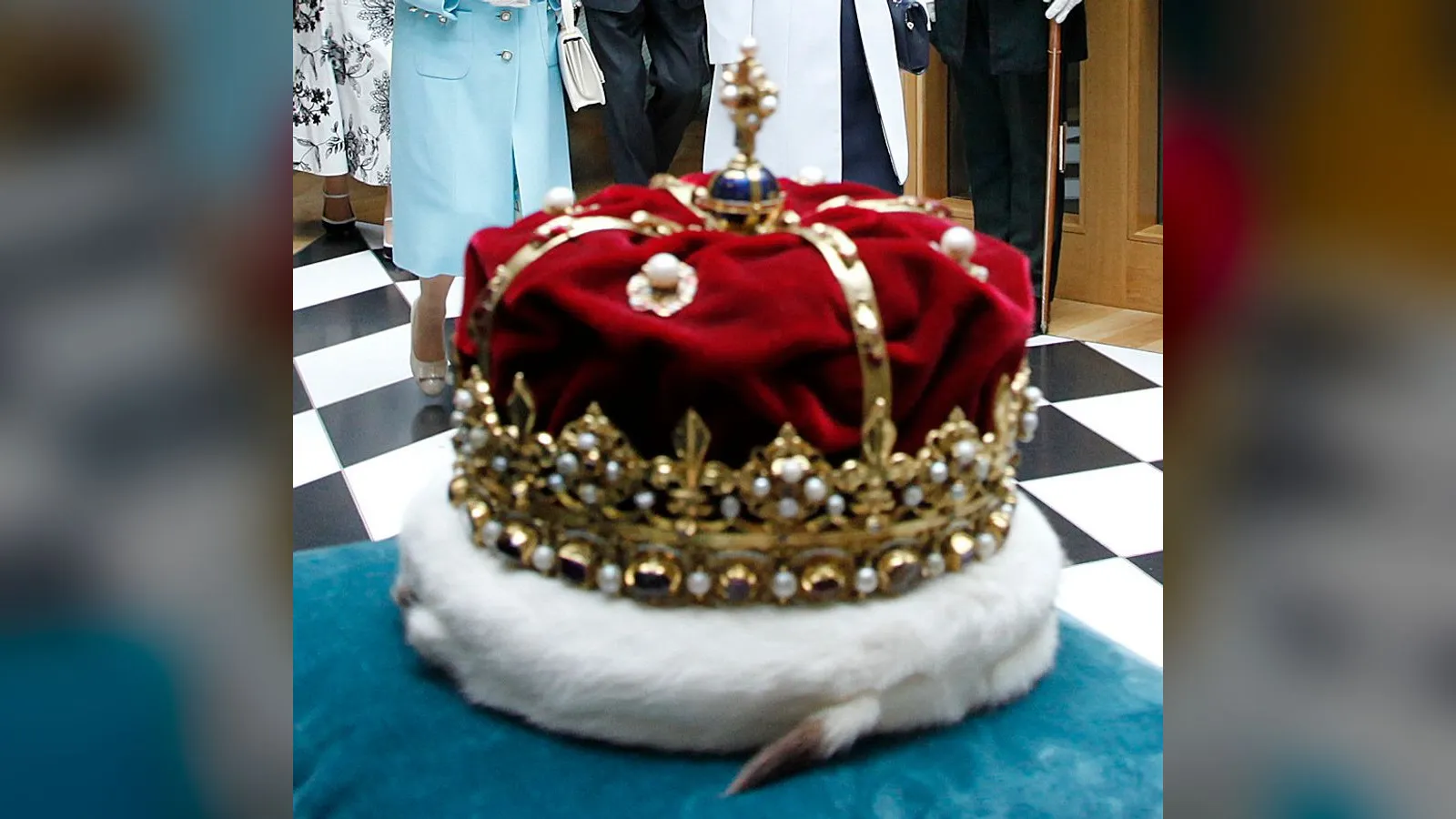
established The Crown of Scotland (present form 1540). The Crown is the centrepiece and the oldest surviving crown in the British Isles. In January 1540 James V commissioned the Edinburgh royal goldsmith John Mosman to remodel an older, damaged crown. Mosman dismantled the old crown, melted down the old circlet, and added 41 ounces of Scottish gold mined at Leadhills (Upper Clydesdale) in Lanarkshire, creating a new circlet decorated with the gemstones and pearls from the old crown, plus the four arches, monde and cross. James V first wore it at the coronation of his queen consort Mary of Guise at Holyrood Abbey on 22 February 1540. The crown weighs 1.64 kg (about 3.5 lb) and is set with gemstones and Scottish freshwater pearls. John Mosman was a documented member of the Incorporation of Goldsmiths of Edinburgh and warden of the mint from 1539; he is also recorded adding James V's initials to the regalia.
shared Sources vary on the exact stone and pearl counts: the Royal Household states "22 gemstones and 20 precious stones taken from the previous crown" plus freshwater pearls; Historic Environment Scotland's official conservation announcement ("Honours of Scotland shine once more") describes the Crown as "laden with 94 pearls and 43 gemstones including diamonds, garnets and amethysts"; Wikipedia gives "69 Scottish freshwater pearls and 43 gemstones."
traditional The popular belief that the circlet is the actual gold band worn by Robert the Bruce in 1306 is unproven. HES and historians note a crown "must have been made" in the era of Bruce or David II, but there is no proof the surviving circlet is Bruce's, and Historia Magazine explicitly calls the Bruce-circlet story "an enduring popular belief."
shared The Sceptre (papal gift, 1494). According to tradition the silver-gilt Sceptre was a gift from Pope Alexander VI to James IV in 1494, as a mark of papal support for Scotland as a "special daughter" of the Holy See. It was made in Italy and replaced a lost native-made sceptre dating from at least the 14th century. It was remodelled and lengthened in 1536 by the Edinburgh goldsmith Adam Leys for James V, and is now about 86 cm long. Its finial features stylised dolphins (symbolic of the Church) and three figures under canopies — the Virgin and Child, St James the Great, and St Andrew — topped by a globe of polished rock crystal. The 1494 Alexander VI attribution is described by the Royal Household as "according to tradition." Pope Innocent VIII conferred the Golden Rose on James IV in 1491, and some older and popular sources (e.g. Historic UK, Broomhall House) wrongly credit Innocent VIII with the sceptre; James IV's mainstream biography places the sceptre as a gift of Alexander VI in 1494.
established The Sword of State (papal gift, 1507). It was presented to James IV in 1507 by Pope Julius II (the patron who commissioned Michelangelo's Sistine Chapel ceiling), together with a blessed or consecrated hat, in recognition of James as a defender of Christendom — the traditional "blessed sword and hat" bestowed on Catholic monarchs. It was made in Italy by the craftsman Domenico da Sutri and replaced an earlier native-made Scottish sword. Per Historic Environment Scotland (trove.scot), it measures 137.8 cm overall with a 99 cm steel blade; the blade is etched with figures of St Peter and St Paul and the gold-inlaid inscription "JULIUS II PONT MAX" ("Julius II Supreme Pontiff"). The silver-gilt handle is decorated with oak leaves and acorns (symbols of the risen Christ) with dolphin-form quillons.
shared The blade is broken and repaired — according to tradition snapped in two around 1652 so it could be smuggled from Cromwell's troops ("according to tradition" and "likely" per HES and the Royal Household). Because the original is now too fragile, it was retired in 2022 and replaced for ceremonial use by the new Elizabeth Sword (designed by Mark Dennis, made by Scottish craftspeople, with a pommel of Lewisian gneiss from Iona and an oak hilt from Perthshire).
2. Status as the oldest crown jewels in the British Isles
established The claim is accurate as stated for the British Isles and the United Kingdom. Edinburgh Castle (HES), the Royal Household, and the Royal Collection all describe the Honours as "the oldest Crown jewels in Britain" or "the oldest regalia in the British Isles." The Royal Family's official site states plainly: "The Honours of Scotland are the oldest regalia in the British Isles. The crown, the sword and sceptre date from the late fifteenth and early sixteenth century." Wikipedia agrees ("the oldest surviving set of crown jewels in the British Isles").
established The comparison with England is decisive: after the execution of Charles I in 1649, the Commonwealth Parliament under Cromwell ordered the royal regalia "totally broken," with precious stones sold and metal sent to the Mint to be coined. Only a few pieces escaped — most famously the 12th-century Coronation Spoon, bought by Clement Kynnersley (a Yeoman of Charles I's Wardrobe) for 16 shillings and returned at the Restoration. New English regalia were made for Charles II's coronation in 1661 at a cost of nearly £12,185. So the surviving English Crown Jewels are overwhelmingly post-1661, whereas the Scottish Honours survived intact from the 15th–16th centuries — over a century older as complete objects.
established The "oldest in Europe" claim fails. Several bodies of surviving European regalia are older:
- The Hungarian Holy Crown (Crown of St Stephen) dates in its surviving form to the 11th–12th centuries and is widely called the oldest surviving royal crown still intact in Europe; almost the entire medieval Hungarian coronation ensemble survives.
- The Bohemian Crown of St Wenceslas was made in 1346–47 for Charles IV and is described as the fourth-oldest crown in Europe.
- The Crown of Princess Blanche (the "Palatine Crown," c.1370–80) is older than the Scottish crown and is the oldest surviving royal crown known to have been in England.
shared The precise, defensible wording is therefore "the oldest surviving crown jewels or regalia in the British Isles", and "the Crown of Scotland is the oldest surviving crown in the British Isles". HES and others sometimes append "and among the oldest in Europe," which is defensible only in the weak sense of "among the older sets"; the stronger phrasing "the oldest in Europe" (seen on some tourism and commercial pages) is incorrect. Historia Magazine's careful phrasing — "the oldest complete set of crown jewels in Europe and the crown is the oldest in Britain" — hinges entirely on the words "complete set," and even that is contestable given the near-complete Hungarian ensemble.
3. Coronations and the "Hiding of the Honours"
established Coronation use. The three Honours were first used together at the coronation of the nine-month-old Mary, Queen of Scots in 1543 (Chapel Royal, Stirling Castle, 9 September 1543). The historian John Guy, in his biography of Mary (2004; "My Heart is My Own", US edition Queen of Scots: The True Life of Mary Stuart), gives the order of procession: the governor, the Earl of Arran, bore the crown, the Earl of Lennox the sceptre and the Earl of Argyll the sword. The crown was far too large for a child, so Cardinal David Beaton held it over her head as he anointed her. The date was the thirtieth anniversary of Flodden.
established The crown was subsequently used at the coronations of James VI (1567), Charles I (Holyrood, 1633), and Charles II (Scone, 1 January 1651). The 1651 coronation of Charles II at Scone was the last coronation ever held on Scottish soil — confirmed by the Royal Household and by peer-reviewed scholarship (George W. C. Gross, "1651: The Last Coronation in Scotland — An Anomaly?", The Court Historian, vol. 26, 2021). At that ceremony the Honours were placed on a table beside the king; Robert Douglas preached; Charles swore to uphold the National Covenant and Solemn League and Covenant; notably he was not anointed, a break from earlier Scottish practice. Charles II was crowned again at Westminster in 1661, but that was in England.
established The hiding from Cromwell (1651–1660). With Cromwell's forces occupying Scotland after Dunbar (1650) and the English regalia already destroyed, the Honours were taken for safekeeping to Dunnottar Castle, the coastal stronghold near Stonehaven of the Earl Marischal. Cromwell's army besieged Dunnottar; when its fall became inevitable, the Honours were smuggled out and buried beneath the floor of Kinneff Old Church, where they remained until the Restoration in 1660. Dunnottar surrendered on 26 May 1652, and Cromwell's men found the regalia gone.
established The plan was arranged by Elizabeth Douglas (wife of the governor, Sir George Ogilvy of Barras) and Christian Fletcher (wife of James Granger, minister of Kinneff). Christian Fletcher's own account states that over three visits in February and March 1652 she carried the crown, sceptre, sword and scabbard out of the besieged castle hidden among sacks of goods. A genuine surviving primary source — 17th-century Treasury records transcribed in W. Moir Bryce's "The Ancient Regalia of Scotland" (Book of the Old Edinburgh Club, vol. 8, 1915) — records that to conceal the sword's scabbard "in ane sackfull of cods" (a sack of cushions) it had to be "folden in tua becaus of its length and greatnes" (folded or bent in two), which is why the Treasury later paid for a new scabbard. This version rests on contemporary Treasury records, her own testimony and the 1661 parliamentary award, and is the one accepted by Historic Environment Scotland and by Chris Tabraham, author of the authoritative HES study The Honours of Scotland: The Story of the Scottish Crown Jewels and the Stone of Destiny (2019).
established Fletcher's service was formally recognised. The Records of the Parliaments of Scotland (1661) state that "the estates of parliament do understand that Christian Fletcher, spouse to Mr James Granger, minister at Kinneff, was most active in conveying the royal honours" out of the castle, and "do appoint 2,000 merks Scots to be forthwith paid to her… as a testimony of their sense of her service." In practice the money went largely unpaid for decades (The Scotsman notes "the money was never paid" in full within her lifetime; partial Treasury payments were still being ordered in the 1670s and 1680s).
traditional The vivid version in which the Honours were lowered over the castle walls to a woman gathering seaweed and smuggled out in a creel under layers of dulse is an 18th-century tradition (attributed to William Meston, a tutor in the Earl Marischal's household) and is regarded as embellishment. So is Sir Walter Scott's romantic 19th-century retelling in which the minister's wife carried the crown out beneath her skirts while her maid hid the sceptre and sword under bundles of flax. Popular travel and magazine sources add further colour — riding along the cliffs ready to hurl the Honours into the sea, and so on — which is legend, not documented fact.
established There was also a genuine post-Restoration credit dispute: Sir George Ogilvy of Barras (rewarded with a baronetcy) and his descendants quarrelled with the Keith/Marischal family over who deserved credit; a 1701 pamphlet by Ogilvy's son ("A True Account of the Preservation of the Regalia of Scotland") was ordered burned at Edinburgh's Mercat Cross in 1702.
4. The 1818 "rediscovery" by Walter Scott
established After the Treaty and Acts of Union of 1707 dissolved the Scottish Parliament, the Honours lost their ceremonial function and were locked in an oak chest in the Crown Room of Edinburgh Castle. They stayed there, sealed, for 111 years (from 7 March 1707). An Article of the Treaty of Union guaranteed the Honours would remain in Scotland "in all times coming," but rumours nonetheless spread that they had been secretly removed to England.
established Sir Walter Scott, the novelist, became convinced they were still there. With the permission of the Prince Regent (later George IV) — issued via royal warrant — Scott and a group of Officers of State, in the presence of the Castle's governor, forced open the sealed doors and the oak chest on 4 February 1818, finding the regalia intact in their linen wrappings. Scott's own letter to J. W. Croker (7 February 1818) conveys "the intense eagerness with which we watched the rising of the lid of the chest." The Honours were put on public display in 1819 and have remained on view ever since.
shared The rediscovery mattered far beyond the objects themselves: it fed Scott's wider project of Romantic Scottish national revival, which culminated in his stage-management of George IV's 1822 visit to Scotland (covered in this collection's Highland and tartan companion pieces). Scott used the Honours to reassure Scots of their distinct nationhood within the Union. Scott's oft-quoted line that the crown's ruby "glowed with all its ancient lustre" is his own Romantic framing, and secondhand renderings of the discovery (e.g. that the searchers "feared the chest might be empty," or that Major Drummond had knocked on it in 1794 and heard nothing) blur into anecdote.
5. Modern ceremonial role
established Scottish Parliament. The Crown of Scotland is present at each ceremonial opening of the Scottish Parliament. Its use at the Parliament's inauguration on 1 July 1999 was its first appearance in a public ceremony since 1953. It featured again at subsequent openings (2003, 2007, 2011, 2016, 2021) and at the opening of the seventh session in 2024, when it was carried by the Duke of Hamilton and escorted down the Royal Mile.
established Charles III, 5 July 2023. At a National Service of Thanksgiving and Dedication at St Giles' Cathedral, Edinburgh, the Honours were presented to the King — mirroring the 1953 service for Elizabeth II. This was explicitly not a coronation but a service of thanksgiving. The Crown was borne by the Duke of Hamilton and Brandon, the Sceptre by Lady Dorrian (the Lord Justice Clerk), and — because the ancient Sword of State is too fragile — the new Elizabeth Sword was carried by Olympic champion Dame Katherine Grainger. A People's Procession moved down the Royal Mile; the event closed with a 21-gun salute from Edinburgh Castle and a Red Arrows flypast. (The Church of Scotland dimension of the service is covered in the companion Church of Scotland piece.)
established Display and visitors. The Honours are displayed in the Crown Room of the Royal Palace at Edinburgh Castle, alongside the Stone of Destiny (added 1996; the Stone was subsequently moved to the new Perth Museum in 2024). Edinburgh Castle is Scotland's most-visited paid attraction: per the Association of Leading Visitor Attractions (ALVA), it recorded 1,904,723 visits in 2023 and 1,981,152 in 2024 (a 4% increase, ranking it Scotland's top paid attraction), with figures reaching 2,044,963 in 2025. The Crown Room is scheduled to close January–April 2026 for refurbishment, with a digital display in the Great Hall during the closure. In 2023 the Honours also underwent the most significant conservation work in their history.
shared World War II. In 1941, facing possible German invasion, the Honours were buried at separate locations within the Castle. The crown and the Stewart jewels were concealed under the floor of a latrine closet in the medieval David's Tower, and the other pieces hidden in a wall; plans of the hiding places were entrusted to a very small circle including the King. One online dissenter disputes the latrine detail, but it is repeated by Edinburgh Castle's own official material and HES-linked sources.
Did You Know?
- The Crown's gold includes 41 ounces mined at Leadhills in Lanarkshire.
- Mary, Queen of Scots was nine months old at her coronation, and the Crown had to be held over her head.
- Her coronation fell on the thirtieth anniversary of Flodden.
- Charles II was not anointed at Scone in 1651, the last coronation in Scotland.
- England's Coronation Spoon survived Cromwell because a royal servant bought it for 16 shillings.
- The Sword of State's scabbard had to be folded in two to fit in a sack of cushions.
- Christian Fletcher was voted 2,000 merks in 1661 but was never paid in full.
- A pamphlet claiming credit for saving the Honours was burned at Edinburgh's Mercat Cross in 1702.
- The Honours lay in a locked chest for 111 years before Scott opened it in 1818.
- In 1941 the Crown was hidden under the floor of a medieval latrine at Edinburgh Castle.
- The Elizabeth Sword's pommel is Lewisian gneiss from Iona.
FAQ
1What are the Honours of Scotland?
The Crown, the Sceptre and the Sword of State, the Scottish crown jewels.
2Are they the oldest crown jewels in Britain?
Yes. They are the oldest surviving crown jewels in the British Isles, because the English regalia were destroyed in 1649 and remade in 1661.
3Are they the oldest in Europe?
No. The Hungarian Holy Crown and the Bohemian Crown of St Wenceslas are older.
4Who made the Crown?
The Edinburgh goldsmith John Mosman remodelled an older crown for James V in 1540, using Scottish gold.
5Is the Crown Robert the Bruce's?
There is no proof. The belief that the circlet is Bruce's 1306 band is a popular tradition.
6Where did the Sceptre and Sword come from?
Both were papal gifts to James IV, made in Italy: the Sceptre traditionally from Alexander VI in 1494, the Sword from Julius II in 1507.
7How were the Honours saved from Cromwell?
Christian Fletcher carried them out of besieged Dunnottar Castle among sacks of goods in early 1652, and they were buried under the floor of Kinneff Old Church until 1660.
8Were they lowered over the cliffs in a basket of seaweed?
That is an 18th-century tradition, not the documented account.
9Why were they locked away after 1707?
The Union ended the Scottish Parliament and the Honours' ceremonial role. They were sealed in a chest in the Crown Room.
10Who found them again?
Sir Walter Scott and the Officers of State, who opened the chest on 4 February 1818.
11Were the Honours used to crown Charles III?
No. They were presented to him at a National Service of Thanksgiving at St Giles' Cathedral on 5 July 2023, which was not a coronation.
12Why is there a new sword?
The 1507 Sword of State is too fragile, so the Elizabeth Sword replaced it for ceremonial use in 2022.
13Where can I see the Honours?
In the Crown Room of the Royal Palace at Edinburgh Castle, apart from a closure for refurbishment from January to April 2026.
Sources and Further Reading
Primary/Institutional
- Records of the Parliaments of Scotland (1661), award to Christian Fletcher
- W. Moir Bryce, "The Ancient Regalia of Scotland", Book of the Old Edinburgh Club, vol. 8 (1915), transcribing 17th-century Treasury records
- Walter Scott, letter to J. W. Croker, 7 February 1818
- Historic Environment Scotland, Edinburgh Castle and "Honours of Scotland shine once more"; trove.scot
- The Royal Household (royal.uk)
- Royal Collection
- Association of Leading Visitor Attractions (ALVA)
Scholarly/Critical
- Chris Tabraham, The Honours of Scotland: The Story of the Scottish Crown Jewels and the Stone of Destiny (HES, 2019)
- George W. C. Gross, "1651: The Last Coronation in Scotland — An Anomaly?", The Court Historian, vol. 26 (2021)
- John Guy, "My Heart is My Own": The Life of Mary Queen of Scots (2004; US edition Queen of Scots: The True Life of Mary Stuart)
Specialist
- Historia Magazine
- William Meston (18th-century tradition of the seaweed creel)
- Sir George Ogilvy's son, A True Account of the Preservation of the Regalia of Scotland (1701)
General
- The Scotsman
- Historic UK
- Broomhall House
- Wikipedia, "Honours of Scotland"
Caveats: Myths and Disputed Claims
- Myth: the Honours are the oldest crown jewels in Europe, or the world. Older regalia survive in Hungary (11th–12th century) and Bohemia (1346). They are the oldest in the British Isles.
- Disputed: the "oldest complete set in Europe". The claim hinges on "complete set" and is contestable given the near-complete Hungarian ensemble.
- Myth: the Crown's circlet is Robert the Bruce's crown of 1306. There is no evidence for it.
- Myth: Pope Innocent VIII gave the Sceptre. Innocent VIII gave the Golden Rose (1491); the Sceptre is attributed to Alexander VI (1494), and even that is "according to tradition".
- Myth: the Honours were lowered over the walls in a seaweed creel, or carried out under a woman's skirts. These are 18th- and 19th-century embellishments; the documented account is Christian Fletcher carrying them out among sacks of goods over three visits.
- Disputed: the Sword was snapped in two to hide it from Cromwell. The break is real; its cause is inferred.
- Disputed: Scott's ruby "glowed with all its ancient lustre". It is his Romantic framing, as are other dramatic flourishes of the discovery.
- Myth: the Crown was made for Mary, Queen of Scots, or first used at her coronation. James V first wore it at Mary of Guise's coronation in 1540.
- Disputed: the number of gems and pearls in the Crown. Official sources give different counts.
- Disputed: the date of Christian Fletcher's sworn statement. The "1664" date rests on Tabraham as relayed by Wikipedia; her documented petitions date to about 1670.
- Disputed: the 1941 latrine hiding place. The burial within the Castle is secure; the latrine location has one dissenter.
Finished reading? Try the Fact Machine: three reels, one surprising Scottish connection →
Card 046 · Traditions