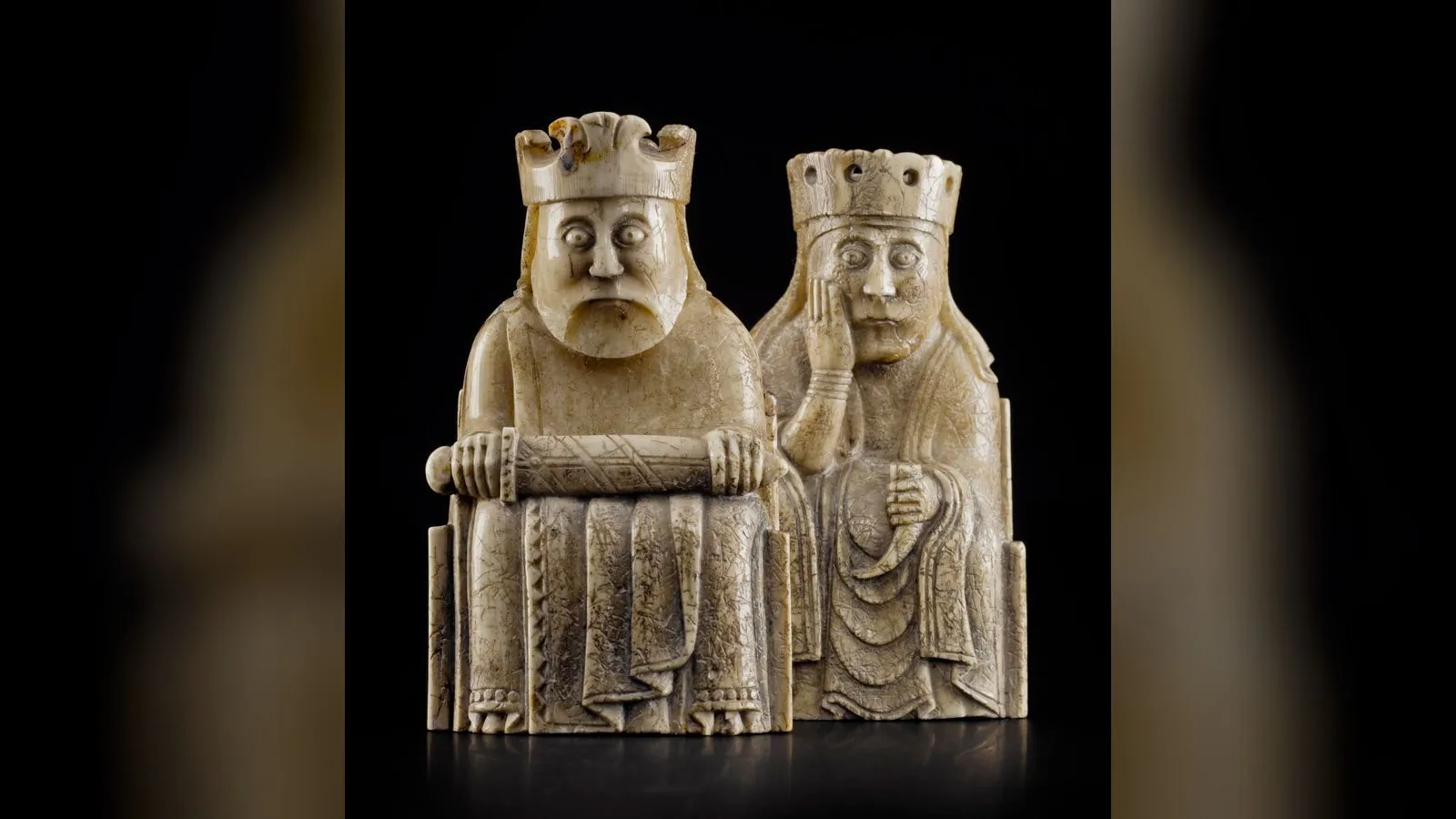

The Lewis Chessmen: Scotland's Most Famous Treasure That Scotland Did Not Make
Contents
The Lewis Chessmen are a hoard of 93 twelfth-century game pieces found on the Isle of Lewis in or before 1831. This card tests their "Scottishness": where they were made, how they were found, why they are split between London and Edinburgh, and which parts of their popular story are legend.
TL;DR
- established The hoard comprises 93 twelfth-century game pieces, 78 of them chess pieces, found on the Isle of Lewis and first exhibited in 1831.
- shared They are not a Scottish creation: the scholarly consensus is that they were carved in Norway, most likely Trondheim (medieval Nidaros), around 1150–1200, when the Hebrides were part of the Norse-ruled Kingdom of the Isles, not Scotland. Iceland is a contested minority theory.
- traditional The story that the crofter Malcolm "Sprot" MacLeod found them in the dunes at Uig Bay is first recorded in 1863; the cow that uncovered them and the elves he feared are legend.
- established 82 pieces are held by the British Museum in London and 11 by National Museums Scotland in Edinburgh, with six of the British Museum's pieces on long-term loan to Museum nan Eilean on Lewis since 2017; SNP politicians have repeatedly called for repatriation.
- established A "lost" 79th chess piece resurfaced and sold for £735,000 in 2019.
Key Facts
- Date made
- c.1150–1200
- Probable place made
- Norway, probably Trondheim (Nidaros)
- Material
- Walrus ivory, a few in sperm-whale tooth
- Found
- Isle of Lewis, in or before 1831; Uig Bay or possibly Mealista
- Hoard
- 93 objects (some say 94): 78 chess pieces, 14 tablemen, 1 belt buckle
- Chess pieces
- 8 kings, 8 queens, 16 bishops, 15 knights, 13 warders, 19 pawns (main collection); 79 known since 2019
- Sets
- At least four incomplete sets
- British Museum
- 82 pieces (Room 40); six on loan to Museum nan Eilean, Stornoway, since 2017
- National Museums Scotland
- 11 pieces
- Hebrides become Scottish
- Treaty of Perth, 2 July 1266
- 2019 sale
- Warder sold at Sotheby's for £735,000
A Note on Claims and Evidence
Each major claim carries one of three labels. established means supported by primary records, official bodies or several independent reliable sources. shared means the core fact is sound but sources disagree on details, dates or interpretation. traditional means widely repeated but not traceable to a primary or independent source.
The materials, dating, distribution, acquisition price and 2019 sale are documented. The Norway attribution is a probabilistic scholarly consensus ("probably Norway/Trondheim"), not a proven certainty; the museums themselves hedge with "probably". The discovery mechanics, exact find-spot and number of original sets are genuinely uncertain in the primary record. Some vivid quotations and discovery variants come from popular or commercial sources (chess retailers, tourism sites) and rank below the British Museum, National Museums Scotland and peer-reviewed archaeology. The reported "conversion" of Alex Woolf to sympathy for the Iceland theory comes mainly from Iceland-theory proponents; his documented position supports Norway.
Timeline
The Hebrides form part of the Norse-Gaelic Kingdom of the Isles.
Chessmen carved, probably in Trondheim.
Battle of Largs.
Treaty of Perth cedes the Hebrides to Scotland.
Pieces exhibited at the Society of Antiquaries of Scotland, with the permission of Roderick Ririe.
Frederic Madden's foundational paper.
Discoverer's name first recorded.
Sharpe's pieces reach the Society of Antiquaries of Scotland via Christie's.
An Edinburgh dealer buys a warder for £5.
Loan relationship between the museums begins.
Replicas appear in Harry Potter and the Philosopher's Stone.
Fifth in a British Museum list of top British archaeological finds.
Repatriation campaign prominent.
"Airbrushing" row; Iceland theory revived; A History of the World in 100 Objects; "Unmasked" exhibition opens.
Met Cloisters exhibition.
Nancy Marie Brown's Ivory Vikings.
Six pieces on long-term loan to Museum nan Eilean.
Rediscovered warder sold for £735,000.
British Museum–NTNU research project.
Six pieces shown in Trondheim.
Details
1. Discovery
established The pieces first entered the record on 11 April 1831, when they were exhibited at the Society of Antiquaries of Scotland in Edinburgh with the permission of Roderick Ririe (also spelled Ryrie/Rirrie) of Stornoway. The exact date and circumstances of the find itself are not recorded, so some scholars write "in or before 1831."
shared The generally cited location is Uig Bay (Camas Uig) on the west coast of Lewis, in a sandbank or dune near Ardroil, at a spot locally called Cnoc an Teampuill ("Temple Hill"). However, National Museums Scotland curators (Caldwell, Hall and Wilkinson) argue that Mealista, about six miles (10 km) further south down the same coast in the parish of Uig, is a more likely find-spot — an important, under-reported scholarly qualification.
traditional The romantic discovery story — a crofter named Malcolm "Sprot" MacLeod (Calum an Sprot) of Pennydonald finding them in a stone kist in the dunes at Uig Bay, near Ardroil — is not contemporaneously documented: the discoverer's name is first recorded only in 1863, three decades later. The famous embellishments (a cow uncovering the hoard; MacLeod fleeing in terror thinking they were elves or gnomes) are legend, and locals in Uig generally dismiss the cow story as fabrication.
established Number of pieces. The hoard as recorded contained 93 objects (some sources say 94): 78 chess pieces, 14 tablemen (plain gaming discs for a game such as tables/backgammon), and one walrus-ivory belt buckle. With the 2019 rediscovery there are now 79 known chess pieces. The chess pieces comprise (in the main collection) 8 kings, 8 queens, 16 bishops, 15 knights, 13 warders (rooks) and 19 pawns.
established Distribution. 82 of the 93 pieces are owned by the British Museum in London (displayed in Room 40); 11 are held by National Museums Scotland in Edinburgh. Since March 2017, six of the British Museum's pieces have been on long-term loan to Museum nan Eilean at Lews Castle, Stornoway, on Lewis itself. At least one further piece (the 2019 warder) is in private hands, and four other major pieces plus many pawns remain missing.
established Acquisition. Ririe sold ten pieces to the Scottish collector Charles Kirkpatrick Sharpe (who later acquired an eleventh, a bishop); the rest went via a dealer, T. A. Forrest, to the British Museum, whose purchase (82 pieces) was instigated by Sir Frederic Madden, Assistant Keeper of Manuscripts and a chess enthusiast. The British Museum paid 80 guineas. Sharpe's pieces later passed to Baron Londesborough and, in 1888, via Christie's to the Society of Antiquaries of Scotland for the national collection in Edinburgh. The pieces were bought, not looted — Ririe reportedly paid MacLeod about £30, and the dealer sold them on to the museum for 80 guineas.
2. Origin: Norse, not Scottish
shared The scholarly consensus is that the chessmen were made in Norway, most probably in Trondheim (medieval Nidaros), around 1150–1200. Both the British Museum and National Museums Scotland officially attribute their manufacture to Norway. The British Museum's own summary states "a popular theory is that they were made in Trondheim in western Norway around 1150–1200," citing three reasons: Trondheim as a centre of walrus-ivory carving, a comparable queen-piece fragment found in a local church, and throne decoration resembling medieval Norwegian church carvings.
established The evidence for Norway is primarily physical and art-historical: (1) a broken queen fragment in a closely comparable style — apparently broken during manufacture — was found in Trondheim (in St Olav's Church, near the Archbishop's Palace), an in-situ production indicator that Iceland has no equivalent to; (2) the decoration on the thrones resembles carving in Nidaros Cathedral and other medieval Norwegian churches; (3) Trondheim was a major centre of the walrus-ivory carving trade; and (4) related finds such as a kite-shaped shield excavated in Trondheim and a chess king found on Hitra island near the mouth of Trondheim Fjord (though the Hitra king is sperm-whale tooth, stylistically weaker and probably later in date, so it should not be overstated). James Barrett, professor of archaeology at NTNU and a leading figure in current research, has stated that "Trondheim was an important trade hub for walrus ivory, particularly from Greenland and Northern Norway," adding that artistic similarities between the carvings and medieval sculptures in Nidaros Cathedral support a Trondheim origin. Dr Alex Woolf of the University of St Andrews similarly argued that the wealthy patron was probably the archbishop of Trondheim, whose jurisdiction included the Hebrides.
established Why Norse objects turn up on a Scottish island. From the ninth to the thirteenth centuries the Hebrides were part of the Norse-Gaelic world — specifically the Kingdom of the Isles (Old Norse Suðreyjar, the "Southern Isles"). Lewis was one of the most densely Norse-settled parts of western Scotland; the culture was a Norse-Gaelic hybrid, and the local church fell under the Archbishopric of Nidaros/Trondheim. The islands remained under Norwegian overlordship until the Treaty of Perth (2 July 1266), when, after the inconclusive Battle of Largs (1263) and the death of King Håkon IV in Orkney, his successor Magnus VI ceded the Hebrides and the Isle of Man to Alexander III of Scotland in exchange for a lump sum of 4,000 marks and an annuity of 100 marks. This is distinct from Shetland and Orkney, which the same treaty confirmed as remaining Norwegian. Scotland did not hold sovereignty over Lewis when the chessmen were made, and on most theories they were buried before 1266. traditional The chessmen are usually thought to have reached Lewis as a merchant's stock in transit, possibly bound for Ireland (Dublin), and buried for reasons unknown.
shared The Iceland theory. A genuine minority hypothesis holds that the pieces were made in Iceland. It is not new — Frederic Madden himself suggested Iceland in his foundational 1832 paper — but it was revived in 2010 by Gudmundur G. Thórarinsson (an Icelandic civil engineer and former chess-federation official, not a medievalist) and popularised by Nancy Marie Brown's 2015 book Ivory Vikings. Its arguments are essentially textual and linguistic: that Icelandic and English were the only languages to call the pieces "bishop/biskup" and "rook/hrókr"; that Bishop Páll Jónsson of Skálholt could have commissioned the set; that a named female saga carver, Margrét the Adroit ("Margrét hin haga"), worked walrus ivory "so skillfully that no one in Iceland had seen such artistry before"; and that a chess figure found at Siglufjörður in 2010 shows local production.
established This case rests on circumstantial, saga-based evidence with no matching archaeological production find comparable to the Trondheim queen fragment, and it has been sharply criticised — notably by the Norwegian scholar Morten Lilleøren, who called Thórarinsson's work "filled with faults and oversights" and pointed out that Icelandic law of the period penalised gambling games and outlawed berserkers, making a bishop's commission of shield-biting berserker pieces implausible. Norway/Trondheim is the mainstream, evidence-backed attribution; Iceland is a contested minority theory. A local Hebridean (Norse-Gaelic) manufacture has also been floated by a few scholars but is not the mainstream view.
established A note on "Viking". The pieces are routinely marketed as "Viking" chess pieces. Strictly, they belong to the medieval Norse world of c.1150–1200, more than a century after the Viking Age proper; the berserker imagery evokes the saga past rather than depicting the makers' own era.
3. Craftsmanship, iconography and significance
established Materials. Almost all pieces are carved from walrus ivory; a few are sperm-whale tooth. Much of the walrus ivory used across medieval Europe came from Norse-hunted sources in western Greenland, traded south through Norwegian ports — a supply chain established by DNA and isotope analyses of medieval walrus tusks led by NTNU's James Barrett, which showed that the majority of Europe's demand in the 12th and 13th centuries was met by one source: western Greenland.
established The pieces. The pieces are Romanesque miniature sculptures, famous for their expressive, almost comic faces. Kings sit on thrones holding swords across their laps; queens sit holding a hand to the cheek (read by modern eyes as sorrow or, by scholars, as contemplation or wisdom); bishops hold croziers and sometimes books (seven seated, nine standing in the main collection); knights ride notably small horses; warders (rooks) are standing warriors, four of them the wild-eyed berserkers biting their shields. Pawns are abstract geometric "tombstones," a combination of abstract pawns with figurative pieces that is unique among medieval sets. Some pieces bore traces of red stain when found (analysis found mercury, consistent with the pigment cinnabar), implying the two sides were red and white rather than black and white.
shared Number of sets. The chess pieces represent at least four incomplete sets; the range of pawn sizes has suggested to some scholars as many as five sets. Caldwell, Hall and Wilkinson's forensic facial analysis grouped the pieces into five stylistic clusters, proposing they were the work of about five different craftsmen.
established Significance to chess. They are among the earliest known chess sets to feature a bishop and among the earliest to feature a queen — evidence of how the game, arriving from India via the Islamic world, was re-imagined in European feudal terms (king, queen, bishop, knight, warder/rook, pawn). Frederic Madden's 1832 paper, which coined the term "warder" and first identified the shield-biters as berserkers from his knowledge of Norse sagas, remains a foundational work.
4. Modern cultural status and popular culture
established Harry Potter. Replicas of the Lewis Chessmen were used for the wizard's-chess scene in Harry Potter and the Philosopher's Stone (2001). shared A widely repeated claim that the queen piece "became the model for the white queen" is essentially a design homage; the documented fact is simply that the film used Lewis-style pieces. The British Museum's Irving Finkel — who as a boy was introduced to the chessmen's curator and later wrote a 1995 children's book about them — lent his personal chess collection to the filmmakers.
established Recognition. The pieces were number five in a 2003 British Museum list of top British archaeological finds and were featured in the 2010 BBC/British Museum series A History of the World in 100 Objects.
established Exhibitions and tourism. Various pieces have appeared in more than 20 exhibitions worldwide since 1995. The joint National Museums Scotland/British Museum touring exhibition "The Lewis Chessmen: Unmasked" opened in Edinburgh in May 2010 and toured Aberdeen, Shetland and Stornoway (2011); a five-month showing at Museum nan Eilean drew over 23,000 visitors, and the wider Scottish tour attracted more than 120,000. A Met Cloisters exhibition ("The Game of Kings") showed 34 pieces in 2011–12. In 2025–26, six British Museum pieces travelled to the NTNU University Museum in Trondheim for the "Sea Ivories" exhibition — framed as a "homecoming" to their probable birthplace. The chessmen are heavily used in Scottish and Hebridean cultural marketing (giant wooden replicas stand near Uig Bay; local craft businesses use the imagery), and this is exactly where the Norse-origin caveat is most often dropped.
established The 2019 rediscovery. A warder that an Edinburgh antiques dealer had bought for £5 in 1964 — catalogued only as an "Antique Walrus Tusk Warrior Chessman" and kept in a family drawer for 55 years — was identified as one of the missing Lewis pieces and sold at Sotheby's London on 2 July 2019 for £735,000 (about $929,000), a record for a medieval chess piece; the pre-sale estimate had been £600,000–£1,000,000. It is 8.8 cm (3.5 inches) tall, made of walrus ivory, and belongs to a private collector.
5. Legal and repatriation disputes
established The London/Edinburgh split. The division — 82 in London, 11 in Edinburgh — has been contentious since at least 2007. SNP politicians from the Western Isles (Councillor Annie Macdonald, MSP Alasdair Allan, and MP Angus MacNeil) called for the pieces' return to where they were found. Scottish culture minister Linda Fabiani called it "unacceptable that only 11 Lewis chessmen rest at the National Museum of Scotland while the other 67 (as well as the 14 tablemen) remain in the British Museum in London"; the then Westminster arts minister Margaret Hodge dismissed the campaign, responding: "It's a lot of nonsense, isn't it?"
established The "airbrushing" row. In 2010 Angus MacNeil accused the British Museum of "historical airbrushing" after London Underground posters for A History of the World in 100 Objects labelled the queen piece "AD 1150–1200 Norway" with no mention of Lewis, the Hebrides or Scotland. He tabled an Early Day Motion in the Commons that won cross-party backing. The episode illustrates the collection's core tension: the accurate origin label (Norway) and the accurate find-spot claim (Lewis, Scotland) pull in opposite directions.
shared The Norway complication. Commentators have noted the awkwardness that if Scotland claims the pieces because they were found there, Norway could claim them because they were probably made there — a reason the repatriation case is legally and ethically messier than looted-artifact cases such as the Parthenon (Elgin) Marbles, which the British Museum fears would set a precedent.
established Current arrangement. No transfer of ownership has occurred. The British Museum retains 82 pieces and NMS 11, but a long-standing loan relationship (since 1995) culminated in six British Museum pieces going on long-term display at Museum nan Eilean, Lews Castle, from 2017 — the first time the pieces have been shown effectively permanently on Lewis. An ongoing British Museum–NTNU research project (2024–2027) is studying the pieces' materials, manufacture and burial; as of 2026 it has not published conclusions that overturn the Norway consensus.
Did You Know?
- The British Museum bought its 82 pieces for 80 guineas.
- The finder reportedly received about £30.
- Some pieces still bore traces of red stain, so the two sides were probably red and white.
- Four of the warders are berserkers biting the tops of their shields.
- The Lewis pieces are among the earliest chess sets with a bishop and among the earliest with a queen.
- The pawns are plain "tombstones", although the other pieces are figures.
- Most of Europe's medieval walrus ivory came from western Greenland.
- A missing warder bought for £5 in 1964 sold for £735,000 in 2019.
- Frederic Madden coined the term "warder" in 1832, and also first suggested Iceland as their origin.
- In 2025–26 six pieces went "home" to Trondheim for an exhibition.
FAQ
1Are the Lewis Chessmen Scottish?
They were found in Scotland, on Lewis. The scholarly consensus is that they were made in Norway, probably Trondheim, around 1150–1200.
2Why were Norwegian chessmen on Lewis?
The Hebrides were part of the Norse Kingdom of the Isles until the Treaty of Perth in 1266. The pieces may have been a merchant's stock in transit.
3Could they have been made in Iceland?
It is a minority theory, revived in 2010. It rests on texts and sagas and has no archaeological production find to match Trondheim's broken queen.
4Are they Viking?
Not strictly. They date from c.1150–1200, more than a century after the Viking Age.
5Who found them?
Tradition names Malcolm "Sprot" MacLeod, but his name is first recorded in 1863. The pieces were first exhibited in Edinburgh on 11 April 1831.
6Did a cow dig them up?
That is legend; locals in Uig generally dismiss it.
7Where were they found?
Usually said to be Uig Bay, near Ardroil; National Museums Scotland curators argue Mealista is more likely.
8How many pieces are there?
The hoard has 93 objects: 78 chess pieces, 14 tablemen and a buckle. A 79th chess piece surfaced in 2019.
9Where can I see them?
At the British Museum (82, with six on loan to Museum nan Eilean in Stornoway) and National Museums Scotland in Edinburgh (11).
10Were they looted?
No. They were bought: Ririe sold them on, and the British Museum paid 80 guineas.
11Were they used in Harry Potter?
Replicas were used in the wizard's-chess scene of Harry Potter and the Philosopher's Stone (2001).
12Will they be returned to Lewis?
There has been no transfer of ownership. The six-piece loan to Lews Castle since 2017 is the practical compromise.
Sources and Further Reading
Primary/Institutional
- British Museum, Lewis Chessmen collection and Room 40
- National Museums Scotland
- Museum nan Eilean, Lews Castle, Stornoway
- Society of Antiquaries of Scotland (exhibition of 11 April 1831)
- NTNU University Museum, Trondheim, "Sea Ivories" (2025–26)
- UK Parliament, Early Day Motion tabled by Angus MacNeil (2010)
Scholarly/Critical
- Frederic Madden, paper on the Lewis Chessmen (1832)
- David Caldwell, Mark Hall and Caroline Wilkinson (National Museums Scotland), on the find-spot and carvers
- James Barrett (NTNU), on walrus ivory and the Trondheim origin
- Alex Woolf (University of St Andrews)
- Morten Lilleøren, critique of the Iceland theory
Specialist
- Gudmundur G. Thórarinsson, the Iceland theory (2010)
- Irving Finkel, children's book on the Lewis Chessmen (1995)
- The Met Cloisters, "The Game of Kings" (2011–12)
- Sotheby's, sale of 2 July 2019
General
- BBC / British Museum, A History of the World in 100 Objects (2010)
Further reading
- Nancy Marie Brown, Ivory Vikings (2015)
Caveats: Myths and Disputed Claims
- Myth: the Lewis Chessmen are a Scottish creation. They are a Scottish find, not a Scottish creation; the consensus is that they were made in Norway.
- Myth: they are "Viking" chessmen. They are medieval Norse (c.1150–1200), after the Viking Age.
- Myth: a cow uncovered them and the finder fled thinking they were elves. The story is undocumented and dismissed locally; the discoverer's name appears only from 1863.
- Disputed: they were found at Uig Bay in 1831. The honest position is "in or before 1831", at Uig Bay or possibly Mealista.
- Disputed: the queen inspired Harry Potter's white queen. The documented fact is only that Lewis-style replicas were used in the film.
- Disputed: Iceland made them. A real but minority, largely textual hypothesis, without a production find; it does not carry the weight of the Norway/Trondheim consensus.
- Disputed: the number of sets and carvers. "Four sets" is the documented minimum; "five sets" and "five carvers" are reasoned interpretations.
- Disputed: Alex Woolf's view of the Iceland theory. Reports of his "conversion" come from Iceland-theory proponents; his documented position supports Norway.
Finished reading? Try the Fact Machine: three reels, one surprising Scottish connection →
Card 047 · Traditions