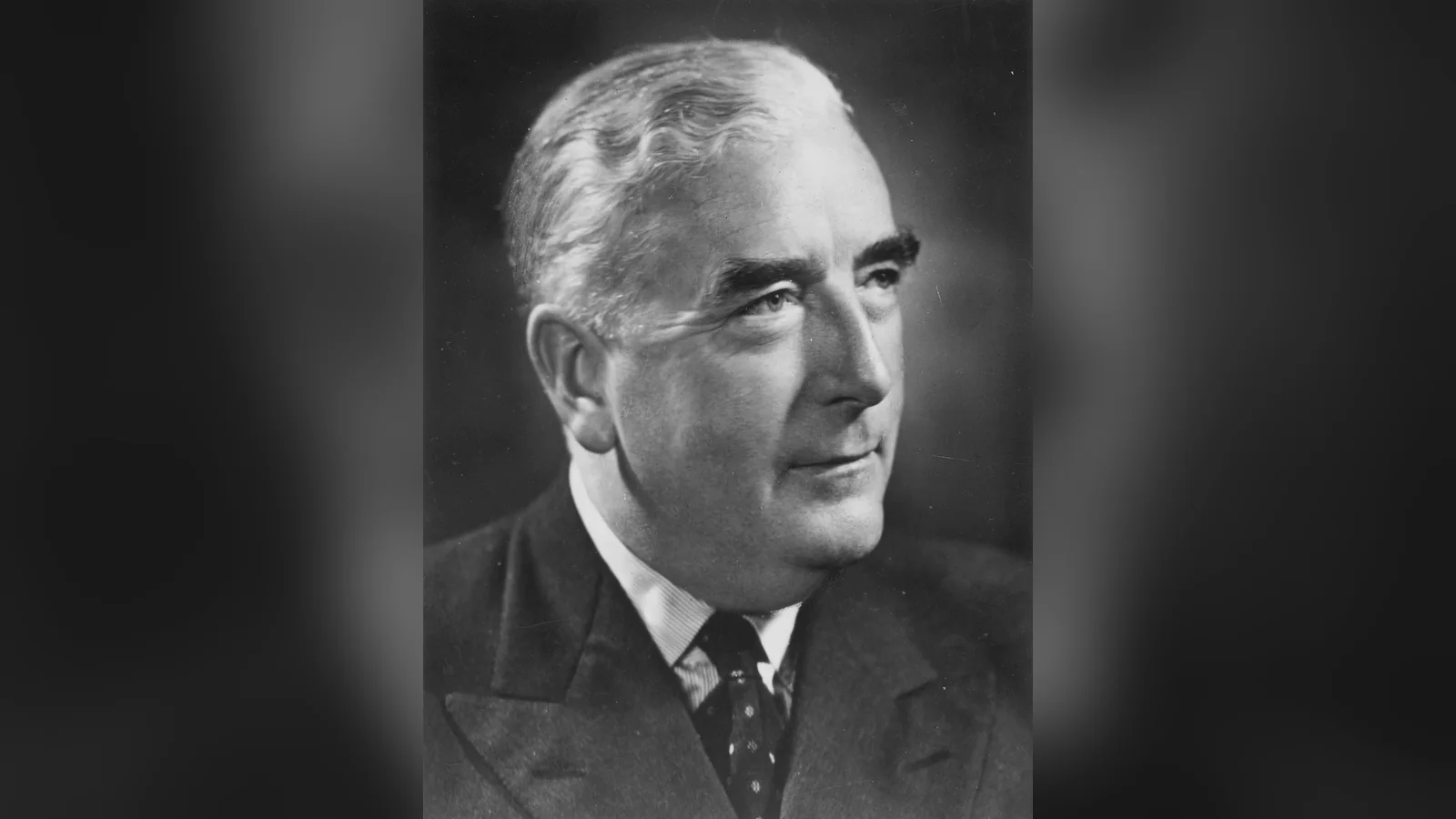

Sir Robert Menzies (1894–1978): A Gold-Rush Scot's Grandson and Australia's Longest-Serving Prime Minister
Contents
Robert Gordon Menzies was born in a small town in the Victorian Wimmera in 1894 and was Australia's prime minister for more than eighteen years, longer than anyone before or since. He was not Scottish-born. His grandfather, a young seaman from the Greenock and Port Glasgow district, jumped ship at Melbourne in 1854 to dig for gold at Ballarat and married the daughter of a Fife cobbler he had met on the voyage. Menzies grew up in a household his biographer calls overwhelmingly Scots in flavour, and the Scots strain was the part of his background he boasted of most. In 1963 he became the only Australian ever made a Knight of the Thistle. W. Martin's Robert Menzies: A Life, Volume 1: 1894–1943 (Melbourne University Press, 1993), the standard biography, which draws on Menzies's diaries and family papers.
TL;DR
- established Menzies's paternal grandfather, Robert Menzies, was born and raised near Glasgow, the son of a bleacher and gardener with a little land between Port Glasgow and Greenock. He reached Melbourne in 1854 as a 22-year-old seaman and went to the Ballarat goldfields.
- established In 1855 he married Elizabeth Brand, eldest daughter of a Fife cobbler, Thomas Brand. Their son James, a coachpainter, was Robert Gordon Menzies's father. His mother, Kate Sampson, was the daughter of a Cornish miner and union leader.
- established Robert Gordon Menzies was born at Jeparit, Victoria, on 20 December 1894. He became a leading constitutional barrister, federal Attorney-General in 1934, and prime minister from April 1939 to August 1941. As Attorney-General he forced the Port Kembla waterside workers to load pig iron for Japan in 1938–39, which earned him the lifelong nickname "Pig-iron Bob".
- established He founded the Liberal Party in 1944–45 and was prime minister again from December 1949 to January 1966. He was invested as a Knight of the Thistle in Edinburgh on 1 July 1963, the only Australian to receive the honour.
- shared Martin writes that the Scots parentage was "the most deeply internalized" part of his background. Colleagues saw it in his manner, and Mackenzie King thought it showed in all his views.
Key Facts
- Born
- 20 December 1894, Jeparit, Victoria
- Died
- 15 May 1978, Melbourne
- Scottish link
- Grandson of Robert Menzies (c. 1832–1879), seaman from the Port Glasgow–Greenock district, and Elizabeth Brand, daughter of a Fife cobbler
- Parents
- James Menzies, coachpainter, storekeeper and Victorian MP; Kate Sampson, daughter of the Cornish miner John Sampson
- School
- Grenville College and Ballarat; Wesley College, Melbourne
- University
- University of Melbourne, law, first-class honours
- Prime minister
- 26 April 1939 – 29 August 1941; 19 December 1949 – 26 January 1966
- Party
- United Australia Party; founder of the Liberal Party of Australia (1944–45)
- Married
- Pattie Maie Leckie, Kew Presbyterian Church, 1920
- Scottish honours
- Knight of the Thistle (conferred March 1963, installed at St Giles' Cathedral, Edinburgh, 1 July 1963)
- Other
- Lord Warden of the Cinque Ports, 1965, succeeding Winston Churchill
Scottish Impact Index (SI Score)
- Global Influence
- 7/10
- Enduring Connection
- 8/10
- Material Contribution
- 8/10
- Scottish Diaspora Distinctiveness
- 7/10
- Diaspora Legacy
- 7/10
- Recognition
- 7/10
44/60
Ranked =43rd of 93 in Diaspora
A Note on Claims and Evidence
Each major claim carries one of three labels. established means supported by primary records, official bodies or several independent reliable sources. shared means the core fact is sound but sources disagree on details, dates or interpretation. traditional means widely repeated but not traceable to a primary or independent source.
- established marks facts from parliamentary and government records, family papers and the press, as used by Martin.
- shared marks Martin's interpretations, and contemporaries' judgements of Menzies's character.
- traditional marks family stories without independent record.
Martin's first volume ends in 1943. His account of the Menzies family's origins rests on two family sources: Hugh Menzies's article "An Australian Menzies Family" in the Menzies Clan Society magazine (Aberfeldy, 1987), and Frank G. Menzies's privately circulated Reminiscences of the Menzies Family. The later career and the Thistle are taken from the standard record and from the Robert Menzies Institute.
Timeline
The grandfather's father, James Menzies, bleacher and gardener of the Port Glasgow–Greenock district, dies.
Robert Menzies, aged 22, reaches Melbourne as a seaman on the Thomas Feildon, jumps ship and goes to Ballarat.
He marries Elizabeth Brand, daughter of the Fife cobbler Thomas Brand, in Collingwood.
He dies of pneumonia at Ballarat, aged 46, leaving nine children.
James Menzies marries Kate Sampson.
The family moves to Jeparit for James's health and opens a store.
Robert Gordon Menzies is born at Jeparit.
He enters Wesley College, Melbourne, after his father had sent him to enrol at Scotch College.
He marries Pattie Leckie in the Kew Presbyterian church.
He wins the Engineers' case in the High Court, which makes his name at the Bar.
He enters the Victorian Legislative Council.
He enters federal parliament for Kooyong and becomes Attorney-General.
His first journey to Britain, recorded in the unpublished "Jubilee Pilgrim".
On a second journey he tours Edinburgh and the Borders abbeys.
He spends four days in Germany, meeting Schacht and the British ambassador.
The Port Kembla pig-iron dispute.
He becomes prime minister after the death of Joseph Lyons.
He spends four months in Britain, visits Ottawa in May, and resigns as prime minister in August.
Broadcasts "The Forgotten People".
He founds the Liberal Party of Australia.
He becomes prime minister again.
The Queen installs him as a Knight of the Thistle in Edinburgh.
He retires as prime minister.
He dies in Melbourne.
Details
From the Clyde to Ballarat
established Martin traces the family to the lower Clyde. The grandfather's father, James Menzies, was in his time a bleacher, chargekeeper and gardener, and owned a little land in a rocky valley between the parishes of Port Glasgow and Greenock. He died in 1832. His widow, Catherine, left the property to her eldest son, Hugh, so the younger Robert had little reason to stay. Robert went to sea, and in 1854, aged twenty-two, reached Melbourne on the Thomas Feildon, jumped ship and joined the rush to Ballarat. His brother Hugh, also a seaman, sold the land, spent some time in Quebec, and followed him to the Victorian diggings.
established On the voyage Robert befriended Thomas Brand, a cobbler from Fife emigrating with his family. In 1855 he married Brand's eldest daughter, Elizabeth, at Collingwood, and took her to a tent beside Ballarat's Yarrowee Creek. He mined until 1861, mostly for one of the deep-lead companies, then sold imported mining machinery, and finally worked as a travelling salesman for Ballarat's Phoenix foundry. In 1879 he caught a chill helping to rescue a wagon from a fire and died of pneumonia, aged forty-six. Several Ballarat firms closed for his funeral, and his employers put an obelisk over his grave.
established Elizabeth Menzies lived another thirty-two years. Her older sons, including James, kept the family going. James became a skilled coachpainter, painted the first of his neighbour Hugh Victor McKay's stripper-harvesters and, Martin says, gave it the name "Sunshine Harvester". In Ballarat he was a Presbyterian elder at Scots Church, Soldiers' Hill. At Jeparit, where the Methodists were the strongest Protestant church, he joined them. He liked to call himself "a Presbyterian by conviction and a Methodist by adoption".
A Scots household
established Robert Gordon Menzies was born at Jeparit on 20 December 1894, the fourth of five children. Sent back to Ballarat for schooling, he lived with Grandmother Menzies, and Martin says the clearest memory of those years was the "overwhelmingly Scots flavour" of that household. She was a short, devout widow in black bombazine. The only books always allowed were the Bible, the Presbyterian hymn book, the Ingoldsby Legends and The Pilgrim's Progress, and every evening at half past six she ordered him to his book. She also docked a penny from his pocket money when she found he walked to his other grandfather's house to save the tram fare.
established That other grandfather, John Sampson, a Cornish immigrant of 1854, had led a miners' strike at Creswick and been blacklisted for it. He gave the boy Labor editorials to read and argue over. Menzies later said he learned tolerance from him, though not his politics.
shared Martin's judgement is that, of the two "accidents of fate" Menzies liked to boast of, his Scots parentage and his country birth, the Scots strain went deepest. The country town was a useful symbol, but one he was glad to leave.
The Scotland in his blood
established Menzies first went to Britain in 1935, for the Silver Jubilee, and turned his diary into a book he called "Jubilee Pilgrim", subtitled as an account of "an Australian to England and Scotland". It was never published. In 1936, on a second journey, he took the Flying Scotsman to Edinburgh and spent several days in Peeblesshire. He wrote home a four-page letter about the battlefields of Dunbar, Prestonpans and Carberry Hill, the Pentlands and Arthur's Seat, and the abbeys of Melrose, Dryburgh and Jedburgh. At Jedburgh he was taken with the caretaker who spoke of attacks on the abbey five hundred years before as if they had happened to her own family. He apologised for the length of the letter, saying that "there is something about this Scotland that comes bubbling up in my blood".
shared Others saw the Scot in him too. His contemporary at the Bar, Percy Joske, said he would ride roughshod over opponents "like many another Scot". When the Canadian prime minister Mackenzie King, himself the grandson of a Scot, met him in Ottawa in May 1941, he wrote in his diary that Menzies revealed his "Scotch Presbyterian origin" in his thoughts and views generally. A colleague's tribute found in him cheerful fellowship with "a hint of Scottish dourness", and Martin himself speaks of Menzies's stern "improved Scottishness".
Lawyer and minister
established Menzies took first-class honours in law at the University of Melbourne, was president of the students' council and edited the university magazine. He did not enlist in the First World War, which his enemies used against him for the rest of his life; Martin notes that he did serve his compulsory militia term. In 1920, still a junior barrister, he won the Engineers' case in the High Court, which transformed the relationship between the Commonwealth and the states and made his name. He married Pattie Leckie in the Kew Presbyterian church the same year.
established He entered the Victorian Legislative Council in 1928 and moved to the federal seat of Kooyong in 1934 as Attorney-General in Joseph Lyons's government. On Lyons's death he became prime minister on 26 April 1939, and within months led Australia into the Second World War. After four months in wartime Britain in 1941, he lost the confidence of his coalition and resigned in August 1941.
Berlin and Port Kembla, 1938
established In July 1938 Menzies and his wife flew to Germany for a four-day semi-official visit, travelling "with true Scotch caution", Martin notes, in separate aeroplanes. They were entertained by the British ambassador, Sir Nevile Henderson, and by Hjalmar Schacht of the Reichsbank, and toured factories, workers' housing and the new autobahns. Menzies told Schacht that the suppression of criticism would ultimately destroy Germany, and found execution without trial impossible to understand. He also wrote that it would be a blunder to deny that Nazism had "a real and disinterested enthusiasm" behind it, and he came home urging Lord Halifax to put more pressure on Prague, not on Berlin. Martin rejects the myth that he came back an uncritical admirer of the regime; his own letters show he came back an appeaser.
established That November waterside workers at Port Kembla, New South Wales, refused to load the steamer Dalfram with pig iron for Japan, then at war in China. As Attorney-General, Menzies insisted that a union could not make the nation's foreign policy and invoked the licensing system against them. BHP's steel subsidiary at Port Kembla announced that its works would close, putting 5,000 jobs at risk, and when Menzies drove to Wollongong in January 1939 to negotiate, the road was lined with booing crowds. The men went back to work on 21 January on his terms, and the name "Pig-iron Bob" stayed with him. Martin calls the simple story of government against watersiders, on which the nickname rests, too simple: the dispute was also a fight inside the union.
The Gaelic dictation test
established One of the first controversies Menzies inherited as Attorney-General had a Gaelic twist. In 1934 the government tried to keep out the Czech anti-war journalist Egon Kisch. When a court overturned the first ban, officials used the immigration dictation test, which could be set in any European language, and chose Scottish Gaelic. Kisch failed and was charged as a prohibited immigrant. His supporters then won a High Court ruling that Gaelic was not a European language within the meaning of the Act, which Martin says horrified many good Scots. Menzies defended the government's policy as protection against subversion.
The forgotten people
established Out of office after 1941, Menzies gave a series of weekly radio talks in 1942. The most famous, "The Forgotten People", broadcast on 22 May, praised the middle-class home as the backbone of the nation. Martin reads it as autobiography: the boy whose future comes "not by the inheritance of money but by the acquisition of that knowledge which will give him power", like "a Scottish farmer's son", is Menzies himself. The essays were published in 1943 and became the founding text of the Liberal Party he created in 1944–45.
The Thistle
established Menzies returned to power in December 1949 at the head of the Liberal Party he had founded, and stayed until January 1966. In March 1963 the Queen conferred on him the Order of the Thistle, Scotland's highest order of chivalry, and on 1 July 1963 she installed him at St Giles' Cathedral, Edinburgh. He was the only Australian ever appointed. In 1965 he also succeeded Winston Churchill as Lord Warden of the Cinque Ports.
Did You Know?
- Menzies's grandfather jumped ship at Melbourne in 1854 to dig for gold.
- His grandmother's father was a Fife cobbler whom his grandfather met on the voyage out.
- His father painted and named the first Sunshine Harvester.
- His father sent him to enrol at Scotch College, Melbourne, but he chose Wesley to be with his friends.
- In 1934 the Australian government tried to exclude a journalist with a dictation test in Scottish Gaelic.
- He is the only Australian Knight of the Thistle.
- He and his wife flew to Germany in 1938 in separate aeroplanes, "with true Scotch caution".
- His most famous speech compares the self-made Australian to a Scottish farmer's son.
- A Herald cartoon of 1963 showed him as a thistle.
FAQ
1Was Robert Menzies Scottish?
No. He was born in Victoria, Australia. His father's parents were Scots: his grandfather from the Port Glasgow and Greenock district, his grandmother from a Fife family. His mother's family was Cornish.
2Where did the Menzies family come from in Scotland?
Martin places the grandfather's family in the lower Clyde, between Port Glasgow and Greenock. The family's Highland clan name does not mean a Highland origin for this branch.
3Was Menzies a Presbyterian?
He was brought up between Presbyterian and Methodist churches. His father was a Presbyterian elder in Ballarat and a Methodist at Jeparit, and Menzies married in a Presbyterian church.
4Why was he called "Pig-iron Bob"?
Because as Attorney-General in 1938–39 he forced waterside workers at Port Kembla to load pig iron for Japan, then at war with China.
5Did Menzies admire Nazi Germany?
Not uncritically. After visiting in 1938 he condemned the suppression of criticism and execution without trial, but he backed appeasement and saw something "spiritual" in young Germans' devotion to the state.
6What Scottish honour did he receive?
He was made a Knight of the Thistle in 1963, the only Australian to be appointed to the order.
7How long was he prime minister?
About eighteen and a half years in two terms, 1939–41 and 1949–66, the longest of any Australian prime minister.
Sources and Further Reading
- A. W. Martin (with Patsy Hardy), Robert Menzies: A Life, Volume 1: 1894–1943 (Melbourne University Press, 1993)
- A. W. Martin, Robert Menzies: A Life, Volume 2: 1944–1978 (Melbourne University Press, 1999)
- Knight of the Thistle — Robert Menzies Institute, On This Day
- Lord Warden of the Cinque Ports — Robert Menzies Institute, On This Day
- Frith cartoon: Menzies as a thistle, 1963 — Museum of Australian Democracy
Caveats: Myths and Disputed Claims
- Myth: Menzies was born in Scotland, or was a Highland Menzies. He was born at Jeparit. His Scottish grandparents came from the Clyde and Fife.
- Myth: he resigned his militia commission to avoid the war. Martin finds this incorrect; he held his commission until his compulsory service was over. That he did not enlist is true.
- Myth: Menzies came back from Germany in 1938 an admirer of Hitler. Martin rejects this. He was critical of the regime's methods, but he supported appeasement.
- Disputed: "Pig-iron Bob". The nickname rests on a government-against-workers story that Martin calls too simple; the dispute was also a struggle inside the union.
- "Sunshine Harvester." That James Menzies named the machine comes from family tradition as given by Martin. McKay's own company history may tell it differently.
- Sources on the family's origins. They are family accounts. No parish record was checked.
Finished reading? Try the Fact Machine: three reels, one surprising Scottish connection →
Card 059 · Diaspora