
Scotland and Malawi: Livingstonia, Blantyre and "the Voice of Scotland"
Contents
Few Scots ever settled in Malawi. Yet in the 1880s people in Scotland spoke of the country around Lake Nyasa as if it were theirs. Two Scottish churches had planted missions there in memory of David Livingstone, Glasgow businessmen had paid for them, and a Scottish trading company worked the lake. When Portugal claimed the south of the territory in 1889, the Scottish churches raised a petition signed by more than 10,000 ministers and elders and took it to the Prime Minister. Twenty-six years later a man educated in a Scottish mission school led a rising against an estate co-owned by Livingstone's grandson, and in 1959 the Church of Scotland sided with African nationalists against the British government.
TL;DR
- established The Free Church of Scotland founded the Livingstonia mission in 1875 and the Church of Scotland founded Blantyre in 1876, both in what is now Malawi and both in response to Livingstone's death in 1873.
- shared In 1889 a joint committee of the Scottish Presbyterian churches presented Lord Salisbury with a memorial asking that the region should not be given up to Portugal. The surveys give 11,000 signatures; McCracken gives 10,500, collected in April and May.
- shared The British government declined to ratify its draft treaty with Portugal and a British protectorate followed. Historians credit the Scottish campaign with real pressure, and also note that Salisbury could use that pressure for his own ends and that Cecil Rhodes's offer to pay for the administration was what made a protectorate affordable.
- established The head of the Blantyre mission, David Clement Scott, opposed handing the country to Rhodes's chartered company and clashed with the first British administrator, Harry Johnston.
- established The early missions were also small states with their own justice. At Blantyre, before 1881, young Scottish artisans flogged and killed suspects, and the mission was refounded under David Clement Scott.
- established In January 1915 John Chilembwe, educated at a Church of Scotland school near Blantyre, led a rising whose first target was Magomero, headquarters of A. L. Bruce Estates, co-owned by David Livingstone's grandson.
- established After the emergency of 1959 the Church of Scotland, with some dissent in its own ranks, opposed government policy on the Central African Federation; its General Assembly called for a transfer of power to Nyasaland's Africans.
- traditional Nyasaland was often called "almost a Scottish colony". It was a British protectorate; the phrase describes how Scots felt about it.
Key Facts
- Period
- 1875 (Livingstonia founded) to 1964 (independence)
- Place
- The Lake Nyasa (Lake Malawi) region; Blantyre in the southern highlands
- Missions
- Livingstonia (Free Church of Scotland, 1875); Blantyre (Church of Scotland, 1876)
- People
- Robert Laws; James Stewart; David Clement Scott (b. Edinburgh 1853); Archibald Scott; Lord Overtoun
- The 1889 petition
- 10,500 (McCracken) or 11,000 (the surveys) ministers and elders, presented to Lord Salisbury at the Foreign Office
- Trade
- The African Lakes Company, founded 1878 as the Livingstonia Central Africa Company
- Independence
- Midnight, 5 July 1964
- Main sources
- John McCracken, A History of Malawi, 1859–1966 (2012); Bueltmann, Hinson and Morton, The Scottish Diaspora (2013), ch. 12; John M. MacKenzie in Global Migrations (2016)
Scottish Impact Index (SI Score)
- Global Influence
- 5/10
- Enduring Connection
- 9/10
- Material Contribution
- 6/10
- Scottish Diaspora Distinctiveness
- 8/10
- Diaspora Legacy
- 7/10
- Recognition
- 2/10
37/60
Ranked =85th of 93 in Diaspora
A Note on Claims and Evidence
Each major claim carries one of three labels. established means supported by primary records, official bodies or several independent reliable sources. shared means the core fact is sound but sources disagree on details, dates or interpretation. traditional means widely repeated but not traceable to a primary or independent source.
The card began on two academic surveys: the Africa chapter of The Scottish Diaspora (2013) and John MacKenzie's chapter in Global Migrations (2016). It has since been checked against and extended from John McCracken's A History of Malawi, 1859–1966 (2012), the standard history of the colonial period, built on mission journals in the National Library of Scotland, Foreign and Colonial Office files and the Malawi National Archives. McCracken's earlier Politics and Christianity in Malawi and Andrew Ross's work on Blantyre were not consulted directly.
The article is about Scottish action and Scottish opinion. McCracken's book is a history of Malawians as much as of Scots, and only the parts that bear on Scotland are used here.
Timeline
Livingstone's Zambezi expedition, with John Kirk as its doctor and botanist.
Livingstone dies.
The Free Church of Scotland founds Livingstonia.
The Livingstonia party's steamer Ilala enters Lake Malawi.
The Church of Scotland founds Blantyre, named after Livingstone's birthplace in Lanarkshire.
The Livingstonia Central Africa Company, later the African Lakes Company, is formed in Glasgow.
Alexander Chirnside's pamphlet The Blantyre Missionaries – Discreditable Disclosures exposes floggings and killings at Blantyre.
Three Blantyre agents are dismissed; David Clement Scott is ordained and sent to lead Blantyre. Livingstonia moves to Bandawe.
Portugal's claim to the southern part of the region becomes clear.
Harry Johnston reaches a draft agreement in Lisbon that would leave the Shire Highlands, and Blantyre, to Portugal.
The churches' memorial is signed and presented to Lord Salisbury.
Salisbury's ultimatum to Portugal.
Johnston arrives at Zomba to run the British Central Africa Protectorate.
Scott publishes his dictionary of the Mang'anja language.
Robert Laws plans the Overtoun Institution at Livingstonia.
Scott leaves Blantyre.
"Nyasaland" becomes the territory's official name.
The Chilembwe rising begins with the attack on Magomero.
Chilembwe is shot by a patrol near the Mozambique border.
The Blantyre synod of the Church of Central Africa Presbyterian calls for the Federation to be dissolved. Hastings Banda returns to Nyasaland on 6 July.
Nyasaland is joined to Northern and Southern Rhodesia in the Central African Federation.
A state of emergency in Nyasaland. The Church of Scotland takes a public stand against government policy; in May the General Assembly calls for the release of the detainees.
At midnight Nyasaland becomes independent as Malawi.
Details
Two missions for Livingstone
established Livingstone's death in 1873 and his burial in Westminster Abbey produced a wave of missionary effort, and the Scottish churches claimed him as their own. The Free Church founded Livingstonia in 1875. The Established Church followed in 1876 with a mission in the Shire highlands that it called Blantyre.
established The purpose was wider than preaching. Livingstonia was meant to build a community of African Christians whose farming and trade would take the place of the slave economy that Livingstone had described. That programme, "commerce and Christianity", was Livingstone's own. It appealed to devout Glasgow businessmen, who paid for the northern mission. A trading firm, the African Lakes Company, worked alongside the missions.
established In 1894 Robert Laws, an Aberdeen graduate who led Livingstonia, drew up plans for the Overtoun Institution. It bore the title of Lord Overtoun, a chrome manufacturer near Glasgow and a leading patron of missions. It offered technical training on top of a curriculum modelled on a Scottish university.
Mission states
established McCracken adds what the surveys leave out. Livingstonia's first party, paid for by a small group of mostly Glasgow industrialists, brought a prefabricated steamer, the Ilala, and sailed into Lake Malawi on 12 October 1875. They settled at Cape Maclear a week later. In the south no strong African ruler could give the missionaries a place under his authority, as happened elsewhere in Africa. So both missions became tiny Christian states, each responsible by 1880 for several hundred dependants: refugees, escaped slaves and local people looking for a new protector.
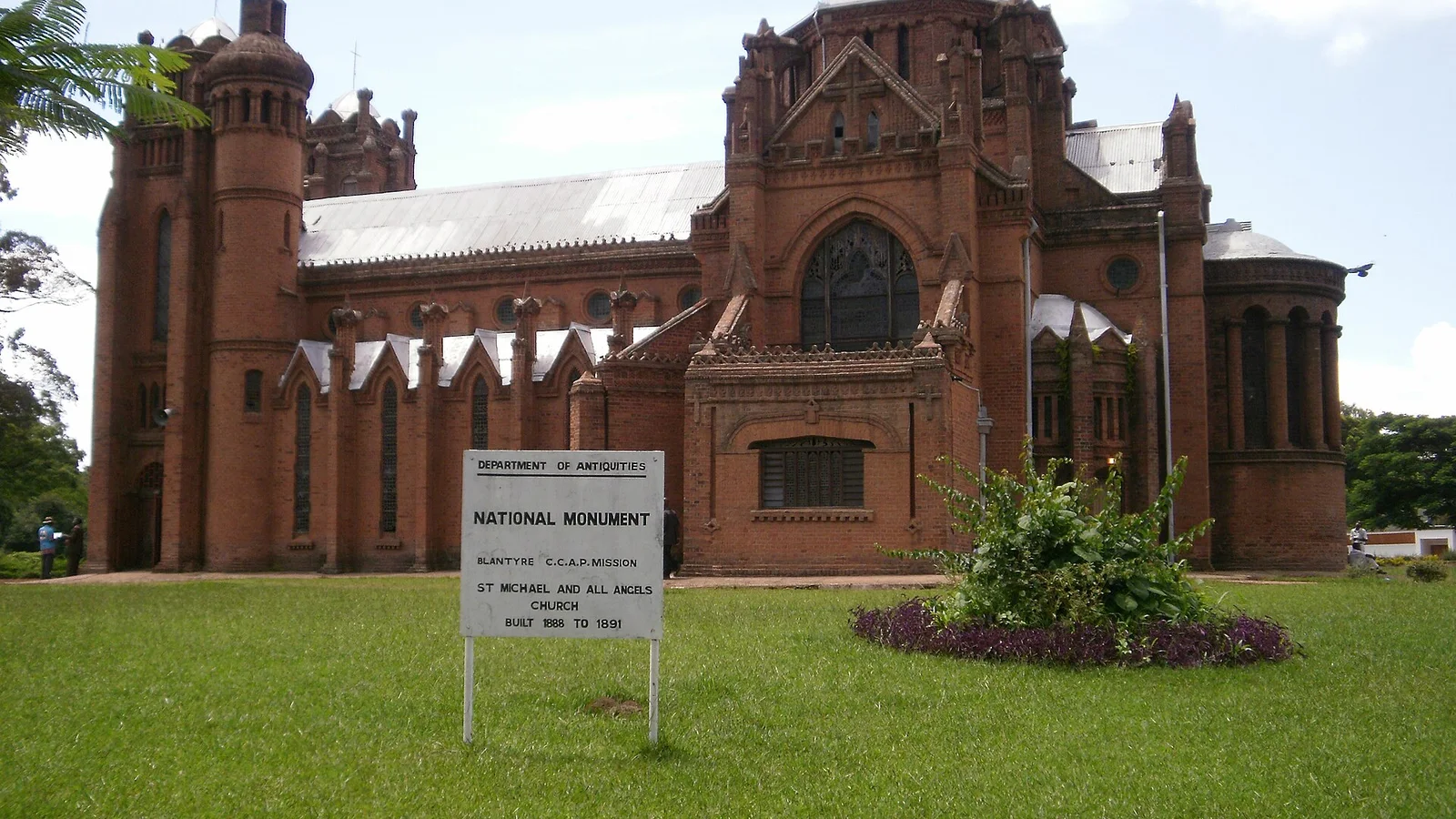
established At Blantyre, no ordained minister came forward until 1878. In the gap, a few young Scottish artisans gained title to thousands of acres in dubious deals with chiefs and ran their own justice. Floggings of up to 200 lashes were routine, sometimes with no evidence of guilt. One man was flogged to death, and another was shot by a firing squad. Alexander Chirnside's pamphlet of 1880 made the scandal public. In 1881 three agents were dismissed and the mission was refounded under David Clement Scott. He still settled local disputes, but through milandu, meetings with headmen and elders. By 1890 the soldier Frederick Lugard praised Blantyre's gardens, workshops and school. Some 2,000 people a year worked on Scott's great church between 1888 and 1891.
established Livingstonia had its own record. A prison, probably Malawi's first, was built at Cape Maclear in 1878, and at the Bandawe out-station lay missionaries flogged workers up to 31 at a time. In 1880 Robert Laws decided that magisterial power hindered his ministry. When the mission moved to Bandawe in 1881, the people there were told the missionaries would not exercise civil jurisdiction.
established The trading company came out of the same circle. In 1878 the brothers John and Fred Moir offered to undercut the slave trade with lawful commerce. James Stevenson, a chemical manufacturer and convener of the Livingstonia committee, and the Govan shipbuilder John Stephen backed them. They raised a nominal capital of £20,000 for the Livingstonia Central Africa Company, later the African Lakes Company. Short of capital and steamers, it lived mostly on ivory, and many of the elephants were shot by the Moirs and their own employees. McCracken finds it did little to change the slave trade it was meant to replace.
"Almost a Scottish colony"
traditional MacKenzie reports that the missions and the trade that went with them led Nyasaland to be regarded as nearly a Scottish colony. One popular missionary biographer went further and presented Scottish work around the lake as making up for the Darien disaster of the 1690s. This was sentiment. No Scottish authority ever governed the territory, the number of Scots living there was small, and the people who lived around the lake had not been asked.
The petition of 1889
established Portugal regarded the south of the region as historically its own, and its intention to assert that claim became plain in 1888. Through 1888 Salisbury refused the Scottish churches' calls for imperial protection, telling the House of Lords it was "not our duty". In March 1889 Harry Johnston reached a draft agreement in Lisbon with the Portuguese foreign minister, Barros Gomes. Portugal would drop its claims to Mashonaland and to the western shore of Lake Malawi, but take the Shire Highlands and the Shire valley. Livingstonia's stations would be safe; Blantyre's would not. McCracken notes that some Free Church officials privately welcomed the deal.
established Missionaries had already warned their churches at home. Meetings were held across Scotland, and the press declared that opinion would not stand for any threat to Livingstone's work. The joint committee of the Presbyterian churches then carried a memorial to the Foreign Office. The surveys give 11,000 signatures of ministers and elders; McCracken gives 10,500, collected in April and May 1889. Archibald Scott, convener of the Church of Scotland's Foreign Mission Committee, presented it to Lord Salisbury as "the voice of Scotland".
shared Salisbury had refused an earlier request. This time the government did not ratify the treaty. The two sources explain the result in different ways. MacKenzie stresses the outcry, while adding that Salisbury may have been glad to use it and that the Scots had English allies. The Scottish Diaspora stresses money: Parliament would not pay for intervention, and nothing happened until Cecil Rhodes offered to meet the cost of administering a protectorate for three years. McCracken gives the figures: Rhodes offered £9,000 a year for the administration of Nyasaland in return for a royal charter for his British South Africa Company.
established McCracken shows how close the confrontation came. In July 1889 Johnston entered the Zambezi by the newly found Chinde mouth with £2,000 from Rhodes for treaty-making. At Blantyre the manse dining room was turned into a workshop making calico Union Jacks to give to chiefs. In August the acting consul, John Buchanan, a Perthshire gardener once dismissed from the mission, declared the Shire Highlands under the Queen's protection without first consulting the Foreign Office. In October the Kololo chief Mlauri flew a British flag in sight of the Portuguese camp. Portuguese troops tore it down, fought his followers and pushed up the Shire, and the British press erupted. On 11 January 1890 Salisbury sent Portugal an ultimatum, backed by naval squadrons sent to Gibraltar. Portugal gave way. A convention of 20 August 1890 and a final agreement of 11 June 1891 placed almost all the Scottish mission field on the British side. The British Central Africa Protectorate came into being, renamed Nyasaland in 1907.
The missionary against Rhodes
established Victory brought a new worry. David Clement Scott, born in Edinburgh in 1853, had led the Blantyre mission since 1881. He was a student of African language and custom, and published a large dictionary of Mang'anja in 1892. He distrusted Rhodes and feared the protectorate would end up as part of the British South Africa Company's territory. He said so publicly. With his colleague Alexander Hetherwick, he opposed leaving every interest, African above all, to the judgement of a single monopoly company, and McCracken judges that their view won. In February 1891 Salisbury approved a split: the Company would govern west of the lake's watershed, and a Foreign Office protectorate east of it, taking in all the mission stations. Johnston set up his capital at Zomba in September 1891, McCracken notes, a convenient 40 miles from the argumentative Scots of Blantyre. Scott remained at odds with him until he left Blantyre in 1898.
shared The Scottish Diaspora describes the missionaries' position as wanting imperial protection without imperial government. James Stewart, for one, favoured keeping other powers out while leaving African political arrangements largely alone. That was a real difference from the chartered-company model. It was still a position held by outsiders about someone else's country.
Planters and the Chilembwe rising, 1915
established Scots were also among the largest landholders. By 1893 John Buchanan and his brothers David and Robert held certificates of claim for 167,823 acres. Alexander Low Bruce, Livingstone's wealthy son-in-law and a leading figure in Edinburgh society, held 176,000. Most of Bruce's land lay south of Zomba, and he named it Magomero, after the first site of the Universities' Mission.
established On the night of 23 January 1915 armed followers of John Chilembwe attacked Magomero, the headquarters of A. L. Bruce Estates. They killed the manager, William Jervis Livingstone, and displayed his head at Chilembwe's service next day. Chilembwe had been educated at a Church of Scotland school near Blantyre before he became the protégé of the Baptist missionary Joseph Booth in 1893. The estate's joint owner was Alexander Livingstone Bruce, David Livingstone's grandson. McCracken argues that he, more than his manager, set its harsh regime: he banned schools from the estate and refused Chilembwe's followers a church. The rising was put down within a fortnight. Chilembwe was shot by a patrol on 3 February, and McCracken records 36 convicted rebels executed. Bruce then moved in the Legislative Council to close every school run by African teachers. Hetherwick and Laws turned to church opinion in Scotland, and the motion failed.
established McCracken describes the estate regime behind the rising. By 1915 nearly half of the 4,926 hut-owners on the 162,000-acre Magomero estate were Lomwe refugees from Mozambique, tenants at will who paid their rent in labour, a system called thangata. On paper it meant a month's work for rent and a month for the hut tax; in practice tax vouchers were withheld, widows and children were rounded up for work, and wages of four or five shillings a month were, an official wrote in 1912, a record low for any settled part of Africa. A Church of Scotland pastor, Stephen Kundecha, told the 1915 inquiry that men worked twelve or thirteen weeks for one hut-tax paper. McCracken cites a historian who calls the rising the only significant rebellion in Africa before the First World War to be inspired by Christianity, and notes that Chilembwe is now on Malawi's banknotes.
What the schools did
established By 1915 Livingstonia ran 514 schools in the north and Blantyre 239 in the south. McCracken finds that what set the Scottish missions apart was their stress on English and academic standards, at the Overtoun Institution and, from 1909, the Henry Henderson Institute at Blantyre; English and literacy were what a migrant needed in the labour markets of southern Africa. He also finds the activists the schools produced drawing on the Bible far more than on secular ideologies, even into the 1930s. Two Overtoun students, Charles Domingo and Eliot Kamwana, went on to lead independent Christian movements.
established The schools did far less for women. Their schooling was mostly domestic, meant to make good Christian wives. At the Overtoun Institution 27 girls were examined out of 193 pupils in 1900, five out of 110 in 1905 and none in the next four years; in 1927 the mission employed 13 African women teachers against 1,403 men. The First World War halted much of the work, and Laws's plan for a university college at Livingstonia never had the government money it needed.
1959: the churches against the Federation
established In 1953 the British government joined Nyasaland to Northern and Southern Rhodesia in the Central African Federation. MacKenzie calls it plainly a vehicle for southern African white rule and for holding down African nationalism. After the emergencies of 1959, particularly in Nyasaland, the Church of Scotland came out against government policy, though not without dissent in its own ranks. Devine describes the General Assembly of the 1950s as speaking out for African nationalism and against white minority rule, at a time when its debates were reported at length and church membership was at its peak. By then the Presbyterian churches in several parts of Africa already governed themselves, with their own synods, ahead of political independence.
established McCracken gives the detail from Malawi. From April 1958 police intelligence reports complained almost every month about the attitude of the Church of Central Africa Presbyterian, the church the Scottish missions had founded, and called Livingstonia's schools breeding grounds for Congress leaders. Its Blantyre synod called publicly for the Federation to be dissolved in 1958. Hastings Banda, a friend of the Livingstonia principal Fergus Macpherson, was invited to speak in its churches. After the emergency began, missionaries' eyewitness accounts of police brutality appeared in British newspapers. The same critics said the government's claim of a murder plot was invented by paid informers. At Nkhata Bay, white troops of the Royal Rhodesian Regiment fired on an unarmed crowd, killing at least twenty. In May 1959, answering an appeal by the former Moderator George MacLeod, the General Assembly called by a large majority for a "daring and creative transfer of power" and the immediate release of the detainees. McCracken calls this well-informed Scottish voice a painful blow to the authorities. With questions in the Commons, it left the government little choice but to hold an inquiry: the Devlin Commission, whose four members included a Scottish lord provost.
shared MacKenzie links that stand to the modern Scotland–Malawi partnership, under which Scotland's devolved government runs its own aid relationship with Malawi even though foreign affairs are reserved to Westminster.
Did You Know?
- Blantyre in Malawi takes its name from the Lanarkshire mill village where Livingstone was born. Early twentieth-century visitors called it Nyasaland's Glasgow, and the capital, Zomba, its Edinburgh.
- In 1889 the Blantyre manse dining room became a workshop making calico Union Jacks to hand out to chiefs.
- The stream on Zomba Mountain, where colonial officials kept cottages for the hot season, was stocked with brown trout brought from Scotland for fly-fishing.
- The convener who handed over the 1889 petition told the Prime Minister it was "the voice of Scotland".
- A missionary biographer claimed that Scottish work on Lake Nyasa made up for the failure of the Darien colony two centuries earlier.
- The head of the Church of Scotland's mission spent years opposing the man, Cecil Rhodes, whose money had made the protectorate possible.
FAQ
1Why is there a Blantyre in Malawi?
The Church of Scotland mission founded there in 1876 was named after Blantyre in Lanarkshire, David Livingstone's birthplace.
2What was Livingstonia?
A Free Church of Scotland mission founded in 1875 in the Lake Nyasa region, later the home of the Overtoun Institution.
3What was the 1889 petition?
A memorial from the Scottish Presbyterian churches, signed by 11,000 ministers and elders, asking the British government not to concede the region to Portugal.
4Did the petition make Malawi British?
It was one cause. The government dropped its draft treaty with Portugal, but the protectorate also depended on Cecil Rhodes's offer to fund its administration.
5Was Nyasaland a Scottish colony?
No. It was a British protectorate. The description reflects the strength of Scottish mission and trading interests there.
6Who was John Chilembwe?
A Malawian pastor, educated at a Church of Scotland school near Blantyre, who led the rising of January 1915. Its first target was the Magomero estate owned by David Livingstone's grandson. He was shot on 3 February 1915 and is now on Malawi's banknotes.
7Did many Scots emigrate to Malawi?
No. The connection ran through missionaries, teachers, doctors and traders, most of whom did not stay for life.
Sources and Further Reading
Scholarly/Critical
- John McCracken, A History of Malawi, 1859–1966 (James Currey, Woodbridge, 2012). ISBN 978-1-84701-050-6. Chapters 2, 4, 5, 11 and 13.
- Tanja Bueltmann, Andrew Hinson and Graeme Morton, The Scottish Diaspora (Edinburgh University Press, 2013), chapter 12, "Africa".
- John M. MacKenzie, "Scottish Diasporas and Africa", in Angela McCarthy and John M. MacKenzie (eds), Global Migrations: The Scottish Diaspora since 1600 (Edinburgh University Press, 2016).
- T. M. Devine, To the Ends of the Earth: Scotland's Global Diaspora, 1750–2010 (Allen Lane, 2011), for the General Assembly in the 1950s.
General
- John McCracken, Politics and Christianity in Malawi, 1875–1940 (Cambridge University Press, 1977). Cited by both sources; not consulted directly.
Caveats: Myths and Disputed Claims
- Myth: Nyasaland was a Scottish colony. It never was.
- Myth: The petition alone saved the Shire highlands. Rhodes's subsidy and Salisbury's own calculations also counted.
- Myth: The missions opposed empire. They asked for British protection. What some of them opposed was company rule and settler power.
- Disputed: the number of signatures in 1889. 11,000 (The Scottish Diaspora; MacKenzie) or 10,500 (McCracken).
- Myth: the Scottish missions were gentle from the start. Before 1881 Blantyre's agents flogged suspects and killed at least two men; Livingstonia built a prison and flogged workers. McCracken treats both missions as small states with their own justice.
- Misprint: the founding years. McCracken's text (p. 45) swaps the years, putting Livingstonia's arrival in 1876 and Blantyre's founding in October 1875. His own notes and every other source give Livingstonia 1875 and Blantyre 1876, and the card follows them.
- Disputed: Livingstone's legacy. MacKenzie has written elsewhere that Livingstone can be read as a prophet or as a patron saint of imperialism. The missions founded in his name carry the same double reading.
Finished reading? Try the Fact Machine: three reels, one surprising Scottish connection →
Card 053 · Diaspora