Bon Scott (1946–1980)
Contents
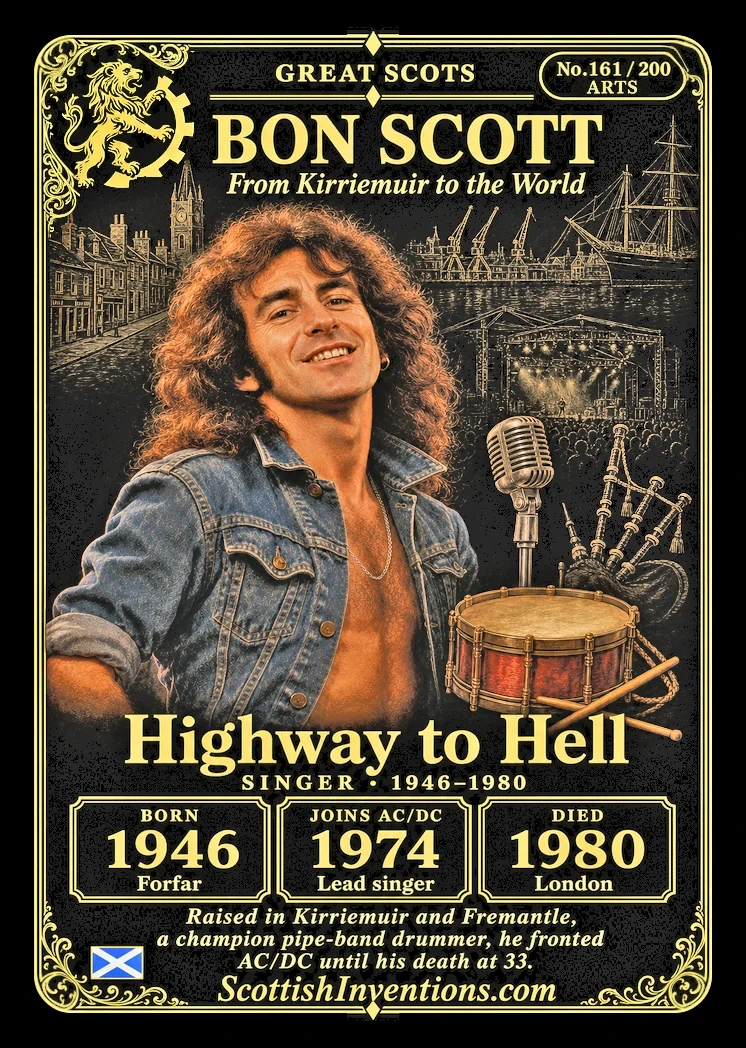
Bon Scott, the singer and lyricist of AC/DC from 1974 until his death in 1980, was born in Forfar and spent his first six years in Kirriemuir before his family emigrated to Australia. His raw voice, wicked humour and swaggering stage presence helped make AC/DC one of the biggest rock bands in the world. He came from a family of bakers, pipers and drummers, learned his trade as a side drummer in a Scottish pipe band in Fremantle, and never quite stopped being the boy who marched up and down behind the Kirriemuir pipe band on a Saturday night.
TL;DR
- established Born Ronald Belford Scott in Forfar, Angus, in 1946, he grew up in the Roods, Kirriemuir, where his father and grandfather ran a bakery in Bank Street. The family emigrated to Australia in 1952.
- established In Fremantle he was a champion side drummer in the town's Scottish pipe band, and played at the opening of the 1962 British Empire and Commonwealth Games in Perth.
- established After nine months in a juvenile institution, then years with the Spektors, the Valentines and Fraternity, he joined AC/DC in September 1974 and wrote the lyrics for the band's songs with Malcolm and Angus Young, themselves Glasgow-born.
- established Highway to Hell (1979) gave AC/DC their international breakthrough. He died in London in February 1980, aged 33, and a coroner recorded death by misadventure from acute alcohol poisoning.
- established His ashes lie in Fremantle Cemetery. Statues honour him in both Fremantle and Kirriemuir, which hosts the Bonfest festival in his memory.
Key Facts
- Born
- 9 July 1946, Fyfe Jamieson Maternity Hospital, Forfar, Angus
- Died
- 19 February 1980, East Dulwich, London (aged 33)
- Birth name
- Ronald Belford Scott
- Parents
- Charles "Chick" Belford Scott, baker; Isa Mitchell, from Kirkcaldy
- Brothers
- Sandy (died in infancy, 1943–44), Derek (born 1949), Graeme (born 1953)
- Emigrated
- To Australia in 1952; Sunshine, Melbourne, then Fremantle from 1956
- Bands
- The Spektors, the Valentines, Fraternity, AC/DC (1974–80)
- Key albums
- High Voltage, T.N.T., Dirty Deeds Done Dirt Cheap, Let There Be Rock, Powerage, Highway to Hell
- Resting place
- Memorial Garden, Fremantle Cemetery, Western Australia
A Note on Claims and Evidence
Each major claim carries one of three labels. established means supported by primary records, official bodies or several independent reliable sources. shared means the core fact is sound but sources disagree on details, dates or interpretation. traditional means widely repeated but not traceable to a primary or independent source.
The two main sources for his life are the Australian Dictionary of Biography and Clinton Walker's biography Highway to Hell, first published in 1994 and revised in 2001 and 2007. Walker interviewed Scott's parents, brothers, wife, girlfriends and bandmates, and quoted contemporary newspapers. Most of the detail here about the family in Kirriemuir, the pipe band in Fremantle and the last night in London comes from that book. Many other stories about him come from bandmates and friends and grew in the telling; they are labelled traditional. Rumours that something other than alcohol caused his death have circulated for decades. Walker examined them at length and rejected them, and they are not supported by the inquest.
Timeline
His grandfather, Alexander Scott, opens a bakery in Bank Street, Kirriemuir.
His parents, Chick Scott and Isa Mitchell, marry during the war; they had met at a dance in Kirkcaldy.
Born in Forfar on 9 July; grows up in the family house in the Roods, Kirriemuir.
Family emigrates to Australia, settling in Sunshine, Melbourne.
Family moves to Fremantle, Western Australia, for the sake of his youngest brother's asthma.
Side drummer with the Fremantle pipe band; novice champion at about 12, then under-17 champion.
Plays at the opening ceremony of the British Empire and Commonwealth Games in Perth.
Sentenced in the Fremantle Children's Court; spends about nine months in the Riverbank juvenile institution.
Drums and sings with the Spektors in Perth.
The Spektors merge with the Winztons to form the Valentines.
The Valentines move to Melbourne.
Joins the Adelaide band Fraternity.
Fraternity wins the national final of the Hoadley's Battle of the Sounds.
Marries Irene Thornton in Adelaide; Fraternity tries its luck in England.
Seriously injured in a motorcycle accident in Adelaide.
Joins AC/DC.
Albums including High Voltage, T.N.T., Dirty Deeds Done Dirt Cheap, Let There Be Rock and Powerage.
Plays the bagpipes on "It's a Long Way to the Top"; AC/DC's first British tour includes a riotous homecoming at Glasgow City Hall.
Highway to Hell breaks the band in the United States.
Last appearance with AC/DC, on Top of the Pops.
Dies in London after a night of heavy drinking.
Cremated in Fremantle.
Statue unveiled in Fremantle.
Statue unveiled in Kirriemuir.
Details
Kirriemuir and the Scotts
established His grandfather, Alexander Scott, started a bakery in Bank Street, Kirriemuir, in 1920. His father, Charles Belford Scott, known as Chick, served his apprenticeship there and joined the local Territorials. When war came in 1939 Chick went with the army as a baker, serving in France, Ireland, North Africa and Italy. While stationed in Kirkcaldy he met Isa Mitchell, one of the four daughters of George Mitchell, at a dance. They married in 1941. Their first son, Sandy, was born in 1943 and died at nine months, while Chick was still away.
established Chick was demobbed on the last day of 1945, and the couple moved back to Kirriemuir. His father bought them a small terraced house in the Roods, on the upper side of the town, which Isa named Raymondscraig after a park she had loved in Kirkcaldy. Chick went back into the bakery with his father and his brother George. He sang with the local Gilbert and Sullivan company and played drums in the Kirriemuir Pipe Band.
established Ronald Belford Scott was born at the Fyfe Jamieson Maternity Hospital in Forfar on 9 July 1946, and taken home to Kirriemuir. A second surviving son, Derek, followed in 1949. shared Walker's account, drawn from his parents' memories, is of a strong-willed toddler who walked early and wandered off from school with his friends rather than come up the hill. He was mad on drums from the start, beating out time on a biscuit tin or the bread board. When the pipe band marched through the square on a Saturday night, he had to march up and down beside it.
traditional His nickname is usually explained as a play on "Bonnie Scotland", given him by Australian classmates who already had another Ronald in the class. Walker does not explain the name. His mother went on calling him Ron for the rest of her life.
The move to Australia
established Chick had found it hard to settle after six years in the army, and Isa's sister had already emigrated to Melbourne. In 1952, when Ronald was six, the family followed. They lived at first with the sister in Sunshine, an industrial suburb in Melbourne's west, then in a house of their own at the bottom of the same street. Chick found work as a window-framer, and Ronald went to Sunshine Primary School. shared Walker records that Isa taught him songs on the voyage out, and that at school in Sunshine he drummed at the back of the line as the children marched in.
established A third son, Graeme, was born in 1953. In 1956 Graeme was diagnosed with asthma, and on the doctors' advice the family moved to the drier climate of Western Australia. They settled in Fremantle, buying a big red-brick house on Harvest Road, North Fremantle, on a rise above the Swan River. Chick joined the Caledonian Society and Isa joined a Scottish club, which, as she later put it, was how they got to know people.
The Fremantle pipe band
established Chick joined the Scots pipe band that was one of the prides of Fremantle, and his eldest son came with him as a side drummer. Graeme later remembered band days as the big Scottish occasions of their childhood, with the whole family in kilts. shared According to his father, he was novice champion at about 12 and then under-17 champion for five years. He appeared on local television drumming for a highland dancer, and in the paper in full highland dress.
established In 1962 the band played at the opening ceremony of the British Empire and Commonwealth Games in Perth. The Fife Free Press in Kirkcaldy, his mother's home town, reported that one of the side drummers was Ronald Scott, son of Mr and Mrs Charles Scott, formerly of the Roods, Kirriemuir. shared His mother said he was mad on pipe bands until he was 17, and then would not wear a kilt again. Once he gave up the band, all he wanted was to play in a rock group.
Riverbank
established He left John Curtin High School as soon as the law allowed, at 15 in 1961, and worked as a farmhand on a market garden, on the crayfishing boats and later as a postman and weighing-machine mechanic. He was a rocker, part of a Fremantle gang, and well known to the local police.
established In March 1963, aged 16, he pleaded guilty in the Fremantle Children's Court to giving a false name and address to the police, escaping legal custody, unlawful carnal knowledge and stealing petrol. The trouble had started after a fight at a dance. He was committed to the care of the Child Welfare Department until he was 18 and spent about nine months in Riverbank, a newly built secure institution for boys on the edge of Perth. shared Silver Smith, his later partner, told Walker that his grandparents had come out from Kirriemuir at about that time. He was too ashamed to face his parents during their visit, and the grandparents had gone home, and later died, before he was released. She believed that part of his drive to succeed was a wish to make it up to his family.
established After his release his parole officer urged him to join the Citizen Military Forces, but they would not take him. traditional He later told a German magazine that the army had rejected him as socially maladjusted.
The Spektors and the Valentines
established In 1965 he formed the Spektors with two young men from the Kwinana oil refinery, Wyn Milson and John Collins, and his friend Brian Gannon. He played drums and sang a song or two himself. traditional His own later explanation for moving out from behind the drum kit was that the singer got more girls. In 1966 the Spektors merged with their rivals, the Winztons, led by Vince Lovegrove, to form the Valentines, with Scott and Lovegrove sharing the vocals. Vince Lovegrove later remembered him then as a cute little drummer with tattoos and a Scottish accent.
established The Valentines became the top pop band in Perth, reaching the Western Australian top five with their first single in 1967, and moved to Melbourne in October 1967. They played teenybopper pop and had some national success, but a police raid in 1969 found them in possession of marijuana, and the band broke up in 1970.
Fraternity and the crash
established He then became singer with Fraternity, a progressive country-rock band living communally in the Adelaide hills. Fraternity's version of "Seasons of Change" was his first single with the band, and in August 1971 they won the national final of the Hoadley's Battle of the Sounds. Fraternity's backer offered to pay for wives, though not girlfriends, to travel to England, and on 24 January 1972 he married Irene Thornton in Adelaide. The band spent more than a year in England without a breakthrough. shared In London he became a great admirer of the Glasgow rocker Alex Harvey, then at his peak. Harvey's humour, storytelling and showmanship had a lasting effect on him.
established Back in Adelaide, with Fraternity falling apart and his marriage failing, he took a day job at a fertiliser works. In late February 1974, after a row and a drunken rehearsal at the Old Lion Hotel, he crashed his motorcycle. He was taken to the Queen Elizabeth Hospital with a broken arm, leg and nose and concussion, his jaw was wired, and he spent three days in and out of consciousness.
Joining AC/DC
established While he recovered, Vince Lovegrove, now a promoter in Adelaide, gave him odd jobs. In August 1974 Lovegrove brought a young Sydney band called AC/DC to town and urged him to see them. The band had been formed by the brothers Malcolm and Angus Young, whose family had emigrated from Glasgow to Sydney's western suburbs in 1963, and it needed a singer. Scott saw them at the Pooraka Hotel and joined that September. He played his first proper show with them at the Brighton-le-Sands Masonic Hall in Sydney. shared At 28 he was older than his bandmates, who called him the old man, and his experience, wit and charisma gave the band a frontman to match Angus Young's schoolboy-uniformed guitar antics. Malcolm Young later called him the biggest single influence on the band.
Pipes on a flat-top truck
established Scott wrote the lyrics for AC/DC's songs and shared the songwriting credits with the Young brothers. He played the bagpipes on "It's a Long Way to the Top (If You Wanna Rock 'n' Roll)" (1975). In early 1976 the television show Countdown filmed the band playing it on the back of a flat-top truck driven through the middle of Melbourne, with three professional pipers alongside. shared Walker reads the moment as the fulfilment of a boyhood dream of leading a pipe band. A few weeks earlier, at a New Year's Day show in Adelaide when the power was cut, Scott had appeared in the middle of the crowd on someone's shoulders, playing the pipes.
established His lyrics, full of double meanings, dealt with sex, rock music, the music business and life on the road. shared His sharp, barking voice and sly humour set him apart from more earnest hard-rock singers of the time. He said himself that he had no vocal training and that the band told him to sound like himself.
Coming back to Scotland
established AC/DC moved to Britain in 1976. The Scottish dates of their first tour were treated as a homecoming by both band and audience. A review of the Glasgow City Hall show described the crowd nearly demolishing the hall, and Glasgow District Council later complained to the record company about damage to the seats, a letter the band reprinted in its advertising. An Ayrshire paper, the Ardrossan Herald, thought his voice sometimes sounded like Alex Harvey's and warned that Glasgow crowds might take it as imitation of their idol. shared Glasgow was the band's favourite place in Britain, he told an Australian magazine, partly because half the audience seemed to be the Youngs' relatives. While the Youngs visited family in Glasgow, he hired a car and drove round Loch Lomond, looking for his roots.
established AC/DC's show at the Glasgow Apollo in April 1978 was filmed and recorded for the live album If You Want Blood You've Got It. Jesse Fink's study of the brothers' songwriting describes Scott on that film conducting Angus like a sorcerer's apprentice. established Their British tour of early 1977 opened in Edinburgh on 18 February. As the band's success grew, AC/DC played down being Australian and stressed its Scottish roots. In the United States in 1977 they were billed as an Australian-Scottish band.
Highway to Hell
established AC/DC built a fierce reputation as a live act in Britain, Europe and the United States. Highway to Hell (1979), produced by Robert John "Mutt" Lange, finally broke the band in America. established As success grew, so did his drinking, and by early 1980 he was seeing a doctor about his liver. In January 1980 the band collected gold records in France, Canada and Britain. On 7 February he recorded his last appearance with AC/DC, on BBC television's Top of the Pops.
The last night
established By February 1980 he had a flat in Victoria, London, and was writing lyrics for the next album. On the evening of 18 February an acquaintance, Alistair Kinnear, invited him to a party at the Music Machine in Camden. Both drank heavily. On the way home Scott fell unconscious in Kinnear's car. Unable to get him into his own flat, Kinnear drove to his own home in Overhill Road, East Dulwich, could not lift him out, and left him in the car under a blanket in the early hours of 19 February. When Kinnear came down that evening he found Scott not breathing, and drove him to King's College Hospital, where he was pronounced dead on arrival.
established The inquest recorded death by misadventure from acute alcohol poisoning. The coroner, Sir Montague Levine, called him "the captain of his own destiny" and described him as a consistent and heavy drinker. shared Walker, who examined the rival theories at length, concluded that the official account was essentially right. Kinnear, who had seemed to vanish after giving one newspaper interview, turned out to be living in Spain, and in 2005 he gave a full statement to Metal Hammer that matched it.
established His body was flown to Australia, accompanied by Malcolm and Angus Young. He was cremated in Fremantle on 29 February 1980, after a Uniting Church service, and his ashes were placed in the Memorial Garden at Fremantle Cemetery. His grave is one of the most visited in Australia and was given heritage status by the National Trust in 2006. traditional Silver Smith later said that he had wanted to be buried in Kirriemuir.
Legacy
established AC/DC carried on with Brian Johnson as singer, and Back in Black (1980), opening with the tolling bell of "Hells Bells" in tribute to Scott, became one of the best-selling albums of all time. shared Scott is regularly ranked among the greatest rock singers; in 2004 Classic Rock magazine named him the greatest frontman of all time. Statues of him stand at Fisherman's Wharf in Fremantle (2008) and in Kirriemuir (2016), where fans gather for the annual Bonfest.
Did You Know?
- He was born in Forfar and grew up in Kirriemuir, where his grandfather started the family bakery in 1920.
- His father played drums in the Kirriemuir Pipe Band, and later joined the Fremantle pipe band alongside him.
- A Kirkcaldy newspaper reported his part in the opening of the 1962 Games in Perth.
- He played bagpipes on "It's a Long Way to the Top", although he had been a drummer, not a piper.
- AC/DC's founders, Malcolm and Angus Young, were born in Glasgow.
- He was 28 when he joined AC/DC, and the band called him the old man.
- Glasgow District Council complained about the seats broken at AC/DC's 1976 City Hall show.
- Back in Black opens with a tolling bell in his memory.
FAQ
1Was Bon Scott Scottish?
Yes. He was born in Forfar and lived in Kirriemuir until he was six. Both his parents were Scots.
2Why was he called Bon?
The usual explanation is a play on "Bonnie Scotland". His mother always called him Ron.
3Why did the family leave Scotland?
His father was restless after six years in the army, and his mother's sister had already emigrated to Melbourne.
4Was he a piper?
No. He was a side drummer in the Fremantle pipe band, though he later played the bagpipes on record.
5When did he join AC/DC?
In September 1974.
6Which AC/DC albums did he sing on?
All the band's albums up to and including Highway to Hell (1979).
7How did he die?
A coroner's inquest found he died of acute alcohol poisoning, by misadventure, in London on 19 February 1980.
8Where is he buried?
His ashes are in the Memorial Garden at Fremantle Cemetery, Western Australia.
9Who replaced him?
Brian Johnson, from Newcastle upon Tyne.
10Is there a statue of him in Scotland?
Yes, in Kirriemuir, unveiled in 2016.
11What is Bonfest?
A rock festival held in Kirriemuir in his memory.
Sources and Further Reading
Primary/Institutional
- Geoff Browne, "Scott, Ronald Belford (Bon) (1946–1980)", Australian Dictionary of Biography (published online 2018) (opened).
Scholarly/Critical
- Clinton Walker, Highway to Hell: The Life and Death of AC/DC Legend Bon Scott (first published 1994; revised edition, Verse Chorus Press, 2007).
- Jesse Fink, The Youngs: The Brothers Who Built AC/DC (2013). Read for the Glasgow Apollo passage.
- Jesse Fink, Bon: The Last Highway (2017).
- Irene Thornton, My Bon Scott (2014).
Caveats: Myths and Disputed Claims
- Disputed: cause of death. Theories persist that heroin was involved, or that "Alistair Kinnear" was an alias for someone else. Walker rejected them, noting that the autopsy found no drugs and that Kinnear later gave his own account. The inquest found acute alcohol poisoning.
- Disputed: place of death. He died in a car parked in Overhill Road, East Dulwich, and was pronounced dead at King's College Hospital, which is why some sources give Lambeth or Camberwell.
- Myth: he was born in Kirriemuir. He was born in Forfar and grew up in Kirriemuir.
- Myth: AC/DC first hired him as their driver. Walker traces the story, which the band itself spread, to the weeks when Scott drove the Youngs around Adelaide in an old Holden.
- Traditional: the origin of "Bon". Several versions exist.
- Traditional: his wish to be buried in Kirriemuir. This rests on one later recollection.
Finished reading? Try the Fact Machine: three reels, one surprising Scottish connection →
Card 161 · Great Scots