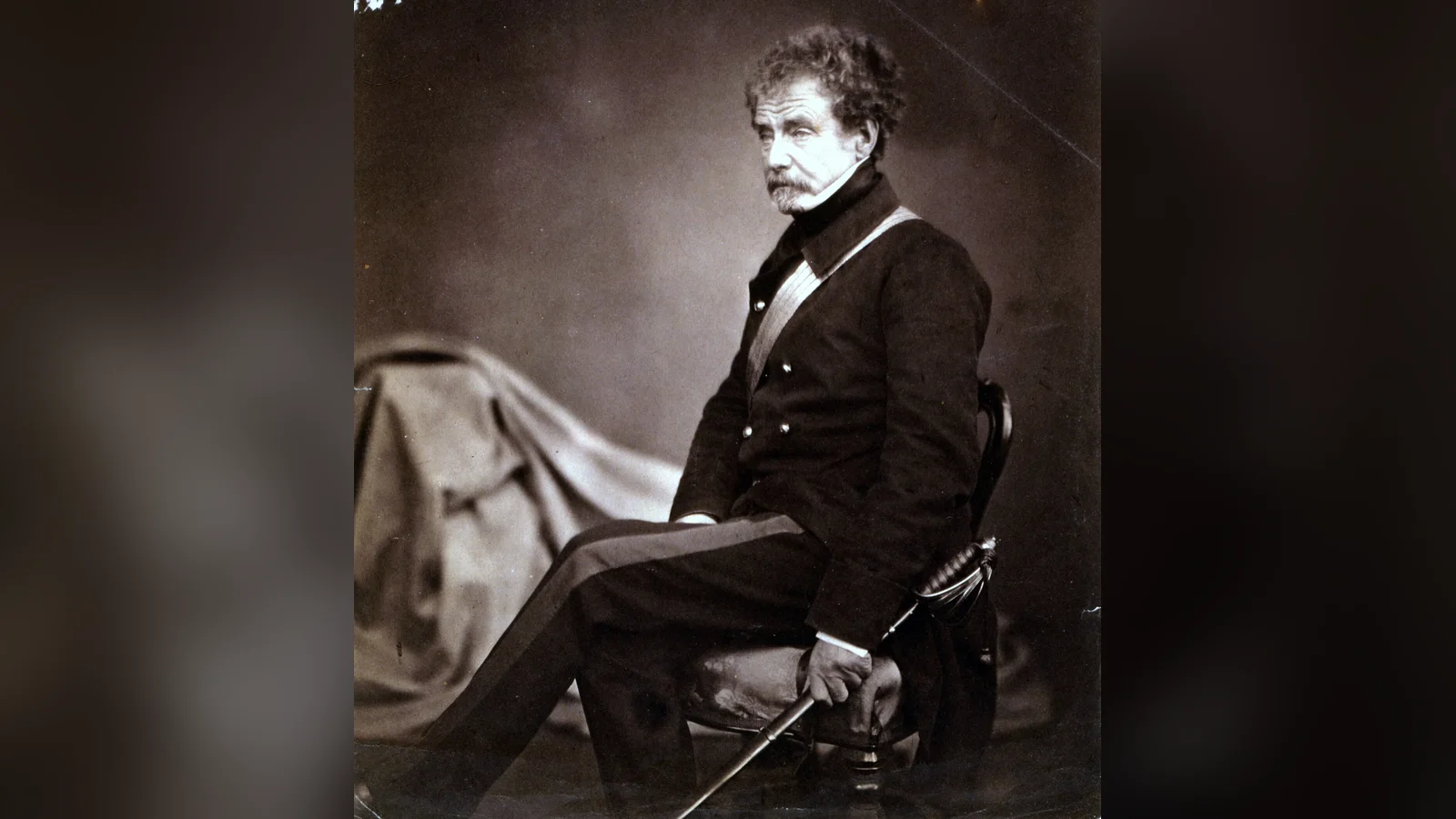

Colin Campbell, Lord Clyde (1792–1863): The Glasgow Cabinetmaker's Son Who Commanded the Thin Red Line
Contents
Colin Campbell was born Colin MacLiver, the son of a Glasgow cabinetmaker, and became a field marshal and a peer. He was commissioned at 15, fought through the Peninsular War, served in the West Indies, Ireland, China and the Punjab, and in his sixties commanded the Highland Brigade in the Crimea. At Balaclava his 93rd Highlanders formed the Thin Red Line. In 1857 he was sent to India as commander-in-chief, relieved Lucknow, beat the rebels at Cawnpore and took Lucknow back in 1858. He spoke with a broad Glasgow accent all his life, never married, and was buried in Westminster Abbey. This account draws on Adrian Greenwood's biography Victoria's Scottish Lion (2015).
TL;DR
- established Born in Glasgow on 20 October 1792, the son of John MacLiver, a cabinetmaker in the Trongate, he took the surname Campbell from his mother's brother, who sponsored his career.
- established He was commissioned without purchase in 1808, fought at Vimeiro and Corunna, and led the forlorn hope at San Sebastian in 1813, where he was wounded twice.
- established Promotion came slowly. He was 62 and a major-general when he led the Highland Brigade up the heights of the Alma in 1854 and formed the 93rd into the Thin Red Line at Balaclava.
- established As commander-in-chief in India from 1857 he relieved Lucknow, brought out its women, children and wounded, defeated the Gwalior Contingent at Cawnpore and retook Lucknow in March 1858.
- shared He leaned towards leniency in the reprisals that followed the rising, and was attacked for it at the time.
- established He was made Baron Clyde in 1858 and a field marshal in 1862, died at Chatham on 14 August 1863, and was buried in Westminster Abbey.
Key Facts
- Born
- 20 October 1792, Glasgow
- Died
- 14 August 1863, Chatham, Kent (aged 70)
- Birth name
- Colin MacLiver
- Parents
- John MacLiver, cabinetmaker; Agnes Campbell
- Education
- Glasgow Grammar School; Royal Academy, Gosport
- First commission
- Ensign, 9th Foot, 26 May 1808
- Major commands
- Highland Brigade, Crimea (1854–56); commander-in-chief, India (1857–60)
- Titles
- Baron Clyde of Clydesdale (1858); field marshal (1862)
- Buried
- Westminster Abbey
Scottish Impact Index (SI Score)
- Global Influence
- 4/10
- Enduring Relevance
- 5/10
- Material Contribution
- 4/10
- Exceptional Achievement
- 6/10
- Lasting Legacy
- 4/10
- Recognition
- 4/10
27/60
Ranked =114th of 179 in Great Scots
A Note on Claims and Evidence
Each major claim carries one of three labels. established means supported by primary records, official bodies or several independent reliable sources. shared means the core fact is sound but sources disagree on details, dates or interpretation. traditional means widely repeated but not traceable to a primary or independent source.
Greenwood's biography draws on Campbell's own letters and journals, on Lawrence Shadwell's authorised life of 1881 and on the memoirs of the men who served with him, among them William Munro, the surgeon of the 93rd; William Forbes-Mitchell, a soldier of the same regiment; Frederick Roberts; and Garnet Wolseley. Greenwood is frank about his subject's failings and about the brutality of the wars he fought, and he takes apart several Victorian stories about Campbell's birth. Where the only evidence for a quotation is a memoir written decades later, it is labelled traditional.
Timeline
Born in Glasgow on 20 October; his parents had moved there from Islay.
Enters Glasgow Grammar School.
His mother and one of his twin sisters die; he is placed in the care of his uncle, Major John Campbell.
Commissioned ensign in the 9th Foot (26 May), as Colin Campbell; fights at Vimeiro (21 August).
Retreat to Corunna; the Walcheren expedition.
Battle of Barrosa.
Vitoria; leads the forlorn hope at San Sebastian (25 July) and is wounded twice; wounded again at the Bidassoa.
West Indies with the 21st Fusiliers; ADC in Demerara during the slave revolt of 1823.
Lieutenant-colonel of the 98th Foot.
Storming of Chinkiangfoo in the First Opium War.
Wounded at Chillianwala; fights at Goojrat; knighted.
Resigns his command at Peshawur after refusing to invade Swat.
Commands the Highland Brigade at the Alma (20 September) and the defence of Balaclava (25 October).
Commander-in-chief in India; relieves Lucknow (16–17 November); defeats the Gwalior Contingent at Cawnpore (6 December).
Retakes Lucknow (March); made Baron Clyde of Clydesdale (3 August).
Leaves India.
Field marshal.
Dies at Chatham on 14 August; buried in Westminster Abbey on 22 August.
Details
A boy from the Trongate
established Campbell's parents, John MacLiver and Agnes Campbell, had moved from Islay to Glasgow in the early 1790s, when rising Highland rents were driving thousands into the towns of the central belt. John was a cabinetmaker with the furniture dealers Cleland, Jack, Paterson and Co. at 81 Trongate. Their first son, Colin, was born in a rented house nearby on 20 October 1792. A brother, John, and twin sisters, Alicia and Margery, followed. shared Greenwood stresses that a cabinetmaker was well paid: Victorian writers who called the father a carpenter made the family sound poorer than it was.
established In 1797 he was enrolled at Glasgow Grammar School. Before he was ten his mother and his sister Margery died, and his father placed him in the care of his wife's brother, Major John Campbell. That side of the family was connected to the Campbell gentry of Islay and, through them, to the earls of Argyll. In 1806 his uncle sent him south to the Royal Academy at Gosport, a modern school that taught mathematics and natural philosophy to boys bound for the army and navy.
Why MacLiver became Campbell
established He was commissioned ensign in the 9th Foot on 26 May 1808 as Colin Campbell, without purchase, five months before his sixteenth birthday. The recommendation came from the colonel of the regiment, on the application of a Captain Campbell who described the boy as his relation. The fact that he had been born MacLiver came out only in the newspapers in 1855, when he was already famous.
traditional The story told ever since is that the Duke of York, meeting the boy with his uncle, assumed he was a Campbell and entered him so, and that his uncle told him to leave the mistake alone. shared Greenwood shows that the story was put about by a cousin, the journalist Peter Stewart MacLiver, in 1855, and that it cannot be true. The recommending letter written a week before the commission already calls him Colin Campbell; the duke did not interview every new ensign in wartime; the boy was on the Isle of Wight at the time; and his sister also dropped the name MacLiver. The cousin's further claim, that the family had lost an Islay estate for supporting Prince Charles Edward Stuart in 1745, is also false. Greenwood thinks the most likely reason for the change is the simplest: he took the name of the uncle who was paying for and sponsoring his career. A Bombay paper said much the same in 1858.
The Peninsula
established Within seven weeks of his commission he was in Portugal. At Vimeiro on 21 August 1808, aged 15, he carried one of the regiment's colours. shared He remembered all his life the kindness of his captain, who walked him up and down in front of the battalion under fire until his fear subsided. He went through the retreat to Corunna in the winter of 1808–09 and was evacuated to Plymouth, then caught the fever of the Walcheren expedition that summer.
established He fought at Barrosa in 1811 and Vitoria in 1813. On 25 July 1813 he led the forlorn hope, the first party into the breach, at the failed first assault on San Sebastian, and was wounded twice. He was wounded again at the crossing of the Bidassoa in October and promoted captain without purchase in November. shared Greenwood notes that San Sebastian was the only time in a career of fifty-five years that Campbell left a battlefield beaten.
The long middle years
established Peace brought slow promotion. Campbell served in Nova Scotia, Gibraltar and from 1819 the West Indies with the 21st Royal North British Fusiliers. In Demerara he was aide-de-camp to the governor when the great slave revolt of August 1823 broke out. Dozens of slaves were hanged after summary trials. established Campbell sat as one of the officers on the court martial of the missionary John Smith, accused of inciting the revolt. Smith was found guilty and sentenced to death with a recommendation of mercy, and died in prison before the case was settled. shared Greenwood finds that Campbell kept as quiet as possible throughout. His only recorded intervention was to have a remark about the governor struck from the record.
established He bought his majority in 1825 and his lieutenant-colonelcy in 1832, and served in Ireland during the tithe war and in the north of England against the Chartists. In 1841 he took the 98th Foot to China for the First Opium War. He stormed Chinkiangfoo in July 1842 and was later governor of the island of Chusan until it was handed back to China in 1846.
The Punjab and Peshawur
established From India he fought in the Second Sikh War as a brigadier-general. He was wounded twice at Chillianwala in January 1849, a bloody and indecisive battle, and fought at Goojrat in February. He was knighted that June. shared Greenwood argues that Chillianwala taught him a lesson he applied in the Crimea: the old habit of holding fire until close to the enemy was out of date.
established As commander at Peshawur from 1849 he led punitive expeditions against the frontier tribes. In 1852 the civil authorities wanted him to invade Swat through the Malakand Pass. He refused, and the governor-general, Lord Dalhousie, rebuked him. He resigned in June 1852 and went home a half-pay colonel, apparently at the end of his career.
The Alma
established The Crimean War saved him. In 1854 he was given the Highland Brigade, the 42nd, 79th and 93rd Highlanders, and promoted major-general. At the Alma on 20 September he insisted that the brigade dress its ranks under the river bank while the pipers of the 42nd played "Blue Bonnets O'er the Border". Then he sent it up the hill in echelon, each regiment a little behind the one on its right, while he rode in front. Advancing two deep and firing as they went, the Highlanders broke column after column. His horse was shot under him. The brigade lost few men, because the ground sheltered it from the worst of the Russian guns. established When it was over Lord Raglan, close to tears, could not speak. Campbell asked him for the honour of wearing the Highland bonnet for the rest of the campaign, and Raglan agreed.
shared Greenwood describes how readily Campbell accepted his new image as a tartan-clad chieftain. He was a Glasgow man, not a Highlander, but his soldiers adored him. To many senior officers, his broad Glasgow accent and his lack of a family marked him as an outsider.
Balaclava
established On 25 October 1854 Campbell commanded the defence of Balaclava, the army's supply port. When the Turkish redoubts on the Causeway Heights fell, a body of about 400 Russian cavalry rode for the harbour. Campbell drew up the 93rd two deep rather than in square, with some invalids and Guardsmen in support. The Turks on either flank fled. The first two volleys at long range did little harm; then he wheeled the grenadier company to fire into the flank of the squadron trying to work round the end of the line, and the Russians turned away. The 93rd lost no one in the action itself. William Russell of The Times, watching from the heights, described the regiment as a thin red streak tipped with steel, and the Thin Red Line was born. traditional His order that there was no retreat and that the men must die where they stood, and Private John Scott's reply, come from later histories. The full account is in the Defence series, Card #27, The Thin Red Line.
established He spent the winter holding Balaclava and the siege lines outside Sebastopol. He was twice passed over for command of the army, and in 1856 he took leave of the Highland Brigade with a farewell address that the regiment long remembered. shared In it he promised that whenever he heard a pipe he would be carried back to the days when he wore the bonnet they had won for him. Glasgow gave him the freedom of the city and a ceremonial sword.
Commander-in-chief in India
established When news of the Indian rising reached London in July 1857, the government offered Campbell the command in India. He accepted on 11 July and landed in Calcutta on 13 August. shared Greenwood shows him struggling for weeks to gather troops, transport and supplies while the British in India called for vengeance after the massacre at Cawnpore.
established In November he marched on Lucknow, where the garrison of the Residency had been besieged since June. On 16 November his troops stormed the Sekundrabagh, a walled garden held by rebel sepoys. The 93rd and the 4th Punjab Infantry broke in, no prisoners were taken and nearly 2,000 rebels were killed. Campbell was wounded twice in the fighting. He decided not to hold the city but to bring the garrison out, and between 19 and 22 November some 600 women and children and 1,000 sick and wounded were withdrawn under the enemy's guns without loss. On 6 December he defeated the Gwalior Contingent at Cawnpore.
established He returned to Lucknow with a much larger army in March 1858 and took the city between 6 and 21 March. Many of the rebels escaped, partly because Campbell held back Sir James Outram's force from closing the last way out. shared Greenwood argues that this was deliberate. Campbell had protested when a rebel promised his life was hanged anyway, and he believed that if ten thousand more were killed, the killing would never end. He was blamed at home for being too slow and too soft, and the campaign dragged on into 1859. He did not stop the looting of the city, which no commander of the day could.
established He was made Baron Clyde of Clydesdale on 3 August 1858. shared According to Greenwood he would have preferred a title from Lucknow, which was already taken; Clyde was suggested by the Duke of Cambridge as a reminder of the part of Scotland he came from.
Old soldier
established Campbell left India in June 1860. He was made colonel of the Coldstream Guards, a knight of the new Order of the Star of India, and a field marshal in November 1862. He refused a Scottish estate and much of the public fuss, and in 1861 gave away more than £6,700. He never married. His health failed after the death of Outram in March 1863. He went to stay with his friend General Henry Eyre at Chatham and died there on 14 August 1863, with his sister Alicia at his bedside.
established He had asked for a plain burial at Kensal Green, but the government and the queen arranged a grave in Westminster Abbey, where he was buried on 22 August 1863 before great crowds. Statues of him stand in Waterloo Place, London, by Carlo Marochetti, and in George Square, Glasgow, by John Henry Foley.
Did You Know?
- He was born Colin MacLiver; the story that the Duke of York renamed him by mistake was invented by a cousin in 1855.
- He carried his regiment's colours at Vimeiro aged 15.
- His father was a cabinetmaker in the Trongate, not a carpenter.
- He sat on the court martial of a missionary accused of inciting a slave revolt in Demerara.
- He was 62 when he commanded the Thin Red Line.
- He asked to wear a Highland bonnet as his reward for the Alma.
- At his death there were said to be more London pubs named after him than after Nelson.
FAQ
1Was Lord Clyde a Highlander?
No. He was born in Glasgow to parents from Islay, and grew up speaking with a strong Glasgow accent.
2Why was he called Campbell and not MacLiver?
He took his mother's family name, almost certainly to please the uncle who sponsored his commission.
3What did he do at Balaclava?
He commanded the defence of the port and drew up the 93rd Highlanders two deep to turn back Russian cavalry: the Thin Red Line.
4What did he do in India?
As commander-in-chief he relieved the Residency at Lucknow in November 1857, defeated the rebels at Cawnpore, and retook Lucknow in March 1858.
5Was he harsh in suppressing the Indian rising?
His troops were, and he did not stop them killing prisoners at the Sekundrabagh. But he opposed wholesale executions and was criticised in Britain for letting rebels escape.
6Where is he buried?
In Westminster Abbey.
7Did he marry?
No.
Sources and Further Reading
Biography
- Adrian Greenwood, Victoria's Scottish Lion: The Life of Colin Campbell, Lord Clyde (The History Press, 2015).
- Lawrence Shadwell, The Life of Colin Campbell, Lord Clyde (2 vols, 1881).
Memoirs used by Greenwood
- William Munro, Reminiscences of Military Service with the 93rd Sutherland Highlanders (1883).
- William Forbes-Mitchell, Reminiscences of the Great Mutiny 1857–59 (1893).
- Frederick Roberts, Forty-One Years in India (1897).
Caveats: Myths and Disputed Claims
- Myth: the Duke of York gave him the name Campbell by mistake. The story first appeared in 1855, and the documents show he was already Colin Campbell before he was commissioned.
- Myth: his family lost an Islay estate after the 1745 rising. Islay had been sold to the Glasgow merchant Daniel Campbell in 1726.
- Myth: he was the son of a poor carpenter. His father was a skilled and well-paid cabinetmaker.
- Disputed: illegitimacy. A newspaper story that Major John Campbell was his real father is unsupported and inconsistent.
- Traditional: the "die where you stand" speech at Balaclava. See Defence Card #27, The Thin Red Line.
- Disputed: his handling of Lucknow in March 1858. Critics at the time said he let the rebels escape and prolonged the war; Greenwood argues he chose not to order a massacre.
Finished reading? Try the Fact Machine: three reels, one surprising Scottish connection →
Card 096 · Great Scots